Glucaric Acid → disodium D-glucarate
Reaction equation

[O:1]=[C:2]([OH:14])[C@@H:3]([C@H:5]([C@@H:7]([C@@H:9]([C:11]([OH:13])=[O:12])[OH:10])[OH:8])[OH:6])[OH:4].[Na:15][Na].O=C[C@@H]([C@H]([C@@H]([C@@H](CO)O)O)O)O>>[O:1]=[C:2]([O-:14])[C@@H:3]([C@H:5]([C@@H:7]([C@@H:9]([C:11]([O-:13])=[O:12])[OH:10])[OH:8])[OH:6])[OH:4].[Na+:15].[Na+:15]Participants

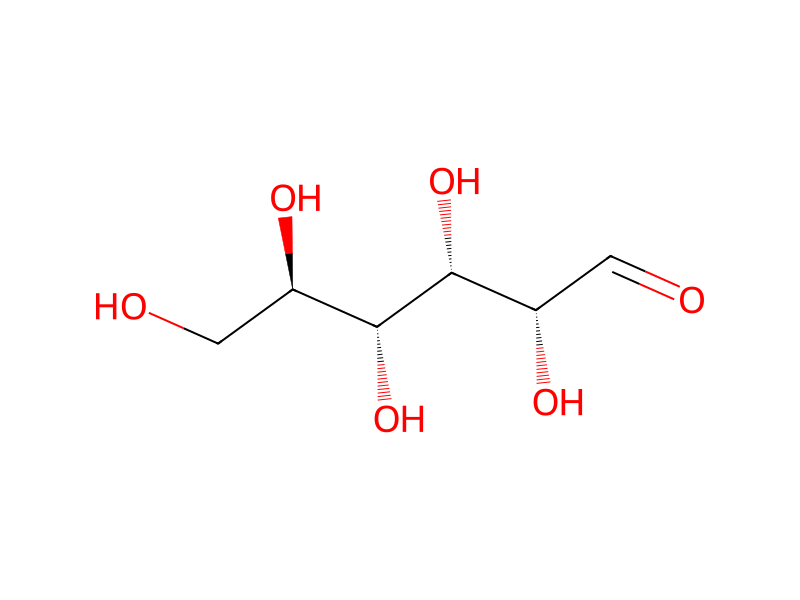


Procedure
Isolation of glucaric acid as its disodium salt.5 D-Glucose (162.5 g, 0.75 mol) was oxidized using the LabMax reactor as described. Following the completion of the reaction, the reaction solution was concentrated to a white foam in vacuo (10-15 mbar) using a rotary evaporator and water bath at 50° C. The concentrate of organic product(s) and residual nitric acid was diluted with deionized water (150 mL), titrated with sodium hydroxide solution (5 M) to an approximate pH of 9.5, and then diluted with deionized water (3700 mL), giving an approximate 2.5% (w/w) solids solution. This solution was then filtered using a nanofiltration unit. The nanofiltration unit, built in-house, is comprised of the necessary valves, pump, lines, pressure gauge and an appropriate membrane such as a GE DL2540F membrane. When the permeate volume reached 1000 mL, 1000 mL of reverse osmosis (RO) purified water was added to the feedstock. The typical rate of the permeate flow when reducing the volume by 1000 mL was 48 mL/min. When 2000 mL of permeate was removed, another 1000 mL of RO water was added to the feedstock. The typical rate of permeate flow when removing the second 1000 mL was 45 mL/min. This procedure was repeated until a total of 4000 mL had been removed via the permeate and 4000 mL of RO water had been added to the feedstock. The typical permeate flow rate when removing the last 1000 mL was 43 mL/min. The filtration process was continued after the last 1000 mL of RO water was added to the feedstock until the permeate flow slowed to a trickle at which time the filtration was stopped. The final volumes of the retentate and permeate were 2800 mL and 5200 mL, respectively. Analysis of the permeate and retentate by ion chromatography (IC) indicated that sodium nitrate is the major component of the permeate and is present only in minor amounts in the retentate. The retentate was concentrated under reduced pressure using a rotary evaporator and further dried in a vacuum oven to yield crude disodium D-glucarate (186.52 g, 97.9% based on pure disodium D-glucarate). The salt was then dissolved in water, and the pH of the solution adjusted with sodium hydroxide to pH 8. The product was precipitated with methanol (1000 mL) as an off white solid (146.24 g, 76.7% based on pure disodium D-glucarate).
Workup
- customthe completion of the reaction
- concentrationthe reaction solution was concentrated to a white foam in vacuo (10-15 mbar)
- customa rotary evaporator and water bath at 50° C
- concentrationThe concentrate of organic product(s) and residual nitric acid
- additionwas diluted with deionized water (150 mL)
- additiondiluted with deionized water (3700 mL)
- customgiving an approximate 2.5% (w/w) solids solution
- filtrationThis solution was then filtered
- custompurified water
- additionwas added to the feedstock
- customWhen 2000 mL of permeate was removed
- additionanother 1000 mL of RO water was added to the feedstock
- customThe typical rate of permeate flow when removing the second 1000 mL
- customhad been removed via the permeate and 4000 mL of RO water
- additionhad been added to the feedstock
- customThe typical permeate flow rate when removing the last 1000 mL
- additionwas added to the feedstock until the permeate flow
- filtrationthe filtration
- concentrationThe retentate was concentrated under reduced pressure
- customa rotary evaporator
- customfurther dried in a vacuum oven
Sources & evidence
- ORD record
- ord-34499592e86d4c1db3a674a90d8da245
- Source dataset
- uspto-grants-2010_04
- Patent number
- US07692041B2
Reaction notes
Loading…