Propargyl alcohol → 3-(2-Chloro-4-(cyclopentylamino)-5-pyrimidinyl)-2-propyn-1-ol
Reaction equation

Br[C:2]1[C:3]([NH:9][CH:10]2[CH2:14][CH2:13][CH2:12][CH2:11]2)=[N:4][C:5]([Cl:8])=[N:6][CH:7]=1.[CH2:15]([OH:18])[C:16]#[CH:17].O.O.O.[F-].C([N+](CCCC)(CCCC)CCCC)CCC>C1(C=CC=CC=1)[P](C1C=CC=CC=1)(C1C=CC=CC=1)[Pd][P](C1C=CC=CC=1)(C1C=CC=CC=1)C1C=CC=CC=1.O1CCCC1>[Cl:8][C:5]1[N:4]=[C:3]([NH:9][CH:10]2[CH2:14][CH2:13][CH2:12][CH2:11]2)[C:2]([C:17]#[C:16][CH2:15][OH:18])=[CH:7][N:6]=1Participants
Reactant 3


Product 1

Reagents, catalysts & solvents 2

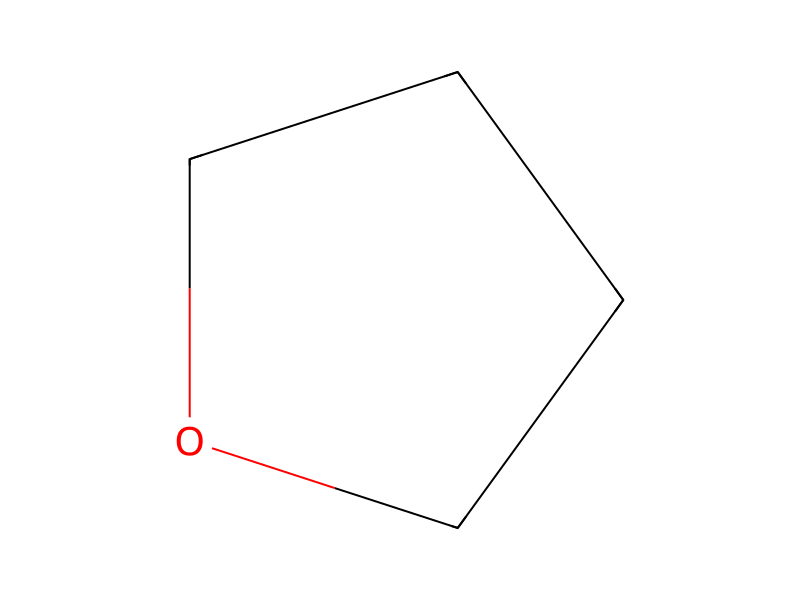
Conditions
- Temperature
- 67 °C
Procedure
A nitrogen-flushed, suitably equipped 5 L 4-neck round bottom flask is charged with 200 g (0.723 mol, 1.0 eq.) of 5-bromo-2-chloro-N-cyclopentylpyrimidin-4-amine (A1f) and 2303 g, (2600 mL) of tetrahydrofuran. The mixture is stirred, heated to reflux (67° C.) and 200 mL of distillate is collected. The sample is cooled to 25° C. and 52.7 g (0.940 mol, 55.6 mL, 1.3 eq.) of propargyl alcohol (A1e), 570.3 g (1.808 mol, 2.5 eq.) of tetrabutylammonium fluoride trihydrate and 25.4 g (0.036 mol, 0.05 eq.) of bis(triphenylphosphine)palladium (II) dichloride are added. The sample is stirred, heated to reflux (67° C.) and maintained at this temperature for 2 h or until 5-7% of the starting material A1f remains as determined by HPLC analysis. The sample is cooled to 25° C. and concentrated under reduced pressure (100 mbar, 30° C. maximum internal temperature) to a volume of 1150 mL to remove tetrahydrofuran. 541 g, (600 mL) of ethyl acetate is charged. The sample is again concentrated under reduced pressure (100 mbar, 30° C. maximum internal temperature) to a volume of 1150 mL to remove residual tetrahydrofuran. 2706 g (3000 mL) of ethyl acetate and a solution of 63 g of sodium bicarbonate dissolved in 1500 g (1500 mL) of water are added. The sample is stirred at 25° C. for 10 min and the phases are separated. The organic (top) phase is washed once with 1500 g (1500 mL) of water. The sample is stirred for 10 min and the phases are separated. The organic (top) phase is concentrated under reduced pressure (100 mbar, 30° C. maximum internal temperature) to a volume of 625 mL to remove ethyl acetate. 1582 g (2000 mL) of acetone is added to the concentrate. The sample is stirred, heated to reflux (58° C.) and maintained at this temperature for 30 min. It is then cooled to 40° C. and clarified by filtering through a pad of filter cel. The flask and filter cake are washed twice with 158 g (200 mL, 2×100 mL per wash) of acetone. The sample is concentrated under reduced pressure (100 mbar, 30° C. maximum internal temperature) to a volume of 460 mL. It is then cooled to 4° C. and is hold at this temperature for 1 h. The solids are filtered and the filter cake is washed twice with 158 g (2×100 mL) of cold (4° C.) acetone. The solids are dried at 50° C. for 16 h, to afford 85.6 g (47.4%, corrected) of Compound A1d as a tan, crystalline solid, mp=162-163° C.
Workup
- customA nitrogen-flushed
- temperatureheated
- customis collected
- temperatureThe sample is cooled to 25° C.
- stirringThe sample is stirred
- temperatureheated
- temperatureto reflux (67° C.)
- temperatureThe sample is cooled to 25° C.
- concentrationconcentrated under reduced pressure (100 mbar, 30° C. maximum internal temperature) to a volume of 1150 mL
- customto remove tetrahydrofuran
- addition541 g, (600 mL) of ethyl acetate is charged
- concentrationThe sample is again concentrated under reduced pressure (100 mbar, 30° C. maximum internal temperature) to a volume of 1150 mL
- customto remove residual tetrahydrofuran
- dissolution2706 g (3000 mL) of ethyl acetate and a solution of 63 g of sodium bicarbonate dissolved in 1500 g (1500 mL) of water
- additionare added
- stirringThe sample is stirred at 25° C. for 10 min
- customthe phases are separated
- washThe organic (top) phase is washed once with 1500 g (1500 mL) of water
- stirringThe sample is stirred for 10 min
- customthe phases are separated
- concentrationThe organic (top) phase is concentrated under reduced pressure (100 mbar, 30° C. maximum internal temperature) to a volume of 625 mL
- customto remove ethyl acetate
- addition1582 g (2000 mL) of acetone is added to the concentrate
- stirringThe sample is stirred
- temperatureheated
- temperatureto reflux (58° C.)
- temperaturemaintained at this temperature for 30 min
- temperatureIt is then cooled to 40° C.
- filtrationby filtering through a pad of filter cel
- filtrationThe flask and filter cake
- washare washed twice with 158 g (200 mL, 2×100 mL per wash) of acetone
- concentrationThe sample is concentrated under reduced pressure (100 mbar, 30° C. maximum internal temperature) to a volume of 460 mL
- temperatureIt is then cooled to 4° C.
- customfor 1 h
- filtrationThe solids are filtered
- washthe filter cake is washed twice with 158 g (2×100 mL) of cold (4° C.) acetone
- customThe solids are dried at 50° C. for 16 h
- customto afford 85.6 g (47.4%, corrected) of Compound A1d as a tan, crystalline solid, mp=162-163° C.
Sources & evidence
- ORD record
- ord-826a8e7b0459406a813627b84bc796cd
- Source dataset
- uspto-grants-2015_11
- Patent number
- US09193732B2
Reaction notes
Loading…