3-Fluoroaniline → Methyl 4-(1-(2-(3-((3-fluorophenyl)amino)azetidin-1-yl)-5-(trifluoromethyl)nicotinamido)cyclopropyl)benzoate
Reaction equation

[F:1][C:2]1[CH:3]=[C:4]([CH:6]=[CH:7][CH:8]=1)[NH2:5].C(=O)([O-])[O-].[K+].[K+].CS(O[CH:20]1[CH2:23][N:22]([C:24]2[N:33]=[CH:32][C:31]([C:34]([F:37])([F:36])[F:35])=[CH:30][C:25]=2[C:26]([O:28]C)=O)[CH2:21]1)(=O)=O.O.[OH-].[Li+].F[P-](F)(F)(F)(F)F.N1(O[P+](N2CCCC2)(N2CCCC2)N2CCCC2)C2C=CC=CC=2N=N1.Cl.[NH2:75][C:76]1([C:79]2[CH:88]=[CH:87][C:82]([C:83]([O:85][CH3:86])=[O:84])=[CH:81][CH:80]=2)[CH2:78][CH2:77]1>C(#N)C.O1CCOCC1.O>[F:1][C:2]1[CH:3]=[C:4]([NH:5][CH:20]2[CH2:21][N:22]([C:24]3[N:33]=[CH:32][C:31]([C:34]([F:37])([F:36])[F:35])=[CH:30][C:25]=3[C:26]([NH:75][C:76]3([C:79]4[CH:88]=[CH:87][C:82]([C:83]([O:85][CH3:86])=[O:84])=[CH:81][CH:80]=4)[CH2:78][CH2:77]3)=[O:28])[CH2:23]2)[CH:6]=[CH:7][CH:8]=1Participants
Reactant 6





Product 1

Reagents, catalysts & solvents 2


Conditions
- Temperature
- 200 °C
Procedure
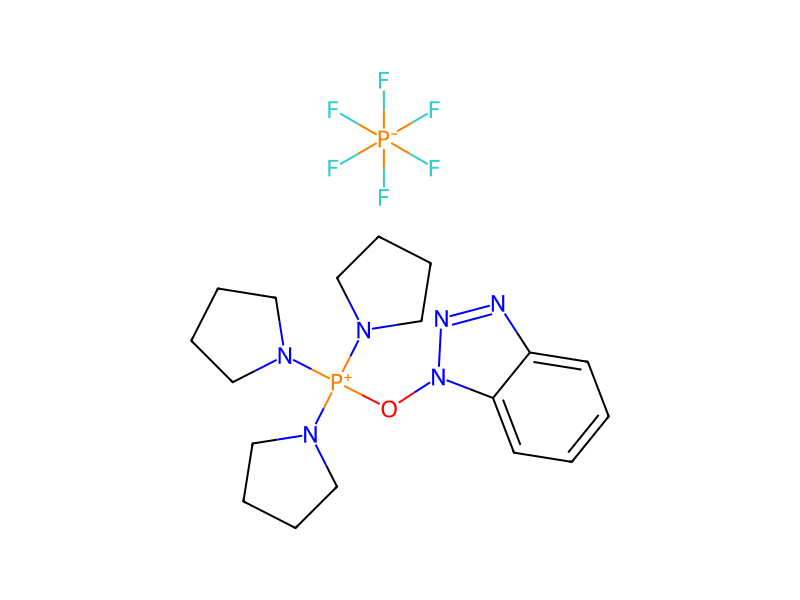
To a solution of 3-Fluoroaniline (0.032 ml, 0.34 mmol) in acetonitrile (0.5 ml), potassium carbonate (61 mg, 0.044 mmol) was added followed by the addition of methyl 2-(3-((methylsulfonyl)oxy)azetidin-1-yl)-5-(trifluoromethyl)nicotinate (D68) (120 mg, 0.374 mmol). The reaction mixture was stirred under microwave irradiation for 50 min at 200° C. (2 cycles of 25 min each). Lithium hydroxide monohydrate (14.26 mg, 0.34 mmol) and a mixture 1,4-dioxane/water (3/1 ml) was added and the mixture was stirred under microwave irradiation for 5 min at 150° C. The mixture was evaporated in vacuo, diluted with water (5 ml)/1M HCl (15 ml) and extracted with ethylacetate (3×20 ml). After solvent evaporation, the residue was dissolved in dimethylformamide (2.5 ml) then (Benzotriazol-1-yloxy)tripyrrolidinophosphonium hexafluorophosphate (PyBOP) (307.55 mg, 0.59 mmol) and N,N-Disopropylethylamine (0.27 ml, 1.57 mmol) were added and the mixture stirred at room temperature for 1 h. Methyl 4-(1-aminocyclopropyl)benzoate hydrochloride (D7) (89.7 mg, 0.394 mmol) was added and the resulting mixture was stirred at room temperature overnight then poured into ice-water and extracted with diethylether (3×20 ml). The combined organic layers were washed with brine, dried over Na2SO4, filtered and concentrated. The crude residue obtained after solvent evaporation was loaded on SNAP-Si cartridge (10 g) and eluted with a mixture cyclohexane/dichloromethane from 30/70 to 0/100 then dichloromethane/ethylacetate from 100/0 to 80/20. Collected fractions, after solvent evaporation afforded the title compound (D183) (16 mg)
Workup
- stirringthe mixture was stirred under microwave irradiation for 5 min at 150° C
- customThe mixture was evaporated in vacuo
- additiondiluted with water (5 ml)/1M HCl (15 ml)
- extractionextracted with ethylacetate (3×20 ml)
- customAfter solvent evaporation
- dissolutionthe residue was dissolved in dimethylformamide (2.5 ml)
- stirringthe mixture stirred at room temperature for 1 h
- stirringthe resulting mixture was stirred at room temperature overnight
- extractionextracted with diethylether (3×20 ml)
- washThe combined organic layers were washed with brine
- dry with materialdried over Na2SO4
- filtrationfiltered
- concentrationconcentrated
- customThe crude residue obtained
- customafter solvent evaporation
- washeluted with a mixture cyclohexane/dichloromethane from 30/70 to 0/100
- customCollected fractions, after solvent evaporation
Sources & evidence
- ORD record
- ord-2a221ddf721d4585bea1a1101e542429
- Source dataset
- uspto-grants-2014_09
- Patent number
- US08828987B2
Reaction notes
Loading…