Hydrochloric Acid → 7-(4-Bromo-2-fluoro-phenylamino)-benzo[d]isothiazole-6-carboxylic acid (2-hydroxy-ethoxy)-amide
Reaction equation
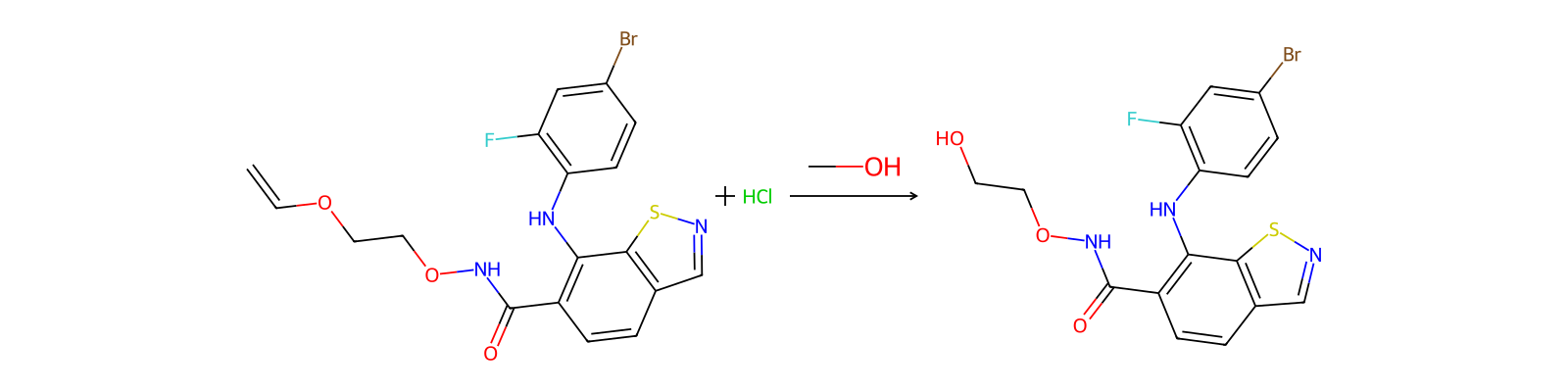
C([O:3][CH2:4][CH2:5][O:6][NH:7][C:8]([C:10]1[CH:18]=[CH:17][C:13]2[CH:14]=[N:15][S:16][C:12]=2[C:11]=1[NH:19][C:20]1[CH:25]=[CH:24][C:23]([Br:26])=[CH:22][C:21]=1[F:27])=[O:9])=C.Cl>CO>[OH:3][CH2:4][CH2:5][O:6][NH:7][C:8]([C:10]1[CH:18]=[CH:17][C:13]2[CH:14]=[N:15][S:16][C:12]=2[C:11]=1[NH:19][C:20]1[CH:25]=[CH:24][C:23]([Br:26])=[CH:22][C:21]=1[F:27])=[O:9]Participants
Reactant 2


Product 1

Reagents, catalysts & solvents 1

Procedure
To a solution of 7-(4-bromo-2-fluoro-phenylamino)-benzo[d]isothiazole-6-carboxylic acid (2-vinyloxy-ethoxy)-amide (95 mg, 0.21 mmol) in MeOH (4 mL) was added a 1.0M aqueous solution of hydrochloric acid (0.42 mL). The reaction mixture was stirred at room temperature for 1 hour before being concentrated in vacuo. The resultant residue was taken up in ethyl acetate, washed with a saturated aqueous solution of sodium hydrogen carbonate then brine, dried (Na2SO4), filtered and evaporated in vacuo. The resultant residue was subjected to flash chromatography (Si—PPC, gradient 0% to 100%, ethyl acetate in DCM) to afford the title compound as a yellow solid (62 mg, 70%). LCMS (method A): RT=9.51 min, [M+H]+=426/428. 1H NMR (CDCl3, 400 MHz) 9.37 (1 H, s), 8.85 (1 H, s), 8.76 (1 H, s), 7.51 (1 H, d, J=8.40 Hz), 7.43 (1 H, d, J=8.40 Hz), 7.34-7.29 (1 H, m), 7.28 (1 H, d, J=8.75 Hz), 7.02 (1 H, t, J=8.46 Hz), 4.10 (2 H, t, J=4.09 Hz), 3.91 (1 H, s), 3.80 (2 H, s).
Workup
- concentrationbefore being concentrated in vacuo
- washwashed with a saturated aqueous solution of sodium hydrogen carbonate
- dry with materialbrine, dried (Na2SO4)
- filtrationfiltered
- customevaporated in vacuo
Sources & evidence
- ORD record
- ord-cf870f71779e48468b0c76d62ab703e7
- Source dataset
- uspto-grants-2014_09
- Patent number
- US08841462B2
Reaction notes
Loading…