Ethylene Glycol → 2-((tert-Butyldiphenylsilyl)oxy)ethanol
Reaction equation

[CH2:1]([OH:4])[CH2:2][OH:3].N1C=CN=C1.[CH3:10][C:11]([Si:14](Cl)([C:21]1[CH:26]=[CH:25][CH:24]=[CH:23][CH:22]=1)[C:15]1[CH:20]=[CH:19][CH:18]=[CH:17][CH:16]=1)([CH3:13])[CH3:12]>O1CCCC1>[Si:14]([O:3][CH2:2][CH2:1][OH:4])([C:11]([CH3:13])([CH3:12])[CH3:10])([C:21]1[CH:22]=[CH:23][CH:24]=[CH:25][CH:26]=1)[C:15]1[CH:20]=[CH:19][CH:18]=[CH:17][CH:16]=1Participants
5
Reactant 3


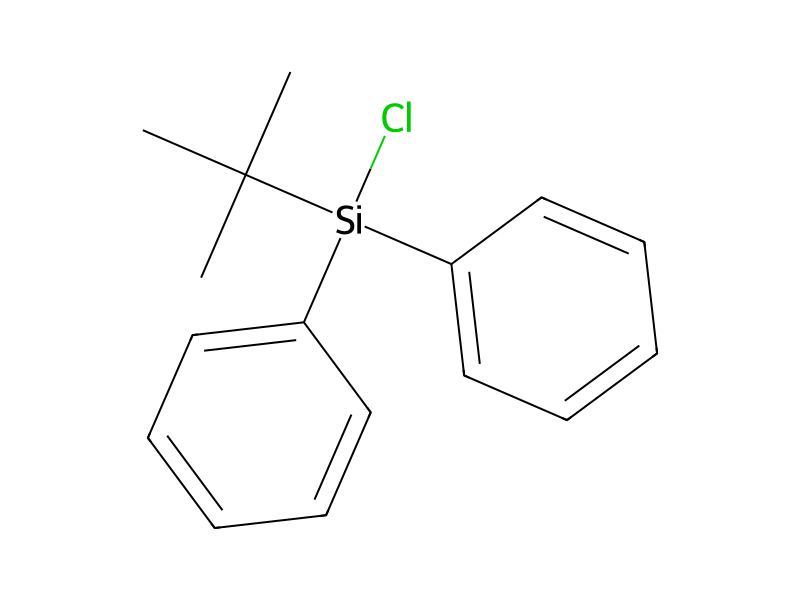
Product 1

Reagents, catalysts & solvents 1

Conditions
- Temperature
- 0 °C
Procedure
Into a 2-L 3-necked round-bottom flask was placed tetrahydrofuran (800 mL), ethane-1,2-diol (40 g, 644.46 mmol, 1.00 equiv) and imidazole (61.4 g, 901.92 mmol, 1.40 equiv). This was followed by the addition of TBDPSCl (186.3 g) dropwise with stirring at 0° C. in 30 min. The resulting solution was stirred overnight at room temperature. The solids were filtered out, and the filtrate cake was washed with 200 mL of EA. The resulting mixture was washed with 200 mL of brine and concentrated under vacuum. The residue was applied onto a silica gel column with ethyl acetate/petroleum ether (1:25). Purification afforded 83 g (43%) of 2-[(tert-butyldiphenylsilyl)oxy]ethan-1-ol (85.2) as a colorless oil.
Workup
- customInto a 2-L 3-necked round-bottom flask was placed
- stirringThe resulting solution was stirred overnight at room temperature
- filtrationThe solids were filtered out
- washthe filtrate cake was washed with 200 mL of EA
- washThe resulting mixture was washed with 200 mL of brine
- concentrationconcentrated under vacuum
- customPurification
Sources & evidence
- ORD record
- ord-15f00605e12d47998dfd15dab0162309
- Source dataset
- uspto-grants-2015_03
- Patent number
- US08969557B2
Reaction notes
Loading…