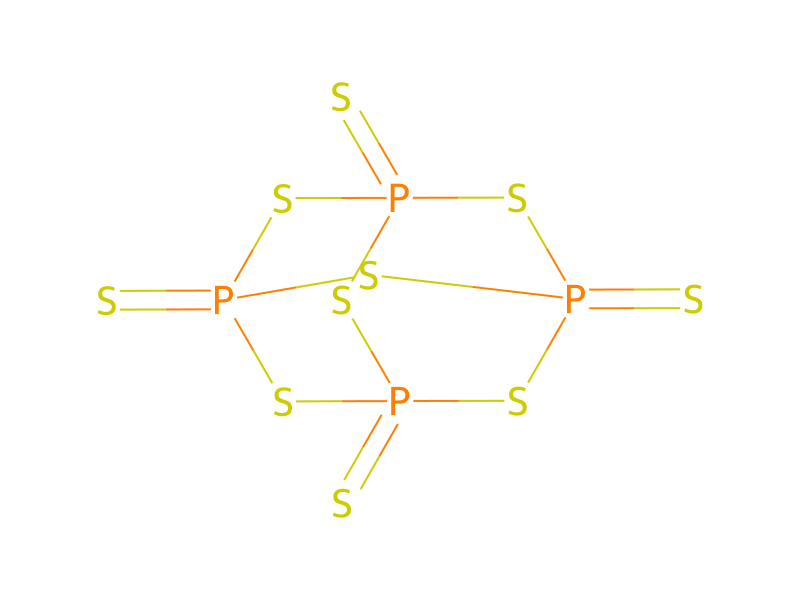
Phosphorus sulfide (P2S5) → HCID 178456440, compound
Reaction equation

P12(SP3(SP(SP(S3)(S1)=S)(=S)S2)=S)=[S:2].[NH2:15][C:16]1[C:17](=O)[NH:18][C:19](=[O:26])[N:20]([CH2:23][CH2:24][CH3:25])[C:21]=1[NH2:22]>N1C=CC=CC=1>[NH2:15][C:16]1[C:17]([SH:2])=[N:18][C:19](=[O:26])[N:20]([CH2:23][CH2:24][CH3:25])[C:21]=1[NH2:22]Participants
Reactant 2

Product 1

Reagents, catalysts & solvents 1

Conditions
- Temperature
- 100 °C
Procedure
Phosphorus pentasulfide (27.1 g, 122 mmol, 1.5 equivalents) was suspended in pyridine (150 mL) and the mixture was heated to 100° C. To the suspension was gradually added 5,6-diamino-1-propyluracil (15.0 g, 81.3 mmol), which was obtained by the method described in Journal of Medicinal Chemistry (J. Med. Chem.), 32 (6), p. 1231, 1989, with heating and stirring, and then the mixture was stirred for 7 hours. After the reaction solution was cooled on ice, the deposited solid was separated by filtration using a filtration aid and washed with pyridine. The filtrate was concentrated, to the residue was added water (90 mL), and the mixture was stirred under reflux with heating for about 40 minutes until intense foaming ceased. The reaction mixture was cooled on ice and then further stirred overnight at room temperature. The deposited yellowish green ocher solid was collected by filtration, sufficiently washed with water and dried under reduced pressure to obtain 5,6-diamino-1,2-dihydro-4-mercapto-2-oxo-1-propylpyrimidine (Compound B4, 11.3 g, 69%). Compound B4 (10.0 g, 50.0 mmol) was suspended in 1,4-dioxane (200 mL) and water (100 mL), to the suspension were added cyclohexanecarboxylic acid (8.06 mL, 65.0 mmol, 1.3 equivalents) and 1-ethyl-3-(3-dimethylaminopropyl)carbodiimide hydrochloride (16.3 g, 85.0 mmol, 1.7 equivalents) at room temperature, and then the mixture was stirred overnight. To the reaction mixture was added 2 mol/L aqueous sodium hydroxide (100 mL), and the mixture was stirred with heating for 2.5 hours. The reaction mixture was cooled on an ice bath, adjusted to pH 6 with 4 mol/L hydrochloric acid and extracted with chloroform. The organic layer was dried over anhydrous magnesium sulfate, and the solvent was evaporated. The residue was dissolved in 0.5 mol/L aqueous sodium hydroxide (150 mL), and to the solution was added methyl iodide (4.70 mL, 75.0 mmol, 1.5 equivalents) and the mixture was stirred overnight at room temperature. The reaction mixture was cooled on an ice bath, adjusted to pH 6.5 with 4 mol/L aqueous hydrochloric acid and extracted with chloroform. The organic layer was dried over anhydrous magnesium sulfate, and the solvent was evaporated. Then, the residue was purified by silica gel column chromatography (chloroform:methanol=100:0 to 96:4) to obtain the title compound (11.8 g, 78%).
Workup
- customwhich was obtained by the method
- temperature1231, 1989, with heating
- stirringthe mixture was stirred for 7 hours
- temperatureAfter the reaction solution was cooled on ice
- customthe deposited solid was separated by filtration
- washwashed with pyridine
- concentrationThe filtrate was concentrated, to the residue
- additionwas added water (90 mL)
- stirringthe mixture was stirred
- temperatureunder reflux
- temperaturewith heating for about 40 minutes until intense foaming
- temperatureThe reaction mixture was cooled on ice
- customfurther stirred overnight
- customat room temperature
- filtrationThe deposited yellowish green ocher solid was collected by filtration
- washsufficiently washed with water
- customdried under reduced pressure
Sources & evidence
- ORD record
- ord-9bc5fae6a8f94c87bea3e323c263fd55
- Source dataset
- uspto-grants-2006_02
- Patent number
- US07005430B2
Reaction notes
Loading…