Methanol → 5-(2-furyl)-1-(4-methoxy-phenyl)-3-(trifluoromethyl)-1H-pyrazole
Reaction equation

CO.Cl.[CH3:4][O:5][C:6]1[CH:11]=[CH:10][C:9]([NH:12][NH2:13])=[CH:8][CH:7]=1.[F:14][C:15]([F:27])([F:26])[C:16](=O)[CH2:17][C:18]([C:20]1[O:21][CH:22]=[CH:23][CH:24]=1)=O.FC(F)(F)C(O)=O>C(O)(C)C.O>[O:21]1[CH:22]=[CH:23][CH:24]=[C:20]1[C:18]1[N:12]([C:9]2[CH:10]=[CH:11][C:6]([O:5][CH3:4])=[CH:7][CH:8]=2)[N:13]=[C:16]([C:15]([F:14])([F:26])[F:27])[CH:17]=1Participants
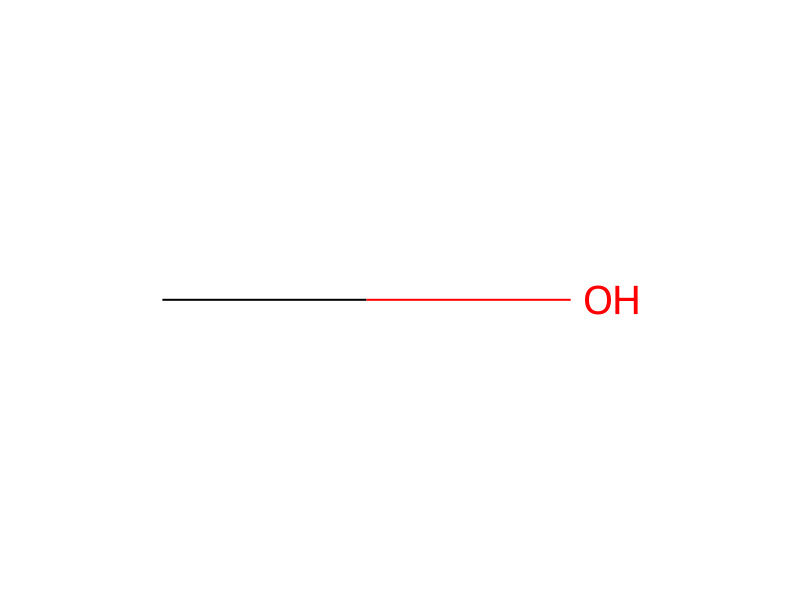
Reactant 4


Product 1

Reagents, catalysts & solvents 1

Procedure
Part A. In a flame-dried 1-L flask was combined anhydrous methyl alcohol (1.4 L), 4-methoxyphenylhydrazine hydrochloride (25 g, 140 mmol), 4,4,4-trifluoro-1-(2-furyl)-1,3-butanedione (30 g, 140 mmol), and trifluoroacetic acid (1.1 mL, 14 mmol). The resulting red slurry was maintained at rt for 14 h. A 50% solution of isopropyl alcohol/water (500 mL) was then added, and the mixture was stirred vigorously for 5 min. The mixture was filtered; additional material precipitated from the filtrate upon standing, and the new mixture was filtered. After another 3 h, the resulting filtrate was filtered a third time, and the combined beige solid was oven dried under vacuum to afford 5-(2-furyl)-1-(4-methoxy-phenyl)-3-(trifluoromethyl)-1H-pyrazole (42 g, 96%) as a light brown solid. 1H NMR (CDCl3) δ 7.42(m, 1H), 7.35 (d, 2H), 6.98 (d, 2H), 6.89 (s, 1H), 6.33 (dd, 1H), 5.90 (d, 1H), 3.88 (s, 3H). Part B. To the product from Part B (20 g, 65 mmol) was added water (410 mL), 5% aqueous sodium dihydrogenphosphate (270 mL), and tert-butanol (410 mL). The resulting mixture was warmed to 60° C., and potassium permanganate (63, 400 mmol) was added over a period of 1.5 h. After an additional 10 min, the resulting purple slurry was cooled to 0° C., and the reaction was quenched by the addition of 400 mL of saturated aqueous sodium bisulfite. The resulting brown slurry was filtered, washed with 500 mL of water, and the filtrate was acidified to pH 1 with concentrated aqueous hydrogen chloride. The aqueous layer was extracted with ethyl acetate (6×150 mL), and the combined organic layers were washed with saturated aqueous sodium chloride, dried over sodium sulfate, and filtered. Concentration afforded 1-(4-methoxyphenyl)-3-(trifluoromethyl)-1H-pyrazole-5-carboxylic acid (16 g, 85%) as a light yellow solid. MS (APCI+): 328.2 (M+H+ CH3CN)+. 1H NMR (CDCl3) δ 7.37 (d, 2H), 7.32 (s, 1H), 6.97 (d, 2H), 3.88 (s, 3H). Part C. To a solution of 2-fluoro-4-iodo-1-methylbenzene (50 g, 210 mmol) in anhydrous acetone (490 mL) was added N-bromosuccinimide (42 g, 230 mmol) and 2,2′-azobisisobutyronitrile (100 mg, 0.60 mmol). The resulting solution was heated to reflux and maintained under reflux conditions for 5 h. The reaction was then cooled, concentrated, and filtered. The filtrate was concentrated, and the resulting dark red residue was purified by flash column chromatography (10% ethyl acetate in hexanes) to afford a 4:1 mixture (58 g) of 1-(bromomethyl)-2-fluoro-4-iodobenzene (49 g, 73%) and 2-fluoro-4-iodo-1-methylbenzene (9 g, 17%) as a red solid. 1H NMR (product) (CDCl3) δ7.40–7.49 (m, 2H), 7.13 (t, 1H), 4.45 (s, 2H). Part D. To the product from Part C (58 g, 140 mmol) in toluene (500 mL) and water (500 mL) was added sodium cyanide (34 g, 700 mmol) and tetrabutylammonium bromide (23 g, 70 mmol). The resulting mixture was heated to reflux and maintained under reflux condition for 14 h. The dark brown mixture was then cooled, and the layers were separated. The aqueous layer was washed with ethyl acetate (200 mL), and the combined organic layers were washed with saturated aqueous sodium chloride and dried over sodium sulfate. The organic layers were concentrated, and the resulting residue was purified by flash column chromatography (10% ethyl acetate in hexanes) to give (2-fluoro-4-iodophenyl)-acetonitrile (20 g, 54%) as a yellow solid. 1H NMR (CDCl3) δ 7.54 (dd, 1H), 7.49 (dd, 1H), 7.18 (t, 1H), 3.72 (s, 2H). Part E. To the product from Part D (20 g, 77 mmol) was added ethyl alcohol (470 mL), water (230 mL), and sodium hydroxide (31 g, 770 mmol). The resulting mixture was heated to reflux and maintained under reflux conditions for 2 h. The reaction was then cooled, concentrated, and acidified to pH 1 with concentrated aqueous hydrochloric acid. The resulting mixture was filtered, and the filter cake was dried in a vacuum oven to afford (2-fluoro-4-iodophenyl)acetic acid (21 g, 96%) as yellow solid. 1H NMR (CDCl3) δ 7.43–7.48 (m, 2H), 7.00 (t, 1H), 3.67 (s, 2H). Part F. To the product from Part E (10 g, 36 mmol) was added methyl alcohol (25 mL) and benzene (250 mL). The resulting solution was cooled to 0° C., and (trimethylsilyl) diazomethane (9 mL, 38 mmol; 2.0 M in hexanes) was added dropwise over 15 min. After 1 h, the reaction was concentrated, and the resulting residue was purified by flash column chromatography (10–20% ethyl acetate in hexanes) to afford methyl (2-fluoro-4-iodophenyl)acetate (6.9 g, 66%) as a yellow oil. 1H NMR (CDCl3) δ 7.42–7.47 (m, 2H), 7.00 (t, 1H), 3.71 (s, 3H), 3.63 (s, 2H). Part G. To methyl (2-fluoro-4-iodophenyl)acetate (1.0 g, 3.4 mmol) in dimethylsulfoxide (68 mL) was added potassium carbonate (1.9 g, 14 mmol) and 2-hydroxypyridine (650 mg, 6.8 mmol). The resulting mixture was degassed (alternate vacuum/nitrogen three times), and copper(I) iodide (650 mg, 3.4 mmol) was added in one portion. The light green mixture was again degassed (vac/N2) and warmed to 125° C. After 14 h, the brown-black mixture was cooled and poured into saturated aqueous ammonium hydroxide (50 mL) and ethyl acetate (100 mL). The layers were separated, and the organic layers were washed with water (2×50 mL) and saturated aqueous sodium chloride. The organic layers were concentrated, and the resulting residue was purified by radial chromatography (20–100% ethyl acetate in hexanes) to afford methyl [2-fluoro-4-(2-oxo-1(2H)-pyridinyl)-phenyl]acetate (340 mg, 39%) as a green-brown solid. LC/MS (ESI+): 262.2 (M+H)+. 1H NMR (CDCl3) δ 7.22–7.36 (m, 3H), 7.08 (t, 2H), 6.54 (d, 1H), 6.18 (t, 1H), 3.63 (s, 5H). Part H. To a stirring solution of trimethylacetyl chloride (0.026 mL, 0.21 mmol), triethylamine (0.058 mL, 0.42 mmol), and diethyl ether (2.6 mL) in a flame-dried flask was added 1-(4-methoxyphenyl)-3-(trifluoromethyl)-1H-pyrazole-5-carboxylic acid (60 mg, 0.21 mmol). The resulting white slurry was warmed to 23° C. and stirred for 1.5 h. The mixture was filtered, and the filtrate was concentrated. The resulting residue was partially redissolved in diethyl ether (2 mL) and filtered again. The filtrate was concentrated to give 2,2-dimethylpropanoic 1-(4-methoxyphenyl)-3-(trifluoromethyl)-1H-pyrazole-5-carboxylic anhydride as a viscous oil.
Workup
- filtrationThe mixture was filtered
- customadditional material precipitated from the filtrate
- filtrationthe new mixture was filtered
- waitAfter another 3 h
- filtrationthe resulting filtrate was filtered a third time
- customdried under vacuum
Sources & evidence
- ORD record
- ord-4f6e26983d1844499b8db9402cba442f
- Source dataset
- uspto-grants-2006_02
- Patent number
- US07005435B2
Reaction notes
Loading…