Isobutylene oxide → HCID 67416478, compound
Reaction equation

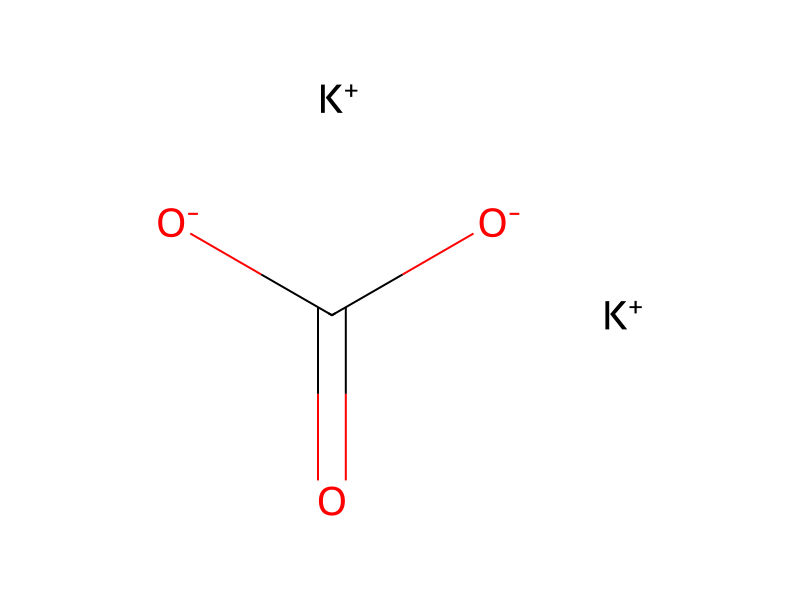
[Br:1][C:2]1[CH:10]=[C:9]2[C:5]([CH:6]=[N:7][NH:8]2)=[CH:4][C:3]=1[O:11][C:12]1[CH:17]=[CH:16][C:15]([F:18])=[CH:14][C:13]=1[F:19].[CH3:20][C:21]1([O:24][CH2:23]1)[CH3:22].C(=O)([O-])[O-].[K+].[K+]>CN(C)C(=O)C>[Br:1][C:2]1[CH:10]=[C:9]2[C:5]([CH:6]=[N:7][N:8]2[CH2:20][C:21]([CH3:23])([OH:24])[CH3:22])=[CH:4][C:3]=1[O:11][C:12]1[CH:17]=[CH:16][C:15]([F:18])=[CH:14][C:13]=1[F:19]Participants
Reactant 3


Product 1

Reagents, catalysts & solvents 1

Conditions
- Temperature
- 80 °C
Procedure
A 5 L pressure vessel fitted with a pressure relief valve, bursting disc, pressure gauge, and oil-filled thermometer well, and containing a 3″×½″ octagonal stir bar was charged with a solution of 6-bromo-5-(2,4-difluorophenoxy)-1H-indazole (prepared according to Example 25, Steps A-D; 150 g, 0.46 mol) and isobutylene oxide (82 mL, 0.92 mol) in N,N-dimethylacetamide (1000 mL). The solution was magnetically stirred, and granular potassium carbonate (191 g, 1.38 mol) was added. The vessel was sealed and stirring was continued. The apparatus was placed behind a blast shield. The vessel was heated with a heating mantle connected to a J-Kem Model 150 temperature controller. The temperature setting was initially set to 55° C., and the temperature was increased to 80° C. over 6 hr. The temperature was maintained at 80° C. for a further 16 hr. The reaction mixture was then cooled to 28° C. and the vessel was opened. The thermometer well was removed and the reaction mixture was decanted from the inorganic salts and filtered through a coarse fritted sintered glass funnel. The salts that remained in the vessel were stirred with DMA (3×200 mL) and the solution decanted as before. The filtrates were combined and the solvent evaporated under reduced pressure to afford a dark brown oil. Meanwhile, the solid remaining in the vessel was partitioned between water (2000 mL) and diethyl ether (1000 mL), and the resulting mixture stirred for 16 hr. The water/ether mixture was transferred to a separatory funnel, and the organic layer was added to the brown oil. Additional ether (2000 mL) was added to completely dissolve the oil. The resulting solution was transferred to a separatory funnel and washed with a mixture of water (500 mL) and brine (500 mL). The organic layer was dried over magnesium sulfate and the solvent was removed under reduced pressure. The residual dark brown oil (an approximate 1:1 mixture of N-1 [less polar] and N-2 [more polar] regioisomers) was purified by chromatography on silica gel, using 70/30 EtOAc/hexanes as eluent. Fractions containing product were pooled and the solvent removed under reduced pressure to afford the title compound as a red-orange solid (93.8 g, 51%).
Workup
- customA 5 L pressure vessel fitted with a pressure relief valve
- additionoil-filled thermometer well
- additioncontaining a 3″×½″ octagonal stir bar
- customThe vessel was sealed
- stirringstirring
- temperatureThe vessel was heated with a heating mantle
- customwas initially set to 55° C.
- temperatureThe temperature was maintained at 80° C. for a further 16 hr
- temperatureThe reaction mixture was then cooled to 28° C.
- customThe thermometer well was removed
- customthe reaction mixture was decanted from the inorganic salts
- filtrationfiltered through a coarse fritted sintered glass funnel
- stirringwere stirred with DMA (3×200 mL)
- customthe solution decanted as before
- customthe solvent evaporated under reduced pressure
- customto afford a dark brown oil
- customwas partitioned between water (2000 mL) and diethyl ether (1000 mL)
- stirringthe resulting mixture stirred for 16 hr
- customThe water/ether mixture was transferred to a separatory funnel
- additionthe organic layer was added to the brown oil
- additionAdditional ether (2000 mL) was added
- dissolutionto completely dissolve the oil
- customThe resulting solution was transferred to a separatory funnel
- washwashed with a mixture of water (500 mL) and brine (500 mL)
- dry with materialThe organic layer was dried over magnesium sulfate
- customthe solvent was removed under reduced pressure
- additionThe residual dark brown oil (an approximate 1:1 mixture of N-1 [less polar] and N-2 [more polar] regioisomers)
- customwas purified by chromatography on silica gel
- additionFractions containing product
- customthe solvent removed under reduced pressure
Sources & evidence
- ORD record
- ord-6c69c6addbac45c8a0696566bde95fdd
- Source dataset
- uspto-grants-2011_09
- Patent number
- US08026233B2
Reaction notes
Loading…