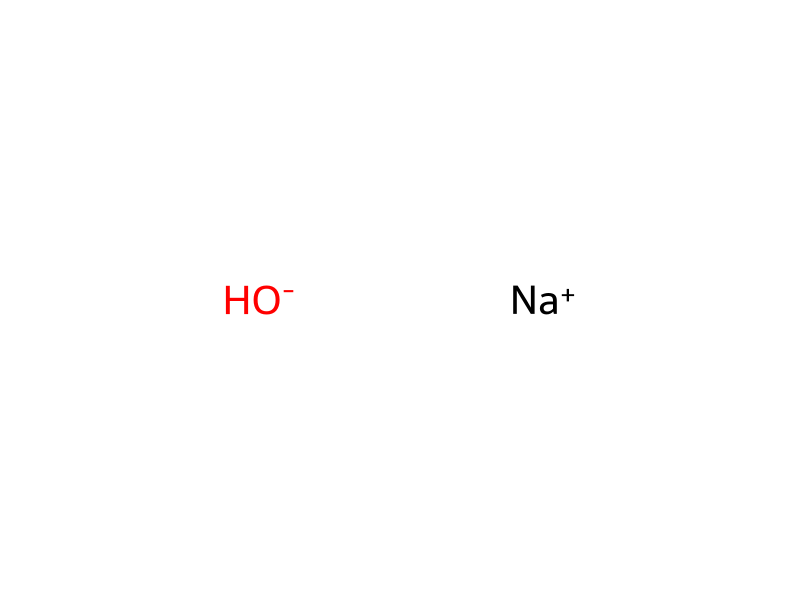
Sodium Hydroxide → HCID 178418873, compound
Reaction equation

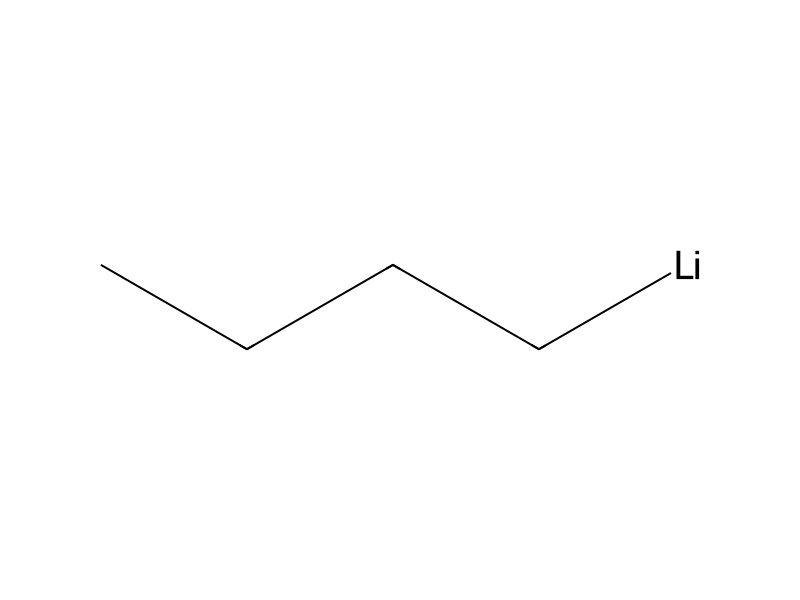
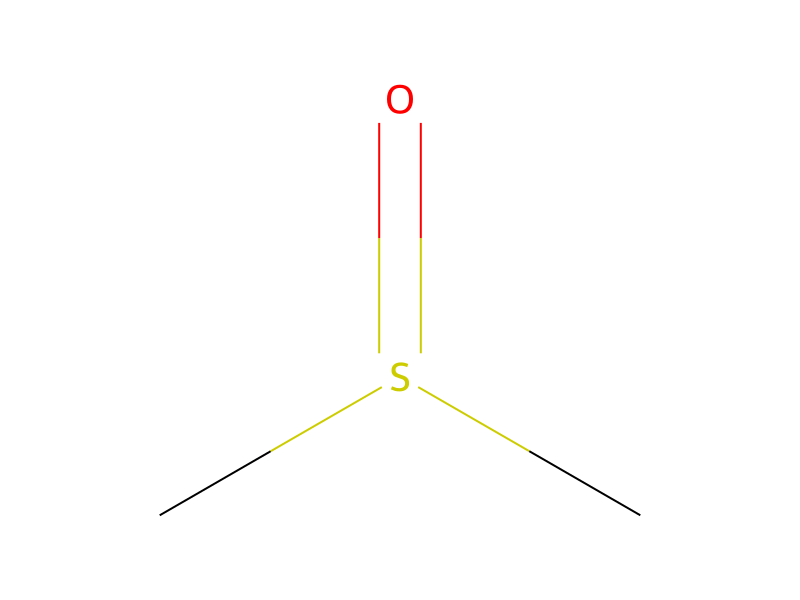
[CH2:1]([Li])[CH2:2][CH2:3][CH3:4].[OH-].[Na+]>[Cl-].C([N+](CC)(CC)CC)C1C=CC=CC=1.CS(C)=O>[CH:1]1[C:3]2[C:2](=[C:1]3[C:2]([CH:4]=2)=[CH:1][C:3]2=[C:4]4[C:3](=[CH:4][C:2]2=[CH:1]3)[CH:4]=[CH:3][CH:2]=[CH:1]4)[CH:4]=[CH:3][CH:2]=1Participants
Reactant 2
Product 1

Reagents, catalysts & solvents 2

Procedure
Groups of Ar1-(Ey)a can be prepared by preparation of a 2,8-dibromo-6,12-dihydroindeno [1,2-b]fluorene using the process of Reaction Scheme IX. In step (1), Suzuki coupling of 2-(2,5-dimethylphenyl)-4,4,5,5-tetramethyl[1,3,2]dioxaborolane (CCLXXX) with commercially available 2-bromo-9-fluorenone (CCLXXIX) provides 2-(2,5-dimethylphenyl)fluoren-9-one (CCLXXXI). Commercially available 2-bromo-p-xylene is converted to 2-(2,5-dimethylphenyl)-4,4,5,5-tetramethyl [1,3,2]dioxaborolane (CCLXXX) by treatment with butyl lithium and reaction of the lithiated intermediate with 2-isopropoxy-4,4,5,5-tetramethyl [1,3,2]dioxaborolane. In step (2), 2-(2,5-dimethylphenyl)fluoren-9-one (CCLXXXI) can be converted to 2-bromo-7-(4-bromo-2,5-dimethylphenyl)fluoren-9-one (CCLXXII) with bromine in chloroform at 0° C. Regiospecific bromination at the 4′-position of the phenyl ring is directed by the 5′-methyl and fluorene substituents. In step (3), 2-bromo-7-(4-bromo-2,5-dimethylphenyl)fluoren-9-one (CCLXXII) can undergo potassium permanganate oxidation to provide 2-bromo-5-(7-bromo-9-oxo-9H-fluoren-2-yl)-terephthalic acid (CCLXXIII). Ring closure, in step (4), to 2,8-dibromo-6,12-dioxa-6,12-dihydroindeno [1,2-b]fluorene-3-carboxylic acid (CCLXXXIV) is effected by treatment with sulfuric acid. Reduction of 2,8-dibromo-6,12-dioxa-6,12-dihydroindeno [1,2-b]fluorene-3-carboxylic acid (CCLXXXIV), in step (5), with red phosphorus provides 2,8-dibromo-6,12-dihydroindeno[1,2-b]fluorene-3-carboxylic acid (CCLXXXV). In step (6), alkylated by reaction with butyl lithium followed by an R3-halide or by phase transfer methods utilizing, for example, benzyltriethylammonium chloride in dimethylsulfoxide, followed by 50% aqueous sodium hydroxide and then R3-Br provides the indeno[1,2-b]fluorene derivative of Formula CCLXXXVI. Treatment of the indeno[1,2-b]fluorene of Formula CCLXXXVI with thionyl chloride gives the reactive acyl chloride intermediate of Formula CCLXXXVII. The oxadiazole, thiadiazole, or triazole may be formed at the acyl chloride group of the acyl chloride intermediate via a benzhydrazide intermediate as in Reaction Schemes II-IV or by direct coupling with a tetrazole as in Reaction Scheme I. In step (8), for example, the oxadiazole of Formula CCLXXXVIII is provided by reaction of the acyl chloride intermediate of Formula CCLXXXVII with 5-(4-octyloxyphenyl)-1H-tetrazole as in Reaction Scheme I.
Sources & evidence
- ORD record
- ord-2e68bbc3462048b4b7e5876616853b34
- Source dataset
- uspto-grants-2007_09
- Patent number
- US07271406B2
Reaction notes
Loading…