Xanthine → 1-Methylxanthine
Reaction equation

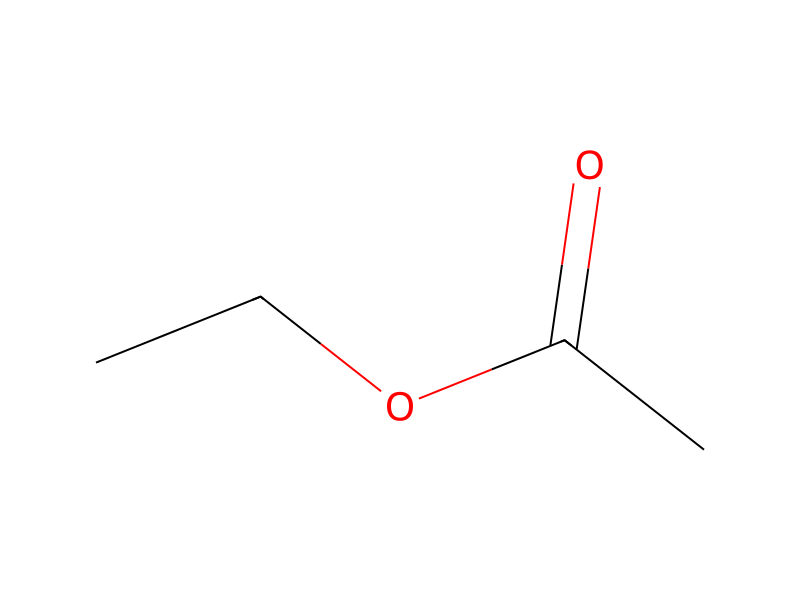
[NH:1]1[C:10](=[O:11])[C:9]2[NH:8][CH:7]=[N:6][C:5]=2[NH:4][C:2]1=[O:3].[CH2:12](OC(=O)C)C>>[CH3:12][N:1]1[C:10](=[O:11])[C:9]2[NH:8][CH:7]=[N:6][C:5]=2[NH:4][C:2]1=[O:3]Participants
Reactant 2

Product 1

Procedure
The first step in the synthesis involves blocking the 7 position in 1-methyl xanthine. The procedure of Hu, Singh and Ullman, J. Am. Chem. Soc., 45: 1711-1713 (1980) was followed. To 700 ml of dry DMF in a 1-liter conical flask was added 3.2 g (18.9 mmoles) of 98% 1-methylxanthine (Aldrich Chemical Co., cat. #28,098-4), the mixture was stirred magnetically and warmed until dissolution occurred and then cooled to room temperature. To the stirred solution was added 2.0 g (18.9 mmoles) of anhydrous sodium carbonate followed by the dropwise addition, over a period of 1 hour, of 3.0 g (19.3 mmoles) of 97% chloromethyl pivalate (Aldrich Chemical Co., cat. #14,118-6) dissolved in 50 ml of DMF. The reaction mixture was stirred overnight at room temperature. The reaction mixture was evaporated to dryness and the residue treated with 50 ml of methylene chloride. The insoluble material was collected by filtration and washed with 1N HCl to give 1.24 g of 1-methylxanthine. The methylene chloride solution was evaporated to dryness to yield a mixture of mono- and bis- protected xanthine. The mono-protected 1-methyl-7-}pivaloyloxy)methyl1 xanthine was separated from the bis protected xanthine by crystallization from ethyl acetate. By this method there was obtained 1.5 g of the monoprotected xanthine (m.p. 204°-206°). The ethylacetate filtrate from the isolation of the monoprotected xanthine, containing the bis-protected xanthine, was evaporated to dryness and refluxed with 20 ml of 2N sodium hydroxide for 18 hours. The reaction mixture was cooled and acidified with concentrated HCl and extracted with chloroform. Evaporation of the aqueous layer yielded 0.5 g of 1-methylxanthine.
Workup
- customwas evaporated to dryness
- temperaturerefluxed with 20 ml of 2N sodium hydroxide for 18 hours
- temperatureThe reaction mixture was cooled
- extractionextracted with chloroform
- customEvaporation of the aqueous layer
Sources & evidence
- ORD record
- ord-ef6afaf58db44d7b89de520f8b34d984
- Source dataset
- uspto-grants-1987_12
- Patent number
- US04713165
Reaction notes
Loading…