化工社化工社化学信息打印报告 · 仅供科研参考
氯甲酸氯乙酯
氯甲酸氯乙酯 · 2-氯乙基氯甲酸酯 · 率甲酸-2-氯乙酯 · 氯甲酸-2-氯乙酯 · 氯甲酸-2-氯乙基酯 · 氯化碳酸-2-氯乙基酯 · 氯甲酸氯乙酯 100G · 氯甲酸氯乙酯(2-氯乙基氯甲酸酯)
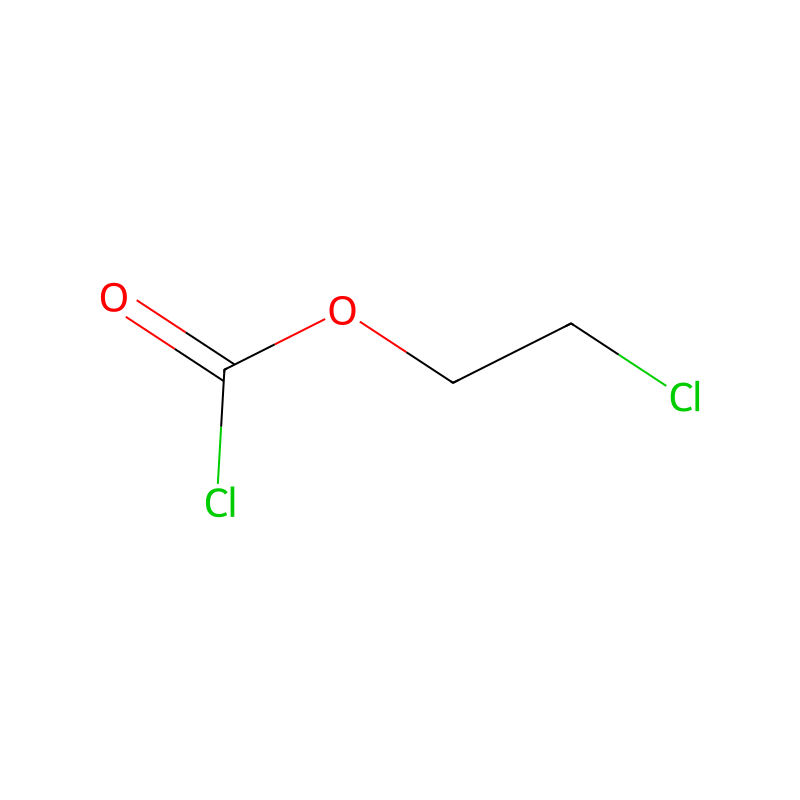
标识与物理属性
| CAS No. | 627-11-2 |
|---|---|
| 分子式 | C3H4Cl2O2 |
| 平均分子量 | 142.97 g/mol |
| 单同位素质量 | 141.95883473 g/mol |
| SMILES | O=C(Cl)OCCCl |
| InChIKey | SVDDJQGVOFZBNX-UHFFFAOYSA-N |
| PubChem CID | 12305 |
| EC No. | 210-982-4 |
| DTXSID | DTXSID2060832 |
| 中文名 | 氯甲酸氯乙酯 |
化学与物理性质
| XLogP | 1.8 |
|---|---|
| 极性表面积 | 26.3 |
| 氢键供体 | 0 |
| 氢键受体 | 2 |
| 可旋转键 | 3 |
| 重原子 | 7 |
| 形式电荷 | 0 |
| 复杂度 | 64 |
| 物质类别 | Toxic Gases & Vapors -> Acid Halides |
| SpringerMaterials Properties | Nuclear quadrupole resonance spectroscopy |
| 密度 | 1.3847 (EPA, 1998) - Denser than waterwill sink1.3847 @ 20 °C/4 °C1.3847 @ 20°C1.385 |
| Color/Form | Colorless liquid |
| 溶解性 | Insol in cold waterSol in alcohol, ether, acetone, benzenesoluble in Ether,Benzene,Acetone |
| 沸点 | 312.3 °F at 760 mmHg (EPA, 1998)155 °C155.7 °C @760 [mm Hg]155-156°C |
| 蒸气压 | 13 mm Hg at 48-49 °C13 [mm Hg]0.23 psi ( 20 °C) |
| 折射率 | Index of refraction: 1.4483 @ 20 °C1.446 |
| Physical Description | Chloroethyl chloroformate is a liquid. (EPA, 1998)Colorless liquid[HSDB] Clear colorless liquid[MSDSonline] |
| Other Experimental Properties | Decomp in alkaline soln and hot waterChloroformates are reactive intermediates that combine acid chloride, and ester functions. They undergo many reactions of acid chlorides, however, the rates are usually slower. Reactions of chloroformates, like other acid chlorides, proceed faster with better yields when alkali hydroxides or tertiary amines are present to react with the HCl as it forms. /Chloroformates/Hydrolyze in water /chloroformates/Conversion factor: 5.84 mg/cu m = 1 ppmFlash point: 158 °F (70 °C) |
| 熔点 | <25 °C |
| 闪点 | 158°F |
| 储存条件 | Inert atmosphere,2-8°C |
| 形态 | Liquid |
| 颜色 | Colorless to yellow |
| BRN | 506639 |
| 亨利常数 | 9.0×10⁻³ mol/(m3Pa) at 25℃, HSDB (2015) |
| InChIKey | SVDDJQGVOFZBNX-UHFFFAOYSA-N |
| CAS 数据库 | 627-11-2(CAS DataBase Reference) |
| NIST化学物质信息 | Carbonochloridic acid, 2-chloroethyl ester(627-11-2) |
| EPA化学物质信息 | 2-Chloroethyl chloroformate (627-11-2) |
化学性质
氯甲酸-2-氯乙酯为无色至浅黄色透明液体,具有强烈刺激性和催泪性,b.p.155~156℃,n20D 1.4460,相对密度1.385,能溶于苯、甲苯、酮、醚等有机溶剂。
安全与法规
| GHS 分类 | DangerH301 (13.2%): Toxic if swallowed [Danger Acute toxicity, oral]P260, P261, P264, P264+P265, P270, P271, P280, P301+P316, P301+P330+P331, P302+P352, P302+P361+P354, P304+P340, P305+P351+P338, P305+P354+P338, P316, P319, P321, P330, P332+P317, P337+P317, P362+P364, P363, P403+P233, P405, and P501 (click each P-code to see the statement)Aggregated GHS information provided per 53 reports by companies from 9 notifications to the ECHA C&L Inventory. Each notification may be associated with multiple companies. |
|---|---|
| 法规信息 | Chemical: Carbonochloridic acid, 2-chloroethyl esterStatus: Active Update: 27-03-2023 https://echa.europa.eu/registration-dossier/-/registered-dossier/31392 |
| 其他安全信息 | Evaluation - Chemicals that are unlikely to require further regulation to manage risks to human health |
| 运输标签(DOT) | Poison Corrosive |
| 火灾危害 | Excerpt from ERG Guide 154 [Substances - Toxic and/or Corrosive (Non-Combustible)]: |
| 健康危害 | (Non-Specific -- Ethyl Chloroformate) Poisonousmay be fatal if inhaled, swallowed or absorbed through skin. Contact may cause burns to skin and eyes. (EPA, 1998) |
| 危害概述 | A strong skin and eye irritant[HSDB] Slowly decomposed by water forming ethanol, hydrogen chloride, and carbon dioxideEvolves hydrogen chloride in moist airMay cause burns[CAMEO] A corrosive substance that can cause injury to the skin, eyes, and respiratory tractInhalation may cause pulmonary edema and chemical pneumonitisA lachrymator[MSDSonline] See CHLOROFORMATES. |
| 反应性基团 | Halogenated Organic Compounds |
| Reactivity Alerts | Water-Reactive |
| Reactivity Profile | CHLOROETHYL CHLOROFORMATE is an acid halide. Acid halides are water reactivesome are violently reactive. They are incompatible with strong oxidizing agents, alcohols, amines, alkali. May react vigorously or explosively if mixed with diisopropyl ether or other ethers in the presence of trace amounts of metal salts [J. Haz. Mat., 1981, 4, 291]. |
| Air and Water Reactions | Decomposed slowly by water forming ethanol, HCl, and CO2on contact with moist air, it gives off HCl fumesattacks many metals especially in humid atmosphere. REF [Handling Chemicals Safely, 1980. p. 476]. |
| CERCLA 应报告数量 | Releases of CERCLA hazardous substances are subject to the release reporting requirement of CERCLA section 103, codified at 40 CFR part 302, in addition to the requirements of 40 CFR part 355. Chloroethyl chloroformate is an extremely hazardous substance (EHS) subject to reporting requirements when stored in amounts in excess of its threshold planning quantity (TPQ) of 1,000 lbs. |
| Hazard Classes and Categories | Acute Tox. 3 (13.2%) |
| 消防 | Excerpt from ERG Guide 154 [Substances - Toxic and/or Corrosive (Non-Combustible)]: |
| 急救 | Warning: Respiratory effects may be delayed up to 72 hrs after exposure. Caution is advised. |
| 非火灾泄漏应对 | (Non-Specific -- Ethyl Chloroformate) Keep unnecessary people awayisolate hazard area and deny entry. Stay upwindkeep out of low areas. Isolate for 1/2 mile in all directions if tank car or truck is involved in fire. Shut off ignition sourcesno flares, smoking or flames in hazard area. Do not touch spilled materialstop leak if you can do so without risk. Use water spray to reduce vapors. |
| 处置方法 | SRP: At the time of review, criteria for land treatment or burial (sanitary landfill) disposal practices are subject to significant revision. Prior to implementing land disposal of waste residue (including waste sludge), consult with environmental regulatory agencies for guidance on acceptable disposal practices. |
| Preventive Measures | SRP: The scientific literature for the use of contact lenses in industry is conflicting. The benefit or detrimental effects of wearing contact lenses depend not only upon the substance, but also on factors including the form of the substance, characteristics and duration of the exposure, the uses of other eye protection equipment, and the hygiene of the lenses. However, there may be individual substances whose irritating or corrosive properties are such that the wearing of contact lenses would be harmful to the eye. In those specific cases, contact lenses should not be worn. In any event, the usual eye protectionequipment should be worn even when contact lenses are in place. |
| Isolation and Evacuation | Excerpt from ERG Guide 154 [Substances - Toxic and/or Corrosive (Non-Combustible)]: |
| Protective Action Criteria (PAC) | 1.8 [mg/m3]20 [mg/m3]120 [mg/m3] |
| Personal Protective Equipment (PPE) | For emergency situations, wear a positive pressure, pressure-demand, full facepiece self-contained breathing apparatus (SCBA) or pressure- demand supplied air respirator with escape SCBA and a fully-encapsulating, chemical resistant suit. (EPA, 1998) |
| 环境归趋 | TERRESTRIAL FATE: Chloroformates hydrolyze readily in water(1)therefore, aqueous hydrolysis will be the dominant fate process in moist soils(SRC). The low-boiling chloroformic esters, such as chloroethyl chloroformate, are highly volatile(2)therefore, evaporation from dry surfaces to the atmosphere will occur(SRC). Results of a single biodegradation study (using the Japanese MITI protocol) have classified ethyl chloroformate (a compound similar in structure to chloroethyl chloroformate) as biodegradable(3) but ethyl chloroformate hydrolyzes so fast the the biodegradation rates are probably for the hydrolysis products.AQUATIC FATE: Chloroformates hydrolyze readily in water(1)ethyl chloroformate has an hydrolysis half-life of 31.5 min at 25 °C(1) and chloroethyl chloroformate is predicted to hydrolyze at a faster rate(2) forming the chloroethyl carbonate which can further hydrolyze to 2-chloroethanol and formic acidtherefore, aqueous hydrolysis will be the dominant fate process in the aquatic environment(SRC). Aqueous volatilization, bioconcentration, biodegradation, and adsorption to sediment are not expected to be important fate processes due to rapid hydrolysis(SRC).ATMOSPHERIC FATE: Based upon a vapor pressure of 13 mm Hg at 48-49 °C(1), chloroethyl chloroformate is expected to exist primarily in the vapor-phase in the ambient atmosphere(2,SRC). It will degrade in the ambient atmosphere by reaction with photochemically produced hydroxyl radicals with an estimated half-life of about 14 days(3,SRC). Since chloroformates hydrolyzes readily in water(4), atmospheric degradation may occur through dissolution into clouds or through contact with rain or other atmospheric water(SRC). |
| 不良影响 | Dermatotoxin - Skin burns. |
| Soil Adsorption/Mobility | Using a structure estimation method based on molecular connectivity indexes, the Koc for chloroethyl chloroformate can be estimated to be approximately 15(1,SRC). According to a suggested classification scheme(2), this estimated Koc value suggests that chloroethyl chloroformate has high mobility in soil(SRC). However, chloroformates hydrolyzes readily in water(3)therefore, leaching in soil is not expected to be an important fate process(SRC). |
| Artificial Pollution Sources | Chloroethyl chloroformate's use as a chemical intermediate in the synthesis of other chemicals(1) could release the compound to the environment through various waste streams generated at sites of production and use(SRC). |
| Environmental Biodegradation | Using the Japanese MITI protocol (4 week incubation period with activated sludge inoculum), ethyl chloroformate (a compound similar in structure to chloroethyl chloroformate) was classified as biodegradable with a theoretical BOD of 81-86%(1) but this probably refers to the hydrolysis product(SRC). |
| Environmental Bioconcentration | Chloroformates hydrolyze readily in water(1)therefore, bioconcentration in aquatic organisms will not be an important process(SRC). |
| Volatilization from Water/Soil | The Henry's Law Constant for chloroethyl chloroformate can be estimated to be 1.1X10⁻³ atm-cu m/mole using a structure estimation method(1,SRC)this value of Henry's Law Constant indicates that volatilization from water is potentially an important fate process(2). However, chloroformates hydrolyze readily in water(3)therefore, volatilization from water is not expected to be important(SRC). The low- boiling chloroformic esters, such as chloroethyl chloroformate, are highly volatile(4)therefore, evaporation from dry surfaces will occur(SRC). |
| Environmental Abiotic Degradation | The rate constant for the vapor-phase reaction of chloroethyl chloroformate with photochemically produced hydroxyl radicals has been estimated to be 1.13X10⁻¹² cu cm/molecule-sec at 25 °C which corresponds to an atmospheric half-life of about 14 days at an atmospheric concn of 5X10+5 hydroxyl radicals per cu cm(1,SRC). Chloroformates hydrolyze readily in pure water(2)although the hydrolysis rate specific to chloroethyl chloroformate was not found, the rate constant for the aqueous hydrolysis of ethyl chloroformate in water at 25 °C has been experimentally determined to be 3.67X10⁻⁴/sec which corresponds to a half life of 31.5 min(2)an hydrolysis rate estimation program(3) predicts that chloroethyl chloroformate will hydrolyze as much as three times faster than ethyl chloroformate(SRC). |
| Probable Routes of Human Exposure | ... by ingestion and inhalation.The low-boiling chloroformic esters (such as chloroethyl chloroformate) are highly volatile(1)therefore, occupational exposure can occur through inhalation(SRC). |
| Environmental Water Concentrations | Chloroethyl chloroformate was tentatively identified in water sample collected from the Philadelphia, PA Torresdale water treatment plant in Mar 1975(1). |
| Environmental Fate/Exposure Summary | Chloroethyl chloroformate's use as a chemical intermediate could release the compound to the environment through various waste streams generated at sites of production and use. If released to the atmosphere, it will degrade in the vapor phase by reaction with photochemically produced hydroxyl radicals (estimated half-life of about 14 days). Since chloroformates hydrolyze readily in water, atmospheric degradation may occur through dissolution into clouds or through contact with rain or other atmospheric water. If released to water or moist soil, hydrolysis will be the dominate degradation process. If released to dry surfaces, chloroethyl chloroformate will evaporate into the atmosphere. Occupational exposure is most likely to occur through inhalation. (SRC) |
| Toxicity Data | LCLo (mice) = 200 mg/m3/10min |
| 水危害等级(WGK) | 3 |
| TSCA 清单状态 | TSCA listed |
| RTECS 号 | LQ5950000 |
| 包装类别 | II |
| 危险类别 | 6.1(a) |
| 安全说明(S) | 26-36/37/39-45 |
| 海关编码 | 29159000 |
| 危险品标志 | T |
| 危险类别码(R) | 23-34 |
| 毒害物质数据 | 627-11-2(Hazardous Substances Data) |
| 运输编号(UN) | 3277 |
急性毒性
吸入-小鼠 LCL0: 200 毫克/立方米/10分
可燃性危险特性
可燃; 火场分解有毒氯化物气体
储运特性
库房低温通风干燥; 与食品原料分开存放
灭火剂
水, 二氧化碳, 干粉, 砂土
用途与应用
用途
氯甲酸-2-氯乙酯是杀菌剂恶霜灵的中间体。
用途
有机合成。
用途
用作医药、农药用中间体
制备与合成方法
生产方法
其制备方法是在通光气釜内加入氯乙醇,启动搅拌,然后通过光气流量计通入光气。通光气温度为40~50℃,继续通光气20~24h,接近终点时取样分析,达标后停止通光气,然后通氮气赶走光气和氯化氢,光气进行破坏分解,赶气至pH=5~6,取样分析为产品。ClCH2CH2OH+COCl2→ClCOOCH2CH2Cl+HCl↑+CO2↑