
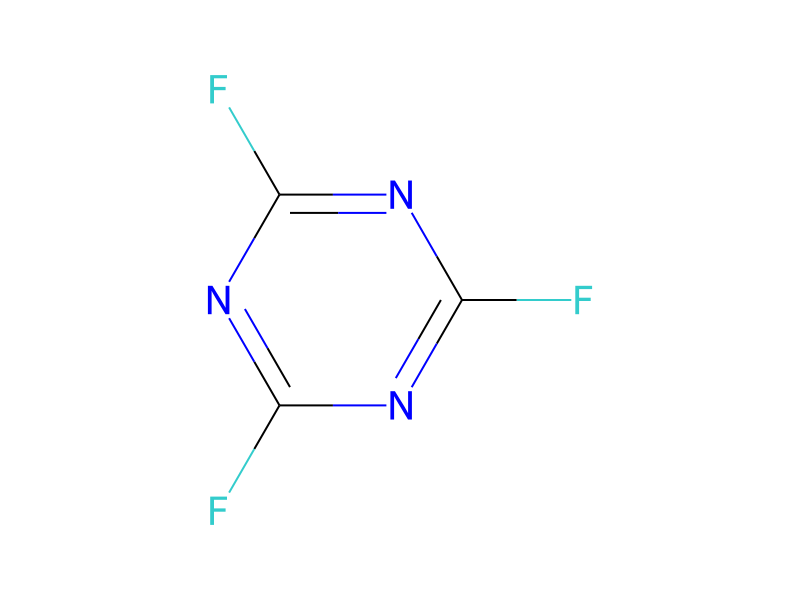
基本信息
- 标准SMILES
Fc1nc(F)nc(F)n1- InChIKey
VMKJWLXVLHBJNK-UHFFFAOYSA-N- 分子式
- C3F3N3
- 平均分子量
- 135.05 g/mol
- 单同位素质量
- 135.00443166
概述
Cyanuric fluoride is a liquid. (EPA, 1998)
名称与标识
- 首选名称
- Cyanuric fluoride
- IUPAC
- 2,4,6-trifluoro-1,3,5-triazine
- 中文名
- 三聚氟氰
- 英文名
- Cyanuric fluoride
- 分子式
- C3F3N3
- 分子量
- 135.05
名称与别名
CYANURIC FLUORIDE2,4,6-Trifluoro-1,3,5-triazine675-14-9TrifluorotriazineTrifluoro-s-triazineCyanuric trifluoride2,4,6-Trifluoro-s-triazines-Triazine, 2,4,6-trifluoro-1,3,5-Triazine, 2,4,6-trifluoro-Trifluoro-1,3,5-triazine2,4,6-Trifluoro-sym-triazines-Triazine, 2,4,6-trifluro-
展开更多名称
氢尿酰氯氰脲酰氟三聚氟氰三氟三嗪氰尿酰氟三聚氰氟三聚氟化氰三氟三聚氰三氟氰尿酸6-三氟-1Cyanuric FlourideNSC 168386Cyanuricfluoride,98%Cyanuric fluoride 98%
2,4,6-Trifluorotriazine31KW4S5FBBNSC-168386DTXSID60609751,3,5-TRIFLUORO-2,4,6-TRIAZINERefChem:129129DTXCID2044896211-620-8
数据库标识
- CAS
675-14-9- PubChem CID
- 12664
- DTXSID
DTXSID6060975- UNII
- 31KW4S5FBB
- EC Number
- 211-620-8
- Nikkaji
- J14.172K
性质
结构计算性质
- XLogP
- 1.3
- 极性表面积
- 38.7 Ų
- 氢键供体
- 0
- 氢键受体
- 6
- 可旋转键
- 0
- 重原子
- 9
- 形式电荷
- 0
- 复杂度
- 69.3
实验与物化性质
Chemical ClassesOther Classes -> Other Organic Compounds
SpringerMaterials Properties15N nuclear magnetic resonance spectrum
Density
1.60 at 25 °C/4 °C
1.60 @25 °C
Color/FormColorless
Boiling Point
72.8 °C
72.4 °C @760 [mm Hg]
Melting Point
-38 °C
-38 °C
Refractive IndexIndex of refraction: 1.3844 at 24 °C/D
Physical Description
Cyanuric fluoride is a liquid. (EPA, 1998)
Colorless liquid; [HSDB]
物理化学性质
- 熔点
- -38 °C · -38°C
- 沸点
- 73 · 73-74°C
- 密度
- 1 · 1,6 g/cm3
- 折射率
- 1.348 · 1.348
- 闪点
- 73 · 73-74°C
- 储存条件
- Hygroscopic, Refrigerator, under inert atmosphere
- 溶解度
- Miscible with chloroform, carbon tetrachloride,ether, dioxane and ketones.
- 酸度系数(pKa)
- -2.62 · -2.62±0.10(Predicted)
- 形态
- Oil
- 颜色
- Clear Colourless
- 敏感性
- Moisture Sensitive
- BRN
- 124237 · 124237
- 暴露限值
- 2.5 mg/m3NIOSH: · ACGIH: TWA 2.5 mg/m3NIOSH: IDLH 250 mg/m3; TWA 2.5 mg/m3
- CAS 数据库
- 675 · 675-14-9(CAS DataBase Reference)
- NIST化学物质信息
- 1 · 1,3,5-Triazine, 2,4,6-trifluoro-(675-14-9)
- EPA化学物质信息
- Cyanuric fluoride (675-14-9)
化学性质
无色液体。沸点69.5-70.5℃。遇水、醇剧烈分解。
安全与法规
GHS分类
GHS Classification
Danger
H310+H330 (16.7%): Fatal in contact with skin or if inhaled [Danger Acute toxicity, dermal; acute toxicity, inhalation]
P260, P262, P264, P264+P265, P270, P271, P280, P284, P301+P330+P331, P302+P352, P302+P361+P354, P304+P340, P305+P354+P338, P316, P317, P320, P321, P361+P364, P363, P403+P233, P405, and P501 (click each P-code to see the statement)
Aggregated GHS information provided per 6 reports by companies from 3 notifications to the ECHA C&L Inventory. Each notification may be associated with multiple companies.
危害信息
Regulatory InformationThe New Jersey Worker and Community Right to Know Act requires public and private employers to provide information about hazardous substances at their workplaces. (N.J.S.A. 34:5A-1 et. seq.)
DOT LabelPoison Inhalation Hazard Corrosive
Fire HazardsWhen heated to decomposition, it emits very toxic fumes of fluorides and nitrogen oxides. Avoid decomposing heat. (EPA, 1998)
Health HazardsThis material is highly toxic by skin contact and inhalation. (EPA, 1998)
Hazards Summary
Cyanuric fluoride is irritating to the skin, eyes, and respiratory tract. Information is limited, but it is not known to cause cyanide poisoning. It is absorbed through the skin. When heated to decomposition, fumes of fluorides and oxides of nitrogen are formed. [HSDB] In high-dose inhalation studies, animals develop pulmonary edema. [ChemIDplus]
Reactive GroupAmines, Phosphines, and Pyridines
Reactivity AlertsWater-Reactive
Reactivity ProfileCyanuric fluoride is used as a mild fluorinating agent for organic chemicals, and it reacts with water in a manner similar to an acyl halide, forming hydrofluoric acid and cyanuric acid.
Air and Water ReactionsNo rapid reaction with air. No rapid reaction with water.
Highly Hazardous SubstanceChemical: Cyanuric Fluoride
CERCLA Reportable Quantities
Releases of CERCLA hazardous substances are subject to the release reporting requirement of CERCLA section 103, codified at 40 CFR part 302, in addition to the requirements of 40 CFR part 355. Cyanuric fluoride is an extremely hazardous substance (EHS) subject to reporting requirements when stored in amounts in excess of its threshold planning quantity (TPQ) of 100 lbs.
Hazard Classes and CategoriesAcute Tox. 2 (100%)
安全与防护
Fire FightingExcerpt from ERG Guide 154 [Substances - Toxic and/or Corrosive (Non-Combustible)]:
First Aid
Signs and Symptoms of Cyanuric Fluoride Exposure: Signs and symptoms of acute exposure to cyanuric fluoride may include irritation or burns of the mucous membranes, lungs, gastrointestinal tract, eyes, and skin. Exposure to cyanuric fluoride may result in pulmonary edema.
Nonfire Spill ResponseAvoid inhalation and skin contact. (EPA, 1998)
Disposal Methods
SRP: At the time of review, criteria for land treatment or burial (sanitary landfill) disposal practices are subject to significant revision. Prior to implementing land disposal of waste residue (including waste sludge), consult with environmental regulatory agencies for guidance on acceptable disposal practices.
Isolation and EvacuationExcerpt from ERG Guide 154 [Substances - Toxic and/or Corrosive (Non-Combustible)]:
Protective Action Criteria (PAC)
0.0021 [ppm]
0.023 [ppm]
0.14 [ppm]
Personal Protective Equipment (PPE)
For emergency situations, wear a positive pressure, pressure-demand, full facepiece self-contained breathing apparatus (SCBA) or pressure- demand supplied air respirator with escape SCBA and a fully-encapsulating, chemical resistant suit. (EPA, 1998)
毒理信息
Adverse EffectsToxic Pneumonitis - Inflammation of the lungs induced by inhalation of metal fumes or toxic gases and vapors.
Environmental Abiotic DegradationCyanuric fluoride is readily hydrolyzed to 2,4,6-trihydroxy-1,3,5-triazine. Cyanuric fluoride reacts faster with nucleophilic agents such as ammonia and amines than cyanuric chloride
Antidote and Emergency Treatment
Basic treatment: Establish a patent airway (oropharyngeal or nasopharyngeal airway, if needed). Suction if necessary. Watch for signs of respiratory insufficiency and assist ventilations if necessary. Administer oxygen by nonrebreather mask at 10 to 15 L/min. Monitor for pulmonary edema and treat if necessary ... . Monitor for shock and treat if necessary ... . For eye contamination, flush eyes immediately with water. Irrigate each eye continuously with 0.9% saline (NS) during transport ... . Do not use emetics. For ingestion, rinse mouth and administer 5 mL/kg up to 200 mL of water if the patient can swallow, has a strong gag reflex, and does not drool. Do not attempt to neutralize because of exothermic reaction. Cover skin burns with dry, sterile dressings after decontamination ... . /Hydrofluoric Acid (HF) and Related Compounds/
Advanced treatment: Consider orotracheal or nasotracheal intubation for airway control in the patient who is unconscious, has severe pulmonary edema, or is in severe respiratory distress. Consider drug therapy for pulmonary edema ... . Early intubation at the first sign of upper airway obstruction may be necessary. Positive-pressure ventilation with a bag valve mask device may be beneficial. Consider drug therapy for pulmonary edema ... . Monitor cardiac rhythm and treat arrhythmias as necessary. Development of QT interval prolongation may signal hypocalcemia and need for IV calcium gluconate administration ... . Start IV administration of D5W /SRP: "To keep open", minimal flow rate/. Use 0.9% saline (NS) or lactated Ringer's (LR) if signs of hypovolemia are present. For hypotension with signs of hypovolemia, administer fluid cautiously. Consider vasopressors if patient is hypotensive with a normal fluid volume. Watch for signs of fluid overload ... . Use 2.5% calcium gluconate gel for skin burns over painful areas after thorough decontamination ... . Iced 0.13% benzalkonium chloride (Zephiran chloride) solution soak or compresses may be used with careful monitoring of body temperature. Compresses should be changed every 2 min. Use proparacaine hydrochloride to assist eye irrigation ... . /Hydrofluoric Acid (HF) and Related Compounds/
Toxicity DataLC50 (rat) = 3.1 ppm/4H
法规信息
CERCLA Reportable Quantities
Releases of CERCLA hazardous substances are subject to the release reporting requirement of CERCLA section 103, codified at 40 CFR part 302, in addition to the requirements of 40 CFR part 355. Cyanuric fluoride is an extremely hazardous substance (EHS) subject to reporting requirements when stored in amounts in excess of its threshold planning quantity (TPQ) of 100 lbs.
安全数据
- F
- 10
- wgk
- 3
- tsca
- TSCA listed
- RTECS号
- XZ1750000
- hazard_note
- Corrosive/Toxic
- 包装类别
- I
- 危险等级
- 6.1
- 安全说明
- 26-28-36/37/39-45
- 危险品标志
- T+,C,T
- 危险类别码
- 24-26-35
- 毒害物质数据
- 675-14-9(Hazardous Substances Data)
- 危险品运输编号
- UN 3389 6.1/PG 1
化学与工业
用途与制造
Uses
Used to produce fiber-reactive dyes; [HSDB]
... Used to manufacture reactive dyes.
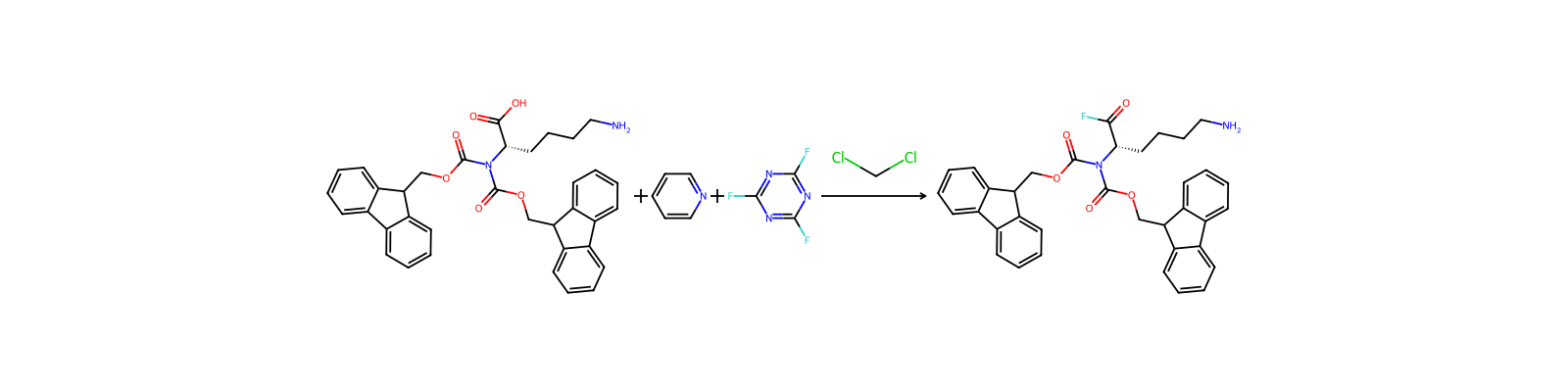
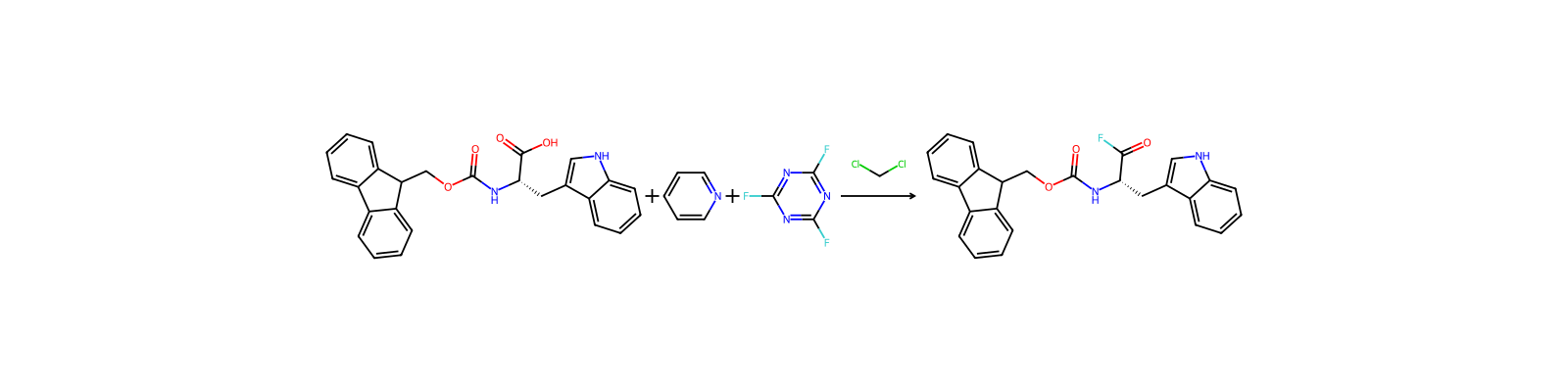
Specific reagent for tyrosine residues in enzymes ... can also serve as a fluorinating agent in fluorodehydroxylation reactions ... preparation of acid fluorides from the corresponding carboxylic acid ... application in peptide syntheis from amino acids through the corresponding acid fluoride.
Used to manufacture reactive dyes by reaction between one or two fluorine substituents with amino groups of chromophores; the remaining fluorine binds to the fiber
Methods of Manufacturing
Can be prepared from cyanuric chloride with numerous fluorinating agents, eg, pentavalent antimony chlorofluoride, silver monofluoride, potassium fluoride, sodium fluoride, potassium fluorosulfinate, and sulfur tetrafluoride ... .
2,4,6-Trifluoro-1,3,5-triazine ... is produced commercially from 2,4,6-trichloro-1,3,5-triazine (cyanuric chloride) with either anhydrous hydrogen fluoride or sodium fluoride in sulfolane.
General Manufacturing Information
1,3,5-Triazine, 2,4,6-trifluoro-: ACTIVE
Cyanuric fluoride has been offered commercially for biochemical applications, eg, as a specific reagent for tyrosine.
应用领域
概述三聚氟氰是合成氟代均三嗪活性染料的关键中间体。氟代均三嗪活性染料与传统的氯代三嗪活性染料相比, 具有以下五大优点: 1.节能, 染色温度低(中温型)60℃, 比KE型活性染料低, 与M型活性染料相当。 2.减排、环保、固色率高, 比相应的氯代三嗪活性染料固色率高15 ~ 20个百分点, 既可提高染料的利用率, 又可减少印染过程中的环境污染。 3.染料稳定性好。 4.耐过氧化物稳定性高。 5.不受AOX法规限制。
用途用于制备活性染料。 有关三聚氟氰的概述、合成、用途是由Chemicalbook的侍艳编辑整理。(2015-11-16)
用途用于有机合成。
用途主要用于制备活性染料
制备方法
生产方法在聚乙烯容器中,加入氰尿酰氯,冷至-78℃,通入干燥的氟化氢气体,氟化氢被冷凝,氰尿酰氯慢慢溶解,当氰尿酰氯全部溶解,反应产生的氯化氢先在低温下逸出,继续在室温下逸出,当不再有氯化氢逸出时,反应即告完成。稍加热并通氮气除去过量的氟化氢,在聚乙烯装置中蒸馏,得氰尿酰氟。产率76%。
上下游产品信息
上游原料
试剂价格
- XW0267514903 · 25G
- 氰尿酰氟 — 1134元
- XW0267514902 · 10G
- 氰尿酰氟 — 512元
供应商50 家
郑州阿尔法化工有限公司+86-18530059196 · [email protected]
湖北永阔科技有限公司027-59223108 15972152991 · [email protected]
上海阿拉丁生化科技股份有限公司400-6206333 13167063860 · [email protected]
湖北万得化工有限公司15377098680 15377098680 · [email protected]
常州新氟化学有限公司13275212658 · [email protected]
武汉欣扬瑞和化学科技有限公司153-07155313 15307155313 · [email protected]
爱斯特(成都)生物制药股份有限公司+86-28-85122536 85324413 · [email protected]
上海仲因实业有限公司2537653158 16621191650 · [email protected]
Dayang Chem (Hangzhou) Co.,Ltd.+86-0571-88938639 17705817739 · [email protected]
衢州明锋化工有限公司0570-3062502 13819002126;13819008176 · [email protected]
Syntechem Co.,Ltd[email protected]
江苏南创化学与生命健康研究院有限公司15720605021
上海颖心实验室设备有限公司021-59178156 17002132182 · [email protected]
阿法埃莎(中国)化学有限公司400-6106006 · [email protected]
安耐吉化学&3A(安徽泽升科技股份有限公司)400-0056266 · [email protected]
武汉凯威斯科技有限公司86-027-67849912 · [email protected]
梯希爱(上海)化工贸易有限公司021-61109150 · [email protected]
上海瀚鸿科技股份有限公司021-54306202 13764082696 · [email protected]
南通合润生物科技有限公司18362409333 · [email protected]
上海景颜化工科技有限公司13817811078 · [email protected]
湖北广奥生物科技有限公司027-02702759223056 18162699093 · [email protected]
广东谦进化学试剂有限公司0751-2818792 13435114148 · [email protected]
湖北成海化工有限公司027-59220433 18327245847 · [email protected]
孝感深远化工有限公司15527621225; 15527621225 · [email protected]
宝鸡缔都医药化工有限公司029-81145305 17791533577 · [email protected]
山东西亚化学有限公司13355009207 13355009207 · [email protected]
四川库利南科技有限公司400-1166-196 18981987031 · [email protected]
天津希恩思生化科技有限公司400 638 7771 · [email protected]
南京维奥化工有限公司Please Send Email 18652950785 · [email protected]
上海皓鸿生物医药科技有限公司400-8210725 4008210725 · [email protected]
广东元丰化学试剂有限公司0751-2829979 13376591640 · [email protected]
上海和宁美生物医药科技有限公司021-18019086215 18019086215 · [email protected]
艾科试剂4008-755-333 18080918076 · [email protected]
HBCChem, Inc.+1-510-219-6317 · [email protected]
成都零六生物科技有限公司400-1166-196 13458535857 · [email protected]
天津安浩生物科技有限公司[email protected]
上海麦克林生化科技股份有限公司15221275939 15221275939 · [email protected]
凯试(上海)科技有限公司021-50135380 · [email protected]
湖北巨胜科技有限公司027-59599241 18871490274 · [email protected]
普善实业(陕西)有限公司029-81310890 18165209495 · [email protected]
天津荣燊化工有限公司18317763565; 18317763565 · [email protected]
南兴化工(江苏)有限公司0512-66387035 18662433356 · [email protected]
九鼎化学(上海)科技有限公司4009209199 · [email protected]
安阳鸿蒙新材料有限公司19588588067 · [email protected]
启源(广东)医药化工有限公司18026564465 · [email protected]
安阳鸿蒙新材料有限公司0372-19588588067 19588588067 · [email protected]
南京艾比克斯生化科技有限公司025-87193546 18652950785 · [email protected]
上海西陇生化科技有限公司021-52907766-8042
上海前衍生物科技有限公司02781293128 · [email protected]
上海源叶生物科技有限公司13636370518 · [email protected]
相关反应
137 条



关联笔记
加载中…