化工社化工社化学信息打印报告 · 仅供科研参考
炔诺孕酮
高诺酮 · 孕烯醇 · 甲炔诺酮 · 左炔孕酮 · 炔诺孕酮 · 药典标准品 · 炔诺孕酮杂质 · 18-甲炔诺酮
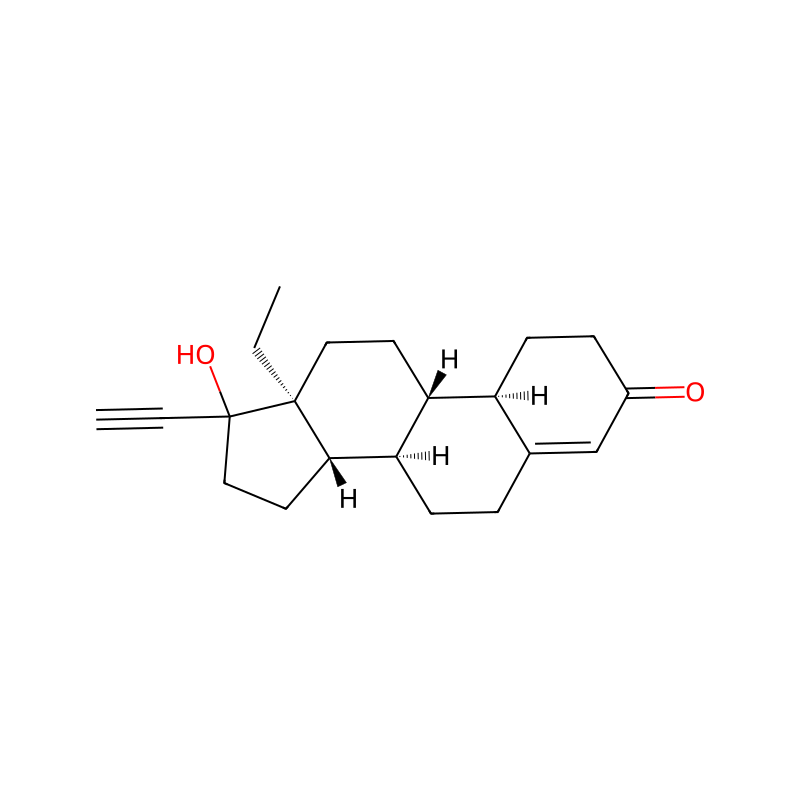
标识与物理属性
| CAS No. | 6533-00-2 |
|---|---|
| 分子式 | C21H28O2 |
| 平均分子量 | 312.4 g/mol |
| 单同位素质量 | 312.20893013 g/mol |
| SMILES | C#CC1(O)CC[C@H]2[C@@H]3CCC4=CC(=O)CC[C@@H]4[C@H]3CC[C@@]21CC |
| InChIKey | WWYNJERNGUHSAO-CULCCENASA-N |
| PubChem CID | 16051930 |
| ChEMBL | CHEMBL2107797 |
| EC No. | 229-433-5 |
| 中文名 | 炔诺孕酮 |
化学与物理性质
| XLogP | 3.3 |
|---|---|
| 极性表面积 | 37.3 |
| 氢键供体 | 1 |
| 氢键受体 | 2 |
| 可旋转键 | 2 |
| 重原子 | 23 |
| 形式电荷 | 0 |
| 复杂度 | 609 |
| Color/Form | Crystals from methanolCrystals from diethyl ether-hexane |
| 溶解性 | In water, 1.73 mg/L, temp not stated.Chloroform (Slightly, Sonicated), Dichloromethane (Slightly), Methanol (Slightly) |
| Decomposition | When heated to decomposition, it emits acrid smoke and irritating fumes. |
| 熔点 | 205-207 °C239-241 °C(lit.) |
| Optical Rotation | Crystals, mp 238-232 °C. Specific optical rotation: +40.7 deg at 25 °C/D (CHCl3) /Norgetrel (+)-form/ |
| 沸点 | 392.36°C (rough estimate) |
| 密度 | 1.0697 (rough estimate) |
| 折射率 | 1.4900 (estimate) |
| 储存条件 | 2-8°C |
| pKa(酸度系数) | 13.09±0.40(Predicted) |
| 形态 | Solid |
| 颜色 | Crystals from diethyl ether-hexane |
| 亨利常数 | 1.3×10⁴ mol/(m3Pa) at 25℃, HSDB (2015) |
| 暴露限值 | PC-TWA: 0.5 mg/m3PC-STEL: 2 mg/m3 |
| InChI | InChI=1/C21H28O2/c1-3-20-11-9-17-16-8-6-15(22)13-14(16)5-7-18(17)19(20)10-12-21(20,23)4-2/h2,13,16-19,23H,3,5-12H2,1H3/t16-,17+,18+,19-,20-,21-/s3 |
| InChIKey | WWYNJERNGUHSAO-XUDSTZEESA-N |
| SMILES | [C@]12(CC)CC[C@]3([H])[C@@]4([H])CCC(=O)C=C4CC[C@@]3([H])[C@]1([H])CC[C@@]2(O)C#C |&1:0,5,7,17,19,23,r| |
| CAS 数据库 | 6533-00-2(CAS DataBase Reference) |
| EPA化学物质信息 | Norgestrel (6533-00-2) |
化学性质
白色或类白色结晶性粉末,无臭,无味。不溶于水,溶于氯仿,微溶于甲醇。
安全与法规
| GHS 分类 | DangerH315 (11.1%): Causes skin irritation [Warning Skin corrosion/irritation]H319 (11.1%): Causes serious eye irritation [Warning Serious eye damage/eye irritation]H351 (92.6%): Suspected of causing cancer [Warning Carcinogenicity]H360 (88.9%): May damage fertility or the unborn child [Danger Reproductive toxicity]H362 (88.9%): May cause harm to breast-fed children [Reproductive toxicity, effects on or via lactation]H400 (88.9%): Very toxic to aquatic life [Warning Hazardous to the aquatic environment, acute hazard]H410 (88.9%): Very toxic to aquatic life with long lasting effects [Warning Hazardous to the aquatic environment, long-term hazard]P203, P260, P263, P264, P264+P265, P270, P273, P280, P302+P352, P305+P351+P338, P318, P321, P332+P317, P337+P317, P362+P364, P391, P405, and P501 (click each P-code to see the statement)Aggregated GHS information provided per 27 reports by companies from 4 notifications to the ECHA C&L Inventory. Each notification may be associated with multiple companies.Information may vary between notifications depending on impurities, additives, and other factors. The percentage value in parenthesis indicates the notified classification ratio from companies that provide hazard codes. Only hazard codes with percentage values above 10% are shown. For more detailed information, please visit ECHA C&L website. |
|---|---|
| 法规信息 | Hazard Traits - Developmental ToxicityAuthoritative List - Prop 65Report - regardless of intended function of ingredient in the product |
| FDA 要求 | The Approved Drug Products with Therapeutic Equivalence Evaluations identifies currently marketed prescription drug products, including norgestrel, approved on the basis of safety and effectiveness by FDA under sections 505 of the Federal Food, Drug, and Cosmetic Act. /In combination with Ethinylestradiol/ |
| Toxic Combustion Products | Emits toxic fumes under fire conditions. |
| Hazard Classes and Categories | Skin Irrit. 2 (11.1%)Eye Irrit. 2 (11.1%)Carc. 2 (92.6%)Repr. 1A (88.9%)Lact. (88.9%)Aquatic Acute 1 (88.9%)Aquatic Chronic 1 (88.9%) |
| 灭火程序 | Water spray, dry chemical, carbon dioxide, or foam as appropriate for surrounding fire and materials. ... As with all fires, evacuate personnel to a safe area. Firefighters should use self-contained breathing equipment and protective clothing. |
| 储存条件 | Store at controlled room temperature 15 °C to 25 °C (59 °F to 77 °F).Store in tight, light-resistant container as defined in the USP-NF. This material should be handled and stored per label instructions to ensure product integrity. |
| 清理方法 | Wear approved respiratory protection, chemically compatible gloves, and protective clothing. Wipe up spillage or collect spillage using a high-efficiency vacuum cleaner. Avoid breathing dust. Wash spill site. Place spillage and all contaminated cleanup materials in a thick plastic hazardous waste disposal bag or leakproof container and label it CAUTION: HAZARDOUS CHEMICAL WASTE. |
| 处置方法 | SRP: Expired or waste pharmaceuticals shall carefully take into consideration applicable DEA, EPA, and FDA regulations. It is not appropriate to dispose by flushing the pharmaceutical down the toilet or discarding to trash. If possible return the pharmaceutical to the manufacturer for proper disposal being careful to properly label and securely package the material. Alternatively, the waste pharmaceutical shall be labeled, securely packaged and transported by a state licensed medical waste contractor to dispose by burial in a licensed hazardous or toxic waste landfill or incinerator.SRP: At the time of review, regulatory criteria for small quantity disposal are subject to significant revision, however, household quantities of waste pharmaceuticals may be managed as follows: Mix with wet cat litter or coffee grounds, double bag in plastic, discard in trash. |
| Preventive Measures | As a general rule, when handling USP Reference Standards, avoid all contact and inhalation of dust, mists, and/or vapors associated with the material. Wash thoroughly after handling.This material is assumed to be combustible. As with all dry powders, it is advisable to ground mechanical equipment in contact with dry material to dissipate the potential buildup of static electricity.Engineering controls such as exhaust ventilation are recommended.SRP: Contaminated protective clothing should be segregated in such a manner so that there is no direct personal contact by personnel who handle, dispose, or clean the clothing. The completeness of the cleaning procedures should be considered before the decontaminated protective clothing is returned for reuse by the workers. Contaminated clothing should not be taken home at the end of shift, but should remain at employee's place of work for cleaning.For more Preventive Measures (Complete) data for NORGESTREL (6 total), please visit the HSDB record page. |
| Personal Protective Equipment (PPE) | Use a NIOSH-approved respirator, if it is determined to be necessary by an industrial hygiene survey involving air monitoring. In the event a respirator is not required, an approved dust mask should be used. Gloves: Chemically compatible. Eye Protection: Safety goggles or glasses. Protective clothing: Protect exposed skin. |
| 相互作用 | The metabolism of estrogens and progestagens may be increased by concomitant use of substances known to induce drug-metabolising enzymes, specifically cytochrome P450 enzymes, such as anticonvulsants (eg phenobarbital, phenytoin, carbamazepine), and anti-infectives (eg rifampicin, rifabutin, nevirapine, efavirenz).Ritonavir and nelfinavir, although known as strong inhibitors, by contrast exhibit inducing properties when used concomitantly with steroid hormones.Herbal preparations containing St John's Wort (Hypericum Perforatum) may induce the metabolism of estrogens and progestagens.Phenytoin and rifampin increase the serum concentrations of sex hormone-binding globulin (SHBG)this significantly decreases the serum concentration of free drug for some progestins, which is a special concern in patients using progestins for contraception. /Progestins/Drug interaction data are not available for rifabutin, but because its structure is similar to that of rifampin, similar precautions with its use with progestins may be warranted. ... /Progestins/ |
| 环境归趋 | TERRESTRIAL FATE: Based on a classification scheme(1), an estimated Koc value of 8,100(SRC), determined from a structure estimation method(2), indicates that norgestrel is expected to be immobile in soil(SRC). Volatilization of norgestrel from moist soil surfaces is not expected to be an important fate process(SRC) given an estimated Henry's Law constant of 7.7X10⁻¹⁰ atm-cu m/mole(SRC), using a fragment constant estimation method(3). Norgestrel is not expected to volatilize from dry soil surfaces(SRC) based upon an estimated vapor pressure of 1.0X10⁻⁹ mm Hg at 25 °C(SRC), determined from a fragment constant method(4). Biodegradation data in soil were not available(SRC, 2011).AQUATIC FATE: Based on a classification scheme(1), an estimated Koc value of 8100(SRC), determined from a structure estimation method(2), indicates that norgestrel is expected to adsorb to suspended solids and sediment(SRC). Volatilization from water surfaces is not expected(3) based upon an estimated Henry's Law constant of 7.7X10⁻¹⁰ atm-cu m/mole(SRC), developed using a fragment constant estimation method(4). According to a classification scheme(5), an estimated BCF of 91(SRC), from an estimated log Kow of 3.48(6) and a regression-derived equation(7), suggests the potential for bioconcentration in aquatic organisms is moderate(SRC). Biodegradation data in water were not available(SRC, 2011).ATMOSPHERIC FATE: According to a model of gas/particle partitioning of semivolatile organic compounds in the atmosphere(1), norgestrel, which has an estimated vapor pressure of 1.0X10⁻⁹ mm Hg at 25 °C(SRC), determined from a fragment constant method(2), is expected to exist solely in the particulate phase in the ambient atmosphere. Particulate-phase norgestrel may be removed from the air by wet or dry deposition(SRC). Norgestrel contains chromophores that absorb at wavelengths >290 nm(4), and therefore may be susceptible to direct photolysis by sunlight(SRC). |
| Milk Concentrations | Small amounts of oral contraceptive steroids have been identified in the milk of nursing mothers and a few adverse effects on the child have been reported, including jaundice and breast enlargement. In addition, oral contraceptives given in the postpartum period may interfere with lactation by decreasing the quantity and quality of breast milk. If possible, the nursing mother should be advised not to use oral contraceptives but to use other forms of contraception until she has completely weaned her child. |
| Soil Adsorption/Mobility | Using a structure estimation method based on molecular connectivity indices(1), the Koc of norgestrel can be estimated to be 8,100(SRC). According to a classification scheme(2), this estimated Koc value suggests that norgestrel is expected to be immobile in soil. |
| Human Toxicity Excerpts | /HUMAN EXPOSURE STUDIES/ The growth hormone, insulin, and blood glucose values were measured during a glucose tolerance test in 12 women before and after 3 months' use of a sequential contraceptive (11 pills containing .05 mg D-norgestrel and .05 mg ethinyl estradiol and 10 pills containing .05 mg D-norgestrel and .05 mg ethinyl estradiol). Neither fasting blood glucose nor glucose tolerance are altered during administration of the contraceptive steroids. Conversely, the reactive insulin level is significantly increased in comparison to the basal value, thus showing the signs of hyperinsulinemia. Both the gestagens and the estrogens appear to contribute to this disturbance of insulin secretion. Presumably the hyperinsulinemia is an expression of decreased sensitivity of the peripheral tissue to insulin. The growth hormone, a so-called insulin antagonist, is not responsible for the insulin resistance observed. The values measured after administration of the contraceptive do not significantly differ from the basal values./SIGNS AND SYMPTOMS/ Serious ill effects have not been reported following acute ingestion of large doses of oral contraceptives by young children. Overdosage may cause nausea, and withdrawal bleeding may occur in females./CASE REPORTS/ ... Presented is the case of a 45-year-old US woman with right lower quadrant pain and a 5-year history of use of a combined oral contraceptive (OC) containing 0.35 ug ethinyl estradiol and 0.35 ug norgestrel. At presentation, the uterus was enlarged to a size corresponding to 12-14 gestational weeks, with a mass at the right fundal margin. Pelvic ultrasonography revealed a large dominant leiomyoma 7.2 x 5.8 x 5.5 cm and several smaller tumors. OC use was discontinued and, 4 months later, the uterus was a size of 8-10 gestational weeks and a single serosal leiomyoma 5.9 x 4.6 x 4.4 cm remained. The leiomyoma volume had decreased by 47% after OC discontinuation, to 63 cu cm. Pelvic sonography 12 months after OC discontinuation revealed no further changes in myoma volume. In OC users with clinically significant uterine leiomyomas, discontinuation of combined OCs should be considered as a low-risk intervention with the potential to decrease uterine volume./CASE REPORTS/ /Investigators/ report a 41-year-old Caucasian woman with polycystic liver and kidney disease, and a 9-year history of severe cyclical urticaria related to her menses. The urticaria was not adequately controlled by antihistamines or Prempak-C (conjugated oestrogens and norgestrel). Intradermal testing with progesterone was strongly positive at 30 min and 18 hr. Buserelin, administered intranasally at doses of up to 800 ug daily, controlled the urticaria within 4 weeks, and she was completely symptom-free thereafter. She had therapy-induced amenorrhea and occasional hot flushes. Unfortunately, her liver cysts progressively enlarged, and a right hepatectomy was performed in June 1992, but she died after complications 3 weeks later. Prior to this she had been free of urticaria for 6 months after starting buserelin. Buserelin, a gonadotrophin-releasing hormone analogue, may be useful in the management of progesterone-induced urticaria, in patients in whom conjugated estrogens are contraindicated or unhelpful.For more Human Toxicity Excerpts (Complete) data for NORGESTREL (33 total), please visit the HSDB record page. |
| Artificial Pollution Sources | Norgestrel's production and use as in oral contraceptive formulations(1) may result in its release to the environment through various waste streams(SRC). |
| Drug Induced Liver Injury | Drug-Induced Liver Injury Severity and Toxicity (DILIst)norgestrelDILI PositiveOralDOI:10.1016/j.drudis.2019.09.022 |
| Environmental Bioconcentration | An estimated BCF of 92 was calculated in fish for norgestrel(SRC), using an estimated log Kow of 3.48(1) and a regression-derived equation(2). According to a classification scheme(3), this BCF suggests the potential for bioconcentration in aquatic organisms is moderate(SRC). |
| Volatilization from Water/Soil | The Henry's Law constant for norgestrel is estimated as 7.7X10⁻¹⁰ atm-cu m/mole(SRC) using a fragment constant estimation method(1). This Henry's Law constant indicates that norgestrel is expected to be essentially nonvolatile from water and moist soil surfaces(2). Norgestrel is not expected to volatilize from dry soil surfaces(SRC) based upon an estimated vapor pressure of 1.0X10⁻⁹ mm Hg(SRC), determined from a fragment constant method(3). |
| Non-Human Toxicity Excerpts | /LABORATORY ANIMALS: Chronic Exposure or Carcinogenicity/ Castrated (C3H x RIII)F1 mice ... of both sexes were fed dL-norgestrel or d-norgestrel in the diet at levels of 1 or 0.5 mg/kg, respectively. Mammary carcinomas were observed in 22/31 dL-norgestrel treated, 27/34 d-norgestrel treated and 17/29 control female mice. In the corresponding males, the incidences were 9/32, 10/32 and 10/61. The increases in incidence /for females/ were slightly raised, but the latencies of mammary tumors were unchanged./LABORATORY ANIMALS: Developmental or Reproductive Toxicity/ Rats were given 0.5-30 ug norgestrel orally from day 1-7 of gestation or 2 ug on days 6-8, or in a single dose /of 2 ug/ on day 6, 7 or 8. Administration of 2 ug continuously for 7 days terminated 100% of pregnanciesa single dose was effective only when given on day 6, terminating 57% of pregnancies2 ug given on days 6-8 terminated 50% of pregnancies./ALTERNATIVE and IN VITRO TESTS/ The effect of synthetic progestins found in oral contraceptives has potential implications for developing embryos in women who receive oral contraceptives during early pregnancy. /Investigators/ assessed the effect of the progestin norgestrel on the developing pre-embryo. B3C6F1 mice were given 5 IU PMSG followed by 5 IU hCG 48 hr later. Studies were performed on pre-embryos recovered and pooled at both 24 hr (Group A) and 48 hr (Group B) post hCG. At each time period, they were randomly assigned to control or norgestrel (4.0 ng/mL) treatment. In a third study, pre-embryos collected 24 hr post hCG were cultured in the absence or presence of 8.0, 80.0, or 800 ng/mL norgestrel. Cultures were performed in Ham's F-10 media with 10% fetal calf serum at 37 degrees C in an atmosphere of 5% CO2, 5% O2 and 90% N2 with 15-30 embryos per 1 mL of culture fluid. At 24 hr, 48 hr and 72 hr post recovery, cultures were viewed, the appearance of embryos noted, and number of blastomeres recorded. Compared to control groups, analysis demonstrated no significant difference in the rate of development of control and norgestrel pre-embryos in any group at any time period (24 hr, 48 hr, or 72 hr post recovery). /The authors/ conclude that norgestrel at the dose tested has no acute adverse morphological effects on development of mouse pre-embryos. This observation has potential clinical implications with regard to inadvertent use of norgestrel-containing oral contraceptives during early days of pregnancy, as well as consideration of the mechanism of action of norgestrel-containing "morning after" pills./ALTERNATIVE and IN VITRO TESTS/ Norgestrel at concentrations of 10(-8)-10(-6) mol/L stimulated the growth of the estrogen receptor-containing and estrogen-sensitive mammary cancer cell lines MCF-7 and T47D:A18this activity was inhibited by the anti-estrogen ICI182,780 and ICI164,384 (at concentration of 10(-6) mol/L), but not by RU486 (at concentration of 10(-7) mol/L). |
| Populations at Special Risk | Oral contraceptives have been reported to produce harmful ocular effects in myopic women. In women who developed myopia at or near puberty and in whom myopia became stable in adulthood, the drugs have reportedly increased the refractive error 2- to 3-fold, usually after 6 months of use. In women who are myopic and have considerable astigmatism, oral contraceptives may produce marked changes in the astigmatic error, possibly leading to frank keratoconus. In addition, oral contraceptives may produce a rapid advancement of the ocular disorder in patients with a family history of marked myopic astigmatism or keratoconus. Contact lens wearers receiving estrogen-progestin contraceptives may have more difficulties with their contact lenses than do nonusers who wear contact lenses. Contact lens wearers who develop visual disturbances or changes in lens tolerance during estrogen-progestin contraceptive use should be assessed by an ophthalmologisttemporary or permanent cessation of contact lens wear should be considered. /Estrogen-Progestin Combination/Mental depression may occur in women receiving oral contraceptives. In a few cases, mental depression has been severe and has led to suicidal behavior. Mental depression appears to occur most frequently in patients with a history of depression, including premenstrual depressionhowever, relief of premenstrual tension occurs in some women. Patients with a history of mental depression should be observed carefully and the estrogen-progestin contraceptive discontinued if severe depression recurs during use. /Estrogen-Progestin Combination/ |
| Environmental Abiotic Degradation | Norgestrel is not expected to undergo hydrolysis in the environment due to the lack of functional groups that hydrolyze under environmental conditions(1). Norgestrel contains chromophores that absorb at wavelengths >290 nm(1), and therefore may be susceptible to direct photolysis by sunlight(SRC). |
| 水危害等级(WGK) | 3 |
| 毒性 | LD50 oral in rat: 5010mg/kg |
| RTECS 号 | JF8259000 |
| 安全说明(S) | 22-36 |
| 海关编码 | 2937230000 |
| 危险品标志 | Xn |
| 危险类别码(R) | 20/21/22-40 |
| 毒害物质数据 | 6533-00-2(Hazardous Substances Data) |
用途与应用
概述
左炔诺孕酮是一种速效、短期口服避孕药,避孕机制是显著抑制排卵和阻止孕卵着床,并使宫颈黏液稠度增加,精子穿透阻力增大,从而发挥速效避孕作用。单用孕激素或用孕激素与雌激素配伍,现已制成品种繁多的女性避孕药,以口服、外用和注射的方式达到避孕目的的药物,目前只用于妇女。