
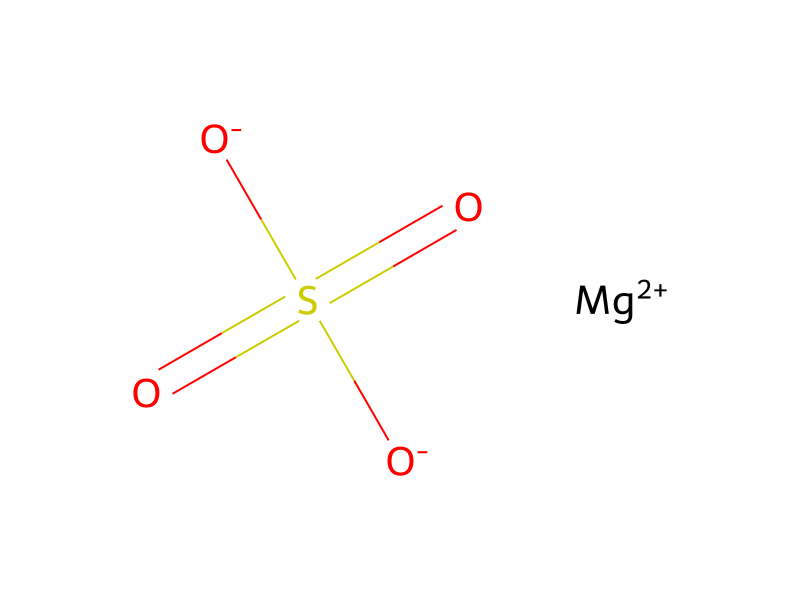
基本信息
- 标准SMILES
O=S(=O)([O-])[O-].[Mg+2]- InChIKey
CSNNHWWHGAXBCP-UHFFFAOYSA-L- 分子式
- MgSO4
- 平均分子量
- 120.37 g/mol
- 单同位素质量
- 119.93677118
概述
Magnesium sulfate is a magnesium salt having sulfate as the counterion. It has a role as a fertilizer, an analgesic, a cardiovascular drug, an anticonvulsant, an anti-arrhythmia drug, a calcium channel blocker, an anaesthetic and a tocolytic agent. It is an organic magnesium salt, a magnesium salt and a metal sulfate.
名称与标识
- 首选名称
- Sulfuric acid magnesium salt (1:1)
- IUPAC
- magnesium sulfate
名称与别名
MAGNESIUM SULFATE7487-88-9Magnesium sulfate anhydrousMgSO4Sulfuric acid magnesium salt (1:1)MagnesiumsulfatMagnesium sulfate (1:1)Sal AngalisSal De sedlitzTomix OTSulfuric acid magnesium saltMagnesium(II) sulfate
展开更多名称
Magnesium sulfate,anhydrousMagnesium sulphate anhydrousML30MJ2U7IMagnesium sulphate, anhydrousMagnesium Sulfate In Plastic ContainerCHEBI:32599Magnesium sulfate in dextrose 5% in plastic containerDTXSID6042105
数据库标识
- CAS
18939-43-0、68081-97-0、7487-88-9- PubChem CID
- 24083
- DTXSID
DTXSID6042105- ChEMBL
CHEMBL2021423、CHEMBL3989857- ChEBI
CHEBI:32599- UNII
- ML30MJ2U7I
- EC Number
- 231-298-2、242-691-3、686-508-9
- Nikkaji
- J3.103H
性质
结构计算性质
- 极性表面积
- 88.6 Ų
- 氢键供体
- 0
- 氢键受体
- 4
- 可旋转键
- 0
- 重原子
- 6
- 形式电荷
- 0
- 复杂度
- 62.2
实验与物化性质
Chemical ClassesMetals -> Metals, Inorganic Compounds
Polymers
Plastics -> N.a.
Plastics -> Pigments agents
Cosmetics
Cosmetic ingredients (Magnesium Sulfate) -> CIR (Cosmetic Ingredient Review)
Hair conditioning; Viscosity controlling; Bulking
pHNeutral to litmus
OdorOdorless
TasteSaline, bitter taste
Density
2.66 g/cu cm
Efflorescent crystals or powder; bitter, saline, cooling taste; density: 1.67; pH 6-7; soluble in water (g/100 ml): 71 @ 20 °C, 91 @ 40 °C; slightly soluble in alcohol; its aqueous soln is neutral; it loses 4 H2O @ 70-80 °C, 5 H2O @ 100 °C, 6 H2O @ 120 °C; loses last molecule of H2O @ about 250 °C; rapidly reabsorbing water when exposed to moist air; on exposure to dry air at ordinary temperatures it losses approx one H2O /Heptahydrate/
2.66 g/cm³
2.66 @25 °C
Color/Form
Colorless crystalline solid
Orthorhombic crystals
Opaque powder
Solubility
SOL IN 2 PARTS H2O AT 20 °C /TRIHYDRATE/
In ether, 1.16 g/100 ml at 18 °C; insoluble in acetone; soluble in alcohol and glycerin
Soluble in glycerol
In water, 360 g/l @ 20 °C
Solubility in water, 20 g/100 ml at 0 °C, 73.8 g/100 ml at 100 °C.
Human Drugs
Breast Feeding; Lactation; Milk, Human; Antiarrhythmics; Anticonvulsants; Cathartics; Gastrointestinal Agents; Magnesium Compounds; Minerals; Tocolytic Agents
FDA approved drugs -> Active ingredient
FDA approved drugs -> Active ingredient
FDA approved drugs -> Active ingredient
Antiseizure medicines
Animal Drugs
Active Ingredients (Magnesium Sulfate) -> FDA Greenbook
Pharmaceuticals -> UK Veterinary Medicines Directorate List
Decomposition
When heated to decomp ... emits toxic fumes of /sulfur oxides/.
1124 °C
安全与法规
GHS分类
GHS Classification
This chemical does not meet GHS hazard criteria for 41.4% (1034 of 2499) of reports.
Warning
H302 (57.2%): Harmful if swallowed [Warning Acute toxicity, oral]
P261, P264, P270, P271, P280, P301+P317, P302+P352, P304+P340, P317, P321, P330, P362+P364, and P501 (click each P-code to see the statement)
Aggregated GHS information provided per 2499 reports by companies from 16 notifications to the ECHA C&L Inventory. Each notification may be associated with multiple companies.
Not Classified
危害信息
Regulatory Information
Chemical: Sulfuric acid, magnesium salt (1:1)
Sulfuric acid magnesium salt (1:1) is listed on the EPA's Chemical Data Reporting (CDR) system. Manufacturers and importers of Sulfuric acid magnesium salt (1:1) are required to report information about their production and use of this chemical to the EPA under the Toxic Substances Control Act (TSCA). (40 eCFR Part 711)
Status: Active Update: 07-04-2023 https://echa.europa.eu/registration-dossier/-/registered-dossier/15865
Magnesium sulfate anhydrous: Does not have an individual approval but may be used under an appropriate group standard
Other Safety InformationIMAP assessments - Sulfuric acid, magnesium salt (1:1): Human health tier I assessment
Fire HazardsNot combustible. Gives off irritating or toxic fumes (or gases) in a fire.
Hazards SummaryNo listed effects of short-term or long-term exposure; [ICSC]
FDA Requirements
This substance is generally recognized as safe when used in accordance with good manufacturing or feeding practice.
Substance added directly to human food affirmed as generally recognized as safe (GRAS).
The Approved Drug Products with Therapeutic Equivalence Evaluations List identifies currently marketed prescription drug products, incl magnesium sulfate, approved on the basis of safety and effectiveness by FDA under sections 505 of the Federal Food, Drug, and Cosmetic Act.
Drug products containing certain active ingredients offered over-the-counter (OTC) for certain uses. Magnesium sulfate is included as a topical acne drug product and an orally administered menstrual drug product.
Drug products containing active ingredients offered over-the-counter (OTC) for the treatment of boils. Magnesium sulfate is included in this section.
EPA Safer ChemicalChemical: Magnesium sulfate, anhydrous
FIFRA Requirements
As the federal pesticide law FIFRA directs, EPA is conducting a comprehensive review of older pesticides to consider their health and environmental effects and make decisions about their future use. Under this pesticide reregistration program, EPA examines health and safety data for pesticide active ingredients initially registered before November 1, 1984, and determines whether they are eligible for reregistration. In addition, all pesticides must meet the new safety standard of the Food Quality Protection Act of 1996. Pesticides for which EPA had not issued Registration Standards prior to the effective date of FIFRA '88 were divided into three lists based upon their potential for human exposure and other factors, with List B containing pesticides of greater concern and List D pesticides of less concern. Magnesium sulfate is found on List D. Case No: 4055; Pesticide type: insecticide, herbicide; Case Status: No products containing the pesticide are actively registered. Therefore, we are characterizing the case as "cancelled." Under FIFRA, pesticide producers may voluntarily cancel their registered products. EPA also may cancel pesticide registrations if registrants fail to pay required fees or make/meet certain reregistration commitments, or if EPA reaches findings of unreasonable adverse effects.; Active ingredient (AI): magnesium sulfate; AI Status: The active ingredient is no longer contained in any registered products. Thus, we characterize it as "cancelled."
Residues of magnesium sulfate are exempted from the requirement of a tolerance when used as a solid diluent, carrier or safener in accordance with good agricultural practices as inert (or occasionally active) ingredients in pesticide formulations applied to growing crops or to raw agricultural commodities after harvest.
Chemical DangersDecomposes on heating. This produces toxic and corrosive fumes including sulfur oxides.
Hazard Classes and Categories
Acute Tox. 4 (57.2%)
Not Classified
Not Classified
Hazardous Reactivities and IncompatibilitiesPotentially explosive reaction when heated with ethoxyethynyl alcohols (e.g., 1-ethoxy-3-methyl-1-butyn-3-ol).
安全与防护
Fire FightingIn case of fire in the surroundings, use appropriate extinguishing media.
First Aid Measures
Fresh air, rest.
Rinse skin with plenty of water or shower.
Rinse with plenty of water (remove contact lenses if easily possible).
Rinse mouth. Give one or two glasses of water to drink.
Safe StorageDry.
Storage ConditionsKEEP WELL CLOSED. /HEPTAHYDRATE/
Disposal Methods
SRP: At the time of review, criteria for land treatment or burial (sanitary landfill) disposal practices are subject to significant revision. Prior to implementing land disposal of waste residue (including waste sludge), consult with environmental regulatory agencies for guidance on acceptable disposal practices.
Spillage Disposal
Personal protection: particulate filter respirator adapted to the airborne concentration of the substance. Sweep spilled substance into covered containers. If appropriate, moisten first to prevent dusting. Store and dispose of according to local regulations. Wash away remainder with plenty of water.
Eye PreventionWear safety spectacles.
Inhalation RiskA harmful concentration of airborne particles can be reached quickly , especially if powdered.
Minimum Risk Level3.5 mmol/L in blood.
Allowable Tolerances
Residues of magnesium sulfate are exempted from the requirement of a tolerance when used as a solid diluent, carrier or safener in accordance with good agricultural practices as inert (or occasionally active) ingredients in pesticide formulations applied to growing crops or to raw agricultural commodities after harvest.
Ingestion PreventionDo not eat, drink, or smoke during work.
Inhalation PreventionAvoid inhalation of dust.
毒理信息
Treatment
EYES: irrigate opened eyes for several minutes under running water. INGESTION: do not induce vomiting. Rinse mouth with water (never give anything by mouth to an unconscious person). Seek immediate medical advice. SKIN: should be treated immediately by rinsing the affected parts in cold running water for at least 15 minutes, followed by thorough washing with soap and water. If necessary, the person should shower and change contaminated clothing and shoes, and then must seek medical attention. INHALATION: supply fresh air. If required provide artificial respiration.
Interactions
ADMIN OF MAGNESIUM SULFATE IN PREECLAMPSIA & ECLAMPSIA POTENTIATES NEUROMUSCULAR BLOCKADE PRODUCED BY D-TUBOCURARINE, DECAMETHONIUM, & SUCCINYLCHOLINE.
When barbiturates, opiates, general anesthetics, or other CNS depressants are administered concomitantly with magnesium sulfate, dosage of these agents must be carefully adjusted because of the additive central depressant effects.
...Magnesium inhibited extracellular calcium entry, intracellular calcium release, cytosolic calcium oscillations, and phasic contractions of myometrial smooth muscle /induced by oxytocin and other uterotonic agonists/.
...The present in vivo rat study examined the effect of magnesium sulfate to alter the pressor response to norepinephrine (NE) and angiotensin II (A II). Magnesium doses were chosen to approximate those used in treating preeclampsia. NE resulted in a significant rise in mean arterial pressure (delta MAP, 46 +/- 3.7 mmHg; p<0.001). A II also resulted in a significant rise in MAP (delta MAP, 23 +/- 3.6 mmHg, p<0.02). Magnesium sulfate alone had no significant effect on MAP but attenuated the pressor response to both NE (delta MAP, 16 +/- 1.5 mmHg) and A II (delta MAP, 12 +/- 2.5 mmHg). After discontinuation of the magnesium sulfate infusion, the control pressor responses to NE and A II were again seen (delta MAP, 39 +/- 3.5 mmHg and delta MAP, 28 +/- 4.2 mmHg, respectively). Although magnesium sulfate is not a primary antihypertensive agent, it may have effects on blood pressure by attenuating the actions of circulating vasoconstrictors.
For more Interactions (Complete) data for MAGNESIUM SULFATE (6 total), please visit the HSDB record page.
Health Effects
May cause a potentially dangerous rash that may develop into Stevens Johnson syndrome, an extremely rare but potentially fatal skin disease. Respiratory paralysis occurs at 5 to 6.5 mmol/L. Cardiac conduction is altered at greater than 7.5 mmol/L, and cardiac arrest can be expected when concentrations of magnesium exceed 12.5 mmol/L.
Environmental Fate
AQUATIC FATE: Natural water systems acquire magnesium through weathering reactions, which involve the interaction of water and atmosphere with the earth's crust and subsequent leaching of magnesium compounds into water. The Mg2+ ion is the predominant form of dissolved magnesium. However, some magnesium complexes do form. The magnesium sulfate ion pair complex (MgSO4) is the most significant complex present, representing 2.6% and 11% of the total magnesium content in fresh and sea water, respectively. The concentrations of bicarbonate and carbonate complexes are significant but considerably less than sulfate complexes. Incorporation of magnesium compounds into sediment is an important removal process. For example, a small amount of magnesium is ion exchanged for calcium on clay minerals in ocean sediment. Also small amounts of magnesium carbonate (about 6% of the magnesium supplied by rivers) are deposited with calcite (CaCO3) in seawater. There is significant uptake of magnesium (about 24% of the river input of magnesium) by sediment in which sulfate reduction is taking place(1). The avg Kd value for magnesium sorption on Po River sediments is 1.3 cu m/kg, which suggests that magnesium ions are weakly sorbed on sediments(2). High-temperature alteration of basalts at hydrothermal vents apparently constitute the most important sink for magnesium in seawater(1).
Adverse Effects
When giving magnesium sulfate, there are minimal side effects with standard therapeutic doses, but magnesium sulfate has a broad therapeutic index. Patients most commonly complain of minor facial flushing and warmth with the administration; however, symptoms typically resolve spontaneously. In patients with neuromuscular disease, such as in myasthenia gravis, the neuromuscular function may worsen at lower concentrations of medication. If given rapidly or in high doses, patients may experience transient hypotension due to smooth muscle inhibition causing a vasodilatory effect that will resolve. If the patient is on a continuous magnesium sulfate infusion, serum levels must be accounted for as symptoms related to hypermagnesemia may become clinically evident. At supratherapeutic serum concentrations, absent reflexes, abnormal cardiac conduction, and muscle weakness may occur.
Exposure Routes
The substance can be absorbed into the body by inhalation of its aerosol and by ingestion.
Parenteral(intravenous, intramuscular) oral.
Toxicity Summary
Safe in the present practices of use and concentration. Ingredient, concentration, and use information are available in documents discoverable at https://cir-reports.cir-safety.org
If patients exhibit signs and symptoms of hypermagnesemia, the recommendation is to discontinue magnesium sulfate products immediately. If the patient consumed magnesium sulfate orally, then the use of magnesium-free enemas or cathartics can be useful in removing excess magnesium from the GI tract. Patients should receive parenteral doses of calcium gluconate to help alleviate symptoms, but continued doses may be necessary as the calcium provides temporary improvement. IV hydration should also occur if clinically appropriate. In patients with severe renal disease, then hemodialysis should be considered.
Magnesium is the second most plentiful cation of the intracellular fluids. It is essential for the activity of many enzyme systems and plays an important role with regard to neurochemical transmission and muscular excitability. Magnesium sulfate reduces striated muscle contractions and blocks peripheral neuromuscular transmission by reducing acetylcholine release at the myoneural junction. Additionally, Magnesium inhibits Ca<sup>2+</sup> influx through dihydropyridine-sensitive, voltage-dependent channels. This accounts for much of its relaxant action on vascular smooth muscle.
Signs and Symptoms
Cough.
Redness.
Abdominal pain. Diarrhoea. Vomiting.
Adverse reactions include hypotension, ECG changes, diarrhea, urinary retention, CNS depression and respiratory depression.
Natural Pollution Sources
OCCURS IN NATURE AS THE MINERAL EPSOMITE. /HEPTAHYDRATE/
MONOHYDRATE OCCURS IN NATURE AS MINERAL KIESERITE. /MONOHYDRATE/
Human Toxicity Excerpts/HUMAN EXPOSURE STUDIES/ Human systemic effects: heart changes, cyanosis, flaccid paralysis with appropriate anesthesia.
Artificial Pollution Sources
The production and use of magnesium compounds as refractories, as chemical intermediates, and in construction materials(1,2) result in their release to the environment through various waste streams(SRC). The production and use of magnesium compounds in environmental applications and in agriculture(1,2) results in their direct release to the environment(SRC). About 69% of the magnesium compounds used in the United States were used for refractories (e.g., olivine)(1). The remaining 31% of magnesium compounds were used in agriculture as fertilizer or animal feed (e.g, magnesium oxide, magnesium sulfate), as chemical intermediates (e.g., magnesium chloride, magnesium hydroxide, magnesium carbonate, magnesium oxide) , construction materials (e.g., magnesium oxide), environmental (e.g., magnesium oxide, magnesium hydroxide), and industrial applications (e.g., magnesium oxide)(1,2). Other uses include road dust and ice control (e.g., magnesium chloride), pulp and paper applications (e.g.,magnesium sulfate), pharmaceuticals (e.g., magnesium sulfate, magnesium carbonate, magnesium oxide), and cosmetics (e.g., magnesium carbonate)(1,2).
Carcinogen ClassificationNo indication of carcinogenicity to humans (not listed by IARC).
法规信息
FDA Requirements
This substance is generally recognized as safe when used in accordance with good manufacturing or feeding practice.
Substance added directly to human food affirmed as generally recognized as safe (GRAS).
The Approved Drug Products with Therapeutic Equivalence Evaluations List identifies currently marketed prescription drug products, incl magnesium sulfate, approved on the basis of safety and effectiveness by FDA under sections 505 of the Federal Food, Drug, and Cosmetic Act.
Drug products containing certain active ingredients offered over-the-counter (OTC) for certain uses. Magnesium sulfate is included as a topical acne drug product and an orally administered menstrual drug product.
Drug products containing active ingredients offered over-the-counter (OTC) for the treatment of boils. Magnesium sulfate is included in this section.
FIFRA Requirements
As the federal pesticide law FIFRA directs, EPA is conducting a comprehensive review of older pesticides to consider their health and environmental effects and make decisions about their future use. Under this pesticide reregistration program, EPA examines health and safety data for pesticide active ingredients initially registered before November 1, 1984, and determines whether they are eligible for reregistration. In addition, all pesticides must meet the new safety standard of the Food Quality Protection Act of 1996. Pesticides for which EPA had not issued Registration Standards prior to the effective date of FIFRA '88 were divided into three lists based upon their potential for human exposure and other factors, with List B containing pesticides of greater concern and List D pesticides of less concern. Magnesium sulfate is found on List D. Case No: 4055; Pesticide type: insecticide, herbicide; Case Status: No products containing the pesticide are actively registered. Therefore, we are characterizing the case as "cancelled." Under FIFRA, pesticide producers may voluntarily cancel their registered products. EPA also may cancel pesticide registrations if registrants fail to pay required fees or make/meet certain reregistration commitments, or if EPA reaches findings of unreasonable adverse effects.; Active ingredient (AI): magnesium sulfate; AI Status: The active ingredient is no longer contained in any registered products. Thus, we characterize it as "cancelled."
Residues of magnesium sulfate are exempted from the requirement of a tolerance when used as a solid diluent, carrier or safener in accordance with good agricultural practices as inert (or occasionally active) ingredients in pesticide formulations applied to growing crops or to raw agricultural commodities after harvest.
化学与工业
药理信息
ATC Code
A - Alimentary tract and metabolism
V - Various
A - Alimentary tract and metabolism
D - Dermatologicals
B - Blood and blood forming organs
QB - Blood and blood forming organs
Protein Binding25-30%
Pharmacodynamics
Magnesium sulfate is a small colorless crystal used as an anticonvulsant, a cathartic, and an electrolyte replenisher in the treatment of pre-eclampsia and eclampsia. It causes direct inhibition of action potentials in myometrial muscle cells. Excitation and contraction are uncoupled, which decreases the frequency and force of contractions. Magnesium sulfate is gaining popularity as an initial treatment in the management of various dysrhythmias, particularly torsades de pointes, and dyrhythmias secondary to TCA overdose or digitalis toxicity.
Mechanism of Action
Magnesium is the second most plentiful cation of the intracellular fluids. It is essential for the activity of many enzyme systems and plays an important role with regard to neurochemical transmission and muscular excitability. Magnesium sulfate reduces striated muscle contractions and blocks peripheral neuromuscular transmission by reducing acetylcholine release at the myoneural junction. Additionally, Magnesium inhibits Ca<sup>2+</sup> influx through dihydropyridine-sensitive, voltage-dependent channels. This accounts for much of its relaxant action on vascular smooth muscle.
CATHARTIC ACTION RESULTS FROM FACT THAT MGSO4 IS NOT ABSORBED FROM INTESTINAL TRACT, & THUS RETAINS SUFFICIENT WATER WITHIN LUMEN OF BOWEL TO MAKE AN ISOTONIC SOLN. IN EVENT...SALT IS GIVEN IN HYPERTONIC SOLN, SOURCE OF WATER WOULD BE BODY FLUIDS, &...DEHYDRATING ACTION IS EXERTED. /HEPTAHYDRATE, USP/
EXACT MECHANISM OF.../CNS/ DEPRESSANT ACTIVITY IS NOT FULLY KNOWN; HOWEVER, EXCESS MAGNESIUM APPEARS TO DECR AMT OF ACETYLCHOLINE LIBERATED BY MOTOR NERVE IMPULSE. /HEPTAHYDRATE INJECTION USP/
Isolated myometrial strips were obtained from humans undergoing elective cesarean section at term pregnancy and Wistar albino rats on gestational days 19-21. These strips were mounted in organ baths for recording of isometric tensions. The effect of magnesium sulfate, isradipine, and ritodrine on the amplitude and frequency of spontaneous contractions was compared. ... Ritodrine (10-8-10-5 M) concentration-dependently inhibited the frequency and amplitude of spontaneous contractions of myometrial strips. At 10-4 M, tachyphylaxis of ritodrine occurred and contractions started again. Magnesium sulfate (10-7-10-4 M) inhibited the frequency but did not change the amplitude of the spontaneous contractions. Isradipine (10-7-10-4 M) had a concentration-related inhibitor effect on both the frequency and amplitude of the spontaneous contractions. The effects of magnesium sulfate, isradipine, and ritodrine were considerably similar in myometrium strips obtained from pregnant rats and humans. ...
Biological Half-Life43.2 hours (for newborns)
Metabolism/Metabolites
None
Magnesium is almost exclusively excreted in the urine, with 90% of the dose excreted during the first 24 hours after an intravenous infusion of MgSO4. The pharmacokinetic profile of MgSO4 after intravenous administration can be described by a 2-compartment model with a rapid distribution (a) phase, followed by a relative slow beta phase of elimination. Route of Elimination: Magnesium is excreted solely by the kidney at a rate proportional to the serum concentration and glomerular filtration. Half Life: 43.2 hours (for newborns)
FDA Pharmacological Classification
MAGNESIUM SULFATE
Increased Large Intestinal Motility [PE]; Stimulation Large Intestine Fluid/Electrolyte Secretion [PE]; Inhibition Small Intestine Fluid/Electrolyte Absorption [PE]; Osmotic Laxative [EPC]; Magnesium Ion Exchange Activity [MoA]; Inhibition Large Intestine Fluid/Electrolyte Absorption [PE]; Osmotic Activity [MoA]; Calculi Dissolution Agent [EPC]
MeSH Pharmacological Classification
Compounds capable of relieving pain without the loss of CONSCIOUSNESS.
Agents capable of inducing a total or partial loss of sensation, especially tactile sensation and pain. They may act to induce general ANESTHESIA, in which an unconscious state is achieved, or may act locally to induce numbness or lack of sensation at a targeted site.
Agents used for the treatment or prevention of cardiac arrhythmias. They may affect the polarization-repolarization phase of the action potential, its excitability or refractoriness, or impulse conduction or membrane responsiveness within cardiac fibers. Anti-arrhythmia agents are often classed into four main groups according to their mechanism of action: sodium channel blockade, beta-adrenergic blockade, repolarization prolongation, or calcium channel blockade.
Drugs used to prevent SEIZURES or reduce their severity.
A class of drugs that act by selective inhibition of calcium influx through cellular membranes.
Drugs that prevent preterm labor and immature birth by suppressing uterine contractions (TOCOLYSIS). Agents used to delay premature uterine activity include magnesium sulfate, beta-mimetics, oxytocin antagonists, calcium channel inhibitors, and adrenergic beta-receptor agonists. The use of intravenous alcohol as a tocolytic is now obsolete.
Absorption, Distribution and Excretion
Magnesium is excreted solely by the kidney at a rate proportional to the serum concentration and glomerular filtration.
Magnesium sulfate is excreted by the kidneys at a rate that varies from one patient to another but that is directly proportional to the serum concn and glomerular filtration.
PLASMA CONCN OF MAGNESIUM INCR IN FETUS & APPROACH MATERNAL BLOOD VALUES AFTER MAGNESIUM SULFATE ADMIN IN ECLAMPSIA & PREECLAMPSIA.
用途与制造
Uses
CIR ingredient: Magnesium Sulfate
Used to weight cotton and silk, augment bleaching of chlorinated lime, tan leather, fireproof fabrics, dye and print fabrics, and to manufacture fertilizers, mineral water, explosives, and matches; Used therapeutically; [Merck Index]
Textiles (Fiber & Fabric Manufacturing) [Category: Industry]
For magnesium sulfate (USEPA/OPP Pesticide Code: 050503) there are 0 labels match. /SRP: Not registered for current use in the U.S., but approved pesticide uses may change periodically and so federal, state and local authorities must be consulted for currently approved uses./
WEIGHTING COTTON AND SILK; INCR BLEACHING ACTION OF CHLORINATED LIME; MFR OF MOTHER-OF-PEARL AND FROSTED PAPERS; FIRE-PROOFING FABRICS; DYEING & PRINTING CALICOS; IN FERTILIZERS; EXPLOSIVES, MATCHES; MINERAL WATER; TANNING LEATHER.
CATALYST CARRIER; CERAMICS; COSMETIC LOTIONS; DIETARY SUPPLEMENT; FERTILIZERS AND TEXTILES.
U.S. Imports
(1972) 1.96X10+10 GRAMS
(1975) 2.99X10+10 GRAMS
U.S. Production
2023: 25,000,000 - <40,000,000 lb
(1973) 5.9X10+10 GRAMS (ANHYDROUS & HYDROUS)
(1975) 4.31X10+10 G (ANHYDROUS & HYDROUS)
Consumption PatternsDERIVATIVE: CONSUMER, DRUG STORE & PHARMACEUTICAL, 25%; CHEMICALS, 20%; PLASTICS, 15%; FERTILIZER, 15%; ANIMAL FEED, 5%; BUILDING PRODUCTS, 5%; DETERGENTS, 5%; PAPER, 3%; MISC, 7% (1981)
Consumer UsesOther
Industry UsesLaboratory chemicals
Methods of Manufacturing
RECOVERY OF THE MINERAL KIESERITE (MAGNESIUM SULFATE MONOHYDRATE) OR EPSOMITE (MAGNESIUM SULFATE HEPTAHYDRATE) FOLLOWED BY DEHYDRATION
Action of sulfuric acid on magnesium oxide, hydroxide or carbonate; mined in a high degree of purity
DRIED MAGNESIUM SULFATE IS PREPARED BY HEATING THE HEPTAHYDRATE UNTIL APPROX 25% OF ITS WEIGHT IS LOST. /DRIED MAGNESIUM SULFATE/
PREPN: BENNETT, US PATENT 3,297,413 (1967 TO DOW). /TRIHYDRATE/
For more Methods of Manufacturing (Complete) data for MAGNESIUM SULFATE (8 total), please visit the HSDB record page.
Formulations/Preparations
.../MAGNESIUM SULFATE/ MOST COMMON FORMS ARE THE CRYSTALLIZED SALT MGSO4.7H2O (EPSOM SALT) & KIESERITE (MGSO4.H2O). WHEN EITHER OF THESE SALTS IS CALCINED TO REMOVE COMBINED WATER, THE ANHYDROUS SALT, MGSO4, IS OBTAINED.
MAGNESIUM SULFATE INJECTION, USP, IS AVAIL IN CONCN OF 10, 12.5, 25 & 50%. /MGSO4 INJECTION/
GRADES: TECHNICAL, CP, USP, FCC
PURITY: 62-70%. /MAGNESIUM SULFATE, DRIED BRITISH PHARMACOPEIA/
For more Formulations/Preparations (Complete) data for MAGNESIUM SULFATE (6 total), please visit the HSDB record page.
Household Products
Information on 35 consumer products that contain Magnesium sulfate in the following categories is provided:
Information on 115 consumer products that contain Magnesium sulfate in the following categories is provided:
Use Classification
EPA Safer Chemical Functional Use Classes -> Processing Aids and Additives
Safer Chemical Classes -> Green circle - The chemical has been verified to be of low concern
Animal Drugs -> FDA Approved Animal Drug Products (Green Book) -> Active Ingredients
Food Additives -> NUTRIENT_SUPPLEMENT -> JECFA Functional Classes
Plastics -> Polymer Type -> N.a.
Plastics -> Pigments agents
General Manufacturing Information
Wholesale and Retail Trade
Sulfuric acid magnesium salt (1:1): ACTIVE
MAGNESIUM SULFATE IS DISSOLVED IN WATER FOR INJECTION, & SOLN, SUITABLY FILTERED UNTIL FREE FROM SUSPENDED MATTER, IS PLACED IN CLEANSED & STERILE AMPULS. THESE ARE SEALED & SUITABLY STERILIZED. /MAGNESIUM SULFATE INJECTION, USP/
INCOMPATIBALITIES: ADDITION OF ALCOHOL MAY CAUSE PPTN OF MAGNESIUM SULFATE FROM AQ SOLN. ALKALI HYDROXIDES FORM INSOL MAGNESIUM HYDROXIDE, ALKALI CARBONATES FORM BASIC CARBONATE, & SALICYLATES FORM BASIC SALICYLATE.
Magnesium sulfate does not occur in nature in anhydrous form. It is found in the form of hydrates and double salts in salt and potash deposits ... .
相关反应
2,102 条






关联笔记
加载中…