
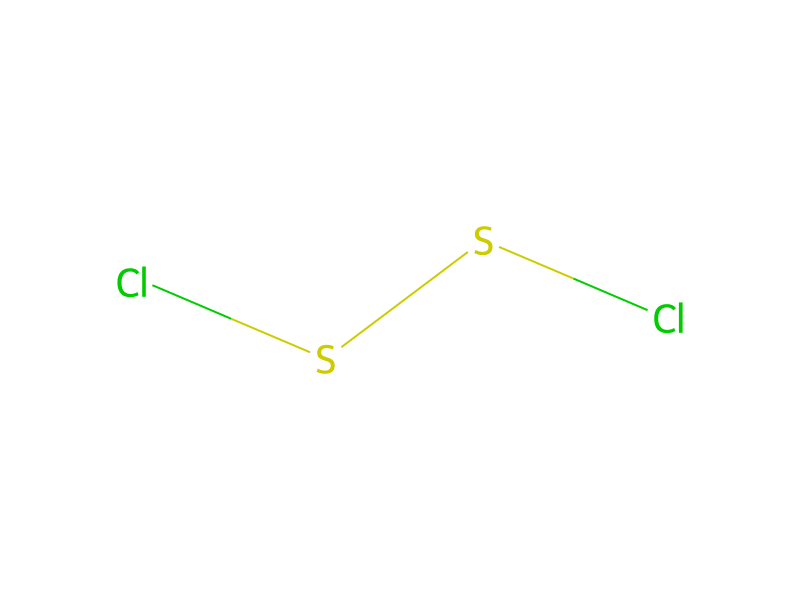
基本信息
- 标准SMILES
ClSSCl- InChIKey
PXJJSXABGXMUSU-UHFFFAOYSA-N- 分子式
- Cl2S2
- 平均分子量
- 135 g/mol
- 单同位素质量
- 133.8818477
名称与标识
- 首选名称
- Sulfur monochloride
- IUPAC
- chlorosulfanyl thiohypochlorite
- 中文名
- 二氯化二硫
- 英文名
- Disulfur dichloride
- 分子式
- Cl2S2
- 分子量
- 135.04
名称与别名
SULFUR MONOCHLORIDEDisulfur dichlorideSulfur subchlorideChlorosulfane10025-67-9Thiosulfurous dichlorideDisulphur dichlorideSiarki chlorekSulfur chloride (S2Cl2)Sulfur chloride (di)NJ7YR2EV0DDTXSID3042427
展开更多名称
氯化硫一氯化硫二氯化二硫硫单氯化物一氯化硫 溶液二氯化二硫,一氯化硫氯化硫(二氯化二硫)S2Cl2SULPHUR MONOCHLORIDEClSSClU.N. 1828siarkichlorekSulfor choride
RefChem:889719DTXCID1022427DTXSID10192708233-036-2Sulfur chloridechlorosulfanyl thiohypochloriteSiarki chlorek [Polish]Chlorschwefel
数据库标识
- CAS
10025-67-9、12771-08-3- PubChem CID
- 24807
- DTXSID
DTXSID3042427- UNII
- NJ7YR2EV0D
- EC Number
- 233-036-2
- Nikkaji
- J98.297K
性质
结构计算性质
- XLogP
- 2.5
- 极性表面积
- 50.6 Ų
- 氢键供体
- 0
- 氢键受体
- 2
- 可旋转键
- 0
- 重原子
- 4
- 形式电荷
- 0
- 复杂度
- 6
实验与物化性质
Odor
Suffocating odor
Pungent, nauseating, irritating odor.
Density
1.68 at 68 °F (USCG, 1999) - Denser than water; will sink
1.6885 at 15.5 °C/15.5 °C
Saturated liquid density= 104.599 lb/cu ft @ 70 °F
Relative density (water = 1): 1.7
1.68
1.6885 @ 15.5°C
Viscosity0.978 cP
Color/FormLight amber to yellowish red oily liquid
Solubility
Decomposes (NIOSH, 2024)
Sol in alc, benzene, ether, carbon disulfide, carbon tetrachloride, oils
Soluble in amyl acetate
Insoluble in water
Solubility in water: reaction
Decomposes
Corrosivity
Sulfur monochloride is minimally corrosive to carbon steel and iron when dry. When wet, it behaves like hydrochloric acid and attacks steel, cast iron, aluminum, stainless steels, copper and copper alloys, and many nickel-based materials.
Sulfur monochloride will attack some forms of plastics, rubber, and coatings.
Flash Point
245 °F (USCG, 1999)
245 °F
266 °F (open cup); 245 °F (closed cup)
118.5 °C c.c.
245 °F
245 °F
Boiling Point
280 °F at 760 mmHg (USCG, 1999)
137 °C
When distilled at its atmospheric boiling point, it undergoes some decomposition to the dichloride, but decomposition is avoided with distillation at about 6.7 kPa (50 mmHg).
138 °C
280 °F
138 °C @760 [mm Hg]
Decomposition
SULFUR CHLORIDE /WHEN HEATED IS/ ... ASSOCIATED WITH EVOLUTION OF DANGEROUS DECOMP PRODUCTS, SULFUR DIOXIDE & HYDROGEN CHLORIDE.
Decomposes on contact with water to produce heat & toxic & corrosive fumes.
Decomposition by water yielding sulfur, hydrogen chloride, sulfur dioxide, hydrogen sulfide, sulfite, thiosulfate
Melting Point
-112 °F (USCG, 1999)
-77 °C
-77 °C
-112 °F
-77 °C
-107 °F
Vapor Density
4.66 (Air = 1)
Relative vapor density (air = 1): 4.7
Odor Threshold
Air: 0.77 ul/l; Odor safety class C; C= less than 50% of distracted persons perceive warning of TLV. /Hydrochloric acid/
Odor low: 7.0 mg/cu m; Odor high: 49.0 mg/cu m; strong irritating odor; Irritating concn= 49.00 mg/cu m. /Hydrochloric acid/
物理化学性质
- 熔点
- 80 °C · −80 °C(lit.)
- 沸点
- 138 °C · 138 °C(lit.)
- 密度
- 1.688 g/mL · 1.688 g/mL at 25 °C(lit.)
- 蒸气密度
- 4.7 · 4.7 (vs air)
- 蒸气压
- 6.8 mm · 6.8 mm Hg ( 20 °C)
- 折射率
- 20 · n20/D 1.658(lit.)
- 闪点
- 130 ℃ · >130℃
- 储存条件
- 30 °C · Store below +30°C.
- 溶解度
- soluble in No data available
- 形态
- yellow-red oily liquid
- 颜色
- yellow-red oily liquid
- 爆炸极限值(explosive limit)
- 4.2 · 4.2-32.5%(V)
- 水溶解性
- reacts
- Merck
- 13 · 13,9060
- 介电常数
- 4.8 · 4.8(15℃)
- InChI
- 1S/Cl2S2/c1-3-4-2
- InChIKey
- PXJJSXABGXMUSU-UHFFFAOYSA-N
- SMILES
- S(SCl)Cl
- CAS 数据库
- 10025 · 10025-67-9(CAS DataBase Reference)
- NIST化学物质信息
- Disulfur dichloride(10025-67-9)
- EPA化学物质信息
- Sulfur monochloride (10025-67-9)
化学性质
黄红色液体,有窒息性、刺激性恶臭。在空气中强烈发烟。相对密度1.678。熔点-80℃。沸点135.6℃。折射率1.570。蒸气压1333Pa(27.5℃)溶于苯、醚、二硫化碳,是硫、碘、金属氯化物、有机化合物的优良溶剂,遇水则分解为硫、二氧化硫和氯化氢而发烟。在室温下十分稳定,但在100℃时分解为硫和氯,在300℃时则完全分解。能被金属还原生成氯化物和硫化物,用氯气饱和可生成二氯化硫等。能与金属氧化物或金属硫化物反应生成金属氯化物。在室温下的干燥一氯化硫对铜和铁均无腐蚀性,但含有水分时则腐蚀性极强。
安全与法规
GHS分类
GHS Classification
Danger
H301: Toxic if swallowed [Danger Acute toxicity, oral];H314: Causes severe skin burns and eye damage [Danger Skin corrosion/irritation];H332: Harmful if inhaled [Warning Acute toxicity, inhalation];H400: Very toxic to aquatic life [Warning Hazardous to the aquatic environment, acute hazard]
P260, P261, P264, P270, P271, P273, P280, P301+P316, P301+P330+P331, P302+P361+P354, P304+P340, P305+P354+P338, P316, P317, P321, P330, P363, P391, P405, and P501 (click each P-code to see the statement)
Danger
危害信息
Regulatory Information
Chemical: Sulfur chloride (S2Cl2)
Sulfur chloride (S2Cl2) is listed on the EPA's Chemical Data Reporting (CDR) system. Manufacturers and importers of Sulfur chloride (S2Cl2) are required to report information about their production and use of this chemical to the EPA under the Toxic Substances Control Act (TSCA). (40 eCFR Part 711)
Status: Active Update: 15-09-2022 https://echa.europa.eu/registration-dossier/-/registered-dossier/10679;Status: Cease Manufacture Update: 23-05-2018 https://echa.europa.eu/registration-dossier/-/registered-dossier/24999
Disulphur dichloride: HSNO Approval: HSR003082 Approved with controls
The New Jersey Worker and Community Right to Know Act requires public and private employers to provide information about hazardous substances at their workplaces. (N.J.S.A. 34:5A-1 et. seq.)
Other Safety InformationIMAP assessments - Sulfur chloride (S2Cl2): Environment tier I assessment;IMAP assessments - Sulfur chloride (S2Cl2): Human health tier I assessment
DOT LabelCorrosive
Fire Hazards
Excerpt from ERG Guide 137 [Substances - Water-Reactive - Corrosive]:;EXCEPT FOR ACETIC ANHYDRIDE (UN1715), THAT IS FLAMMABLE, some of these materials may burn, but none ignite readily. May ignite combustibles (wood, paper, oil, clothing, etc.). Substance will react with water (some violently), releasing corrosive and/or toxic gases and runoff. Flammable/toxic gases may accumulate in confined areas (basement, tanks, hopper/tank cars, etc.). Contact with metals may evolve flammable hydrogen gas. Containers may explode when heated or if contaminated with water. Substance may be transported in a molten form. (ERG, 2024)
Combustible. Gives off irritating or toxic fumes (or gases) in a fire.
Fire PotentialSULFUR CHLORIDE IS FLAMMABLE LIQUID WHICH GIVES RISE TO MODERATE FIRE HAZARD ...
Health HazardsVapors irritate eyes and respiratory system; pulmonary edema may result. Liquid burns and damages eyes. Unless removed at once, it burns the skin. Ingestion causes severe damage to mouth and stomach. (USCG, 1999)
Hazards Summary
Highly corrosive to skin; [Quick CPC] Liquid causes second or third degree burns after short contact; [CHRIS] Sulfur monochloride is a respiratory irritant with a nauseating odor; it hydrolyzes into HCl and SO2. [ACGIH] Tear drawing. A corrosive substance that can cause pulmonary edema; [ICSC] Sulfur chlorides release HCl, SO2, and H2S when spilled in water; [ERG 2016]
The major hazards encountered in the use and handling of sulfur monochloride stem from its toxicologic properties. Toxic by all routes (ie, inhalation, ingestion, and dermal contact), exposure to this yellowish-red, strong smelling, oily liquid may occur from its use as an intermediate and chlorinating agent in the manufacture of high pressure lubricants and cutting oils, sulfur dyes, and insecticides, as a cross-linking catalyst in polymer technology, as a solvent for sulfur compounds, as a rubber extender, and in the purification of sugar juices. Effects from exposure may include headache, dizziness, nausea, burns to the skin and eyes, shortness of breath, respiratory irritation, pulmonary edema, respiratory distress and failure. OSHA has established a Ceiling limit of 1 ppm as a final standard to become effective December 31, 1992. In activities and situations where over-exposure may occur, wear a self-contained breathing apparatus with a full facepiece, and chemical resistant protective clothing specifically recommended by the shipper or producer. If contact should occur, immediately irrigate exposed eyes with copious amounts of tepid water for at least 15 minutes, and wash exposed skin thoroughly with soap and water. Facilities for quick drenching of the body should be provided in sulfur monochloride work areas. Contaminated clothing should be removed and left at the worksite for cleaning. While sulfur monochloride does not ignite easily, it may ignite other combustible materials (eg, wood, paper, oil). Also, it may create an explosion hazard if its heavier-than-air vapor is allowed to accumulate in confined spaces such as sewers. For fires involving sulfur monochloride, extinguish with dry chemical, CO2, or Halon. Because sulfur monochloride may react with water, use water only if large quantities of combustibles are involved. If water is used, apply it in flooding quantities as spray or fog, from as far a distance as possible. Sulfur monochloride should
DOT ID and Guide1828 137
Reactive GroupHalogenating Agents
EC ClassificationSymbol: T, C, N; R: 14-20-25-29-35-50; S: (1/2)-26-36/37/39-45-61
UN ClassificationUN Hazard Class: 8; UN Pack Group: I
Special Reports
Organization for the Prohibition of Chemical Weapons; Convention on the Prohibition of the Development, Production, Stockpiling and Use of Chemical Weapons and Their Destruction. Available from http://www.opcw.org as of November 12, 2008. The Chemical Weapons Convention (CWC) is an international treaty which bans the development, production, stockpiling, and transfer or use of chemical weapons. The Convention mandates the destruction and prohibition of chemical weapons and related facilities and provides for restrictions on international trade in toxic chemicals and precursors.
安全与防护
Fire Fighting
Excerpt from ERG Guide 137 [Substances - Water-Reactive - Corrosive]:;When material is not involved in fire, do not use water on material itself.;SMALL FIRE: Dry chemical or CO2. If it can be done safely, move undamaged containers away from the area around the fire.;LARGE FIRE: Flood fire area with large quantities of water, while knocking down vapors with water fog. If insufficient water supply, responders should withdraw.;FIRE INVOLVING TANKS, RAIL TANK CARS OR HIGHWAY TANKS: Cool containers with flooding quantities of water until well after fire is out. Do not get water inside containers. Withdraw immediately in case of rising sound from venting safety devices or discoloration of tank. ALWAYS stay away from tanks in direct contact with flames. (ERG, 2024)
Use powder, carbon dioxide. NO hydrous agents. NO water. In case of fire: keep drums, etc., cool by spraying with water. NO direct contact with water.
First Aid Measures
Fresh air, rest. Half-upright position. Artificial respiration may be needed. Refer for medical attention.
Remove contaminated clothes. Rinse skin with plenty of water or shower. Refer for medical attention .
First rinse with plenty of water for several minutes (remove contact lenses if easily possible), then refer for medical attention.
Rinse mouth. Do NOT induce vomiting. Refer for medical attention .
First Aid
Excerpt from NIOSH Pocket Guide for Sulfur monochloride:;Eye: IRRIGATE IMMEDIATELY - If this chemical contacts the eyes, immediately wash (irrigate) the eyes with large amounts of water, occasionally lifting the lower and upper lids. Get medical attention immediately.;Skin: WATER FLUSH IMMEDIATELY - If this chemical contacts the skin, immediately flush the contaminated skin with water. If this chemical penetrates the clothing, immediately remove the clothing and flush the skin with water. Get medical attention promptly.;Breathing: RESPIRATORY SUPPORT - If a person breathes large amounts of this chemical, move the exposed person to fresh air at once. If breathing has stopped, perform artificial respiration. Keep the affected person warm and at rest. Get medical attention as soon as possible.;Swallow: MEDICAL ATTENTION IMMEDIATELY - If this chemical has been swallowed, get medical attention immediately. (NIOSH, 2024)
(General first aid procedures);Eye: Irrigate immediately - If this chemical contacts the eyes, immediately wash (irrigate) the eyes with large amounts of water, occasionally lifting the lower and upper lids. Get medical attention immediately.;Skin: Water flush immediately - If this chemical contacts the skin, immediately flush the contaminated skin with water. If this chemical penetrates the clothing, immediately remove the clothing and flush the skin with water. Get medical attention promptly.;Breathing: Respiratory support;Swallow: Medical attention immediately - If this chemical has been swallowed, get medical attention immediately.
Safe StorageSeparated from strong oxidants, peroxides, phosphorus oxides, organic compounds and food and feedstuffs. Cool. Dry. Well closed. Ventilation along the floor.
Firefighting Hazards
Confined fires with high fuel loads of polyvinyl chloride, such as a fire in a vault with a high load of polyvinyl chloride-coated electrical wiring, may generate sufficient hydrogen chloride to cause irritation in fire fighters. Rapid combustion of relatively large amt of polymer may yield ... hydrogen chloride ... . /Hydrochloric acid/
Exposure Control and Personal Protection
TIH (Toxic Inhalation Hazard) - Term used to describe gases and volatile liquids that are toxic when inhaled. Some are TIH materials themselves, e.g., chlorine, and some release TIH gases when spilled in water, e.g., chlorosilanes. [ERG 2016].
Fire Fighting Procedures
Use dry chemical or carbon dioxide. Use water spray to keep fire-exposed containers cool. Approach fire from upwind to avoid hazardous vapors & toxic decomposition products.
/In fire/ wear goggles, self-contained breathing apparatus, & rubber overclothing (including gloves).
Use ... dry sand. Do not use water on material itself. If large quantities of combustibles are involved, use water in flooding quantities as spray and fog. Use water spray to knock-down vapors. Cool all affected containers with flooding quantities of water. Apply water from as far a distance as possible.
Extinguish fire using agent suitable for type of surrounding fire. (Material itself does not burn or burns with difficulty). Use water in flooding quantities as fog. Cool all affected containers with flooding quantities of water. Apply water from as far a distance as possible. /Hydrochloric acid/
Storage Conditions
Store in a cool, dry, well-ventilated location. Isolate from water & oxidizing materials.
Sulfur chlorides are noncorrosive to carbon steel and iron when dry. If it is necessary to avoid discoloration caused by iron sulfide formation, stainless steel should be used. ... When wet, they behave like hydrochloric acid and attack steel, cast iron, aluminum, stainless steels, copper and copper alloys, and many nickel-based materials. Alloys of 62 Ni-28 Mo and 54 Ni-15 Cr-16 are useful under these conditions. /Sulfur chlorides/
Storage temp: ambient
THE ACID SHOULD NOT BE STORED IN THE VICINITY OF FLAMMABLE OR OXIDIZING SUBSTANCES, EG NITRIC ACID OR CHLORATES, OR NEAR METALS AND METAL HYDRIDES THAT MAY BE ATTACKED BY THE ACID ... ELECTRICAL EQUIPMENT SHOULD BE FLAMEPROOF AND PROTECTED AGAINST CORROSIVE ACTION. ... /HYDROCHLORIC ACID/
Aldehydes and epoxides in the presence of hydrochloric acid cause violent polymerization. Alcohol and glycols in the presence of hydrochloric acid lead to dehydration reactions. /Hydrochloric acid/
Cleanup Methods
1) Ventilate area of spill. 2) Spray on a thick layer of a (1:1) mixture of dry soda ash & slaked lime. Mix & spray on water slowly, then add large amounts of water.
Land spill: Dig a pit, pond, lagoon, holding area to contain liquid or solid material. /SRP: If time permits, pits, ponds, lagoons, soak holes, or holding areas should be sealed with an impermeable flexible membrane liner./ Dike surface flow using soil, sand bags, foamed polyurethane, or foamed concrete. Absorb bulk liquid with fly ash or cement powder. Neutralize with agricultural lime (CaO), crushed limestone (CaCO3) or sodium bicarbonate (NaHCO3).
Water spill: Neutralize with agricultural lime (CaO), crushed limestone (CaCO3), or sodium bicarbonate (NaHCO3). Use mechanical dredges or lifts to remove immobilized masses of pollutants and precipitates.
Air spill: Apply water spray or mist to knock down vapors. Vapor knockdown water is corrosive or toxic and should be diked for containment.
For more Cleanup Methods (Complete) data for SULFUR MONOCHLORIDE (9 total), please visit the HSDB record page.
Nonfire Spill Response
Excerpt from ERG Guide 137 [Substances - Water-Reactive - Corrosive]:;Do not touch damaged containers or spilled material unless wearing appropriate protective clothing. Stop leak if you can do it without risk. Use water spray to reduce vapors; do not put water directly on leak, spill area or inside container. Keep combustibles (wood, paper, oil, etc.) away from spilled material.;SMALL SPILL: Cover with DRY earth, DRY sand or other non-combustible material followed with plastic sheet to minimize spreading or contact with rain. Use clean, non-sparking tools to collect material and place it into loosely covered plastic containers for later disposal. Prevent entry into waterways, sewers, basements or confined areas. (ERG, 2024)
Disposal Methods
SRP: The most favorable course of action is to use an alternative chemical product with less inherent propensity for occupational exposure or environmental contamination. Recycle any unused portion of the material for its approved use or return it to the manufacturer or supplier. Ultimate disposal of the chemical must consider: the material's impact on air quality; potential migration in soil or water; effects on animal, aquatic, and plant life; and conformance with environmental and public health regulations.
Neutralize with limestone, soda ash or slaked lime. /Hydrochloric acid/
The acid should never be disposed of into the sewage system until the pH is /adjusted/ to 5.5-8.5. /Hydrochloric acid/
Principles and methods for destruction of chemical weapons: ... "Destruction of chemical weapons" means a process by which chemicals are converted in an essentially irreversible way to a form unsuitable for production of chemical weapons, and which in an irreversible manner renders munitions and other devices unusable as such. ... Each ... /nation/ shall determine how it shall destroy chemical weapons, except that the following processes may not be used: dumping in any body of water, land burial or open-pit burning. It shall destroy chemical weapons only at specifically designated and appropriately designed and equipped facilities. ... Each ... /nation/ shall ensure that its chemical weapons destruction facilities are constructed and operated in a manner to ensure the destruction of the chemical weapons; and that the destruction process can be verified under the provisions of this Convention.
Spillage DisposalConsult an expert! Personal protection: chemical protection suit including self-contained breathing apparatus. Ventilation. Cautiously neutralize spilled liquid with mixture of dry soda ash and slaked lime.
毒理信息
InteractionsHydrochloric acid, carbon monoxide, and unsaturated carbon cmpd interactions account for the extreme toxicity of gases from polyvinyl chloride and other chloride containing polymers.
Target OrgansEyes, skin, respiratory system
Adverse EffectsDermatotoxin - Skin burns.;Lacrimator (Lachrymator) - A substance that irritates the eyes and induces the flow of tears.;Toxic Pneumonitis - Inflammation of the lungs induced by inhalation of metal fumes or toxic gases and vapors.
Exposure Routes
The substance can be absorbed into the body by inhalation of its vapour and by ingestion.
inhalation, ingestion, skin and/or eye contact
Signs and Symptoms
Sore throat. Cough. Burning sensation. Shortness of breath. Laboured breathing. Symptoms may be delayed.
Pain. Redness. Blisters. Skin burns.
Pain. Redness. Severe deep burns. Loss of vision.
Burning sensation. Abdominal pain. Shock or collapse.
irritation eyes, skin, mucous membrane; lacrimation (discharge of tears); cough; eye, skin burns; pulmonary edema
Medical Surveillance
Preemployment and periodic examinations should give special emphasis to the skin, eyes, and respiratory system. Pulmonary function tests may be useful. /SRP: for baseline purposes/
The following medical procedures should be made available to each employee who is exposed to hydrogen chloride at potentially hazardous levels: 1. Initial medical examination: A complete history and physical examination: the purpose is to detect existing conditions that might place the exposed employee at increased risk, and to establish a baseline for future health monitoring. Examination of the respiratory system, skin, and eyes should be stressed. -- 14" x 17" chest roentgenogram: Hydrogen chloride causes lung damage. Surveillance of the lung is indicated. -- FVC and FEV (1 sec): Hydrogen chloride is a respiratory irritant. Persons with impaired pulmonary function may be at increased risk from exposure. Periodic surveillance is indicated. 2. Periodic Medical Examination: The aforementioned medical examinations should be repeated on an annual basis, except that an X-ray is necessary only when indicated by the results of pulmonary function testing or by signs and symptoms of respiratory disease. /Hydrochloric acid/
Human Toxicity Excerpts
/SIGNS AND SYMPTOMS/ Sulfur monochloride vapors are corrosive and irritating to eyes, nose, and throat, inducing tearing and affecting breathing. Even 2 to 9 ppm in air are irritating to eyes.
/SIGNS AND SYMPTOMS/ It is a fuming, corrosive liquid ... The vapor is irritating to the lung and mucous membrane. In contact with skin, liquid can cause chemical burns.
/SIGNS AND SYMPTOMS/ Symptomatology (after ingestion or skin contact): 1. Corrosion of mucous membranes of mouth, throat, and esophagus, with immediate pain and dysphagia. The necrotic areas are at first grayish white but soon acquire a blackish discoloration and sometimes a shrunken or wrinkled texture; the process is described as a "coagulation necrosis." 2. Epigastric pain, which may be associated with nausea and the vomiting of mucoid and "coffee-ground" material. At times, gastric hemorrhage may be intense, and the vomitus then contains fresh blood. Profound thirst. 3. Ulceration of all membranes and tissues with which the acid comes in contact. After the ingestion of concentrated mineral acid, this corrosion may lead within a few hr or a few days to gastric perforation and peritonitis. 4. Circulatory collapse with clammy skin, weak and rapid pulse, shallow respirations, and scanty urine. Circulatory shock is often the immediate cause of death. 5. Asphyxial death due to glottic edema. 6. Late esophageal, gastric and pyloric strictures and stenoses, which may require major surgical repair, should be anticipated. Signs of obstruction commonly appear within a few weeks but may be delayed for months and even years. Permanent scars may also appear in the cornea, skin and oropharynx. 7. Uncorrected circulatory collapse of several hours' duration may lead to renal failure and ischemic lesions in the liver and heart. /Acids/
/SIGNS AND SYMPTOMS/ As result of its ability to release hydrochloric acid on contact with moisture, this compound is considered to be an upper respiratory tract irritant ... Under some conditions, however, the undecomposed vapor might reach the lungs, in which case it would be more toxic than an equivalent quantity of hydrogen chloride. The above data indicate a considerably greater acute toxicity than that of hydrogen chloride.
For more Human Toxicity Excerpts (Complete) data for SULFUR MONOCHLORIDE (15 total), please visit the HSDB record page.
Non-Human Toxicity Excerpts
/LABORATORY ANIMALS: Acute Exposure/ ... Exposure for 1 min at a concentration of 150 ppm was fatal to mice. A concentration of 12 ppm for 15 min was tolerated by cats, but 4 times that concentration, also for 15 min, could lead to death after few days.
Probable Routes of Human Exposure
NIOSH has statistically estimated that 28,181 workers (2,203 of these were female) were potentially exposed to sulfur monochloride in the US(1). Occupational exposure to sulfur monochloride may occur through inhalation and dermal contact with this compound at workplaces where sulfur monochloride is produced or used(SRC).
Sulfur monochloride can affect the body if it is inhaled or if it comes in contact with the eyes or skin. It can also affect the body if it is swallowed.
... IN SOME /OVEN "CURING" ATMOSPHERES SULFUR CHLORIDE/ ... HAS BEEN POURED INTO OPEN CONTAINERS & PLACED ON STEAM COILS ON FLOOR OF CURING OVEN, HAVING LITTLE OR NO VENTILATION. LEAKAGE ... CAUSES PRONOUNCED IRRITATION TO EYES & NOSE OF ANYONE WORKING IN ROOM. DISTRIBUTION & COLLECTION OF OPEN CONTAINERS INVOLVE BRIEF EXPOSURES TO RELATIVELY HIGH CONCN. MEN WHO DO THIS SOMETIMES INADVISEDLY RELY UPON HOLDING THEIR BREATH DURING PERIOD OF EXPOSURE TO HIGH VAPOR CONCN, RATHER THAN WEARING GAS MASK.
Exposure may ... occur during extraction of gold, purification of sugar juice ... processing vegetable oils, hardening of wood ...
The following list include some common operations in which exposure to sulfur monochloride may occur ... Use for production of white vulcanized oils used for coating and impregnating textiles; use as natural and synthetic rubber extenders and modifying agents in erasers, and extruded rubber goods; use with unsaturated fatty acids in production of additives to extreme pressure lubricants and cutting oils; use as a cross linking catalyst in polymer technology; use in chemical synthesis for production of intermediates for dyes, pharmaceuticals, insecticides, and war gases; use for treatment of drying oils for production of varnishes, inks, paints, and cements; use for cold vulcanizing of thin rubber articles; use as a solvent for sulfur and sulfur cmpd.
Antidote and Emergency Treatment
/SRP:/ Immediate first aid: Ensure that adequate decontamination has been carried out. If patient is not breathing, start artificial respiration, preferably with a demand-valve resuscitator, bag-valve-mask device, or pocket mask, as trained. Perform CPR as necessary. Immediately flush contaminated eyes with gently flowing water. Do not induce vomiting. If vomiting occurs, lean patient forward or place on left side (head-down position, if possible) to maintain an open airway and prevent aspiration. Keep patient quiet and maintain normal body temperature. Obtain medical attention. /Inorganic acids and related compounds/
/SRP:/ Basic treatment: Establish a patent airway (oropharyngeal or nasopharyngeal airway, if needed). Suction if necessary. Watch for signs of respiratory insufficiency and assist respirations if needed. Administer oxygen by nonrebreather mask at 10 to 15 L/min. Monitor for pulmonary edema and treat if necessary ... . Monitor for shock and treat if necessary ... . For eye contamination, flush eyes immediately with water. Irrigate each eye continuously with 0.9% saline (NS) during transport ... . Do not use emetics. Activated charcoal is not effective. For ingestion, rinse mouth and administer 5 ml/kg up to 200 ml of water for dilution if the patient can swallow, has a strong gag reflex, and does not drool ... . Do not attempt to neutralize because of exothermic reaction. Cover skin burns with dry, sterile dressings after decontamination ... . /Inorganic acids and related compounds/
/SRP:/ Advanced treatment: Consider orotracheal or nasotracheal intubation for airway control in the patient who is unconscious, has severe pulmonary edema, or is in severe respiratory distress. Early intubation, at the first sign of upper airway obstruction, may be necessary. Positive-pressure ventilation techniques with a bag valve mask device may be beneficial. Consider drug therapy for pulmonary edema ... . Consider administering a beta agonist such as albuterol for severe bronchospasm ... . Monitor cardiac rhythm and treat arrhythmias as necessary ... . Start IV administration of D5W /SRP: "To keep open", minimal flow rate/. Use 0.9% saline (NS) or lactated Ringer's(LR) if signs of hypovolemia are present. For hypotension with signs of hypovolemia, administer fluid cautiously. Consider vasopressors if patient is hypotensive with a normal fluid volume. Watch for signs of fluid overload ... . Use proparacaine hydrochloride to assist eye irrigation ... . /Inorganic acids and related compounds/
/SRP:/ Immediate first aid: Ensure that adequate decontamination has been carried out. If patient is not breathing, start artificial respiration, preferably with a demand-valve resuscitator, bag-valve-mask device, or pocket mask, as trained. Perform CPR as necessary. Immediately flush contaminated eyes with gently flowing water. Do not induce vomiting. If vomiting occurs, lean patient forward or place on left side (head-down position, if possible) to maintain an open airway and prevent aspiration. Keep patient quiet and maintain normal body temperature. Obtain medical attention. /Sulfur and related compounds/
For more Antidote and Emergency Treatment (Complete) data for SULFUR MONOCHLORIDE (6 total), please visit the HSDB record page.
Toxicity DataLC50 (rat) = 2,500 mg/m3/4H
法规信息
Regulatory Information
Chemical: Sulfur chloride (S2Cl2)
Sulfur chloride (S2Cl2) is listed on the EPA's Chemical Data Reporting (CDR) system. Manufacturers and importers of Sulfur chloride (S2Cl2) are required to report information about their production and use of this chemical to the EPA under the Toxic Substances Control Act (TSCA). (40 eCFR Part 711)
Status: Active Update: 15-09-2022 https://echa.europa.eu/registration-dossier/-/registered-dossier/10679;Status: Cease Manufacture Update: 23-05-2018 https://echa.europa.eu/registration-dossier/-/registered-dossier/24999
Disulphur dichloride: HSNO Approval: HSR003082 Approved with controls
The New Jersey Worker and Community Right to Know Act requires public and private employers to provide information about hazardous substances at their workplaces. (N.J.S.A. 34:5A-1 et. seq.)
CERCLA Reportable Quantities
Persons in charge of vessels or facilities are required to notify the National Response Center (NRC) immediately, when there is a release of this designated hazardous substance, in an amount equal to or greater than its reportable quantity of 1000 lb or 454 kg. The toll free number of the NRC is (800) 424-8802. The rule for determining when notification is required is stated in 40 CFR 302.4 (section IV. D.3.b). /CAS number: 12771-08-3/
Clean Water Act Requirements
Designated as a hazardous substance under section 311(b)(2)(A) of the Federal Water Pollution Control Act and further regulated by the Clean Water Act Amendments of 1977 and 1978. These regulations apply to discharges of this substance. /CAS number: 12771-08-3/
安全数据
- wgk
- 3
- tsca
- TSCA listed
- 毒性
- LD50 orally in Rabbit: 132 mg/kg
- RTECS号
- WS4300000
- 包装类别
- I
- 危险等级
- 8
- 存储类别
- 6.1C - Combustible acute toxic Cat.3toxic compounds or compounds which causing chronic effects
- 安全说明
- 26-36/37/39-45-61
- 海关编码
- 28121091
- 自燃温度
- 451 °F
- 危险品标志
- T,C,N
- 危险性类别
- Acute Tox. 3 InhalationAcute Tox. 3 OralAquatic Acute 1Skin Corr. 1A
- 危险类别码
- 14-20-25-29-35-50-67-40-37-22
- 毒害物质数据
- 10025-67-9(Hazardous Substances Data)
- 职业暴露限值
- Ceiling: 1 ppm (6 mg/m3)
- 危险品运输编号
- UN 1828 (SULPHUR CHLORIDES)
- 立即威胁生命和健康浓度
- 5 ppm
毒性防护
急性毒性吸入- 小鼠 LC50: 150 PPM; 口服-大鼠 LD50: 132 毫克/公斤
职业标准TWA 1 PPM (6 毫克/ 立方米); STEL 2 PPM (12 毫克/ 立方米)
包装储运
可燃性危险特性遇高热、明火、氧化剂可燃; 受热或遇水分解有毒氯化物、硫氧化物气体
储运特性库房通风低温干燥; 与碱类、食品添加剂分开存放
灭火剂干砂、二氧化碳; 禁止用水
化学与工业
用途与制造
Uses
. . . used in vulcanizing rubber, chemical synthesis, wood hardening, textile finishing, and gold extraction. [ACGIH]
Textiles (Printing, Dyeing, or Finishing) [Category: Industry];Toxic Gas from Spilling Chemical in Water [Category: Other]
Precursor to mustard gas, lewisite 1, arsenic trichloride, and thionyl chloride.
Use for production of white vulcanized oils used for coating and impregnating textiles; use as natural and synthetic rubber extenders and modifying agents in erasers, and extruded rubber goods; use with unsaturated fatty acids in production of additives to extreme pressure lubricants and cutting oils; use as a cross-linking catalyst in polymer technology; use for treatment of drying oils for production of varnishes, inks, paints, and cements; use as a solvent for sulfur and sulfur cmpd.
Intermediate and chlorinating agent in the manufacture of organic chemicals, sulfur dyes, insecticides; synthetic rubbers;in cold vulcanization of rubber; as polymerization catalyst for vegetable oils; for hardening soft woods.
Chemicals (sulfur solvent, acetic anhydride, thionyl chloride, carbon tetrachloride from carbon disulfide, various chlorohydrins from glycerol, glycol, etc), analytical reagent, rubber vulcanizing, vulcanized oils, purifying sugar juices, military poison, insecticide, hardening soft woods (by treatment with sulfur chloride dissolved in carbon disulfide), pharmacueticals, sulfur dyes, extraction of gold from its ores.
Impurities
... /Commercial disulfur dichloride/ can contain SCl2, SO2, SOCl2, chlorosulfanes, and dissolved sulfur as impurities.
Commercial material may contain 0-5% free sulfur.
U.S. Production
2023: 25,000,000 - <40,000,000 lb;2022: 25,000,000 - <40,000,000 lb;2021: 25,000,000 - <40,000,000 lb;2020: 25,000,000 - <40,000,000 lb
Production volumes for non-confidential chemicals reported under the Inventory Update Rule. [Table#2244]
Industry UsesCBI;Not Known or Reasonably Ascertainable;Intermediate
Methods of Manufacturing
Prepared by passing chlorine into molten sulfur, can be purified by fractional distillation.
Disulfur dichloride is generally produced from the elements. In the batch process, chlorine is passed into a solution of sulfur in S2Cl2 with cooling at about 50 - 70 °C until the correct chlorine content is reached. In the continuous process, gaseous chlorine is passed into molten sulfur at 220 - 260 °C, and the gaseous S2Cl2 leaving the reactor is then condensed.
Disulfur dichloride is an intermediate in the production of carbon tetrachloride ... and trichloromethylsulfenyl chloride ... from CS2 and can be obtained from the process as a byproduct.
Sulfur monochloride is made commercially by direct chlorination of sulfur, usually in a heel of sulfur chloride from a previous batch. The chlorination appears to proceed stepwise through higher sulfur chlorides ... If conducted too quickly, the chlorination may yield products containing SCl2 and SxCl2 as well as S2Cl2. A catalyst, eg, iron, iodine, or a trace of ferric chloride, facilitates the reaction. The manufacture in the absence of Fe and Fe salts at 32-100 °C has also been reported.
For more Methods of Manufacturing (Complete) data for SULFUR MONOCHLORIDE (6 total), please visit the HSDB record page.
Formulations/PreparationsA typical commercial specification is 98.0 wt % sulfur monochloride minimum, 51.4 wt % total chlorine.
General Manufacturing Information
CBI;Petroleum Lubricating Oil and Grease Manufacturing;All Other Chemical Product and Preparation Manufacturing
Sulfur chloride (S2Cl2): ACTIVE
Sulfur chlorides, carbon disulfide and carbon tetrachloride are removed from gases in 2 stages by sorption in disulfur dichloride, with the temp of the first stage maintained at 10-30 deg and that of the second stage at -10 deg to -20 deg.
/The Chemical Weapons Convention (CWC) is an international treaty which bans the development, production, stockpiling, and transfer or use of chemical weapons. The Convention mandates the destruction and prohibition of chemical weapons and related facilities and provides for restrictions on international trade in toxic chemicals and precursors./ The Convention's monitoring and verification measures involve submission of declarations regarding ... /Schedule 1, 2, and 3 chemicals/ and inspections by the Organization for the Prohibition of Chemical Weapons of the facilities where these chemicals are produced. ... Schedule 3 chemicals ... /may/ have been stockpiled or used as weapons, but ... are produced /and used/ in large quantities for purposes not prohibited by the Convention (2). Sulfur monochloride is listed in the CWC Annex on Chemicals under Schedule 3 (1).
应用领域
用途用于橡胶的低温硫化剂和粘接剂,杀虫剂、萃取剂等。
用途二氯化二硫可用于橡胶的低温硫化剂和黏接剂。不饱和脂肪酸经一氯化硫处理,可用作耐压润滑剂;棉子油、豆油、菜子油等植物油经一氯化硫处理,可制成一种白色硫化油胶(白刹婆、白油胶)和琥珀色硫化油胶(黑刹婆、黑油胶)用于橡胶工业。还用于石油添加剂。染料工业和有机合成用作氯化剂。化纤工业用于制造织物的整理剂。用于制造杀虫剂。冶金工业用作金、银等贵稀金属的萃取剂。木材工业用作软木硬化剂。国防工业用作军用毒气。
制备方法
生产方法合成法 先将硫黄粉投入夹套反应器内,然后通入蒸汽加热,同时通入小量氯气,经反应1h后停止加热,并加大通氯量,维持在50~60℃进行反应16~20h,经过滤,于130~141℃进行蒸馏,测定料液的相对密度和沸程的一氯化硫含量合格后,制得一氯化硫成品。其2S+C12→S2C12副产回收法二硫化碳和氯气经计量后,通过混合器混合然后进入反应器于95~100℃进行反应,反应后的物料进入分馏塔,控制塔顶温度在75℃左右,塔釜温度为120~130℃,回流比为1:1,一氯化硫从塔釜流出至贮槽,作为四氯化碳生产过程中的副产品回收。其CS2+3C12→CCl4+S2C12
上下游产品信息
上游原料
下游产品
供应商50 家
Shandong chuangyingchemical Co., Ltd.18853181302 · [email protected]
南通润丰石油化工有限公司66017690 19952660367 · [email protected]
湖北成丰化工有限公司13125175253 · [email protected]
Guangzhou Tosun Pharmaceutical Limited+86-18124244216 +86-18124244216 · [email protected]
上海迈瑞尔生化科技有限公司4006356688 18621169109 · [email protected]
江苏普乐司生物科技有限公司0513-66017706 18551496367 · [email protected]
上海晶抗生物工程有限公司021-54721350 13524668266 · [email protected]
湖北日升昌新材料科技有限公司13396066230 · [email protected]
武汉市聚舜化工有限公司027-02783261126 18971318572 · [email protected]
上海瀚鸿科技股份有限公司021-54306202 13764082696 · [email protected]
嘉兴市艾森化工有限公司0573-85285100 18627885956 · [email protected]
ARCTIC EXPORTS INC+1-3026880818 · [email protected]
广东大小化工有限公司1866-171603 18666171603 · [email protected]
玛雅试剂+86 (573) 82222445 (0)18006601000 452520369 · [email protected]
四川库利南科技有限公司400-1166-196 18981987031 · [email protected]
艾科试剂4008-755-333 18080918076 · [email protected]
PT CHEM GROUP LIMITED+86-85511178; +86-85511178 · [email protected]
上海嵩爰化工科技有限公司010-1234567 18521000990 · [email protected]
成都润泽本土化工有限公司13096311329 028-88469284 616445927 · [email protected]
池州凯隆进出口贸易有限公司[email protected]
九鼎化学(上海)科技有限公司4009209199 · [email protected]
HANGZHOU LEAP CHEM CO., LTD.+86-571-87711850 +86-15355479329 · [email protected]
湖北新福生物有限公司15071082505 · [email protected]
启源(广东)医药化工有限公司18026564465 · [email protected]
成都润泽本土化工有限公司028-88469284 18000562381 · [email protected]
上海前衍生物科技有限公司02781293128 · [email protected]
上海新平精细化学品有限公司18221735425 · [email protected]
上海紫一试剂厂4001650900 · [email protected]
山东小野化学股份有限公司0539-6362799 20)
成都康巴斯生物科技有限公司18582381569 · [email protected]
盼得(上海)国际贸易有限公司80159919 18662931292 · [email protected]
巴师傅(上海)生物医药科技有限公司60662071 18117346937 · [email protected]
上海百舜生物科技有限公司021-37581181 · [email protected]
嘉兴市德亿化工有限公司86-0573-85866609 18367600069 · [email protected]
湖北鑫鸣泰化学有限公司177-7179-1433 17771741533 · [email protected]
上海出澄贸易有限公司021-5983532 15201998618 · [email protected]
河南天孚化工有限公司+86-0371-55170693 +86-19937530512 · [email protected]
厦门盈融达化工有限公司+86-0592-6210733 · [email protected]
上海弗霓生物科技有限公司021-54252912-8903 · [email protected]
career henan chemical co+86-0371-86658258 · [email protected]
广州市桐晖药业有限公司020-66392521-118 18922260391 · [email protected]
海蔚化学86-21-51086038 · [email protected]
爆牛贸易重庆有限公司+86-023-6139-8061 +86-86-13650506873 · [email protected]
XIAMEN AMITY INDUSTRY AND TRADE CO., LTD.+8618950047208 · [email protected]
武汉吉鑫益邦生物科技有限公司59768661 13297943853 · [email protected]
湖北科沃德化工有限公司027-83295551 13317178958 · [email protected]
沾化大荣化工科技有限公司0532-67773200 · [email protected]
SUZHOU SENFEIDA CHEMICAL CO.,LTD+86-0512-83500002 +86-15195660023 · [email protected]
唐缘生命科学(上海)有限公司400-618-1121 17316483629 · [email protected]
上海宝杨宝欣生物科技有限公司021-56698539 19921169802 · [email protected]
相关反应
1 条
关联笔记
加载中…