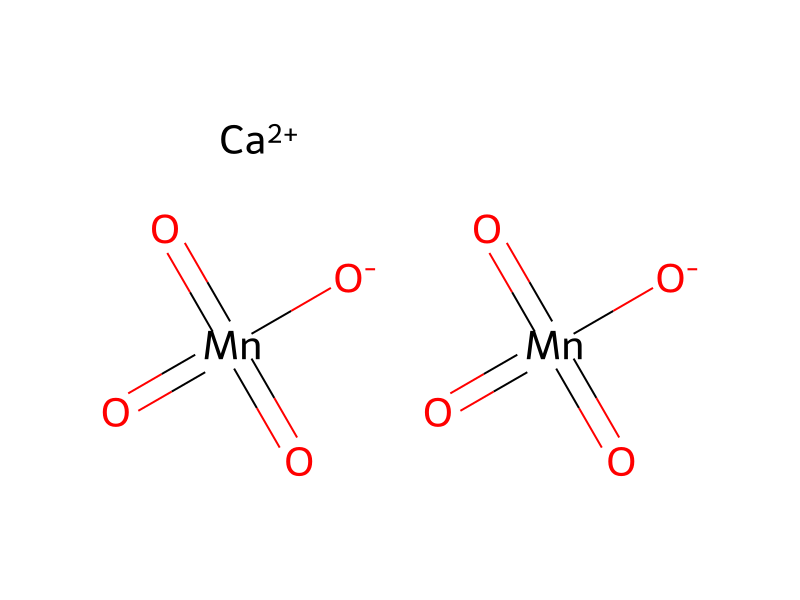
基本信息
- 标准SMILES
[Ca+2].[O]=[Mn](=[O])(=[O])[O-].[O]=[Mn](=[O])(=[O])[O-]- InChIKey
HYSMCTNXSYZEHS-UHFFFAOYSA-N- 分子式
- CaMn2O8
- 平均分子量
- 277.95 g/mol
- 单同位素质量
- 277.79799814
概述
Calcium permanganate is a purple crystalline solid. It is used as a disinfectant and deodorizer, in water purification, and for many other uses.
名称与标识
- 首选名称
- Calcium permanganate
- IUPAC
- calcium dipermanganate
- 中文名
- 高锰酸钙
- 英文名
- CALCIUM PERMANGANATE
- 分子式
- CaMn2O8
- 分子量
- 277.95
名称与别名
展开更多名称
数据库标识
- CAS
10118-76-0- PubChem CID
- 24959
- DTXSID
DTXSID001015791- UNII
- 720Y4E8F5H
- EC Number
- 233-322-7
性质
结构计算性质
- 极性表面积
- 149 Ų
- 氢键供体
- 0
- 氢键受体
- 8
- 可旋转键
- 0
- 重原子
- 11
- 形式电荷
- 0
- 复杂度
- 95.8
实验与物化性质
Physical Description
Calcium permanganate is a purple crystalline solid. It is used as a disinfectant and deodorizer, in water purification, and for many other uses.
Violet to purple crystals (tends to adsorb water from air and become liquid); [HSDB]
Other Experimental Properties
Decomposes in alcohol
Strong oxidizer /tetrahydrate/
Decomposes 130-40 °C /Tetrahydrate/
PURPLE CRYSTALS; DENSITY: 2.4; 331 G SOL IN 100 CC WATER @ 14 °C; 338 G SOL IN 100 CC WATER @ 25 °C; SOL IN AMMONIUM HYDROXIDE /PENTAHYDRATE/
物理化学性质
- 密度
- 2.4 · 2.400
- 溶解度
- reacts with ethanol
- 形态
- purple hygroscopic crystals
- 颜色
- purp hygroscopic crystals, crystalline
- 水溶解性
- 2 O; · very soluble H2O; decomposed by alcohol [MER06]
- EPA化学物质信息
- Permanganic acid (HMnO4), calcium salt (10118-76-0)
安全与法规
危害信息
Fire Hazards
Excerpt from ERG Guide 140 [Oxidizers]:
CAUTION: Ammonium nitrate products may explode if involved in fire or contaminated with hydrocarbons (fuels), organic matter, other contaminants or when hot molten and contained. Treat as an explosive (GUIDE 112).
Health Hazards
Excerpt from ERG Guide 140 [Oxidizers]:
· Inhalation, ingestion or contact (skin, eyes) with vapors or substance may cause severe injury, burns or death.
Hazards Summary
Very toxic by ingestion, inhalation, or skin absorption; Can cause skin burns; [CAMEO] Potassium permanganate crystals and concentrated solutions are corrosive (release potassium hydroxide when contact water); Permanganates can induce methemoglobinemia after ingestion; [Olson, p. 133] See Manganese and linked occupational diseases.
Reactivity Profile
CALCIUM PERMANGANATE is an oxidizing agent. Noncombustible but it will accelerate the burning of combustible material. If the combustible material is finely divided the mixture may be explosive. Contact with liquid combustible materials may result in spontaneous ignition. Contact with sulfuric acid may cause fires or explosions. Mixtures with acetic acid or acetic anhydride can explode if not kept cold [Von Schwartz 1918 p. 34 ]. Explosions can occur when calcium permanganate that has been treated with sulfuric acid comes in contact with benzene, carbon disulfide, diethyl ether, ethyl alcohol, petroleum, or other organic matter.
Atmospheric Standards
Listed as a hazardous air pollutant (HAP) generally known or suspected to cause serious health problems. The Clean Air Act, as amended in 1990, directs EPA to set standards requiring major sources to sharply reduce routine emissions of toxic pollutants. EPA is required to establish and phase in specific performance based standards for all air emission sources that emit one or more of the listed pollutants. Calcium permanganate is included on this list.
... Substances for which a Federal Register notice has been published that included consideration of the serious health effects, including cancer, form ambient air exposure to the substance. Manganese (50 FR 32627; Aug. 13, 1985) is included on this list. /Manganese/
DOT Emergency Guidelines
/GUIDE 140: OXIDIZERS/ Fire or Explosion: These substances will accelerate burning when involved in a fire. Some may decompose explosively when heated or involved in a fire. May explode from heat or contamination. Some will react explosively with hydrocarbons (fuels). May ignite combustibles (wood, paper, oil, clothing, etc.). Containers may explode when heated. Runoff may create fire or explosion hazard.
/GUIDE 140: OXIDIZERS/ Health: Inhalation, ingestion or contact (skin, eyes) with vapors or substance may cause severe injury, burns or death. Fire may produce irritating, corrosive and/or toxic gases. Runoff from fire control or dilution water may cause pollution.
/GUIDE 140: OXIDIZERS/ Public Safety: CALL Emergency Response Telephone Number on Shipping Paper first. If Shipping Paper not available or no answer, refer to appropriate telephone number listed on the inside back cover. As an immediate precautionary measure, isolate spill or leak area in all directions for at least 50 meters (150 feet) for liquids and at least 25 meters (75 feet) for solids. Keep unauthorized personnel away. Stay upwind. Keep out of low areas. Ventilate closed spaces before entering.
/GUIDE 140: OXIDIZERS/ Protective Clothing: Wear positive pressure self-contained breathing apparatus (SCBA). Wear chemical protective clothing that is specifically recommended by the manufacturer. It may provide little or no thermal protection. Structural firefighters' protective clothing will only provide limited protection.
For more DOT Emergency Guidelines (Complete) data for CALCIUM PERMANGANATE (8 total), please visit the HSDB record page.
DOT Hazard Classification
Calcium permanganate
UN1456
Div 5.1 Oxidizer (49 eCFR § 173.127)
PG II: the degree of danger presented by the material is medium
安全与防护
Accidental Release Measures
· CALL 911. Then call emergency response telephone number on shipping paper. If shipping paper not available or no answer, refer to appropriate telephone number listed on the inside back cover.
· Keep combustibles (wood, paper, oil, etc.) away from spilled material.
First Aid
Excerpt from ERG Guide 140 [Oxidizers]:
General First Aid:
Exposure Control and Personal Protection
· Wear positive pressure self-contained breathing apparatus (SCBA).
TIH (Toxic Inhalation Hazard) - Term used to describe gases and volatile liquids that are toxic when inhaled. Some are TIH materials themselves, e.g., chlorine, and some release TIH gases when spilled in water, e.g., chlorosilanes. [ERG 2016].
0.2 [mg/m3], as Mn (inhalable fraction), 0.02 mg/m3, as Mn (respirable fraction)[German Research Foundation (DFG)]
Fire Fighting Procedures
If material on fire or involved in fire: Flood with water. Cool all affected containers with flooding quantities of water. Apply water from as far a distance as possible.
Evacuation: If fire becomes uncontrollable - consider evacuation of one-half (1/2) mile radius.
Disposal Methods
SRP: At the time of review, criteria for land treatment or burial (sanitary landfill) disposal practices are subject to significant revision. Prior to implementing land disposal of waste residue (including waste sludge), consult with environmental regulatory agencies for guidance on acceptable disposal practices.
Preventive Measures
SRP: Local exhaust ventilation should be applied wherever there is an incidence of point source emissions or dispersion of regulated contaminants in the work area. Ventilation control of the contaminant as close to its point of generation is both the most economical and safest method to minimize personnel exposure to airborne contaminants.
WHEN USING WITH STRONG ACIDS TO DESTROY ORGANIC MATTER, PERFORM REACTION BEHIND SAFETY BARRIER. /PERMANGANATES/
If material not on fire and not involved in fire: Keep sparks, flames, and other sources of ignition away. Keep material out of water sources and sewers.
Personnel protection: Avoid breathing dusts. Avoid bodily contact with the material. ... Do not handle broken packages unless wearing appropriate personal protective equipment. Wash away any material which may have contacted the body with copious amounts of water or soap and water. ...
Isolation and Evacuation
Excerpt from ERG Guide 140 [Oxidizers]:
Immediate precautionary measure
Threshold Limit Values (TLV)
0.02 [mg/m3], as Mn (respirable fraction), 0.1 mg/m3, as Mn (inhalable fraction)
8 hr Time Weighted Avg: 0.2 mg/cu m /Manganese and inorganic compounds, as Mn/
Excursion Limit Recommendation: Excursions in worker exposure levels may exceed 3 times the TLV-TWA for no more than a total of 30 minutes during a work day, and under no circumstances should they exceed 5 times the TLV-TWA, provided that the TLV-TWA is not exceeded. /Manganese and inorganic compounds, as Mn/
毒理信息
Treatment
EYES: irrigate opened eyes for several minutes under running water. INGESTION: do not induce vomiting. Rinse mouth with water (never give anything by mouth to an unconscious person). Seek immediate medical advice. SKIN: should be treated immediately by rinsing the affected parts in cold running water for at least 15 minutes, followed by thorough washing with soap and water. If necessary, the person should shower and change contaminated clothing and shoes, and then must seek medical attention. INHALATION: supply fresh air. If required provide artificial respiration.
Health Effects
Manganese mainly affects the nervous system and may cause behavioral changes and other nervous system effects, which include movements that may become slow and clumsy. This combination of symptoms when sufficiently severe is referred to as “manganism”. (L228)
Toxicity Summary
Manganese is a cellular toxicant that can impair transport systems, enzyme activities, and receptor functions. It primarily targets the central nervous system, particularily the globus pallidus of the basal ganglia. It is believed that the manganese ion, Mn(II), enhances the autoxidation or turnover of various intracellular catecholamines, leading to increased production of free radicals, reactive oxygen species, and other cytotoxic metabolites, along with a depletion of cellular antioxidant defense mechanisms, leading to oxidative damage and selective destruction of dopaminergic neurons. In addition to dopamine, manganese is thought to perturbations other neurotransmitters, such as GABA and glutamate. In order to produce oxidative damage, manganese must first overwhelm the antioxidant enzyme manganese superoxide dismutase. The neurotoxicity of Mn(II) has also been linked to its ability to substitute for Ca(II) under physiological conditions. It can enter mitochondria via the calcium uniporter and inhibit mitochondrial oxidative phosphorylation. It may also inhibit the efflux of Ca(II), which can result in a loss of mitochondrial membrane integrity. Mn(II) has been shown to inhibit mitochondrial aconitase activity to a significant level, altering amino acid metabolism and cellular iron homeostasis. (L228)
Signs and Symptoms
Manganese mainly affects the nervous system and may cause behavioral changes and other nervous system effects, which include movements that may become slow and clumsy. This combination of symptoms when sufficiently severe is referred to as “manganism”. (L228)
Non-Human Toxicity Excerpts
PERMANGANATE ... OXIDIZES GASTRIC MUCOSAL CELLS. /PERMANGANATE/
MOST BACTERIA ARE KILLED WITHIN 1 HR BY PERMANGANATES IN DILUTION OF 1:10,000, BUT SOME MICROORGANISMS SURVIVE EXPOSURE TO MUCH HIGHER CONCN. GERMICIDAL EFFICIENCY ... IS GREATLY REDUCED IN PRESENCE OF ORG MATTER. /PERMANGANATES/
Antidote and Emergency Treatment
Basic treatment: Establish a patent airway. Suction if necessary. Watch for signs of respiratory insufficiency and assist ventilations if necessary. Administer oxygen by nonrebreather mask at 10 to 15 L/min. Monitor for pulmonary edema and treat if necessary ... . Monitor for shock and treat if necessary ... . For eye contamination, flush eyes immediately with water. Irrigate each eye continuously with normal saline during transport ... . Do not use emetics. For ingestion, rinse mouth and administer 5 ml/kg up to 200 ml of water for dilution if the patient can swallow, has a strong gag reflex, and does not drool ... . /Manganese and related compounds/
Advanced treatment: Consider orotracheal or nasotracheal intubation for airway control in the patient who is unconscious or in severe respiratory distress. Monitor cardiac rhythm and treat arrhythmias if necessary ... . Start an IV with D5W /SRP: "To keep open", minimal flow rate/. Use lactated Ringer's if signs of hypovolemia are present. Consider drug therapy for pulmonary edema ... . For hypotension with signs of hypovolemia, administer fluid cautiously. Consider vasopressors for hypotension with a normal fluid volume. Watch for signs of fluid overload ... . Use proparacaine hydrochloride to assist eye irrigation ... . /Manganese and related compounds/
法规信息
Atmospheric Standards
Listed as a hazardous air pollutant (HAP) generally known or suspected to cause serious health problems. The Clean Air Act, as amended in 1990, directs EPA to set standards requiring major sources to sharply reduce routine emissions of toxic pollutants. EPA is required to establish and phase in specific performance based standards for all air emission sources that emit one or more of the listed pollutants. Calcium permanganate is included on this list.
... Substances for which a Federal Register notice has been published that included consideration of the serious health effects, including cancer, form ambient air exposure to the substance. Manganese (50 FR 32627; Aug. 13, 1985) is included on this list. /Manganese/
安全数据
- 包装类别
- II
- 危险等级
- 5.1
- 毒害物质数据
- 10118-76-0(Hazardous Substances Data)
- 危险品运输编号
- UN 1456
毒性防护
急性毒性静脉- 兔子LDL0:50毫克/公斤
职业标准TWA 5 毫克(锰) /立方米
包装储运
爆炸物危险特性与还原剂、硫、磷等混合受热、撞击、摩擦可爆; 与乙酸, 乙酸酐反应爆炸
可燃性危险特性燃烧产生有毒含锰化合物烟雾
储运特性库房通风低温干燥; 轻装轻卸; 与有机物、还原剂、硫、磷, 过氧化氢, 易燃物分开存放
灭火剂雾状水、砂土、泡沫、二氧化碳
化学与工业
药理信息
Metabolism/Metabolites
Manganese is absorbed mainly via ingestion, but can also be inhaled. It binds to alpha-2-macroglobulin, albumin, or transferrin in the plasma and is distributed to the brain and all other mammalian tissues, though it tends to accumulate more in the liver, pancreas, and kidney. Manganese is capable of existing in a number of oxidation states and is believed to undergo changes in oxidation state within the body. Manganese oxidation state can influence tissue toxicokinetic behavior, and possibly toxicity. Manganese is excreted primarily in the faeces. (L228)
用途与制造
Uses
Used as an antiseptic, disinfectant, and deodorizer; Used in welding electrode coatings/fluxes and in liquid rocket propellants; [HSDB]
Using Disinfectants or Biocides [Category: Clean]
Antiseptic; disinfectant; deodorizer; with calcium fluoride as binder for welding electrode coatings and fluxes
Additive (with hydrogen peroxide) in liquid rocket propellants; textile Industry; sterilizing water; dentistry, disinfectant, deodorizer. /Tetrahydrate/
Calcium permanganate is used as an oxidizing agent and is believed to help whiten teeth . (L241)
制备方法
生产方法往高锰酸银水溶液中,加入计算量的氯化钙,滤出产生的氯化银,将滤液置于浓硫酸上浓缩,即得五水合物结晶。
上下游产品信息
上游原料
供应商6 家
相关反应
当前筛选下没有反应记录。
关联笔记
加载中…