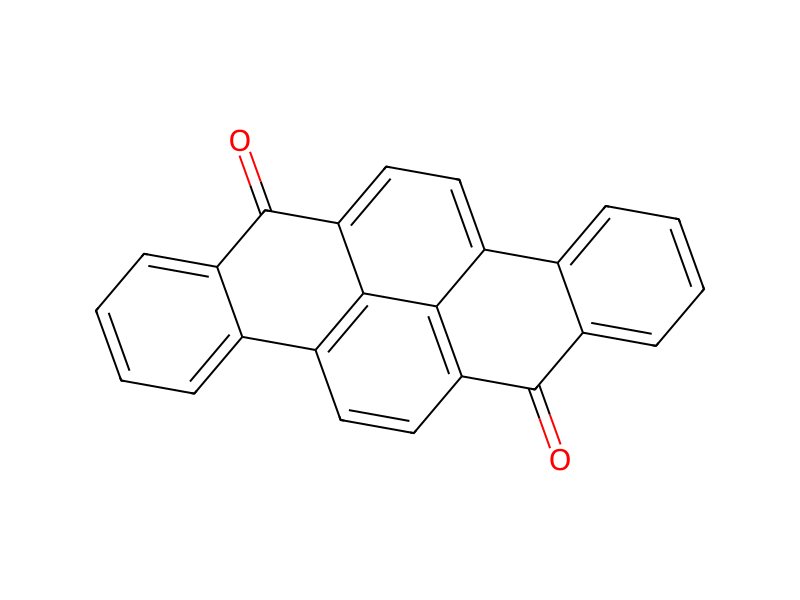
基本信息
- 标准SMILES
O=C1c2ccccc2-c2ccc3c4c(ccc1c24)-c1ccccc1C3=O- InChIKey
ZTWQZJLUUZHJGS-UHFFFAOYSA-N- 分子式
- C24H12O2
- 平均分子量
- 332.3 g/mol
- 单同位素质量
- 332.08372962
概述
C.i. vat yellow 4 is a viscous orange liquid. Used for coloring of cotton, wool and cellulose acetate.
名称与标识
- 首选名称
- Dibenzo(b,def)chrysene-7,14-dione
- IUPAC
- hexacyclo[10.10.2.02,7.09,23.013,18.020,24]tetracosa-1(23),2,4,6,9,11,13,15,17,20(24),21-undecaene-8,19-dione
- 中文名
- 还原黄4
- 英文名
- Vat Yellow 4
- 分子式
- C24H12O2
- 分子量
- 332.35
名称与别名
展开更多名称
数据库标识
- CAS
128-66-5- PubChem CID
- 31412
- DTXSID
DTXSID6021454- ChEBI
CHEBI:82548- UNII
- 8XO6A4G496
- EC Number
- 204-903-2
- Nikkaji
- J5.411I
性质
结构计算性质
- XLogP
- 5.4
- 极性表面积
- 34.1 Ų
- 氢键供体
- 0
- 氢键受体
- 2
- 可旋转键
- 0
- 重原子
- 26
- 形式电荷
- 0
- 复杂度
- 570
实验与物化性质
Flash Point
greater than 200 °F (NTP, 1992)
Flash Point > 93 °C
Physical Description
C.i. vat yellow 4 is a viscous orange liquid. Used for coloring of cotton, wool and cellulose acetate.
Orange liquid; [CAMEO]
物理化学性质
- 熔点
- 385 °C · 385 °C
- 沸点
- 429.48 °C · 429.48°C (rough estimate)
- 密度
- 1.1459 · 1.1459 (rough estimate)
- 折射率
- 1.4891 · 1.4891 (estimate)
- 稳定性
- Stable. Combustible. Incompatible with strong oxidizing agents.
- CAS 数据库
- 128 · 128-66-5
- (IARC)致癌物分类
- 3 · 3 (Vol. 48) 1990
- EPA化学物质信息
- 4 · C.I. Vat Yellow 4 (128-66-5)
化学性质
黄色粉状,不溶于水,溶于二甲苯、硝基苯和四氢化萘,微溶于丙酮、乙醇、苯、氯仿、甲苯、吡啶、邻氯苯酚。在浓硫酸中呈红光青莲色,稀释后成橙色沉淀。在碱性保佑险粉还原液中呈枣红色,在酸性液中呈金黄色。属蒽醌系还原染料。具有严重光脆性。
安全与法规
GHS分类
危害信息
Special Reports
REVIEW OF INHALATION (TOTAL-BODY-EXPOSURE) STUDIES OF COLORED CHEM SMOKES. ACUTE TOXICITIES, TIME TO DEATHS, & GROSS SIGNS COMPARED. TOXICOLOGICAL EVALUATION OF DYES IN SMOKE MIXT INCL. ONE OF THE DYES USED IN CHEM SMOKES IS DIBENZO(B,DEF)CHRYSENE-7,14-DIONE.[OWENS EJ, WARD DM; USNTIS AD/A REP ISS NO 003827/3GA 72 PP (1974)]
DHEW/NCI; Bioassay of C.I. Vat Yellow 4 for Possible Carcinogenicity (1979) Technical Rpt Series No. 134 DHEW Pub No. (NIH) 79-1389
安全与防护
First Aid
EYES: First check the victim for contact lenses and remove if present. Flush victim's eyes with water or normal saline solution for 20 to 30 minutes while simultaneously calling a hospital or poison control center. Do not put any ointments, oils, or medication in the victim's eyes without specific instructions from a physician. IMMEDIATELY transport the victim after flushing eyes to a hospital even if no symptoms (such as redness or irritation) develop.
Nonfire Spill Response
SMALL SPILLS AND LEAKAGE: If you should spill this chemical, use absorbent paper to pick up all liquid spill material. Seal the absorbent paper, as well as any of your clothing which may be contaminated, in a vapor-tight plastic bag for eventual disposal. Wash any surfaces you may have contaminated with a soap and water solution. Do not reenter the contaminated area until the Safety Officer (or other responsible person) has verified that the area has been properly cleaned.
Personal Protective Equipment (PPE)
RECOMMENDED RESPIRATOR: Where the neat test chemical is weighed and diluted, wear a NIOSH-approved half face respirator equipped with a combination filter cartridge, i.e. organic vapor/acid gas/HEPA (specific for organic vapors, HCl, acid gas, SO2 and a high efficiency particulate filter). (NTP, 1992)
毒理信息
Ongoing Test Status
The following link will take the user to the National Toxicology Program (NTP) Test Agent Search Results page, which tabulates all of the "Standard Toxicology & Carcinogenesis Studies", "Developmental Studies", and "Genetic Toxicity Studies" performed with this chemical. Clicking on the "Testing Status" link will take the user to the status (i.e., in review, in progress, in preparation, on test, completed, etc.) and results of all the studies that the NTP has done on this chemical. [http://ntp-apps.niehs.nih.gov/ntp_tox/index.cfm?fuseaction=ntpsearch.searchresults&searchterm=128-66-5]
Human Toxicity Excerpts
Most organic azo dyes are potential skin sensitizers, the most important of which are paraphenylenediamine and its analogs. Water soluble azo dyes are more likely to cause clinical sensitization than insoluble dyes. ... In addition to allergic eczematous contact dermatitis, color developing solutions have caused lichen planus like eruptions. /Organic dyes/
Carcinogen Classification
Vat Yellow 4
Group 3: Not classifiable as to its carcinogenicity to humans
Volume 48: (1990) Some Flame Retardants and Textile Chemicals, and Exposures in the Textile Manufacturing Industry
1990
1989
C.I. Vat yellow 4
Non-Human Toxicity Excerpts
Vat yellow 4 (C.I. 59100) was tested for mutagenicity in the Salmonella/microsome preincubation assay using a protocol approved by the National Toxicology Program. Vat yellow 4 was tested over a wide range of doses (0, 100, 333, 1000, 3333, and 10,000 ug/plate) in four Salmonella typhimurium strains (TA98, TA100, TA1535, and TA1537) in the presence and absence of Aroclor-induced rat or hamster liver S9. Vat yellow 4 was negative in these tests and the highest ineffective dose level tested in any Salmonella tester strain was 10,000 ug/plate.
Despite their widespread use and potential for significant human exposure, genotoxicity data on anthraquinones and other dyes are limited. In this study, 16 anthraquinones and one azo dye (Solvent Red 1) were selected for testing using the thymidine locus and micronucleus (MN) analysis in L5178Y/TK(+ or -)-3.7.2C mouse lymphoma cells. Six of the dyes were from the same lot used in the NTP rodent bioassay. The dyes used were all production lots and thus varied in their purity. Disperse Blue 7, 2-aminoanthraquinone; 1-amino-2-methylanthraquinone, Disperse Blue 3 and Disperse Red 11 were genotoxic (inducing 1814 mutants/10(6) survivors, 369 MN/1000 cells at 13% survival; 397 mutants/10(6) survivors, 196 MN/1000 cells at 21% survival; 178 mutants/10(6) survivors, 119 MN/1000 cells at 51% survival; 264 mutants/10(6) survivors, 109 MN/1000 cells at 15% survival, respectively). Reactive Blue 19 was weakly mutagenic (inducing 144 mutants/10(6) survivors, but only 8 MN/1000 cells at 13% survival). Vat Yellow 4 and Solvent Red 1, with exogenous activation, were also mutagenic (inducing 300 mutants/10(6) survivors, 18 MN/1000 cells at 57% survival, and 100 mutants/10(6) survivors and 16 MN/1000 cells at 22% survival, respectively). With activation 1-nitro-2-methylanthraquinone was judged to give an equivocal mutagenicity response. The maximum test concentration was limited for some compounds by their solubility. Those chemicals that did not induce mutation or cytotoxicity at the limits of solubility were classified separately. Compounds which were not evaluated without exogenous activation because of insolubility but were evaluated with activation include 1-nitro-2-methylanthraquinone, Solvent Red 1 and Vat Yellow 4.
Evidence for Carcinogenicity
Evaluation: There is limited evidence for the carcinogenicity of Vat Yellow 4 in experimental animals. No data were available from studies in humans on the carcinogenicity of Vat Yellow 4. Overall evaluation: Vat Yellow 4 is not classifiable as to its carcinogenicity to humans (Group 3).
National Toxicology Program Studies
FISCHER 344 RATS OF EACH SEX ADMIN FORMULATED PRODUCT CONTAINING CI VAT YELLOW 4 IN DIET FOR 104 WK OR 106 WK @ 3500 OR 7000 PPM. TUMOR INCIDENCE WAS NOT HIGHER THAN THAT OF CONTROLS.
B6C3F1 MICE ADMIN FORMULATED PRODUCT CONTAINING CI VAT YELLOW 4 IN DIET FOR 104 WK OR 106 WK, (25,000 OR 50,000 PPM FOR MALES & 12,500 OR 25,000 PPM FOR FEMALES). IT WAS CARCINOGENIC FOR MALES, BUT NOT FEMALES, INDUCING LYMPHOMAS.
安全数据
- tsca
- TSCA listed
- 毒害物质数据
- 128-66-5(Hazardous Substances Data)
化学与工业
用途与制造
Uses
Used as a dye for cotton, silk, wool, and paper; [HSDB]
Pulp and Paper Processing [Category: Industry]
DYE FOR COTTON, SILK, WOOL & PAPER, FOR PRINTING COTTON
U.S. Imports
(1977) 3.88X10+6 G (PRINCPL CUSTMS DISTS)
(1979) 3.50X10+6 G (PRINCPL CUSTMS DISTS)
U.S. Production
(1978) PROBABLY GREATER THAN 2.27X10+6 G
(1979) PROBABLY GREATER THAN 2.27X10+6 G
应用领域
用途用于棉、蚕丝、锦纶织物的染色印花。也可用于粘纤通讯涤棉混纺织物的印花。该品的光脆性亚重,一般用于不经常是晒的冬季深色花布。该品可代替还原黄GCN与还艳绿FFB拼绿色,给色量较还原黄GCN高得多。该品以分别与还原黄GCN、还原艳RF、还原艳红R、还原棕RRD、还原灰BG等色,作相互调节色光用。该品的印染织物,用尿醛或氰醛、DMEU、2D树脂整理,变色极微,而以BHES树脂整理,色光较红与暗。
制备方法
生产方法由精萘、苯甲酰氯及三氯化铝进行苯甲酰化,再用三氯化铝、氯化钠、二硝基氯苯完成闭环,而后精制及过滤、干燥、标准化处理,而制得产品。原料消耗(kg/t)精萘 1650苯甲酰氯 1630三氯化铝 9600二硝基氯苯 890次氯酸钠(有效氯含量10%) 13400盐酸 670纯碱 30工业盐 1650
上下游产品信息
上游原料
下游产品
供应商19 家
相关反应
当前筛选下没有反应记录。
关联笔记
加载中…