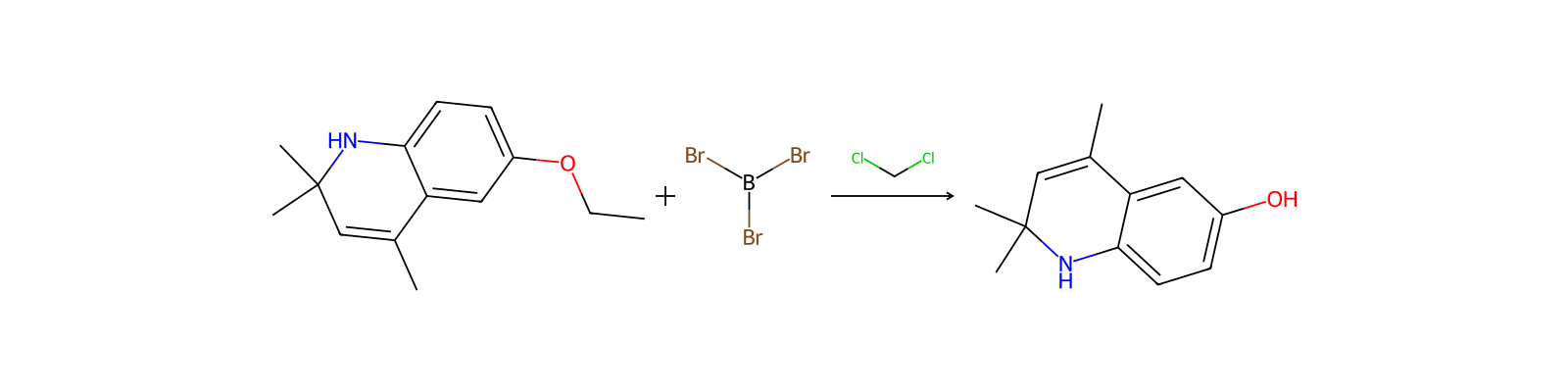
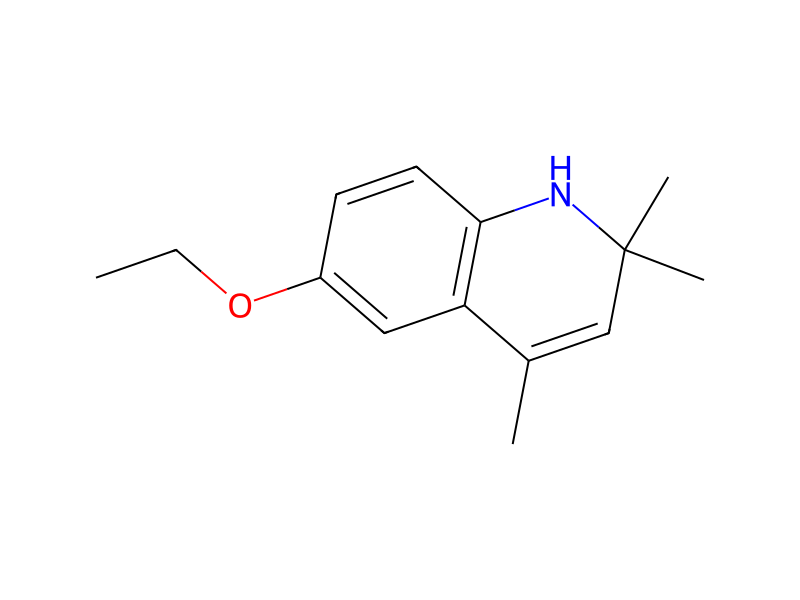
基本信息
- 标准SMILES
CCOc1ccc2c(c1)C(C)=CC(C)(C)N2- InChIKey
DECIPOUIJURFOJ-UHFFFAOYSA-N- 分子式
- C14H19NO
- 平均分子量
- 217.31 g/mol
- 单同位素质量
- 217.14666423
概述
Ethoxyquin is a clear light yellow to dark brown viscous liquid. Discolors and stains badly. Mercaptan-like odor. (NTP, 1992)
名称与标识
- 首选名称
- Ethoxyquin
- IUPAC
- 6-ethoxy-2,2,4-trimethyl-1H-quinoline
- 中文名
- 乙氧基喹啉
- 英文名
- Ethoxyquin
- 分子式
- C14H19NO
- 分子量
- 217.31
名称与别名
ethoxyquin91-53-26-Ethoxy-2,2,4-trimethyl-1,2-dihydroquinolineSantoquinEthoxyquineAntioxidant ECStop-ScaldNix-ScaldSantoquineNiflexSantoflex ASantoflex AW
展开更多名称
乙氧喹促长啉珊多喹衣索金抗氧宝虎皮灵山道喹蛋氨酸镁乙氧喹啉乙氧基奎eqEthoxiquinemqSantoflexEthoxyQuinoline1,2-dihydro-2,2,4-trimethyl-6-ethoxyquinolineETMDQ
Dawe's nutrigardNocrack AWQuinol EDAries AntoxPermanax 103Amea 100Niflex DAntage AW
数据库标识
- CAS
63301-91-7、91-53-2- PubChem CID
- 3293
- DTXSID
DTXSID9020582- ChEMBL
CHEMBL172064- ChEBI
CHEBI:77323- UNII
- 9T1410R4OR
- EC Number
- 202-075-7
- Nikkaji
- J3.556D
性质
结构计算性质
- XLogP
- 3.1
- 极性表面积
- 21.3 Ų
- 氢键供体
- 1
- 氢键受体
- 2
- 可旋转键
- 2
- 重原子
- 16
- 形式电荷
- 0
- 复杂度
- 282
实验与物化性质
Chemical Classes
Other Uses -> Animal Feed Additives
Antioxidant
Pesticides
Plant Growth Regulators
Active substance -> EU Pesticides database: Not approved
Pesticide (Ethoxyquin) -> USDA PDB
Food AdditivesANTIOXIDANT -> FDA Substance added to food
Density
1.029 to 1.031 at 77 °F (NTP, 1992)
1.029-1.031 AT 25 °C/25 °C
Color/FormYELLOW LIQUID
Solubilityless than 1 mg/mL at 68 °F (NTP, 1992)
Flash Point225 °F (NTP, 1992)
Animal DrugsPharmaceuticals -> Animal Drugs -> Approved in Taiwan
Boiling Point
253 to 257 °F at 2 mmHg (NTP, 1992)
123-125 °C AT 2 MM HG
Decomposition... WHEN HEATED TO DECOMP, EMITS TOXIC FUMES ... .
Melting Point
less than 32 °F (NTP, 1992)
Approximately 0 °C
Vapor Density
7.48 (NTP, 1992) - Heavier than air; will sink (Relative to Air)
7.48 (AIR= 1)
物理化学性质
- 熔点
- 0 °C · <0°C
- 沸点
- 123 · 123-125°C
- 密度
- 1.03 g/mL · 1.03 g/mL at 20 °C (lit.)
- 蒸气压
- 0.035 Pa · 0.035Pa at 25℃
- 折射率
- 1.569 · 1.569~1.571
- 闪点
- 137 °C · 137 °C
- 储存条件
- 2 · 2-8°C
- 溶解度
- 50 mL/L, · ethanol: 50 mL/L, clear, brown
- 酸度系数(pKa)
- 5.02 · 5.02±0.70(Predicted)
- 形态
- Liquid
- 颜色
- Yellow to Very Dark Brown
- 水溶解性
- 0.1 g/100 · <0.1 g/100 mL at 20 ºC
- Merck
- 14 · 14,3753
- BRN
- 158223 · 158223
- Henry's Law Constant
- 8 · 8.0×100 mol/(m3Pa) at 25℃, Ebert et al. (2023)
- 稳定性
- Stable. Combustible. Incompatible with oxidizing agents, strong acids. Polymerizes if heated. May polymerize upon exposure to light and air.
- 主要应用
- cleaning productscosmeticsfood and beveragespersonal care
- InChI
- 1S/C14H19NO/c1-5-16-11-6-7-13-12(8-11)10(2)9-14(3,4)15-13/h6-9,15H,5H2,1-4H3
- InChIKey
- DECIPOUIJURFOJ-UHFFFAOYSA-N
- SMILES
- CCOc1ccc2NC(C)(C)C=C(C)c2c1
- LogP
- 3.39 · 3.39
- CAS 数据库
- 91 · 91-53-2(CAS DataBase Reference)
- NIST化学物质信息
- 6 · Quinoline, 6-ethoxy-1,2-dihydro-2,2,4-trimethyl-(91-53-2)
- EPA化学物质信息
- Ethoxyquin (91-53-2)
化学性质
纯品为浅褐色粘稠液体。 溶于苯、汽油、乙醚、乙醇、四氯化碳、丙酮、二氯乙烷,不溶于水。
安全与法规
GHS分类
GHS Classification
Warning
H302: Harmful if swallowed [Warning Acute toxicity, oral]
P264, P270, P301+P317, P330, and P501 (click each P-code to see the statement)
Warning
H302 (100%): Harmful if swallowed [Warning Acute toxicity, oral]
P264, P270, P273, P301+P317, P330, P391, and P501 (click each P-code to see the statement)
危害信息
Regulatory Information
Chemical: Quinoline, 6-ethoxy-1,2-dihydro-2,2,4-trimethyl-
Regulation (EC) No 1831/2003 (amended)
Ethoxyquin is listed in the dataset of EPA Human Health Benchmarks for Pesticides under the Safe Drinking Water Act (40 eCFR 141)
2008/941, 2011/143/EU
REACH registered substance: Ethoxyquin (EC: 202-075-7)
Ethoxyquin: Does not have an individual approval but may be used under an appropriate group standard
Fire HazardsThis chemical is combustible. (NTP, 1992)
Fire PotentialFIRE HAZARD /IS/ SLIGHT
Health Hazards
SYMPTOMS: Symptoms of exposure to this compound include skin irritation. It can cause eye irritation. It can also cause skin sensitization (allergic reactions), lacrimation, depression, reproductive effects, liver effects, kidney effects and thyroid effects. Dermatitis may also occur.
Hazards Summary
Allergic contact dermatitis reported in a feed mill worker; [Kanerva, p. 1793] A skin irritant; May cause reversible changes to the liver; Reports of contact dermatitis in animal feed employees; [HSDB] May polymerize on exposure to light and air; A skin and eye irritant; May cause skin sensitization; [CAMEO] Strongly associated with cases of occupational contact dermatitis; Causes increased liver enzymes in animal experiments; [Reference #2]
FDA Requirements
Ethoxyquin is a food additive permitted for direct addition to food for human consumption, as long as 1) the quantity added to food does not exceed the amount reasonably required to accomplish its intended physical, nutritive, or other technical effect in food, and 2) when intended for use in or on food it is of appropriate food grade and is prepared and handled as a food ingredient.
Ethoxyquin in animal feeds may be safely used in accordance with conditions prescribed in 21 CFR Part 573.
Ethoxyquin in certain dehydrated forage crops may be safely used in accordance with conditions prescribed in 21 CFR Part 573.
Reactive GroupAmines, Phosphines, and Pyridines
FIFRA Requirements
As the federal pesticide law FIFRA directs, EPA is conducting a comprehensive review of older pesticides to consider their health and environmental effects and make decisions about their future use. Under this pesticide reregistration program, EPA examines health and safety data for pesticide active ingredients initially registered before November 1, 1984, and determines whether they are eligible for reregistration. In addition, all pesticides must meet the new safety standard of the Food Quality Protection Act of 1996. Ethoxyquin is found on List A, which contains most food use pesticides and consists of the 194 chemical cases (or 350 individual active ingredients) for which EPA issued registration standards prior to FIFRA, as amended in 1988. Case No: 0003; Pesticide type: Herbicide; Registration Standard Date: 03/01/81; Case Status: OPP is reviewing data from the pesticide's producers regarding its human health and/or environmental effects, or OPP is determining the pesticide's eligibility for reregistration and developing the Reregistration Eligibility Decision (RED) document.; Active ingredient (AI): Ethoxyquin; Data Call-in (DCI) Date(s): 08/20/90, 10/13/95; AI Status: The producers of the pesticide has made commitments to conduct the studies and pay the fees required for reregistration, and are meeting those commitments in a timely manner.
A tolerance is established for residues of the plant regulator ethoxyquin (1,2-dihydro-6-ethoxy-2,2,4-trimethylquinoline) from preharvest or postharvest use in or on apples and pears.
Reactivity AlertsPolymerizable
Reactivity ProfileETHOXYQUIN may undergo a hazardous polymerization at temperatures above 320 °F. Tends to polymerize and darken in color on exposure to light and air. Not compatible with oxidizing agents and with strong acids (NTP, 1992).
Air and Water ReactionsPolymerizes and darkens in color on exposure to light and air. Insoluble in water.
Hazard Classes and Categories
Acute Tox. 4 (100%)
Acute toxicity - category 4
Acute toxicity (Oral) - Category 4
Acute Tox. 4 *
安全与防护
Fire FightingFires involving this material can be controlled with a dry chemical, carbon dioxide or Halon extinguisher. A water spray may also be used. (NTP, 1992)
First Aid
EYES: First check the victim for contact lenses and remove if present. Flush victim's eyes with water or normal saline solution for 20 to 30 minutes while simultaneously calling a hospital or poison control center. Do not put any ointments, oils, or medication in the victim's eyes without specific instructions from a physician. IMMEDIATELY transport the victim after flushing eyes to a hospital even if no symptoms (such as redness or irritation) develop.
Nonfire Spill Response
SMALL SPILLS AND LEAKAGE: If you spill this chemical, FIRST REMOVE ALL SOURCES OF IGNITION. Then, use absorbent paper to pick up all liquid spill material. Your contaminated clothing and absorbent paper should be sealed in a vapor-tight plastic bag for eventual disposal. Solvent wash all contaminated surfaces with 60-70% ethanol followed by washing with a soap and water solution. Do not reenter the contaminated area until the Safety Officer (or other responsible person) has verified that the area has been properly cleaned.
Disposal Methods
SRP: At the time of review, criteria for land treatment or burial (sanitary landfill) disposal practices are subject to significant revision. Prior to implementing land disposal of waste residue (including waste sludge), consult with environmental regulatory agencies for guidance on acceptable disposal practices.
Allowable TolerancesA tolerance of 3 ppm is established for residues of the plant regulator ethoxyquin (1,2-dihydro -6-ethoxy -2,2,4-trimethylquinoline)from preharvest or postharvest use in or on apples and pears.
Personal Protective Equipment (PPE)
RECOMMENDED RESPIRATOR: Where the neat test chemical is weighed and diluted, wear a NIOSH-approved half face respirator equipped with an organic vapor/acid gas cartridge (specific for organic vapors, HCl, acid gas and SO2) with a dust/mist filter. (NTP, 1992)
毒理信息
Interactions
ELEVATION OF EPOXIDE HYDRATASE ACTIVITY IS OBTAINED BY IP OR ORAL TREATMENT OF MICE WITH ETHOXYQUIN. THIS ELEVATION IS PREVENTED BY CONCOMITANT TREATMENT WITH CYCLOHEXIMIDE.
SINGLE ORAL DOSE OF ETHOXYQUIN (200 MG/KG) TO RATS INHIBITED HEPATIC MICROSOMAL HYDROXYLATION OF THIABENDAZOLE, ANILINE & BIPHENYL BY 65, 40 & 40% IN VITRO AT 1 HR AFTER DOSAGE. ORAL ETHOXYQUIN (400 MG/KG) DELAYED ABSORPTION OF & DECR PLASMA CONCN OF THIABENDAZOLE.
The effects of dietary administration of ethoxyquin on aflatoxin B1 metabolism, DNA adduct formation and removal and hepatic tumorigenesis were examined in male Fischer rats. Rats were fed a semipurified diet containing 0.4% ethoxyquin for 1 wk, gavaged with 250 ug of aflatoxin B1 per kg 5 times a wk during the next 2 wk, and finally restored to the control diet 1 wk after cessation of dosing. At 4 mo, focal areas of hepatocellular alteration were identified and quantitated by staining sections of liver for gamma-glutamyl transpeptidase. Treatment with ethoxyquin reduced by greater than 95% both area and volume of liver occupied by gamma-glutamyl transpeptidase-positive foci. Utilizing the same multiple dosing protocol, patterns of covalent modifications of DNA by aflatoxin B1 were determined. Ethoxyquin produced a dramatic reduction in the binding of aflatoxin B1 to hepatic DNA: 18-fold initially and 3-fold at the end of the dosing period. Although binding was detectable at 3 and 4 mo postdosing, no effect of ethoxyquin was observed, suggesting that these persistent adducts are not of primary relevance to aflatoxin B1 carcinogenesis. Analysis of nucleic acid bases by high-performance liquid chromatography revealed no qualitative differences in adduct species between treatment groups. The inhibitory effect of ethoxyquin on aflatoxin B1 binding to DNA and tumorigenesis appears related to induction of detoxication enzymes. Rats fed 0.4% ethoxyquin for 7 days showed a 5-fold increase in hepatic cytosolic glutathione S-transferase (GST)-specific activities. Multiple molecular forms of glutathione S-transferase were induced, and concomitant elevations in messenger RNA levels coding for the synthesis of glutathione S-transferase subunits were observed. Correspondingly, billary elimination of aflatoxin B1-glutathione conjugate was increased 4.5-fold in animals on the ethoxyquin diet during the first 2 hr following oral administration of 250 micrograms of aflatoxin B1 per kg. Thus, induction by ethoxyquin of enzymes important to aflatoxin B1 detoxication, such as glutathione S-transferase can lead to enhanced carcinogen elimination, as well as reductions of aflatoxin B1-DNA adduct formation and subsequent expression of preneoplastic lesions, and, ultimately, neoplasia.
Adverse EffectsOccupational hepatotoxin - Secondary hepatotoxins: the potential for toxic effect in the occupational setting is based on cases of poisoning by human ingestion or animal experimentation.
Ongoing Test Status
The following link will take the user to the National Toxicology Program (NTP) Test Agent Search Results page, which tabulates all of the "Standard Toxicology & Carcinogenesis Studies", "Developmental Studies", and "Genetic Toxicity Studies" performed with this chemical. Clicking on the "Testing Status" link will take the user to the status (i.e., in review, in progress, in preparation, on test, completed, etc.) and results of all the studies that the NTP has done on this chemical. [http://ntp-apps.niehs.nih.gov/ntp_tox/index.cfm?fuseaction=ntpsearch.searchresults&searchterm=91-53-2]
Human Toxicity Excerpts
SKIN IRRITANT. MAY PRODUCE REVERSIBLE LIVER CHANGES.
CASES OF CONTACT DERMATITIS DUE TO ADDITIVES IN ANIMAL FEED SUBSTANCES ARE DESCRIBED OCCURRING IN ANIMAL FEED WORKERS. THERE ARE 2 CASES OF SENSITIVITY TO ETHOXYQUIN.
Carcinogen ClassificationNo indication of carcinogenicity to humans (not listed by IARC).
Non-Human Toxicity Excerpts
ITS CHRONIC TOXICITY IS APPARENTLY LOW, 0.2% IN DIET CAUSING TRANSIENT DEPRESSION IN GROWTH RATE OF RATS. AT AUTOPSY, DAMAGE WAS APPARENT IN KIDNEYS, LIVER & THYROID GLAND IN MANY MALES BUT IN NONE OF FEMALES ... .
/IN RATS FED A DIET CONTAINING 0.2% OF SANTOQUIN/ SOME TUMORS WERE FOUND AFTER CONTINUOUS ADMIN ... .
ORAL ADMIN OF ETHOXYQUIN TO RATS INCR EPOXIDE HYDRATASE ACTIVITY IN LIVER MICROSOMES. T/2 OF INCR 3-4 DAYS. AN INCR OF THIS ENZYME WAS ALSO PRODUCED IN MICE BY IP ADMIN.
DIETARY ADMIN OF 0.5% ETHOXYQUIN MARKEDLY ENHANCED RAT HEPATIC UDP-GLUCURONOSYLTRANSFERASE ACTIVITIES.
For more Non-Human Toxicity Excerpts (Complete) data for ETHOXYQUIN (12 total), please visit the HSDB record page.
RAIS Toxicity Values
1
OPP
0.04
OPP
EPA Human Health Benchmarks for Pesticides
Ethoxyquin
1
7000
Children
0.04
200
法规信息
FDA Requirements
Ethoxyquin is a food additive permitted for direct addition to food for human consumption, as long as 1) the quantity added to food does not exceed the amount reasonably required to accomplish its intended physical, nutritive, or other technical effect in food, and 2) when intended for use in or on food it is of appropriate food grade and is prepared and handled as a food ingredient.
Ethoxyquin in animal feeds may be safely used in accordance with conditions prescribed in 21 CFR Part 573.
Ethoxyquin in certain dehydrated forage crops may be safely used in accordance with conditions prescribed in 21 CFR Part 573.
FIFRA Requirements
As the federal pesticide law FIFRA directs, EPA is conducting a comprehensive review of older pesticides to consider their health and environmental effects and make decisions about their future use. Under this pesticide reregistration program, EPA examines health and safety data for pesticide active ingredients initially registered before November 1, 1984, and determines whether they are eligible for reregistration. In addition, all pesticides must meet the new safety standard of the Food Quality Protection Act of 1996. Ethoxyquin is found on List A, which contains most food use pesticides and consists of the 194 chemical cases (or 350 individual active ingredients) for which EPA issued registration standards prior to FIFRA, as amended in 1988. Case No: 0003; Pesticide type: Herbicide; Registration Standard Date: 03/01/81; Case Status: OPP is reviewing data from the pesticide's producers regarding its human health and/or environmental effects, or OPP is determining the pesticide's eligibility for reregistration and developing the Reregistration Eligibility Decision (RED) document.; Active ingredient (AI): Ethoxyquin; Data Call-in (DCI) Date(s): 08/20/90, 10/13/95; AI Status: The producers of the pesticide has made commitments to conduct the studies and pay the fees required for reregistration, and are meeting those commitments in a timely manner.
A tolerance is established for residues of the plant regulator ethoxyquin (1,2-dihydro-6-ethoxy-2,2,4-trimethylquinoline) from preharvest or postharvest use in or on apples and pears.
安全数据
- F
- 2-8-10
- wgk
- 1
- tsca
- TSCA listed
- 毒性
- LD50 orally in rats, mice: 1920, 1730 mg/kg (Piul'skaya)
- RTECS号
- VB8225000
- 包装类别
- III
- 危险等级
- 9
- 存储类别
- 10 - Combustible liquids
- 安全说明
- 24
- 海关编码
- 29334900
- 危险品标志
- Xn
- 危险性类别
- Acute Tox. 4 Oral
- 危险类别码
- 22
- 毒害物质数据
- 91-53-2(Hazardous Substances Data)
- 危险品运输编号
- 3082
毒性防护
毒性GRAS(FDA,§172.140,2000)。LD50 800mg/kg(大鼠,经口)。
急性毒性口服- 大鼠 LD50 800 毫克/ 公斤; 口服- 小鼠 LD50: 1584 毫克/公斤
包装储运
可燃性危险特性可燃, 火场排出辛辣刺激烟雾
储运特性库房低温, 通风, 干燥 ; 防火; 与氧化剂, 食品原料分开存放
灭火剂水, 二氧化碳, 干粉, 泡沫
化学与工业
药理信息
Metabolism/Metabolites
MAJOR METABOLIC REACTION WAS DEETHYLATION OF ETHOXYQUIN WHICH PRODUCED 6-HYDROXY-2,2,4-TRIMETHYL-1,2-DIHYDROQUINOLINE & 2,2,4-TRIMETHYL-6-QUINOLINE. OTHER REACTIONS WERE HYDROXYLATION TO FOUR DIFFERENT HYDROXYLATED METABOLITES & ONE DIHYDROXYLATED METABOLITE.
An avg of 28 & 36% of dose of radioactivity was recovered in bile in 12 & 24 hr respectively following intragastric admin of (14)C-ethoxyquin to bile duct cannulated rats. Biliary radioactive substances included, in addn to unchanged ethoxyquin...8-hydroxyethoxyquin; hydroxylated 8-hydroxyethoxyquin; 6-ethoxy-2,2,4-trimethylquinolone; hydroxylated 6-ethoxy-2,2,4-trimethyl-8-quinolone; 6-ethoxy-2,4-dimethylquinoline; and 2,2,4-trimethyl-6-quinolone.
Absorption, Distribution and Excretion
FEEDING TRIAL IN COWS WAS CONDUCTED TO DETERMINE WHETHER ETHOXYQUIN OR ITS RESIDUES ARE TRANSFERRED FROM FEED TO MILK WHEN ADDED TO COW FEED AT 0.015% OF DRY MATTER INTAKE. LESS THAN 7 UG ETHOXYQUIN/L WAS DETECTED IN MILK BY FLUORIMETRY & BY THIN-LAYER CHROMATOGRAPHY.
(14)C-ETHOXYQUIN WAS DISTRIBUTED THROUGHOUT MOST TISSUES & BLOOD AT 0.5 HR AFTER ADMIN TO RATS. HIGHEST RADIOACTIVITY THROUGHOUT EXPERIMENT WAS OBSERVED IN LIVER, KIDNEY, GI TRACT & ADIPOSE TISSUE. THERE WAS NO ACTIVITY IN CNS. OF DOSE INGESTED BY RAT 2.2 & 0.2% WERE FOUND IN LIVER AT 0.5 HR & 6 DAYS RESPECTIVELY FOLLOWING DOSE. HEPATIC PEAK IN RADIOACTIVITY WAS MEASURED AT 8 HR; & AFTER 6 DAYS 7.5% OF THIS LEVEL WAS STILL PRESENT IN LIVER. 6 DAYS AFTER ADMIN TO RATS RESIDUES OF ETHOXYQUIN & METABOLITES WERE PRESENT IN KIDNEY CORTEX, INTESTINES, LUNG, VARIOUS ADIPOSE TISSUES & BLOOD.
The compound is readily absorbed, metabolized, and excreted in urine and feces.
Ethoxyquin residue levels in the mouse tissue were determined by the HPLC-fluorometric detection method. Mice were given powdered feed containing 0, 0.125, and 0.5% ethoxyquin hydrochloric acid and the ethoxyquin residue levels in liver kidney, lung, and brain tissues were determined after 2, 4, 6, 10, and 14 wk (4 mice/group). The tissue samples were homogenized in 10 volumes (w/v) of acetonitrile-water (7:3 v/v) centrifuged and the supernatants were stored in a freezer for 2-3 hr or until the two layers separated; then the clear upper layers were analyzed. The mean ethoxyquin residue levels in the tissue ranged 0.84-4.58 ug ethoxyquin/g liver and 0.11-0.92 ug ethoxyquin/g brain. The relative weight of the liver (5.21-7.07% body weight) and the hepatic glutathione level (5.99-7.83 uM GSH/g tissue) of mice that received ethoxyquin were significantly higher than those of the controls (4.67-5.05% body weight and 4.30-5.78 uM GSH/g tissue, respectively). The mean hepatic mitochondrial glutathione levels of the higher ethoxyquin feeding group following dietary administration of ethoxyquin for 14 wk, was approximately twofold (1.68 nM GSH/mg protein) of both the control and the lower ethoxyquin feeding groups (0.83 and 0.74 nM GSH/mg protein, respectively.
Cellular LocationsMembrane
用途与制造
Uses
Used as an additive to animal feed; [Kanerva, p. 1793] Used as an antioxidant for food and feed and as anti-degradation agent for rubber; [Merck Index] Also used as a post-harvest dip for apples and pears; [ChemIDplus] Registered in the US as an antioxidant for the control of post-harvest scald (browning) in pears; Also registered with the FDA as a preservative for animal feed, dehydrated crops, sorghum, and for color preservation in chili powder, paprika, and ground chili; [Reference #2]
Farming (Pesticides) [Category: Industry]
For ethoxyquin (USEPA/OPP Pesticide Code: 055501) ACTIVE products with label matches. /SRP: Registered for use in the U.S. but approved pesticide uses may change periodically and so federal, state and local authorities must be consulted for currently approved uses./
MEDICATION (VET):
ANTIOXIDANT IN FEED & FOOD; ANTIDEGRADATION AGENT FOR RUBBER
Antioxidant, used as post-harvest fruit-drop to prevent common scald of apples & pears in storge; Formerly added to poultry feeds & forage crops
Methods of Manufacturing/BY PASSING ACETONE VAPOR INTO P-PHENETIDINE CONTAINING 1% OF IODINE @ 120-130 °C & SEPARATING BY DISTILLATION/
Formulations/Preparations
USEPA/OPP Pesticide Code 055501; Trade Names: Stop-scald.
Emulsifiable concentrate
Use ClassificationPharmaceuticals -> Animal Drugs -> Approved in Taiwan
General Manufacturing Information
Quinoline, 6-ethoxy-1,2-dihydro-2,2,4-trimethyl-: ACTIVE
2,4-DIMETHYL-6-ETHOXYQUINOLINE, A REACTION PRODUCT OF ETHOXYQUIN, OCCURS IN COMMERCIAL FEEDS & COULD INTERFERE IN ANALYSIS OF MIXED COMMERCIAL FEEDS FOR AFLATOXIN.
THE USE OF ETHOXYQUIN AS FEED ADDITIVE MAY AGGRAVATE POTENTIAL MYCOTOXIN HAZARDS IN CONTAMINATED FEEDSTUFFS BY ALTERING THE TYPE & QUANTITY OF AFLATOXIN PRODUCED.
/ Stop Scald /trade name / discontinued
应用领域
用途主要用作橡胶防老化,对防止臭氧引起的龟裂有优良的防护性能,特别适用于动态条件下使用的橡胶制品
用途乙氧基喹啉一般以喷雾法喷布于饲料表面,可有效防止饲料中油脂酸败和蛋白质氧化,且能防止维生素变质,具有抗氧化作用。饲料中用量100-150g/kg。如果过量使用(添加量超过0.1%)会导致猪肉脂肪色泽变暗或发黄,影响屠体品质。常用的商品制剂分两类:一类为含乙氧喹10%~70%的粉状物,物理性质稳定,不滑润,不流动,在饲料中分布均匀,可与饲料均匀混合;另一类为液体状态的添加剂,分为以水和甘油作为溶剂两种。
用途乙氧基喹啉具有保鲜和抗氧化作用。主要用于水果的保鲜,防治苹果虎皮病、鸭梨及香蕉等的黑皮病。我国规定可用于苹果的保鲜,按生产需要适量使用,残留量1mg/kg。还可用于维生素A、维生素D、β-胡萝卜素、脂肪等物质的抗氧化。作用基本与BHA和BHT相同,但价格便宜。
用途乙氧基喹啉是最佳抗氧化剂、适用于全价饲料。它具有抗氧化效率高、安全无毒、使用方便、在动物体内不蓄积等特点。它能防止饲料氧化腐败,保持动物蛋白饲料能量。在饲料混合和贮藏过程中能防止维生素A、维生素E、叶黄素的破坏。防止脂溶性维生素和色素的氧化损失。抑制自身发热,提高鱼粉的质量,同时还能使饲养的动物体重增加。提高饲料的转化率,促进动物对色素充分作用,防止维生素A、E缺乏症,延长饲料的货架寿命,具有更高的市场价格。乙氧基喹啉粉剂是世界上公认的最有效、最经济实用的一种饲料抗氧化剂。
制备方法
生产方法一般由对氨基苯乙醚与丙酮在催化剂作用下缩合而得。将对氨基苯乙醚、催化剂(对甲苯磺酸或碘),在155~165℃和搅拌下通入丙酮蒸气进行缩合。反应生成的水和未反应的丙酮,经冷凝后入丙酮回收器以回收丙酮。反应结束后,蒸馏得到成品。每吨产品消耗对氨基苯乙醚1000kg、丙酮800kg、苯磺酸100kg。也可用1%I2作催化剂,在120~130℃下缩合
生产方法将丙酮蒸气通入对氨基苯乙醚,在1%碘催化下,在120~130℃下环合而成,然后再蒸馏分离而得。
上下游产品信息
上游原料
下游产品
试剂价格
- HY-B1425R · 250 mg
- 乙氧基喹啉Ethoxyquin (Standard) — 380元
- E0237 · 25G
- 6-乙氧基-2,2,4-三甲基-1,2-二氢喹啉[橡胶抗氧化剂]6-Ethoxy-2,2,4-trimethyl-1,2-dihydroquinoline [Antioxidant for rubber] — 270元
供应商50 家
北京华美互利生物化工010-56205725 · [email protected]
梯希爱(上海)化成工业发展有限公司021-67121386 · [email protected]
上海阿拉丁生化科技股份有限公司400-6206333 13167063860 · [email protected]
合肥翰刚医药科技有限公司+8618062405514 · [email protected]
Hong Kong Tiansheng New Material Trading Co., Ltd+8617320695765 · [email protected]
河北创海生物科技有限公司+86-86-13131129325 · [email protected]
河北展药生物科技有限公司15369953316 +8615369953316 · [email protected]
Baoji Guokang Healthchem co.,ltd+8615604608665 15604608665 · [email protected]
Hebei Yanxi Chemical Co., Ltd.+86-17531190177 · [email protected]
上海迈瑞尔生化科技有限公司4006356688 18621169109 · [email protected]
安耐吉化学&3A(安徽泽升科技股份有限公司)400-0056266 · [email protected]
上海瀚鸿科技股份有限公司021-54306202 13764082696 · [email protected]
上海钰康生物科技有限公司+86-18930848214 +86-021-56762820 · [email protected]
上海泰坦科技股份有限公司400-6009262 15618770481 · [email protected]
孝感深远化工有限公司15527621225; 15527621225 · [email protected]
玛雅试剂+86 (573) 82222445 (0)18006601000 452520369 · [email protected]
四川库利南科技有限公司400-1166-196 18981987031 · [email protected]
天津希恩思生化科技有限公司400 638 7771 · [email protected]
斯百全化学(上海)有限公司021-021-021-67601398-809-809-809 15221380277 · [email protected]
上海源叶生物科技有限公司13636370518 · [email protected]
上海思域化工科技有限公司86-21-34053660 · [email protected]
上海遐瑞医药科技有限公司+86 21 61551611
TCI AMERICA800-4238616 · [email protected]
TOKYO CHEMICAL INDUSTRY CO., LTD.03-36680489 · [email protected]
TCI Europe320-37350700 · [email protected]
深圳振强药物研发有限公司0755-66853366 13670046396 · [email protected]
Chempioneer Limited+86-398-3831668 · [email protected]
烟台东方化学有限公司+86 532 68629711 137 8060 5697 · [email protected]
上海将来实业股份有限公司021-61552785 · [email protected]
安徽科迪达化工有限公司0554-2106669 · [email protected]
成都零六生物科技有限公司400-1166-196 13458535857 · [email protected]
上海麦克林生化科技股份有限公司15221275939 15221275939 · [email protected]
杭州杰恒化工有限公司0571-87396432 · [email protected]
上海嵩爰化工科技有限公司010-1234567 18521000990 · [email protected]
江苏艾康生物医药研发有限公司025-66028182 17714375163 · [email protected]
上海拓目化工有限公司13391076197 · [email protected]
凯试(上海)科技有限公司021-50135380 · [email protected]
湖北巨胜科技有限公司027-59599241 18871490274 · [email protected]
池州凯隆进出口贸易有限公司[email protected]
Sigma-Aldrich西格玛奥德里奇(上海)贸易有限公司021-61415566 800-8193336 · [email protected]
潍坊市前进精细化工有限公司18753684562 · [email protected]
天津阿尔塔科技有限公司022-6537-8550 15522853686 · [email protected]
TargetMol中国(陶术生物)021-021-33632979 15002134094 · [email protected]
上海陶术生物科技股份有限公司+1-781-999-5354; +1-00000000000 · [email protected]
北京诺其雅盛生物科技有限公司4000-819-385 010-62329685 13718666987
九鼎化学(上海)科技有限公司4009209199 · [email protected]
厦门志信化学有限公司+86-5922680277 +86-13806087780 · [email protected]
上海岚克医药科技发展有限公司0086-21-58956006
上海西陇生化科技有限公司021-52907766-8042
上海前衍生物科技有限公司02781293128 · [email protected]
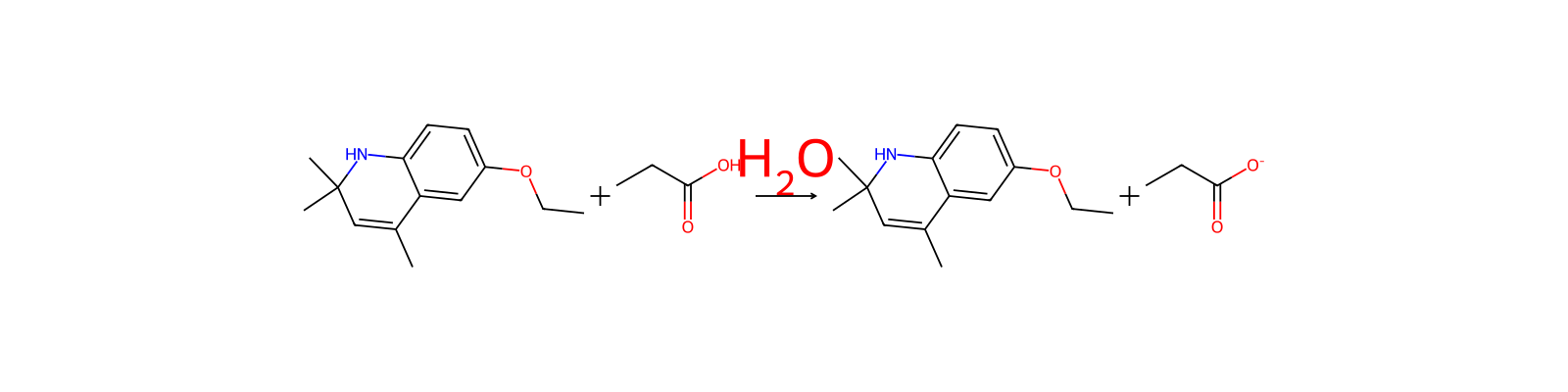
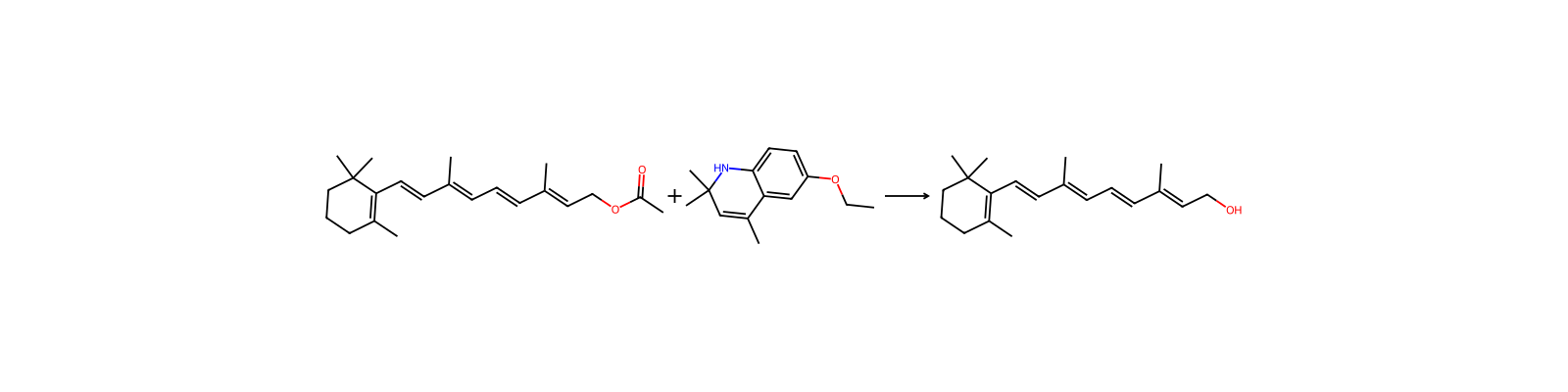
相关反应
13 条




关联笔记
加载中…