
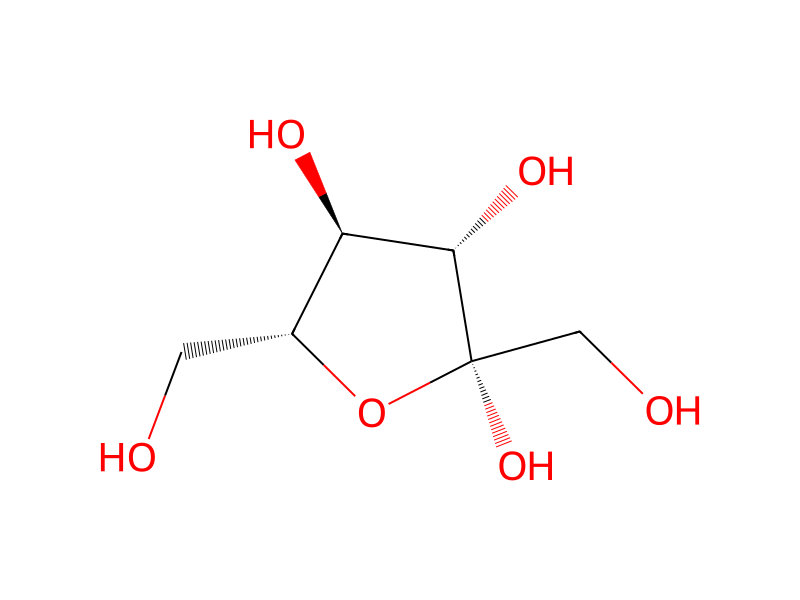
基本信息
- 标准SMILES
OC[C@H]1O[C@](O)(CO)[C@@H](O)[C@@H]1O- InChIKey
RFSUNEUAIZKAJO-ARQDHWQXSA-N- 分子式
- C6H12O6
- 平均分子量
- 180.16 g/mol
- 单同位素质量
- 180.0633881
概述
Beta-D-fructofuranose is a D-fructofuranose. It has a role as a mouse metabolite. It is an enantiomer of a beta-L-fructofuranose.
名称与标识
- 首选名称
- beta-D-fructose
- IUPAC
- (2R,3S,4S,5R)-2,5-bis(hydroxymethyl)oxolane-2,3,4-triol
- 中文名
- B-D-呋喃果糖
- 英文名
- (2R,3S,4S,5R)-2,5-Bis(hydroxymethyl)-oxolane-2,3,4-triol
- 分子式
- C6H12O6
- 分子量
- 180.16
名称与别名
beta-D-fructofuranosebeta-Levulosebeta-D-Fructosebeta-Fruit sugar53188-23-1beta-D-Arabino-hexuloseB986VTP17JCHEBI:28645DTXSID60859011RefChem:937011GlyTouCan:G23778LQBETA-D.-FRUCTOFURANOSE
展开更多名称
乳果糖杂质31乳果糖杂质11Β-D-呋喃果糖B-D-呋喃果糖(2R,3S,4S,5R)-2,5-双(羟甲基)四氢呋喃-2,3,4-三醇Lactulose Impurity 31Lactulose Impurity 11Cyanocobalamin Impurity 13 Acetate
DTXCID103081DTXSID20273991G23778LQ470-23-5Fructooligosaccharides(2R,3S,4S,5R)-2,5-bis(hydroxymethyl)tetrahydrofuran-2,3,4-triolb-D-Fructofuranose308066-66-2
数据库标识
- CAS
470-23-5、53188-23-1、57-48-7- PubChem CID
- 439709
- DTXSID
DTXSID60859011- ChEMBL
CHEMBL604608- ChEBI
CHEBI:28645- UNII
- B986VTP17J
- Nikkaji
- J450.088A
性质
结构计算性质
- XLogP
- -2.3
- 极性表面积
- 110 Ų
- 氢键供体
- 5
- 氢键受体
- 6
- 可旋转键
- 2
- 重原子
- 12
- 形式电荷
- 0
- 复杂度
- 162
实验与物化性质
Solubility778 mg/mL at 20 °C
Melting Point119 - 122 °C
Physical DescriptionSolid
物理化学性质
- 沸点
- 440.1 · 440.1±45.0 °C(Predicted)
- 密度
- 1.694 · 1.694±0.06 g/cm3(Predicted)
- 酸度系数(pKa)
- 11.42 · 11.42±0.70(Predicted)
安全与法规
毒理信息
Health Effects
Acute consumption of fructose or high fructose corn syrup is essentially non-toxic. Chronic, excess fructose consumption has been shown to be a cause (or indirect cause) of gout, insulin resistance, hypertension, obesity, fatty liver disease, elevated LDL cholesterol and elevated triglycerides, leading to metabolic syndrome. In Wistar rats, a laboratory model of diabetes, 10% fructose feeding as opposed to 10% glucose feeding was found to increase blood triglyceride levels by 86%, whereas the same amount of glucose had no effect on triglycerides. A 2008 study found a substantial risk of incident gout associated with the consumption of fructose or fructose-rich foods. It is suspected that the fructose found in soft drinks (e.g., carbonated beverages) and other sweetened drinks is the primary reason for this increased incidence.
Exposure RoutesIngestion
Toxicity Summary
Fructose is distinct from other sugars in its ability to cause intracellular ATP depletion, nucleotide turnover, and the generation of uric acid. Uric acid is generated via fructose due to its rapid phosphorylation (to fructose-1-phosphate) in the liver, leading to a rapid drop in free phosphate and ATP. This drop in ATP leads to the stimulation of adenosine monophosphate (AMP) deaminase which deaminates AMP to produce IMP, which is subsequently converted to uric acid (A15346). Uric acid is normally an anti-oxidant but without sufficient amounts of ascorbic acid (vitamin C) present in the plasma, it functions as a pro-oxidant. Because many soft drinks and foods that are sweetened with high fructose corn syrup do not contain vitamin C, the resulting uric acid can lead to a number of harmful effects, including gout, chronic inflammation, hypertension, increased adiposity, fatty liver disease and obesity (A15346). Many studies have shown that elevated uric acid levels are associated with several metabolic and cardiovascular conditions, including diabetes and coronary artery disease (A15346). Elevated serum uric acid has also been shown to be the most reliable predictor for the development of hypertension and incident renal disease (A15347) as well as fatty liver disease (A15348). Fructose-induced uric acid generation also causes mitochondrial oxidative stress that stimulates fat accumulation independent of excessive caloric intake (A15349). Several studies have demonstrated that oxidative stress is one of the earliest phenomena observed in vascular, renal, liver cells and adipocytes exposed to uric acid (A15347). High fructose consumption is also associated with more severe depletion of liver ATP, which may impair liver "energy balance”. High-fructose beverages have also been shown to lead to lower circulating insulin and leptin levels, and higher ghrelin levels. Since leptin and insulin decrease appetite and ghrelin increases appetite, some researchers suspect that eating large amounts of fructose increases the likelihood of weight gain.
Carcinogen ClassificationNo indication of carcinogenicity to humans (not listed by IARC).
Toxicity Data
Consuming more than 100 g a day of pure fructose may lead to a modest but statistically significant rise in body weight of 0.44 kg a week. Consuming 100 g or more of fructose a day also significantly increases fasting levels of serum triglycerides. LD50: 15000 mg/kg (intravenous, rabbit)
化学与工业
药理信息
Metabolism/Metabolites
Free fructose is absorbed directly by the intestine. When fructose is consumed in the form of sucrose, it is digested (broken down) and then absorbed as free fructose. Fructose absorption occurs on the mucosal membrane via facilitated transport involving GLUT5 and GLUT2 transport proteins. Fructose is phosphorylated in the liver by fructokinase (Km= 0.5 mM). Fructokinase initially produces fructose 1-phosphate, which is split by aldolase B to produce the trioses dihydroxyacetone phosphate (DHAP) and glyceraldehyde. DHAP is then converted to glycerol-3-phophate which stimulates production of triglycerides. Nearly half (45%) of all pure fructose consumed is used up within 3-6 hours by the body for energy. If fructose is consumed with glucose (as it typically is in nature), up to 66% of it is used for energy within the same time frame. Roughly a third (29%) to a half (54%) of all fructose consumed is converted to glucose. Less than 1% of fructose appears to be directly converted to triglycerides.
Tissue LocationsLiver
Cellular LocationsExtracellular
Metabolite PathwaysAmino Sugar Metabolism
上下游产品信息
下游产品
供应商32 家
陕西缔都医药有限责任公司029-81124775 17791530730 · [email protected]
山东泰诚生物科技有限公司18769832557 18769832557 · [email protected]
天津市光复科技发展有限公司022-85689490 13132141716 · [email protected]
合肥翰刚医药科技有限公司+8618062405514 · [email protected]
上海毕得医药科技股份有限公司400-1647117 13681763483 · [email protected]
Dayang Chem (Hangzhou) Co.,Ltd.+86-0571-88938639 17705817739 · [email protected]
北京索莱宝科技有限公司010-50973130 17801761073 · [email protected]
广东云星生物技术有限公司0751-18902340975/189023400307 18902340307 · [email protected]
上海皓鸿生物医药科技有限公司400-8210725 4008210725 · [email protected]
上海倍卓生物科技有限公司021-61119791,13386096464 · [email protected]
上海将来实业股份有限公司400-0066400 13621662912 · [email protected]
上海将来实业股份有限公司021-61552785 · [email protected]
上海毕得医药科技股份有限公司400-164-7117 18317119277 · [email protected]
上海艾康睿医药科技有限公司021-33730573 15821573036 · [email protected]
山东爱采生物科技有限公司13573016375 13573016375
佛山晟熠生物科技有限公司18064670521 · [email protected]
Shanghai Acmec Biochemical Technology Co., Ltd.+86-18621343501 · [email protected]
湖北东曹化学科技有限公司027-83238443 13343438265 · [email protected]
杭州洁汉化工有限公司+86-571-86217390; +8618058761490 · [email protected]
珠海嘉亿生物科技有限公司18578209868 2355327026 · [email protected]
江苏艾康生物医药研发有限公司025-66061636 19370895928 · [email protected]
佛山道麒生物科技有限公司18062666947 · [email protected]
career henan chemical co+86-0371-86658258 · [email protected]
湖北康鑫源顺医药化工有限公司027-51831887 15337167856 · [email protected]
广东翁江化学试剂有限公司0751-2815688 13927872512 · [email protected]
东莞市瓦里西化工有限公司0796-8612228 18664658771 · [email protected]
XIAMEN AMITY INDUSTRY AND TRADE CO., LTD.+8618950047208 · [email protected]
TargetMol中国(陶术生物)4008200310 15002144251 · [email protected]
SHANGHAI KEAN TECHNOLOGY CO., LTD.+8613817748580 · [email protected]
南京松冠生物科技有限公司13584088977
Hefei TNJ Chemical Industry Co.,Ltd.+86-0551-65418671 +86-189 4982 3763 · [email protected]
河南威梯希化工科技有限公司0371-55135753 18003832934 · [email protected]
相关反应
3 条


关联笔记
加载中…