
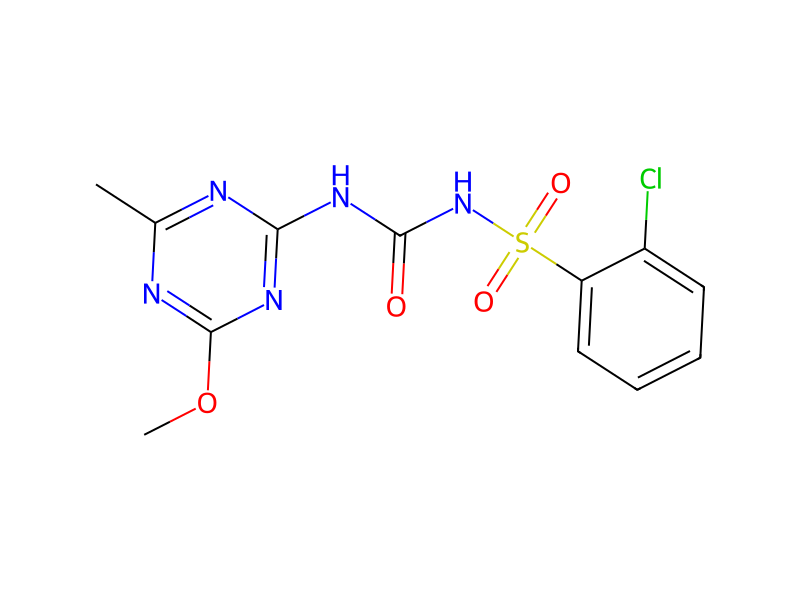
基本信息
- 标准SMILES
COc1nc(C)nc(NC(=O)NS(=O)(=O)c2ccccc2Cl)n1- InChIKey
VJYIFXVZLXQVHO-UHFFFAOYSA-N- 分子式
- C12H12ClN5O4S
- 平均分子量
- 357.77 g/mol
- 单同位素质量
- 357.02985254
概述
Chlorsulfuron appears as colorless crystals. Non corrosive. Insoluble in water. Used as an herbicide.
名称与标识
- 首选名称
- Chlorsulfuron
- IUPAC
- 1-(2-chlorophenyl)sulfonyl-3-(4-methoxy-6-methyl-1,3,5-triazin-2-yl)urea
- 中文名
- 氯磺隆
- 英文名
- Chlorsulfuron
- 分子式
- C12H12ClN5O4S
- 分子量
- 357.77
名称与别名
CHLORSULFURON64902-72-3GleanChlorsulfonTelarTrilixon2-ChlorsulfuronGlean C1-(2-chlorophenyl)sulfonyl-3-(4-methoxy-6-methyl-1,3,5-triazin-2-yl)ureaGlean 20DFDPX 4189DTXSID7023980
展开更多名称
氯磺隆嗪磺隆绿磺隆绿黄隆氯硫酮氯磺隆溶液丙酮中氯磺隆甲醇中氯磺隆乙腈中氯磺隆氯磺隆 标准品CleanfinessePRESSW-4189gleancLASHERTuligenonamide
O6S620ML451-(2-Chlorophenylsulfonyl)-3-(4-methoxy-6-methyl-1,3,5-triazin-2-yl)urea2-Chloro-N-((4-methoxy-6-methyl-1,3,5-triazin-2-yl)aminocarbonyl)-benzenesulfonamide1-((o-Chlorophenyl)sulfonyl)-3-(4-methoxy-6-methyl-s-triazin-2-yl)urea1-(2-Chlorophenylsulphonyl)-3-(4-methoxy-6-methyl-1,3,5-triazin-2-yl)ureaCHEBI:3652DTXCID5039802-Chloro-N-(((4-methoxy-6-methyl-1,3,5-triazin-2-yl)amino)carbonyl)benzenesulfonamide
数据库标识
- CAS
112143-77-8、64902-72-3、79793-04-7- PubChem CID
- 47491
- DTXSID
DTXSID7023980- ChEMBL
CHEMBL1229721- ChEBI
CHEBI:3652- UNII
- O6S620ML45
- EC Number
- 265-268-5、279-271-4
- Nikkaji
- J20.653I
性质
结构计算性质
- XLogP
- 2.3
- 极性表面积
- 132 Ų
- 氢键供体
- 2
- 氢键受体
- 7
- 可旋转键
- 4
- 重原子
- 23
- 形式电荷
- 0
- 复杂度
- 514
实验与物化性质
Pesticides
Pesticide -> EPA IRIS
Herbicides
Active substance -> EU Pesticides database: Not approved
Pesticides -> Herbicides, Sulfonylurea
Pesticide (Chlorsulfuron) -> USDA PDB
Pesticide
LogP
log Kow = 0.74 at pH 5 and -1.34 at pH 7
1.54
OdorOdorless
Color/Form
White crystalline solid
Crystals from ether
Solubility
In water, 125 mg/L at 25 °C
Solubility (25 °C) : 4 g/L acetone; 102 g/L dichloromethane, <0.01 g/L hexane, 15 g/L methanol; 3 g/L toluene
Moderately soluble in methylene chloride; less soluble in acetone, acetonitril. Low solubility in hydrocarbon solvents.
Slight solubility in methylene chloride, acetone, methanol, toluene, hexane
>53.7 [ug/mL] (The mean of the results at pH 7.4)
CorrosivityNon-corrosive
Endocrine DisruptorsPotential endocrine disrupting compound
DecompositionWhen heated to decomposition it emits toxic vapors of /nitrogen oxides, sulfur oxides, and chloride/.
Melting Point
176 °C
MP: 174-178 °C
Vapor Pressure
2.25X10⁻¹¹ mm Hg at 25 °C
0.81313 [mm Hg] @25 °C
Henry's Law ConstantHenry's Law constant = 5X10⁻¹⁰ (pH 5); 2.5X10⁻¹¹ (pH 7); 3.2X10⁻¹² (pH 9) (all in Pa-cu m/mol, 20 °C)
Physical Description
Chlorsulfuron appears as colorless crystals. Non corrosive. Insoluble in water. Used as an herbicide.
Colorless or white odorless solid; [HSDB]
物理化学性质
- 熔点
- 174 · 174-178°C
- 密度
- 1.6111 · 1.6111 (rough estimate)
- 折射率
- 1.563 · 1.5630 (estimate)
- 储存条件
- 0 · 0-6°C
- 溶解度
- Chloroform (Slightly), DMSO (Slightly), Methanol (Slightly)
- 酸度系数(pKa)
- 4.21 · 4.21±0.10(Predicted)
- 形态
- Solid
- 颜色
- White to off-white
- Merck
- 13 · 13,2210
- BRN
- 577255 · 577255
- Henry's Law Constant
- 3.2 · 3.2×104 mol/(m3Pa) at 25℃, Mackay et al. (2006)
- 主要应用
- agricultureenvironmental
- InChI
- 1S/C12H12ClN5O4S/c1-7-14-10(17-12(15-7)22-2)16-11(19)18-23(20,21)9-6-4-3-5-8(9)13/h3-6H,1-2H3,(H2,14,15,16,17,18,19)
- InChIKey
- VJYIFXVZLXQVHO-UHFFFAOYSA-N
- SMILES
- COc1nc(C)nc(NC(=O)NS(=O)(=O)c2ccccc2Cl)n1
- CAS 数据库
- 64902 · 64902-72-3(CAS DataBase Reference)
- NIST化学物质信息
- Chlorsulfuron(64902-72-3)
- EPA化学物质信息
- Chlorsulfuron (64902-72-3)
化学性质
纯品为白色结晶,无臭味。m.p.174~178℃,192℃分解,蒸气压6.133×10⁻⁴Pa (25℃)。在有机溶剂中溶解度:二氯甲烷102g/L,丙酮57g/L,甲醇14g/L,甲苯3g/L,己烷10mg/L;25℃时在水中溶解度:100~125mg/L (pH=4.1), 27.9g/L (pH=7)。酸性条件下不稳定,pH值5.7~7时水解半衰期为4~8周,pH值4时为1周。干燥条件下,30d内在植物表面光分解30%,土壤表面光分解15%。在土壤中半衰期为4~6周。
安全与法规
GHS分类
GHS Classification
Warning
H400: Very toxic to aquatic life [Warning Hazardous to the aquatic environment, acute hazard]
P273, P391, and P501 (click each P-code to see the statement)
Warning
H400 (100%): Very toxic to aquatic life [Warning Hazardous to the aquatic environment, acute hazard]
P273, P391, and P501 (click each P-code to see the statement)
危害信息
Regulatory Information
Commission Regulation (EC) No 1490/2002
Chlorsulfuron is listed in the dataset of EPA Human Health Benchmarks for Pesticides under the Safe Drinking Water Act (40 eCFR 141)
2009/77/EC, Reg. (EU) 2022/801, Reg. (EU) No 540/2011
Chlorsulfuron: Does not have an individual approval but may be used under an appropriate group standard
The New Jersey Worker and Community Right to Know Act requires public and private employers to provide information about hazardous substances at their workplaces. (N.J.S.A. 34:5A-1 et. seq.)
Other Safety InformationIMAP assessments - Benzenesulfonamide, 2-chloro-N-[[(4-methoxy-6-methyl-1,3,5-triazin-2-yl)amino]carbonyl]-: Environment tier I assessment
DOT LabelClass 9
Fire HazardsExcerpt from ERG Guide 171 [Substances (Low to Moderate Hazard)]:
Health HazardsExcerpt from ERG Guide 171 [Substances (Low to Moderate Hazard)]:
Hazards SummaryAn eye irritant; [HSDB] For the triazine herbicides, systemic toxicity unlikely unless large amounts are ingested; May cause irritation; [EPA Pesticides, p. 121]
Reactive GroupAmides and Imides
Special Reports
USEPA/Office of Prevention, Pesticides and Toxic Substances; Reregistration Eligibility Decision Document - Chlorsulfuron (May 2005). The RED summarizes the risk assessment conclusions and outlines any risk reduction measures necessary for the pesticide to continue to be registered in the USA.[Available from, as of June 20, 2017 http://www.epa.gov/pesticides/reregistration/status.htm]
Blair AM, Martin TD; Pestic Sci 22 (3): 195-220 (1988). A review of the activity fate and mode of action of sulfonylurea herbicides
FIFRA Requirements
Tolerances are established for the combined residues of chlorsulfuron (2-chloro-N-[(4-methoxy-6-methyl-1,3,5-triazin-2-yl)aminocarbonyl]benzenesulfonamide) and its metabolite, 2-chloro-5-hydroxy-N-[(4-methoxy-6-methyl-1,3,5-triazin-2-yl)aminocarbonyl] benzenesulfonamide in or on the following raw agricultural commodities:[Table#6355]
Tolerances are established for residues of chlorsulfuron (2-chloro-N-[(4-methoxy-6-methyl-1,3,5-triazin-2- yl)aminocarbonyl] benzenesulfonamide) in or on the following raw agricultural commodities.[Table#6356]
The Agency has completed its assessment of the residential, occupational, and ecological risks associated with the use of pesticides containing the active ingredient chlorsulfuron as well as a chlorsulfuron-specific dietary risk assessment. Based on a review of these data and public comments on the Agency's assessments for the active ingredient chlorsulfuron, EPA has sufficient information on the human health and ecological effects of chlorsulfuron to make decisions as part of the tolerance reassessment process under Federal Food, Drug and Cosmetic Act (FFDCA) and reregistration under FIFRA, as amended by the Food Quality Protection Act (FQPA). The Agency has determined that currently registered uses of chlorsulfuron will not pose unreasonable risks or adverse effects to humans or the environment if the risk mitigation measures and label changes outlined in the RED are implemented. The Agency has determined that chlorsulfuron is eligible for reregistration.
As the federal pesticide law FIFRA directs, EPA is conducting a comprehensive review of older pesticides to consider their health and environmental effects and make decisions about their continued use. Under this pesticide reregistration program, EPA examines newer health and safety data for pesticide active ingredients initially registered before November 1, 1984, and determines whether the use of the pesticide does not pose unreasonable risk in accordance to newer safety standards, such as those described in the Food Quality Protection Act of 1996. Chlorsulfuron is found on List A, which contains most pesticides that are used on foods and, hence, have a high potential for human exposure. List A consists of the 194 chemical cases (or 350 individual active ingredients) for which EPA issued registration standards prior to FIFRA '88. Case No: 0631; Pesticide type: herbicide; Registration Standard Date: 09/30/82; Case Status: OPP is reviewing data from the pesticide's producers regarding its human health and/or environmental effects, or OPP is determining the pesticide's eligibility for reregistration and developing the Reregistration Eligibility Decision (RED) document.; Active ingredient (AI): Chlorsulfuron; Data Call-in (DCI) Date(s): 08/06/90, 08/16/91, 10/13/95; AI Status: The producers of the pesticide has made commitments to conduct the studies and pay the fees required for reregistration, and are meeting those commitments in a timely manner.
Air and Water ReactionsInsoluble in water. Reacts slowly with water. The reaction is promoted by acid such that the pH is less than 5.0 (1/2 life of 24-48 hrs.). Reaction is also promoted by polar organic solvents such as methanol and acetone.
Toxic Combustion ProductsSpecial hazards arising from the substance or mixture: Carbon oxides, nitrogen oxides (NOx), sulfur oxides, hydrogen chloride gas.
Hazard Classes and Categories
Aquatic Acute 1 (100%)
Hazardous to the aquatic environment (acute) - category 1
Aquatic Acute 1
安全与防护
Fire FightingExcerpt from ERG Guide 171 [Substances (Low to Moderate Hazard)]:
First AidExcerpt from ERG Guide 171 [Substances (Low to Moderate Hazard)]:
Fire Fighting Procedures
Suitable extinguishing media: Use water spray, alcohol-resistant foam, dry chemical or carbon dioxide.
Advice for firefighters: Wear self contained breathing apparatus for fire fighting if necessary.
Storage ConditionsKeep container tightly closed in a dry and well-ventilated place.
Cleanup Methods
ACCIDENTAL RELEASE MEASURES: Personal precautions, protective equipment and emergency procedures. Use personal protective equipment. Avoid dust formation. Avoid breathing vapors, mist or gas. Ensure adequate ventilation. Evacuate personnel to safe areas. Avoid breathing dust. Environmental precautions: Prevent further leakage or spillage if safe to do so. Do not let product enter drains. Discharge into the environment must be avoided. Methods and materials for containment and cleaning up: Pick up and arrange disposal without creating dust. Sweep up and shovel. Keep in suitable, closed containers for disposal.
Nonfire Spill ResponseExcerpt from ERG Guide 171 [Substances (Low to Moderate Hazard)]:
Disposal Methods
SRP: Recycle any unused portion of the material for its approved use or return it to the manufacturer or supplier. Ultimate disposal of the chemical must consider: the material's impact on air quality; potential migration in air, soil or water; effects on animal, aquatic and plant life; and conformance with environmental and public health regulations. If it is possible or reasonable use an alternative chemical product with less inherent propensity for occupational harm/injury/toxicity or environmental contamination.
Product: Offer surplus and non-recyclable solutions to a licensed disposal company; Contaminated packaging: Dispose of as unused product.
Preventive Measures
ACCIDENTAL RELEASE MEASURES: Personal precautions, protective equipment and emergency procedures. Use personal protective equipment. Avoid dust formation. Avoid breathing vapors, mist or gas. Ensure adequate ventilation. Evacuate personnel to safe areas. Avoid breathing dust. Environmental precautions: Prevent further leakage or spillage if safe to do so. Do not let product enter drains. Discharge into the environment must be avoided.
Precautions for safe handling: Provide appropriate exhaust ventilation at places where dust is formed.
Appropriate engineering controls: Handle in accordance with good industrial hygiene and safety practice. Wash hands before breaks and at the end of workday.
Gloves must be inspected prior to use. Use proper glove removal technique (without touching glove's outer surface) to avoid skin contact with this product. Dispose of contaminated gloves after use in accordance with applicable laws and good laboratory practices. Wash and dry hands.
For more Preventive Measures (Complete) data for Chlorsulfuron (7 total), please visit the HSDB record page.
Isolation and EvacuationExcerpt from ERG Guide 171 [Substances (Low to Moderate Hazard)]:
Allowable Tolerances
Tolerances are established for the combined residues of chlorsulfuron (2-chloro-N-[(4-methoxy-6-methyl-1,3,5-triazin-2-yl)aminocarbonyl]benzenesulfonamide) and its metabolite, 2-chloro-5-hydroxy-N-[(4-methoxy-6-methyl-1,3,5-triazin-2-yl)aminocarbonyl] benzenesulfonamide in or on the following raw agricultural commodities:[Table#6353]
Tolerances are established for residues of chlorsulfuron (2-chloro-N-[(4-methoxy-6-methyl-1,3,5-triazin-2- yl)aminocarbonyl] benzenesulfonamide) in or on the following raw agricultural commodities.[Table#6354]
Protective Action Criteria (PAC)
3.9 [mg/m3]
43 [mg/m3]
260 [mg/m3]
Personal Protective Equipment (PPE)
Excerpt from ERG Guide 171 [Substances (Low to Moderate Hazard)]:
Eye/face protection: Use equipment for eye protection tested and approved under appropriate government standards such as NIOSH (US) or EN 166(EU).
Skin protection: Handle with gloves.
Body Protection: Choose body protection in relation to its type, to the concentration and amount of dangerous substances, and to the specific work-place.
Respiratory protection: Respiratory protection is not required. Where protection from nuisance levels of dusts are desired, use type N95 (US) or type P1 (EN 143) dust masks. Use respirators and components tested and approved under appropriate government standards such as NIOSH (US) or CEN (EU).
... Baseline attire (long sleeve shirt, long pants, shoes, and socks).
毒理信息
Interactions
Pea (Pisum sativum L. cv Alaska) root tips were excised and cultured aseptically in White's medium. Cultures were treated immediately or after a 24 hour equilibration time with 28 nanomolar chlorsulfuron plus isoleucine and valine (each 0.1 millimolar), isoleucine and valine, or untreated. The percentage of mitotic figures in untreated control roots sampled immediately after excision showed a transitory drop and recovery within 24 hours (an excision effect). In chlorsulfuron-treated roots, the percentage of mitotic figures did not recover. In roots treated with chlorsulfuron plus isoleucine and valine, a complete recovery did occur. If roots were treated with chlorsulfuron 24 hours after excision, the percentage of mitotic figures was reduced to near 0 by 8 hours. In roots treated with chlorsulfuron plus isoleucine and valine, no reduction in mitotic figures occurred. The complete reversal of chlorsulfuron-inhibited mitotic entry by isoleucine and valine implicates these amino acids, in some manner, with the control of cell cycles progression.
Ecotoxicity Values
LC50; Species: Americamysis bahia (Opossum shrimp) juvenile; Conditions: saltwater, static; Concentration: 89000 ug/L for 96 hr (95% confidence limit: 71000-136000 ug/L) /98.2% purity/[USEPA, Office of Pesticide Programs; Pesticide Ecotoxicity Database (2000) on 2-Chloro-N-[
LD50; Species: Anas platyrhynchos (Mallard duck) juvenile; oral via capsule >5000 mg/kg[USEPA, Office of Pesticide Programs; Pesticide Ecotoxicity Database (2000) on 2-Chloro-N-[
LC50; Species: Anas platyrhynchos (Mallard duck) dietary (in food) >5000 ppm for 8 days[USEPA, Office of Pesticide Programs; Pesticide Ecotoxicity Database (2000) on 2-Chloro-N-[
LD50; Species: Apis mellifera (Honey bee) adult; topical >25 ug/bee for 48 hr /98.2% purity/[USEPA, Office of Pesticide Programs; Pesticide Ecotoxicity Database (2000) on 2-Chloro-N-[
For more Ecotoxicity Values (Complete) data for Chlorsulfuron (22 total), please visit the HSDB record page.
Environmental Fate
TERRESTRIAL FATE: Based on a classification scheme(1), Koc values of 6.3-154(2-3) indicate that chlorsulfuron is expected to have very high to high mobility in soil(SRC). The pKa of chlorsulfuron is 3.4(4), indicating that this compound will exist almost entirely in the anion form in the environment and anions generally do not adsorb more strongly to soils containing organic carbon and clay than their neutral counterparts(5). Volatilization of the anion from moist soil is not expected because anions do not volatilize(SRC). Chlorsulfuron is not expected to volatilize from dry soil surfaces(SRC) based upon a vapor pressure of 2.25X10⁻¹¹ mm Hg at 25 °C(4). The degradation half-life of chlorsulfuron incubated at 70% field capacity and 30 °C for 7 weeks was 8 and 6 days in samples from the 0-20 (pH 5.6 and 26.4% organic matter) and 20-40 cm (pH 5.2 and 35.1% organic matter) depths, respectively(6). Degradation of chlorsulfuron in 2 different soils at 25 °C and a moisture content 70% of field capacity followed 1st order kinetics, with rate constants of 0.015 and 0.025/day(7). Chlorsulfuron decomposition was faster in the soil with greater organic matter (3.0 vs 1.9%) and lower pH (6.0 vs 7.6)(7). N-(2-Chlorobenzenesulfonyl)carbamic acid was identified as a breakdown product(7). Chlorsulfuron applied to alkaline soils (pH 7.1-9.4) at 40 ug/kg and maintained at 70% of field capacity and 25 °C, degraded with half-lives of 19 to 42 days in surface soils(8). The rate of degradation decreased with increasing soil depth, as half-lives were nearly four times greater at 30-40 cm, as compared to the surface soils(8). The half-life of chlorsulfuron was 12-28 days in the field in soils with pH values of 4.9-6.5 with temperatures of 2.7-23.2 °C(9).
AQUATIC FATE: Based on a classification scheme(1), Koc values of 6.3-154(2-3) indicate that chlorsulfuron may adsorb to suspended solids and sediment(SRC). A pKa of 3.4(4) indicates chlorsulfuron will exist almost entirely in the anion form at pH values of 5 to 9 and, therefore, volatilization from water surfaces is not expected to be an important fate process(SRC). Chlorsulfuron will undergo hydrolysis with aqueous half-lives of 4 weeks at pH 5.7 and 8 weeks at pH 7.0 at 20 °C(5). According to a classification scheme(6), an estimated BCF of 3(SRC), from its log Kow of -1.34(7) and a regression-derived equation(8), suggests the potential for bioconcentration in aquatic organisms is low. Photolysis in sunlit surface waters may be an important fate process given an aqueous photolysis half-life of 1 month(9). Biodegradation of chlorsulfuron in water is expected to occur slowly given half-lives of 103 to 207 days at 40 °C in alkaline(pH 7.5 to 8.7) river water obtained from the Arno River, Italy(10).
ATMOSPHERIC FATE: According to a model of gas/particle partitioning of semivolatile organic compounds in the atmosphere(1), chlorsulfuron, which has a vapor pressure of 2.25X10⁻¹¹ mm Hg at 25 °C(2), is expected to exist solely in the particulate phase in the ambient atmosphere. Particulate-phase chlorsulfuron may be removed from the air by wet and dry deposition(SRC). Chlorsulfuron is unlikely to undergo direct photolysis in the atmosphere(3).
Milk Concentrations
Chlorsulfuron was not detected (detection limit 0.6 ug/kg) in 100 raw milk, 30 full-fat milk, 20 half-skimmed milk and 20 skimmed milk samples(1). Raw milk was provided by a local farm and all other milk samples were obtained from local supermarkets in Shenyang, China(1).
Toxicity Summary
IDENTIFICATION AND USE: Chlorsulfuron is a white crystalline solid. It is a selective preemergence or early postemergence herbicide used at low rates. HUMAN STUDIES: There are no data available. ANIMAL STUDIES: In 2 yr feeding trials, rats receiving 100 mg/kg diet and mice receiving 500 mg/kg diet showed no ill-effects. Developmental studies in rats demonstrated reduced maternal body weights and food consumption at 1500 mg/kg/day and decreased fetal body weights at 1500 mg/kg/day. There were no teratogenic effects. Chlorsulfuron tested negative for mutagenicity in Salmonella typhimurium bacterial strains TA98, TA100, TA1535, TA1537 treated for 48 hours with chlorsulfuron at 0, 0.001, 0.005, 0.01, 0.05, 0.1 or 0.5 ug/plate with or without metabolic activation. ECOTOXICITY STUDIES: Chlorsulfuron is practically non-toxic to birds and mammals on an acute exposure basis and is also practically nontoxic to birds on a subacute dietary exposure basis. Following chronic exposure, bobwhite quail exhibited significant reductions in female body weight, 14-day old survivors/normal hatchlings, viable embryos/eggs set, and 14-day hatchling survival/eggs set. Chlorsulfuron is also practically nontoxic to honeybees on an acute contact basis. Chlorsulfuron is practically nontoxic to both freshwater and estuarine/marine fish on an acute exposure basis and is slightly toxic to estuarine/marine invertebrates. Aquatic plant toxicity ranged from practically nontoxic to very highly toxic. Chlorsulfuron is toxic to nontarget terrestrial plants. Chlorsulfuron is a potent inhibitor of cell division and branched amino acid biosynthesis in plants.
Ecotoxicity Excerpts
/BIRDS and MAMMALS/ Chlorsulfuron is practically non-toxic to birds and mammals on an acute exposure basis and is also practically nontoxic to birds on a subacute dietary exposure basis. Following chronic exposure, bobwhite quail exhibited significant reductions in female body weight, 14-day old survivors/normal hatchlings, viable embryos/eggs set, and 14-day hatchling survival/eggs set. Chlorsulfuron is also practically nontoxic to honeybees on an acute contact basis.
/AQUATIC SPECIES/ Chlorsulfuron is practically nontoxic to both freshwater and estuarine/marine fish on an acute exposure basis and is slightly toxic to estuarine/marine invertebrates. Chronic exposure of rainbow trout (Oncorhynchus mykiss) to chlorsulfuron resulted in a No Observed Effect Concentration (NOEC) of 32 mg/L while a chronic study of waterfleas (Daphnia magna) resulted in a NOEC of 20 mg/L.
/AQUATIC SPECIES/ Aquatic plant toxicity ranged from practically nontoxic to very highly toxic. Duckweed (Lemna gibba) was the most sensitive vascular aquatic plant ... The most sensitive nonvascular aquatic plant is green algae ...
/AQUATIC SPECIES/ Research has been conducted on the effect of chlorsulfuron on non-target plants but little information is available on its effects on aquatic macrophytes. Potamogeton pectinatus (sago pondweed) is an ecologically important submerged aquatic macrophyte found in freshwater bodies. Many species of wildlife use this plant as a food source. The objective of this study was to measure the phytotoxic effects of chlorsulfuron on sago pondweed. P. pectinatus plants were exposed to chlorsulfuron at 0, 0.25, 0.50, 1.0, or 2.0 ppb, in an environmental growth chamber. Plants exposed to 0.25 ppb chlorsulfuron showed a reduction in length (76%), number of leaves (50%), and number of stems (50%), compared to control plants. A reduction (47%) was also observed in the length of stems produced by plants treated with > or = 0.50 ppb chlorsulfuron. Significant reductions in wet and dry weights, and increased mortality were observed on treatments with > or = 1.0 ppb chlorsulfuron.
For more Ecotoxicity Excerpts (Complete) data for Chlorsulfuron (10 total), please visit the HSDB record page.
Ongoing Test Status
EPA has released the Interactive Chemical Safety for Sustainability (iCSS) Dashboard. The iCSS Dashboard provides an interactive tool to explore rapid, automated (or in vitro high-throughput) chemical screening data generated by the Toxicity Forecaster (ToxCast) project and the federal Toxicity Testing in the 21st century (Tox21) collaboration. /The title compound was tested by ToxCast and/or Tox21 assays/[USEPA; ICSS Dashboard Application; Available from, as of July 27, 2017: http://actor.epa.gov/dashboard/]
EPA IRIS Information
Chlorsulfuron
5 x 10 ^-2 mg/kg-day
Soil Adsorption/Mobility
Experimental Koc values of 6.3 to 154 have been reported in many different soil types(1-8). Decreases in the amount of organic carbon, an increase in soil pH and an increase in soil temperature have been observed to result in an increase in the mobility of chlorsulfuron(1-6). At a pH of approximately 4, chlorsulfuron was moderately adsorbed to soil, but was weakly adsorbed and very mobile at higher pH(3). According to a classification scheme(9), these Koc values suggest that chlorsulfuron is expected to have very high to high mobility in soil.
Experimental soil adsorption coefficient's of chlorsulfuron were reported in soils at different temperatures as follows(1):[Table#6357]
The soil distribution coefficients (Kd and Koc) of chlorsulfuron in three tilled surface soils collected in Spain were as follows(1):[Table#6358]
Leaching of the herbicides chlorsulfuron and metsulfuron methyl was studied using field lysimeters containing either undisturbed soil monoliths or packed soil. Three soil types were represented, two sandy soils and one clay soil. Each herbicide was applied at two rates, 4 and 8 g ai/ha, representing normal and double doses of the compound for spring cereals. All lysimeters received supplementary watering in addition to natural rainfall. With the exception of a single sample that had a chlorsulfuron concentration (14 ng/L) just above the detection limit, neither compound was detectable in leachate from lysimeters receiving the normal dose of the herbicides. For both herbicides at double dose, levels above the minimum detectable were found in selected lysimeters, reaching 43 and 21 ng/L drainage water for chlorsulfuron and metsulfuron methyl, respectively. Converted to fluxes over the 7 mo period, considerably less than 1% of the applied chlorsulfuron and metsulfuron methyl appeared in leachate.
For more Soil Adsorption/Mobility (Complete) data for Chlorsulfuron (7 total), please visit the HSDB record page.
Artificial Pollution SourcesChlorsulfuron's production may result in its release to the environment through various waste streams; it's use as an herbicide(1) will result in its direct release to the environment(SRC).
Environmental Biodegradation
AEROBIC: The half-life of chlorsulfuron in non-sterile soils was 5 and 15 days at 30 °C compared to the half-life of 21 and 28 days in the sterile soils(1). Microbial breakdown accounted for 79% of the total initial degradation in a silt loam soil (pH 5.9, organic matter 5%), 50% in a sandy loam soil (pH 6.5, organic matter 1%) and 91% in a silt loam soil (pH 8.0, organic matter 5%)(1). Microbial breakdown accounted for only 25% of total loss in a silty clay loam soil (pH 5.6, organic matter 2.4%)(2).
Carcinogen ClassificationNo indication of carcinogenicity to humans (not listed by IARC).
法规信息
FIFRA Requirements
Tolerances are established for the combined residues of chlorsulfuron (2-chloro-N-[(4-methoxy-6-methyl-1,3,5-triazin-2-yl)aminocarbonyl]benzenesulfonamide) and its metabolite, 2-chloro-5-hydroxy-N-[(4-methoxy-6-methyl-1,3,5-triazin-2-yl)aminocarbonyl] benzenesulfonamide in or on the following raw agricultural commodities:[Table#6355]
Tolerances are established for residues of chlorsulfuron (2-chloro-N-[(4-methoxy-6-methyl-1,3,5-triazin-2- yl)aminocarbonyl] benzenesulfonamide) in or on the following raw agricultural commodities.[Table#6356]
The Agency has completed its assessment of the residential, occupational, and ecological risks associated with the use of pesticides containing the active ingredient chlorsulfuron as well as a chlorsulfuron-specific dietary risk assessment. Based on a review of these data and public comments on the Agency's assessments for the active ingredient chlorsulfuron, EPA has sufficient information on the human health and ecological effects of chlorsulfuron to make decisions as part of the tolerance reassessment process under Federal Food, Drug and Cosmetic Act (FFDCA) and reregistration under FIFRA, as amended by the Food Quality Protection Act (FQPA). The Agency has determined that currently registered uses of chlorsulfuron will not pose unreasonable risks or adverse effects to humans or the environment if the risk mitigation measures and label changes outlined in the RED are implemented. The Agency has determined that chlorsulfuron is eligible for reregistration.
As the federal pesticide law FIFRA directs, EPA is conducting a comprehensive review of older pesticides to consider their health and environmental effects and make decisions about their continued use. Under this pesticide reregistration program, EPA examines newer health and safety data for pesticide active ingredients initially registered before November 1, 1984, and determines whether the use of the pesticide does not pose unreasonable risk in accordance to newer safety standards, such as those described in the Food Quality Protection Act of 1996. Chlorsulfuron is found on List A, which contains most pesticides that are used on foods and, hence, have a high potential for human exposure. List A consists of the 194 chemical cases (or 350 individual active ingredients) for which EPA issued registration standards prior to FIFRA '88. Case No: 0631; Pesticide type: herbicide; Registration Standard Date: 09/30/82; Case Status: OPP is reviewing data from the pesticide's producers regarding its human health and/or environmental effects, or OPP is determining the pesticide's eligibility for reregistration and developing the Reregistration Eligibility Decision (RED) document.; Active ingredient (AI): Chlorsulfuron; Data Call-in (DCI) Date(s): 08/06/90, 08/16/91, 10/13/95; AI Status: The producers of the pesticide has made commitments to conduct the studies and pay the fees required for reregistration, and are meeting those commitments in a timely manner.
安全数据
- wgk
- 2
- 毒性
- LD50 in male, female rats (mg/kg): 5545, 6293 orally (Levitt)
- RTECS号
- YS6640000
- 存储类别
- 11 - Combustible Solids
- 安全说明
- 60-61-36-26
- 危险品标志
- N,Xi
- 危险性类别
- Aquatic Acute 1Aquatic Chronic 1
- 危险类别码
- 50/53
- 毒害物质数据
- 64902-72-3(Hazardous Substances Data)
- 危险品运输编号
- UN3077 9/PG 3
毒性防护
毒性雄性大鼠急性经口LD50为5545mg/kg,雌性为6293mg/kg;兔急性经皮LD50>3400mg/kg。对眼睛有轻微刺激,对皮肤无刺激。以500mg/kg剂量饲喂大鼠90d,未发现病变。大鼠2年饲养试验作用剂量为100mg/kg,小鼠为500mg/kg。动物试验未见致畸、致癌、致突变作用。虹鳟鱼LC50>250mg/kg(96h),鹌鹑LC50>5000mg/kg饲料(8d)。
化学与工业
药理信息
Mechanism of Action
The sulfonylurea herbicide chlorsulfuron blocks the biosynthesis of the amino acids valine and isoleucine in plants. Addition of these two amino acids to excised pea root (Pisum sativum L. var Alaska) cultures incubated in the presence of chlorsulfuron completely alleviates herbicide-induced growth inhibition. The site of action of chlorsulfuron is the enzyme acetolactate synthase which catalyzes the first step in the biosynthesis of valine and isoleucine. This enzyme is extremely sensitive to inhibition by chlorsulfuron having I(50) values ranging from 18 to 36 nanomolar. In addition, acetolactate synthase from a wide variety of tolerant and sensitive plants species is highly sensitive to inhibition by chlorsulfuron.
Chlorsulfuron, an inhibitor of acetolactate synthase markedly inhibited the growth of Lemna minor at concentrations of 10(-8) molar and above, but had no inhibitory effects on growth at 10(-9) molar. At growth inhibitory concentrations, chlorsulfuron caused a pronounced increase in total free amino acid levels within 24 hours. Valine, leucine, and isoleucine, however, became smaller percentages of the total free amino acid pool as the concentration of chlorsulfuron was increased. At concentrations of chlorsulfuron of 10(-8) molar and above, a new amino acid was accumulated in the free pool. This amino acid was identified as alpha-amino-n-butyrate by chemical ionization and electron impact gas chromatography-mass spectrometry. The amount of alpha-amino-n-butyrate increased from undetectable levels in untreated plants, to as high as 840 nanomoles per gram fresh weight (2.44% of the total free pool) in plants treated with 10(-4) molar chlorsulfuron for 24 hours. The accumulation of this amino acid was completely inhibited by methionine sulfoximine. Chlorsulfuron did not inhibit the methionine sulfoximine induced accumulations of valine, leucine, and isoleucine, supporting the idea that the accumulation of the branched-chain amino acids in methionine sulfoximine treated plants is the result of protein turnover rather than enhanced synthesis. Protein turnover may be primarily responsible for the failure to achieve complete depletion of valine, leucine, and isoleucine even at concentrations of chlorsulfuron some 10(4) times greater than that required to inhibit growth. Tracer studies with (15)N demonstrate that chlorsulfuron inhibits the incorporation of (15)N into valine, leucine, and isoleucine. The alpha-amino-n-butyrate accumulated in the presence of chlorsulfuron and [(15)N]H(4) (+) was heavily labeled with (15)N at early time points and appeared to be derived by transamination from a rapidly labeled amino acid such as glutamate or alanine. We propose that chlorsulfuron inhibition of acetolactate synthase may lead to accumulation of 2-oxobutyrate in the isoleucine branch of the pathway, and transamination of 2-oxobutyrate to alpha-amino-n-butyrate by a constitutive transaminase utilizing either glutamate or alanine as alpha-amino-N donors.
The sulfonylurea herbicide chlorsulfuron and the imidazolinone herbicide imazaquin were shown to be noncompetitive and uncompetitive inhibitors, respectively, of purified acetolactate synthase from barley (Hordeum vulgare L.) with respect to pyruvate. From double-reciprocal plots of the time-dependent biphasic inhibition by chlorsulfuron, an initial apparent inhibition constant of 68 nanomolar was calculated (a 0 to 4 minute assay was used for the initial inhibition), and a final steady-state dissociation constant of 3 nanomolar was estimated. The corresponding constants for imazaquin were 10 and 0.55 micromolar. Specific binding of [(14)C]chlorsulfuron and [(14)C]imazaquin to purified acetolactate synthase from barley and partially purified enzyme from corn (Zea mays L.) could be demonstrated by gel filtration and equilibrium dialysis. Evidence is presented that the binding of the inhibitors to the enzyme follows the previously described mechanism of slow reversibility once excess inhibitor has been removed. However, after formation of the slowly reversible complex and subsequent dissociation, both chlorsulfuron and imazaquin seem to permanently inactivate acetolactate synthase. These results add a new feature to the mode of action of these herbicides with respect to their high herbicidal potency.
The DNA sequence of a 196 base pair region of the acetolactate synthase genes of three weed species, kochia, prickly lettuce, and Russian thistle, was determined. This region encompasses the coding sequence for Domain A, a region of the amino acid sequence previously demonstrated to play a pivotal role in conferring resistance to herbicides that inhibit acetolactate synthase. The Domain A DNA sequence from a chlorsulfuron resistant prickly lettuce biotype differed from that of a chlorsulfuron susceptible biotype by a single point mutation, which substituted a histidine for a proline. The Domain A DNA sequence from a chlorsulfuron resistant kochia biotype also differed from that of an chlorsulfuron susceptible biotype by a single point mutation in the same proline codon. This point mutation, however, conferred substitution of threonine for proline. Two different acetolactate synthase homologous sequences were isolated from an chlorsulfuron resistant biotype of Russian thistle. Neither sequence encoded amino acid substitutions in Domain A that differed from the consensus chlorsulfuron susceptible sequence. Most collections showed excellent correspondence between the chlorsulfuron susceptibility and restriction digest pattern and the phenotypic response to chlorsulfuron application. However, one entirely chlorsulfuron resistant collection had the chlorsulfuron susceptibility and restriction digest pattern of the chlorsulfuron susceptible biotype, suggesting that resistance was not due to mutation in the proline codon.
For more Mechanism of Action (Complete) data for Chlorsulfuron (7 total), please visit the HSDB record page.
MeSH Pharmacological ClassificationPesticides used to destroy unwanted vegetation, especially various types of weeds, grasses (POACEAE), and woody plants. Some plants develop HERBICIDE RESISTANCE.
Absorption, Distribution and ExcretionAbsorbed by foliage and roots of both resistant and susceptible species, with acropetal and basipetal translocation.
用途与制造
Uses
Used as pre- and post-emergence herbicide to control weeds on cereal grains, pasture, rangeland, industrial sites, and turf grass; [Reference #1]
Farming (Pesticides) [Category: Industry]
For chlorsulfuron (USEPA/OPP Pesticide Code: 118601) ACTIVE products with label matches. /SRP: Registered for use in the U.S. but approved pesticide uses may change periodically and so federal, state and local authorities must be consulted for currently approved uses./
A selective preemergence or early postemergence herbicide used at low rates.
This is a man-made compound that is used as a pesticide.
Methods of Manufacturing
Chlorsulfuron is produced by reaction of 2-sulfonylisocyanate chlorobenzene with 2-amino-4,6-dimethoxy-1,3,5-triazine.
Prepn: G. Levitt, German patent 2715786; idem, United States of America patent 4127405 (1977, 1978 both to du Pont).
Formulations/Preparations
NUP 08136 (Nufarm Americas, Inc): Active ingredient: chlorsulfuron 15% and metsulfuron 48%.
Nufarm Chlorsulf SPC 75 WDG Herbicide (Nufarm Americas, Inc): Active ingredient: chlorsulfuron 75%.
ETI 123 01 H-D2 (Nufarm Americas, Inc): Active ingredient: chlorsulfuron 75%.
ETI 122 01 H-D (Nufarm Americas, Inc): Active ingredient: chlorsulfuron 62.5% and metsulfuron 12.5%.
For more Formulations/Preparations (Complete) data for Chlorsulfuron (33 total), please visit the HSDB record page.
General Manufacturing Information
The WHO Recommended Classification of Pesticides by Hazard identifies Chlorsulfuron (technical grade) as unlikely to present an acute hazard in normal use; Main Use: herbicide.
Application methods: Preemergence or early postemergence treatments show the most activity on annual grass weeds and broadleaf weeds. Later postemergence treatments are effective on most broadleaf weeds but less effective on grasses. Treatments may be made with aerial or ground equipment. Rates: 0.2-0.5 oz/acre preemergence or postemergence on wheat and only postemergence on barley, oats, rye and flax. 0.5-1.5 oz/acre for fallow weed control. Usual carrier: water 1.5-40 gallons/acre plus a surfactant @ 0.1% by volume for control of emerged weeds.
应用领域
用途内吸、超高效磺酰脲类除草剂。药剂被杂草叶面或根系吸收后,可传导到植株全身,通过抑制乙酰乳酸酶的活性,阻碍支链氨基酸、缬氨酸和亮氨酸的合成,从而使细胞分裂停止,植株失绿,枯萎而死。用于防除禾谷作物田的阔叶杂草及禾本科杂草,如藜、蓼、苋、猪殃殃、苘麻、田旋花、田蓟、荞麦蔓、母菊,以及狗尾草、黑麦草、早熟禾、小根蒜等。对野燕麦、龙葵效果不佳。芽前或芽后早期使用,一般在秋季作物播后芽前或春季杂草芽后施药,更宜芽后叶面处理。用0.15~0.6g有效成分/100m2 ,对水喷雾。与绿麦隆、异丙隆混用效果良好。对后茬敏感的作物有玉米、油菜等,药量超过0.6g对后茬水稻也略有影响。
用途绿黄隆是1978年美国杜邦公司开发的磺酰脲类新型除草剂,1981年将其商品化,它是低毒广谱的麦田选择性除草剂,其突出的特点是具有超高活性。
用途属麦田选择性、超高效除草剂,杀草谱广,对麦苗安全
制备方法
生产方法以邻氯苯磺酰异氰酸酯与2-氨基-4-甲氧基-6-甲基-1,3,5-三嗪进行加成而得。1.邻氯苯磺酰基异氰酸酯的合成(1)邻氯苯磺酰氯的合成 邻氯苯胺重氮化后加入含氯化铜和二氧化硫冰醋酸溶液反应后即得。(2)邻氯苯磺酰胺的合成 由邻氯苯磺酰氯与浓氨水反应而得。(3)邻氯苯磺酰基异氰酸酯的合成邻氯苯磺酰胺在异氰酸正丁酯催化剂下,与光气,反应即得。2. 2-氨基-4-甲氧基-6-甲基-1,3,5-三嗪的合成(1)O-甲基-3-脒基异脲盐酸盐的合成 氯化铜与双氰胺,反应得桃红色铜络合物,与硫化氢,反应即得。(2)2-氨基-4-甲氧基-6-甲基-1,3,5-三嗪的合成O-甲基-3-脒基异脲盐酸盐与乙酰氯反应而得。3.绿黄隆的合成 2-氨基-4-甲氧基-6-甲基-1,3,5-三嗪和邻氯苯磺酰异氰酸酯反应而得。
生产方法2-氨基-4-甲基-6-甲氧基均三嗪的制备 采用异脲盐法工艺过程如下:将4.7g氰胺(90%)和4g水混合,于10℃加入乙亚胺乙酯盐酸盐(90%),搅拌1h,然后用氢氧化钠调节pH值5~6,在5~10℃搅拌1h,加10mL水,搅拌分层,油层减压蒸馏,得N-氰基乙亚胺乙酯,收率91%。将50g脲、100g硫酸二甲酯和32g甲醇混合,慢慢升温至55℃停止加热,自动升至60℃,达68℃时适当冷却,83℃时停止冷却,继续升温至113℃,然后自动降至105℃,冷至50℃,得甲基异脲硫酸甲酯盐,收率93%。在25mL甲醇中加1.4g金属钠,冷至-10℃,加入11.2g甲基异脲硫酸甲酯盐(90%),于0~14℃滴加5.6g N-氰基乙亚胺乙酯,升温至20℃,共搅拌20h,经后处理得2~氨基-4-甲氧基-6-甲基均三嗪,收率69.3%。其他合成方法见甲磺隆的制备。邻氯苯磺酰异氰酸酯的制备 将230mL浓盐酸、70mL水和121g邻氯苯胺混合后,冷却至-5℃。滴加40%亚硝酸钠溶液,反应温度3℃以下,并使亚硝酸过量。反应结束用少许尿素破坏过量的亚硝酸,过滤除去固体杂质,完成邻氯苯胺的重氮化。将198g亚硫酸氢钠溶于350mL水中,把溶液分成2份,其中一份投入到含有770mL浓盐酸和24g无水硫酸铜的反应瓶中,然后在搅拌和冷却条件下,同时滴入另一份亚硫酸氢钠溶液和重氮盐溶液,反应温度保持0℃,反应结束后分出油层,用水洗涤,制得邻氯苯磺酰氯,上两步收率88.7%。将邻氯苯磺酰氯滴入到装有430mL浓氨水的反应瓶中,浴温控制在60℃,保温反应4h。过滤,用水和二氧六环(5:1)混合溶剂重结晶,脱色,得邻氯苯磺酰胺,收率63%。将19.2g邻氯苯磺酰胺、150mL邻二氯苯、63.5g草酰氯混合后,回流反应9h,蒸出过量草酰氯,直至反应温度升至180℃止,减压蒸出邻二氯苯,减压蒸馏得邻氯苯磺酰异氰酸酯,收率57。3%。也可用光气替代草酰氯,在叔胺存在下合成氰酸酯。绿磺隆的合成 将0.02mol 2-氨基-4-甲基-6-甲氧在均三嗪和40mL无水乙腈混合手,将0.02mol邻氯苯磺酰氯异氰酸酯乙腈溶液于室温下滴入,滴毕在室渐下继续搅拌反应24h,过滤出白色粉末,用乙腈洗涤,干燥,得产品绿磺隆,收率70%。绿磺隆也可通过邻氯苯磺酰胺与4-甲基-6-甲氧基均三嗪-2-异氰酸酯加成反应制得。其中4-甲基-6-甲氧基均三嗪-2-异氰酸酯由2-氨基-4-甲基-6-甲氧基均三嗪与光气反应制得。
上下游产品信息
上游原料
下游产品
试剂价格
- HY-119737 · 25 mg
- 氯磺隆Chlorsulfuron — 150元
- HY-119737 · 10 mM * 1 mL in DMSO
- 氯磺隆Chlorsulfuron — 165元
相关反应
2 条

关联笔记
加载中…