基本信息
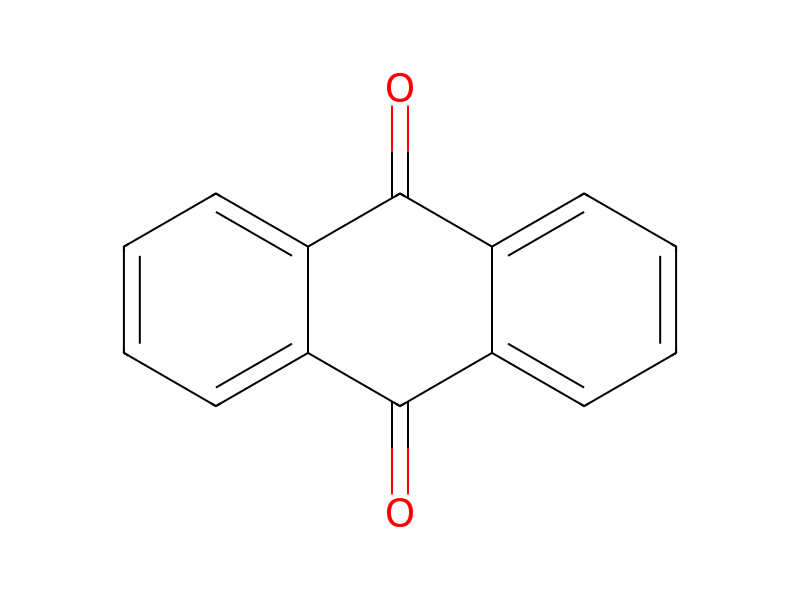
- 标准SMILES
O=C1c2ccccc2C(=O)c2ccccc21- InChIKey
RZVHIXYEVGDQDX-UHFFFAOYSA-N- 分子式
- C14H8O2
- 平均分子量
- 208.21 g/mol
- 单同位素质量
- 208.0524295
概述
Anthraquinone can cause cancer according to The National Toxicology Program.
名称与标识
- 首选名称
- Anthraquinone
- IUPAC
- anthracene-9,10-dione
- 中文名
- 蒽醌
- 英文名
- Anthraquinone
- 分子式
- C14H8O2
- 分子量
- 208.21
名称与别名
ANTHRAQUINONE84-65-1anthracene-9,10-dione9,10-Anthraquinone9,10-AnthracenedioneAnthradioneHoeliteMorkit9,10-DioxoanthraceneCorbitAnthrapel9,10-Anthrachinon
展开更多名称
恩恩菎蒽醌蒽醌-4游离蒽醌甙二苯基甲酮蒽醌化合物植物总蒽醌蒽醌对照品乙腈中蒽醌AQAnthracenedioneAnthrachinon9,10-anthracenequinone
DTXSID3020095AvipelKawasaki saqAnthracene, 9,10-dihydro-9,10-dioxo-030MS0JBDOEPA Pesticide Chemical Code 122701FLIGHT CONTROLCHEBI:40448
数据库标识
- CAS
84-65-1- PubChem CID
- 6780
- DTXSID
DTXSID3020095- ChEMBL
CHEMBL55659- ChEBI
CHEBI:40448- UNII
- 030MS0JBDO
- EC Number
- 201-549-0
- Nikkaji
- J294A
性质
结构计算性质
- XLogP
- 3.4
- 极性表面积
- 34.1 Ų
- 氢键供体
- 0
- 氢键受体
- 2
- 可旋转键
- 0
- 重原子
- 16
- 形式电荷
- 0
- 复杂度
- 261
实验与物化性质
Chemical Classes
Other Classes -> Aromatic Ketones
Dye
Semi-Volatile Organic Compound (SVOC) and(or) Waste-water effluent contaminant
SpringerMaterials Properties13C nuclear magnetic resonance spectrum
Pesticides
Repellants
Active substance -> EU Pesticides database: Not approved
Pesticide (Anthraquinone) -> USDA PDB
LogP
log Kow = 3.39
3.39
3.28
OdorAromatic odor (technical)
Density
1.438 at 68 °F (NTP, 1992) - Denser than water; will sink
1.42-1.44 at 20 °C/4 °C
1.4 g/cm³
1.42-1.44 @ 20°C
Color/Form
Light yellow, slender monoclinic prisms by sublimation in vacuo. Almost colorless, orthorhombic, bipyramidal crystals from sulfuric acid and water.
Yellow rhombic needles from alcohol, benzene
Yellow-green crystals
Solubility
less than 1 mg/mL at 73 °F (NTP, 1992)
0.44 g/100 g alc at 25 °C; 2.25 g/100 g boiling alc; 0.11 g/100 g ether at 25 °C; 0.61 g/100 g chloroform at 20 °C; 0.26 g/100 g benzene at 20 °C; 0.30 g/100 g toluene at 25 °C
SOL IN CONCN SULFURIC ACID
Soluble in acetone
In water, 1.353 mg/L at 25 °C
Solubility in water: very poor
Flash Point
365 °F (NTP, 1992)
185 °C
365 °F (185 °C) (Closed cup)
185 °C c.c.
Boiling Point
714 to 718 °F at 760 mmHg (NTP, 1992)
377 °C at 760 mm Hg
380 °C
376.9 °C @760 [mm Hg]
DecompositionWhen heated to decomposition it emits acrid smoke and irritating fumes.
Melting Point
547 °F (sublimes) (NTP, 1992)
286 °C
Liquid Molar Volume = 0.193625 cu m/kmol; IG Heat of Formation = -9.52X10+7 J/kmol; Heat Fusion at Melting Point = 3.2552X10+7 J/kmol
286 °C
286 °C
物理化学性质
- 熔点
- 284 · 284-286 °C (lit.)
- 沸点
- 379 · 379-381 °C (lit.)
- 堆积密度
- 600 kg/m3 · 600kg/m3
- 密度
- 1.438 · 1.438
- 蒸气密度
- 7.16 · 7.16 (vs air)
- 蒸气压
- 1 mm · 1 mm Hg ( 190 °C)
- 折射率
- 1.5681 · 1.5681 (estimate)
- 闪点
- 365 °F · 365 °F
- 储存条件
- no restrictions.
- 溶解度
- 0.00007 g/l · 0.00007g/l
- 形态
- Powder
- 颜色
- Yellow-green to khaki to tan
- 水溶解性
- 0.1 g/100 · <0.1 g/100 mL at 23 ºC
- Merck
- 14 · 14,687
- BRN
- 390030 · 390030
- Henry's Law Constant
- 4.2 · 4.2×102 mol/(m3Pa) at 25℃, Duchowicz et al. (2020)
- 稳定性
- Stable. Incompatible with strong oxidizing agents. Combustible.
- 主要应用
- food and beveragespharmaceutical
- InChI
- 1S/C14H8O2/c15-13-9-5-1-2-6-10(9)14(16)12-8-4-3-7-11(12)13/h1-8H
- InChIKey
- RZVHIXYEVGDQDX-UHFFFAOYSA-N
- SMILES
- O=C1c2ccccc2C(=O)c3ccccc13
- LogP
- 3.39 · 3.39-3.4 at 30℃
- CAS 数据库
- 84 · 84-65-1(CAS DataBase Reference)
- (IARC)致癌物分类
- 2 B · 2B (Vol. 101) 2013
- NIST化学物质信息
- 9 · 9,10-Anthraquinone(84-65-1)
- EPA化学物质信息
- Anthraquinone (84-65-1)
化学性质
黄色针状结晶。熔点 286C(升华);沸点 377~381C (760mmHg,升华为黄色针状晶体)。蒸气压:5X10mPa(20C),1X10mPa(25C,OECD 104)。KowlgP=3.52(22C)。Henry常数1.24X10Pam/mol(20C,计算)。相对密度1.44 (20C)。水中溶解度(20C)0.084mg/L;其他溶剂中溶解度(g/kg):氯仿6.1,苯2.6(20C), 乙醇4.4,甲苯3.0,乙醚1.1(25C)。在酸或碱性条件下稳定。
安全与法规
GHS分类
GHS Classification
Danger
H350: May cause cancer [Danger Carcinogenicity]
P203, P280, P318, P405, and P501 (click each P-code to see the statement)
This chemical does not meet GHS hazard criteria for 4.1% (10 of 242) of reports.
Danger
H317 (80.6%): May cause an allergic skin reaction [Warning Sensitization, Skin]
危害信息
Regulatory Information
Chemical: 9,10-Anthracenedione
Hazard Traits - Carcinogenicity
9,10-Anthracenedione is listed on the EPA's Chemical Data Reporting (CDR) system. Manufacturers and importers of 9,10-Anthracenedione are required to report information about their production and use of this chemical to the EPA under the Toxic Substances Control Act (TSCA). (40 eCFR Part 711)
Anthraquinone is listed in the dataset of EPA Human Health Benchmarks for Pesticides under the Safe Drinking Water Act (40 eCFR 141)
2008/986
Status: Active Update: 10-01-2023 https://echa.europa.eu/registration-dossier/-/registered-dossier/2211
Other Safety InformationIMAP assessments - 9,10-Anthracenedione: Human health tier II assessment
Fire Hazards
This chemical is combustible. (NTP, 1992)
Combustible.
Fire PotentialConbustible when exposed to heat or flame.
Health HazardsSYMPTOMS: Symptoms following exposure to this compound may include skin and eye irritation, allergic skin reaction and skin sensitization. It may cause discoloration of the urine.
Hazards Summary
May cause skin irritation and sensitization; [Merck Index] Toxic by ingestion; Found in certain plants, e.g., Rhamnus berries; A skin irritant; [HSDB] An irritant and possible skin sensitizer; [CAMEO] An irritant; [ICSC] No results for 84-65-1[EC/RN Number] AND dermatitis, allergic contact[mesh]; [PubMed] Allergic dermatitis reported; [RTECS] Antraquuinone, insoluble in water and lipids, is biologically inert. [Ullmann] An irritant; [MSDSonline]
Reactive GroupHydrocarbons, Aromatic
Special Reports
ZWAVING JH; RECENT DEVELOPMENTS IN THE ANALYSIS OF ANTHRAQUINONE DERIVATIVES; PHARMACOLOGY 20(SUPPL 1) 65 (1980). A REVIEW & DISCUSSION ON RECENT DEVELOPMENTS IN THE ANALYSIS OF ANTHRAQUINONE DERIVATIVES.
FRIEDMANN CA; STRUCTURE-ACTIVITY RELATIONSHIPS OF ANTHRAQUINONES IN SOME PATHOLOGICAL CONDITIONS; PHARMACOLOGY 20(SUPPL 1) 113 (1980). A REVIEW ON THE STRUCTURE-ACTIVITY RELATIONSHIPS OF ANTHRAQUINONES IN SOME PATHOLOGICAL CONDITIONS.
ANTON R ET AL; PHARMACOLOGY 20 (SUPPL 1): 104 (1980). A REVIEW & DISCUSSION ON THE THERAPEUTIC USE OF NATURAL ANTHRAQUINONE FOR OTHER THAN LAXATIVE ACTIONS.
TSCA Requirements
Pursuant to section 8(d) of TSCA, EPA promulgated a model Health and Safety Data Reporting Rule. The section 8(d) model rule requires manufacturers, importers, and processors of listed chemical substances and mixtures to submit to EPA copies and lists of unpublished health and safety studies. Anthraquinone is included on this list.
Manufacturers and processors of anthraquinone are required to conduct specific chemical tests as required under TSCA section 4.
Reactivity ProfileANTHRAQUINONE is incompatible with strong oxidizing agents. (NTP, 1992)
Atmospheric Standards
This action promulgates standards of performance for equipment leaks of Volatile Organic Compounds (VOC) in the Synthetic Organic Chemical Manufacturing Industry (SOCMI). The intended effect of these standards is to require all newly constructed, modified, and reconstructed SOCMI process units to use the best demonstrated system of continuous emission reduction for equipment leaks of VOC, considering costs, non air quality health and environmental impact and energy requirements. Anthraquinone is produced, as an intermediate or a final product, by process units covered under this subpart.
Chemical DangersDecomposes on burning. This produces toxic fumes.
安全与防护
Fire Fighting
Fires involving this compound should be controlled using a dr chemical, carbon dioxide or Halon extinguisher. A water spray can also be use. (NTP, 1992)
Use water spray, powder, foam, carbon dioxide.
First Aid Measures
Fresh air, rest.
Rinse and then wash skin with water and soap.
First rinse with plenty of water for several minutes (remove contact lenses if easily possible), then refer for medical attention.
Rinse mouth.
First Aid
EYES: First check the victim for contact lenses and remove if present. Flush victim's eyes with water or normal saline solution for 20 to 30 minutes while simultaneously calling a hospital or poison control center. Do not put any ointments, oils, or medication in the victim's eyes without specific instructions from a physician. IMMEDIATELY transport the victim after flushing eyes to a hospital even if no symptoms (such as redness or irritation) develop.
Safe StorageStore in an area without drain or sewer access.
Fire Fighting ProceduresTo fight fire use water, foam, carbon dioxide, water spray or mist, dry chemical.
Nonfire Spill Response
SMALL SPILLS AND LEAKAGE: Should a spill occur while you are handling this chemical, FIRST REMOVE ALL SOURCES OF IGNITION, then you should dampen the solid spill material with 60-70% ethanol and transfer the dampened material to a suitable container. Use absorbent paper dampened with 60-70% ethanol to pick up any remaining material. Seal the absorbent paper, and any of your clothes, which may be contaminated, in a vapor-tight plastic bag for eventual disposal. Solvent wash all contaminated surfaces with 60-70% ethanol followed by washing with a soap and water solution. Do not reenter the contaminated area until the Safety Officer (or other responsible person) has verified that the area has been properly cleaned.
Disposal Methods
SRP: The most favorable course of action is to use an alternative chemical product with less inherent propensity for occupational exposure or environmental contamination. Recycle any unused portion of the material for its approved use or return it to the manufacturer or supplier. Ultimate disposal of the chemical must consider: the material's impact on air quality; potential migration in soil or water; effects on animal, aquatic, and plant life; and conformance with environmental and public health regulations.
Spillage DisposalPersonal protection: particulate filter respirator adapted to the airborne concentration of the substance. Do NOT let this chemical enter the environment. Sweep spilled substance into covered containers.
Preventive Measures
SRP: The scientific literature for the use of contact lenses in industry is conflicting. The benefit or detrimental effects of wearing contact lenses depend not only upon the substance, but also on factors including the form of the substance, characteristics and duration of the exposure, the uses of other eye protection equipment, and the hygiene of the lenses. However, there may be individual substances whose irritating or corrosive properties are such that the wearing of contact lenses would be harmful to the eye. In those specific cases, contact lenses should not be worn. In any event, the usual eye protection equipment should be worn even when contact lenses are in place.
Eye PreventionWear safety goggles.
Fire PreventionNO open flames.
Skin PreventionProtective gloves.
毒理信息
Interactions
Anthraquinone seems to inhibit the function of certain enzymes in the S-9 mix (rat liver homogenate) by which 3-amino-1-methyl-5H-pyrido(2,3-b)indol, 2-acetylaminofluorene and benzo(a)pyrene are activated. Ina mutation assay (according to Ames with some modification) anthraquinone decreased markedly the mutagenicities of the mutagens mentioned above (test strains: S.typhimurium TA 98, TA 100; assay with metabolic activation).
Ecotoxicity Values
LC50 Lepomis macrochirus (Bluegill) >5 mg/L/24 hr; Static
LC50 Pimephales promelas (Fathead minnow) 2,650 mg/L/96 hr /Conditions of bioassay not specified in source examined/
EC50 Lemna gibba (Duckweed; growth inhibition) 1.5 mg/L/7 days; renewal, under photosynthetically active radiation
EC50 Lemna gibba (Duckweed; growth inhibition) 1.5 mg/L/7 days; renewal, under simulated solar radiation
EC50 Lemna gibba (Duckweed; growth inhibition) 1.5 mg/L/7 days; renewal, after photomodification
Environmental Fate
TERRESTRIAL FATE: Based on a classification scheme(1), Koc values of 2,755-17,416, determined in five European reference soils(2), indicates that anthraquinone is expected to have slight mobility or be immobile in soil(SRC). Volatilization of anthraquinone from moist soil surfaces is not expected to be an important fate process(SRC) given an estimated Henry's Law constant of 2.35X10⁻⁸ atm-cu m/mole(SRC), based upon its vapor pressure, 1.16X10⁻⁷ mm Hg(3), and water solubility, 1.35 mg/L(4). Anthraquinone is not expected to volatilize from dry soil surfaces(SRC) based upon its vapor pressure. Direct photolysis is possible on sunlit solid surfaces(5). Biodegradation of anthraquinone is expected to be a major fate process for this compound in soil; 68% of added anthraquinone was biodegraded by a mixed soil population within 12 weeks(6). A mixed bacterial population, isolated from a coal-tar contaminated soil, biodegraded anthraquinone even faster with only 6.5% of the initial concentration of anthraquinone remaining after 3 days(7). A BOD/ThOD of 54% and a CO2/ThCO2 of 41% were measured in a biodegradation study using a garden soil inoculum and a 58-day incubation period(8). Rapid degradation, apparently due to microbial activity, has been reported for different soils with half-lives of 7-10 days(5).
AQUATIC FATE: Based on a classification scheme(1), Koc values of 2755-17416, determined in five European reference soils(2), indicate that anthraquinone is expected to adsorb to suspended solids and sediment(SRC). Volatilization from water surfaces is not expected(3) based upon an estimated Henry's Law constant of 2.35X10⁻⁸ atm-cu m/mole(SRC) derived from its vapor pressure, 1.16X10⁻⁷ mm Hg(4), and water solubility, 1.35 mg/L(5). According to a classification scheme(6), an estimated BCF of 12(SRC), from its log Kow of 3.39(7) and a regression-derived equation(8), suggests the potential for bioconcentration in aquatic organisms is low(SRC). Anthraquinone is stable to aqueous environmental hydrolysis, but sensitive to light with a reported direct photolysis half-life of about 9 minutes in aqueous solution(9).
AQUATIC FATE: Biodegradation of anthraquinone in the water column is expected to be a major fate process. Over a three day period, 82% of the added anthraquinone (at 10 mg/L) was degraded by river water, 91% was degraded by sea water(1). Biodegradation using mixed cultures from seawater degraded anthraquinone 50% over 10 days; metabolite concentration was low but included mainly benzoic and phthalic acids(2). Mixed bacterial populations from groundwater were able to completely degrade anthraquinone within 5 days(3). From 50-100% degradation has been reported using activated sludge as an inoculum and a three week incubation period(4-9).
ATMOSPHERIC FATE: According to a model of gas/particle partitioning of semivolatile organic compounds in the atmosphere(1), anthraquinone, which has a vapor pressure of 1.16X10⁻⁷ mm Hg at 25 °C(2), will exist in both the vapor and particulate phases in the ambient atmosphere. Vapor-phase anthraquinone is degraded in the atmosphere by reaction with photochemically-produced hydroxyl radicals(SRC); the half-life for this reaction in air is estimated to be about 11 days(SRC), calculated from its rate constant of 1.5X10⁻¹² cu cm/molecule-sec at 25 °C(SRC) that was derived using a structure estimation method(3). Anthraquinone absorbs at wavelengths >290nm(4) and therefore may be susceptible to direct photolysis by sunlight(SRC). Anthraquinone is sensitive to light in aqueous solution with a reported half-life of about 9 minutes(6) which suggests direct photolysis in air may be important(SRC). Particulate-phase anthraquinone may be removed from the air by wet or dry deposition(SRC); anthraquinone has been detected in rain water from several storm events(5).
Adverse EffectsIARC Carcinogen - Class 3: Chemicals are not classifiable by the International Agency for Research on Cancer.
Plant Concentrations2 of 6 samples of mosses collected near a chemical factory in Czechoslovakia and 3 of 6 samples of needles from the same area contained anthraquinone; (mosses = 1756.8 to 4054.1 ng/g; needles = 459.5 to 1918.9 ng/g)(1).
Animal Concentrations2 of 5 earthworm samples collected near a chemical factory in Czechoslovakia contained anthraquinone; (concentrations = 473 to 4715.9 ng/g)(1).
Signs and Symptoms
Cough.
Pain. Redness.
Ongoing Test Status
The following link will take the user to the National Toxicology Program (NTP) Test Agent Search Results page, which tabulates all of the "Standard Toxicology & Carcinogenesis Studies", "Developmental Studies", and "Genetic Toxicity Studies" performed with this chemical. Clicking on the "Testing Status" link will take the user to the status (i.e., in review, in progress, in preparation, on test, completed, etc.) and results of all the studies that the NTP has done on this chemical. [http://ntp-apps.niehs.nih.gov/ntp_tox/index.cfm?fuseaction=ntpsearch.searchresults&searchterm=84-65-1]
Effluent Concentrations
Anthraquinone was emitted at concns of 24.3 and 4.4 ug/km, resepectively, during particulate emission tests (simulating urban driving conditions) of tailpipes of non-catalyst (average of 1965 Mercury Monterey, 1969 Ford Mustang, 1970 Buick Skylark, 1972 Chevrolet Caprice, 1974 Ford Pinto, and 1976 Volkswagen Beetle) and catalyst cars (average of 1977 Chevrolet Vega, 1980 Honda Civic 150, 1980 Honda 1500, 1980 Toyota Corolla, Datsun 200 SX, 1983 Chevrolet Malibu CL, and 1983 Dodge Omni), and at a concn of 23.5 ug/km from tailpipes of heavy-duty diesel trucks (average of a 1987 GMC truck, two-axle, and a 1987 Ford Dump truck, three-axle)(1). Particulate samples obtained from an automobile using a diesel engine contained anthraquinone at unreported concns(2). Diesel emission particulates from a Volkswagen Rabbit contained anthraquinone(3). Particulate emissions from a representative small aircraft gas turbine engine contained detectable quantities of anthraquinone in 5 of 8 different sampling conditions (concns of 0.06-58.49 ng/cu m; detection limit = 0.01 ug)(4). Organic extracts of emissions from burning cereal straw contained anthraquinone at 995 ug/kg fuel(5). Particulate samples from the exhaust of a flame retention head residential oil burner combusting No. 2 fuel oil contained anthraquinone(6).
Anthraquinone was detected in 2 of 4 extracts of MM5 air sampling trains from 4 different municipal waste incinerators (concentration = 2.9-9.0 ug/ml)(1). Flyash extracts from municipal incinerators contained anthraquinone in 3 of 5 sites(2). Anthraquinone was identified in the flyash of an Ontario municipal incinerator at unreported concentrations(3). Anthraquinone was not detected in tire wear particles and was present at concentrations of 0.31 and 0.41 ug/g in brake lining particles and road dust particles, respectively(4).
Anthraquinone was detected in leachate (concentration = 0.7 ug/l) from central Texas lignite under conditions meant to replicate rainfall leaching of coal piles(1). Tap water (pH = 9) exposed to test panels coated with a commercial coal tar contained anthraquinone(2). Anthraquinone was detected in pulping liquors from processes using this compound as a catalyst for the delignification of wood; in black liquors n=14, concentration = 3.0-170 mg/L; in alkaline pulping liquors n = 6, concentration = 0.5-11.5 mg/L; in wash liquors n = 5, concentration = 0.13-0.75; in filtrates from bleaching n = 5, concentration = 0.04-0.66(3). Anthraquinone was detected at concentrations of 49-110 ppb in the raw wastewater of a dye manufacturing plant; it was not detected in the final effluent of the same plant(4). Anthraquinone was detected in 235 samples obtained from superfund sites; data were compiled from CLP Analytical Results Database(5).
Anthraquinone was detected in particulate emissions collected from the tailpipes of diesel and gasoline vehicles at conc of 1.3 to 130 ug/g (extract mass) in Japan(1). An anthraquinone conc of 2.8 ug/cu m was detected in smoke particulate matter collected from a controlled burn of forest litter in the Amazon(2).
ICSC Environmental DataThe substance is harmful to aquatic organisms. The substance may cause long-term effects in the aquatic environment.
Soil Adsorption/Mobility
Using an HPLC screening technique and five European reference soils, Koc values ranging from 2,755 to 17,416 were determined for anthraquinone(1). According to a suggested classification scheme(2), these Koc values suggest that anthraquinone has slight mobility or is immobile in soil(SRC). Laboratory trials with BBA soils did not reveal any leaching potential(3). Results of a 23-day soil column leaching study have shown that anthraquinone has the potential to reach ground water under recharge conditions similar to those in arid and semi-arid climates(4).
Atmospheric Concentrations
SOURCE DOMINATED: Anthraquinone was detected in one of eight air samples (concentration = 44.5 ng/cu m) near a chemical factory in Czechoslovakia(1). Air samples from a freeway tunnel in Japan contained a conc of 52 ug/g (extract mass)(2). Anthraquinone was detected in air samples collected in the potroom of an aluminum reduction plant at a concentration of 297 ng/cu m(3).
URBAN/SUBURBAN: Organic extracts from airborne particulate matter collected in Barcelona, Spain contained anthraquinone at 9, not detected, 26, and 21 pg/cu m during the spring, summer, fall, and winter, respectively(1). Atmospheric aerosol samples were collected in Barcelona; anthraquinone was present in the summer sample at 82 pg/cu m and in the winter sample at 75 pg/cu m(2). Anthraquinone was detected in airborne particulate matter in Duisburg, Germany from February to April, 1982 (concentration = 0.22-1.89 ng/cu m(3). Ambient air levels of anthraquinone in Toronto, Ontario were reported as 0.9 to 1.3 pg/cu m(4). 2 of 7 sites in the US sampled for ambient air particulates (Upland, CA; Lake Charles, LA) contained anthraquinone at unreported concentrations(5). Mean gas and particulate-phase concentrations of anthraquinone were measured in Portland, OR during February and April, 1984 and February and April, 1985 (gas concentration = 2.5 ng/cu m; particulate concn = 0.59 ng/cu m)(6). Urban air particles from St. Louis, MO contained anthraquinone at unreported concentrations(7). An anthraquinone concentration of 0.3 ng/cu m was detected in ambient air samples collected from Los Angeles, CA during a smog episode on Sept 8, 1993(8). Atmospheric particulate samples collected from 12 sites in southern California in 1995 contained anthraquinone concentrations of 0.011 to 0.218 ng/cu m(9).
RURAL/REMOTE: Airborne particulate matter sampled near Chacaltaya, Bolivia (remote location) and Antwerp, Belgium (urban location) contained anthraquinone in 6 of 6 samples (Bolivia, n = 2, concentration = 0.064-0.065 ug/1000 cu m; Belgium, n = 4, concentration = 0.57-1.0 ug/1000 cu m; detection limit = 0.02 ug/1000 cu m)(1). An anthraquinone concentration of 2.8 ug/g (total weight mass) was reported for a Japanese rural air sample(2).
法规信息
TSCA Requirements
Pursuant to section 8(d) of TSCA, EPA promulgated a model Health and Safety Data Reporting Rule. The section 8(d) model rule requires manufacturers, importers, and processors of listed chemical substances and mixtures to submit to EPA copies and lists of unpublished health and safety studies. Anthraquinone is included on this list.
Manufacturers and processors of anthraquinone are required to conduct specific chemical tests as required under TSCA section 4.
Atmospheric Standards
This action promulgates standards of performance for equipment leaks of Volatile Organic Compounds (VOC) in the Synthetic Organic Chemical Manufacturing Industry (SOCMI). The intended effect of these standards is to require all newly constructed, modified, and reconstructed SOCMI process units to use the best demonstrated system of continuous emission reduction for equipment leaks of VOC, considering costs, non air quality health and environmental impact and energy requirements. Anthraquinone is produced, as an intermediate or a final product, by process units covered under this subpart.
安全数据
- wgk
- 1
- tsca
- TSCA listed
- 毒性
- LD50 orally in Rabbit: > 5000 mg/kg
- RTECS号
- CB4725000
- 包装类别
- III
- 危险等级
- 9
- 存储类别
- 6.1C - Combustible acute toxic Cat.3toxic compounds or compounds which causing chronic effects
- 安全说明
- 36/37-37/39-26-24
- 海关编码
- 2914 61 00
- 自燃温度
- 650 °C
- 危险品标志
- Xi
- 危险性类别
- Carc. 1BSkin Sens. 1
- 危险类别码
- 43-36/37/38
- 毒害物质数据
- 84-65-1(Hazardous Substances Data)
- 危险品运输编号
- 3077
毒性防护
急性毒性口服- 小鼠 LD50: 5000 毫克/ 公斤; 口服-大鼠 LDL0: 15000 毫克/公斤
职业标准STEL 5 毫克/ 立方米
包装储运
可燃性危险特性明火高温可燃; 燃烧产生刺激烟雾
储运特性库房通风低温干燥
灭火剂干粉,泡沫,二氧化碳, 雾状水
化学与工业
药理信息
Mechanism of Action
The quinones are alpha-beta-unsaturated ketones and react with sulfhydryl (-SH) groups. This reaction has been suggested as the critical biochemical lesion involving the -SH groups of enzymes such as amylase and carboxylase which are inhibited by quinones. ... Overall /fungicidal/ mechanism may involve binding of enzyme to quinone nucleus by substitution or addition at the double bond, oxidative reaction with -SH group, and change in redox potential. /Quinones/
Metabolism/Metabolites
Yields anthrone, 9,10-dihydroxyanthracene, and 2-hydroxyanthraquinone in rats. /from table/
Quinones (ie, 6,12-dione) have been shown to undergo oxidation-reduction cycles involving quinone, hydroquinone, and molecular oxygen, resulting in the formation of oxygen radicals and semiquinone radicals. /Quinones/
Anthraquinone (labelled with 14C in the 9,10-positions) was administered orally in a dose of 5 mg/kg bw to male rats and the urine and the feces of the animals were collected until 48 hr after administration: the elimination ratio (renal: fecal) amounted to about 1:1.6. The main elimination product in feces, anthraquinone amounted to minimum 40% of the totally recovered radioactivity (in the excreta and the carcass 48 hr after administration), non conjugated 2-hydroxy-anthraquinone as a minor fecal metabolite was found in approximately 4%. Urine contained as main biotransformation product (approximately 20% of the totally recovered radioactivity) conjugated 2-hydroxy-anthraquinone, unchanged anthraquinone amounted to about 1% in the urine.
In a study of the metabolism of anthraquinone, rats were maintained for 4 days on a diet containing 5% of anthraquinone, the urines being collected daily. The following urinary metabolites were detectable: 2-hydroxyanthraquinone and its sulphuric ester, conjugates of 9-hydroxy-, 9,10-dihydroxy- and 2,9,10-thrihydroxyanthracene and anthrone.
A metabolism study was conducted using male Fischer 344 rats in which they were fed formulations of 4 lots of anthraquinone, produced by three different synthetic routes, with concentrations of 938, 3750 and 7500 ppm and a control diet containing no anthraquinone in irradiated NTP 2000 feed for seven consecutive days. One of the lots had been previously used to conduct subchronic and chronic rodent toxicity studies in feed. Ten animals were used per group. The formulations were prepared using anthraquinone with particle sizes smaller than 80 mesh and consistent in distribution for each lot. All animals were placed in individual metabolism cages following dosing and urine was collected for 24 hours. The urine of all animals from each group was pooled. The purpose of this study was to evaluate any difference in absorption and metabolism of the anthraquinone. A high performance liquid chromatographic method with ultraviolet absorbance detection (HPLC/UV) was developed to analyze the urine samples for 1- and 2-hydroxyanthraquinone, metabolites of anthraquinone. The method consisted of extracting 2 mL of urine with three 2-mL aliquots of ethyl acetate, combining them, evaporating, and reconstituting in 25% water:75% acetonitrile. The reconstituted extracts were analyzed using a C18 reverse-phase column, a mobile phase starting at 75% water:25% acetonitrile, remaining there for 5 minutes and then going to 25%water:75% acetonitrile over 20 minutes with a linear gradient, and a detection wavelength of 260 nm. This method was validated and found to have acceptable linearity, specificity, sensitivity, accuracy, precision, recovery, and ruggedness. Analysis of the samples found that the metabolic profiles and concentrations were consistent for each source of anthraquinone at a given dose level. 1- and 2-hydroxyanthraquinone and anthraquinone were found in all samples from the dosed animals. Within a given sample the concentrations of 2-hydroanthraquinone and anthraquinone were similar and the concentration of 1-hydroxyanthraquinone was approximately 2% of the other two.
Absorption, Distribution and Excretion
Following a single oral administration of anthraquinone (labelled with 14C in the 9,10-positions) at dose levels of 0.1, 1.0, 3.0 mg/kg bw (male rats) or of 1.0 mg/kg bw (females rats), the radioactivity resulting from anthraquinone was nearly completely absorbed, the absorption commencing after a short lag period of about 2-3 minutes. After dosing male or female rats with 1.0 mg/kg bw, the absorption could not be described by a unique half-life. Following administration of 0.1 mg/kg bw to males, the absorption period was best characterized by a half-life of roughly 40 minutes, the maximum plasma level of P=0.75 was reached after 2.5 hr. Following oral administration of 1.0 mg/kg bw to males of females, the plasma concentration peaked after 5 hr (P=0.46) and 12 hr (P=0.43), respectively. The radioactivity was slowly eliminated form the body: 2 days after oral intubation on average about 5% of the administered dose could be measured in the body excluding the GI tract, within 2 days after oral administration <0.01% of the recovered radioactivity were excreted with the expired air. Within the test interval of 2 days about 95% of the retrieved radioactivity were excreted with urine and feces after oral administration, the ratio of the amounts excreted via both routes was about 1.6 (feces:urine). At sacrifice of the male rats 48 hr after administration of 1.0 mg/kg bw, a relative concentration of P=0.052 was determined in the body excluding the GI tract. In the kidney and in the liver these values were about 7 times higher and in the brain they were about 10 times lower as compared with the sum of all organs tissues. At sacrifice of the females a relative concentration of P=0.063 was determined in the body excluding the GI tract and in the kidney and in the liver these vales were about 8 times higher and in the fat and in the brain the relative concentrations were 4 times and 8 times, respectively, lower (results representing the sum of the unchanged substance and its labelled metabolites. P=relative concentration=activity measured/grams of plasma: activity administered/grams of bw).
/In animals/ elimination is quick; almost 96% is excreted within 48 hr in the urine and feces.
用途与制造
Uses
Used as a chemical intermediate for dyes and pigments, an additive in Kraft pulp processing, a catalyst in vegetable oil processing, an accelerant in nickel electroplating, an additive in tire manufacturing, and a bird repellent; [HSDB]
Electroplating [Category: Plate]
For anthraquinone (USEPA/OPP Pesticide Code: 122701) ACTIVE products with label matches. /SRP: Registered for use in the U.S. but approved pesticide uses may change periodically and so federal, state and local authorities must be consulted for currently approved uses./
Chem intermediate for vat dyes, acid dyes, mordant dyes, disperse dyes, solvent dyes, and for pigments
Anthraquinone serves as the basis for the production of a large number of acid and base dyes, vat dyes, disperse dyes, and reactive dyes.
As an additive in the soda and kraft chemical alkaline pulping processes in the paper pulping industry.
U.S. Imports
(1972) 3X10+7 GRAMS (PRINCPL CUSTMS DISTS)
(1975) 1.03X10+8 GRAMS (PRINCPL CUSTMS DISTS)
813,322 pounds (in 1983)
U.S. Production
2023: 1,636,495 lb
This chemical is listed as a High Production Volume (HPV) (65FR81686). Chemicals listed as HPV were produced in or imported into the U.S. in >1 million pounds in 1990 and/or 1994. The HPV list is based on the 1990 Inventory Update Rule. (IUR) (40 CFR part 710 subpart B; 51FR21438).
(1972) PROBABLY GREATER THAN 4.54X10+5 GRAMS
(1975) GREATER THAN 4.54X10+5 GRAMS
(1986) >500 thousand-1 million pounds
For more U.S. Production (Complete) data for ANTHRAQUINONE (8 total), please visit the HSDB record page.
Consumption PatternsEssentially 100% as a chemical intermediate for the manufacture of dyes (1976)
Consumer UsesOxidizing agent
Industry UsesChemical reaction regulator
Methods of Manufacturing
Through the oxidation of naphthalene to naphthaquinone, which is condensed with butadiene to yield tetrahydroanthraquinone; this is dehydrogenated to produce anthraquinone.
Industrial preperation from phthalic anhydride and benzene: From anthracene with vanadium pentoxide, sodium chlorate, glacial acetic, and sulfuric acids.
Anthracene + nitric acid, concentrated (nitric acid oxidation process); o-Benzoylbenzoic acid (acid-catalyzed condensation)
Styrene is dimerized in the liquid phase to 1-methyl-3-phenylindane, utilizing phosphoric acid as catalyst, followed by catalytic vapor phase oxidation to anthraquinone.
For more Methods of Manufacturing (Complete) data for ANTHRAQUINONE (6 total), please visit the HSDB record page.
Formulations/Preparations
Grades: sublimed; 30% paste (sold on 100% basis); electrical 99.5%.
Anthraquinone cathartics all contain characteristic derivatives which are present in the free state ...or in glycosidic combination with glucose, arabinose, or rhamnose. Major active constituents ... /include/ anthraquinone ...
As seed dressings: 25% wp or in conjunction with other seed protectants.
Seed treatments (DS, FS, WP)
For more Formulations/Preparations (Complete) data for ANTHRAQUINONE (6 total), please visit the HSDB record page.
Household ProductsInformation on 6 consumer products that contain Anthraquinone in the following categories is provided:
General Manufacturing Information
Paper Manufacturing
9,10-Anthracenedione: ACTIVE
BASIC PRODUCERS: BAYER AG (WEST GERMANY) (CORBIT*, MORKIT*)
Anthraquinone dye. A dye whose molecular structure is based on anthraquinone. ... C.I. numbers from 58000 to 72999. These are acid or mordant dyes when OH or HSO3 groups respectively are present. Those anthraquinone dyes that can be reduced to alkaline sol leuco (vat) derivative that has affinity for fibers, & which can be reoxidized to the dye, are known as anthraquinone vat dyes. They are largely used on cotton, rayon, & silk, & have excellent properties of color and fastness. /Anthraquinone dye/
... Disperse dyes (used for acetate, rayon & synthetic fibers) ... disperse colors may be anthraquinone ... dyes...
Fungicidal activity is found in variety of quinones in general order 1,4-naphthoquinone greater than phenanthroquinone greater than p-benzoquinone greater than anthraquinone.
应用领域
用途有机合成中高级染中间体,如阴丹士林类还原染料、酸性染料、部份活性染料重要原料。 用作造纸蒸煮剂及双氧水原料等,可降低用碱量,缩短蒸煮时间。 用作造纸制浆蒸煮剂 在碱法蒸煮液中只需加入少量蒽醌,即可加快脱木素的速度,缩短蒸煮时间,提高纸浆得率,减少废液负荷。目前使用蒽醌添加剂的造纸厂越来越多。
用途用作造纸制浆蒸煮助剂,可降低用碱量,缩短蒸煮时间。
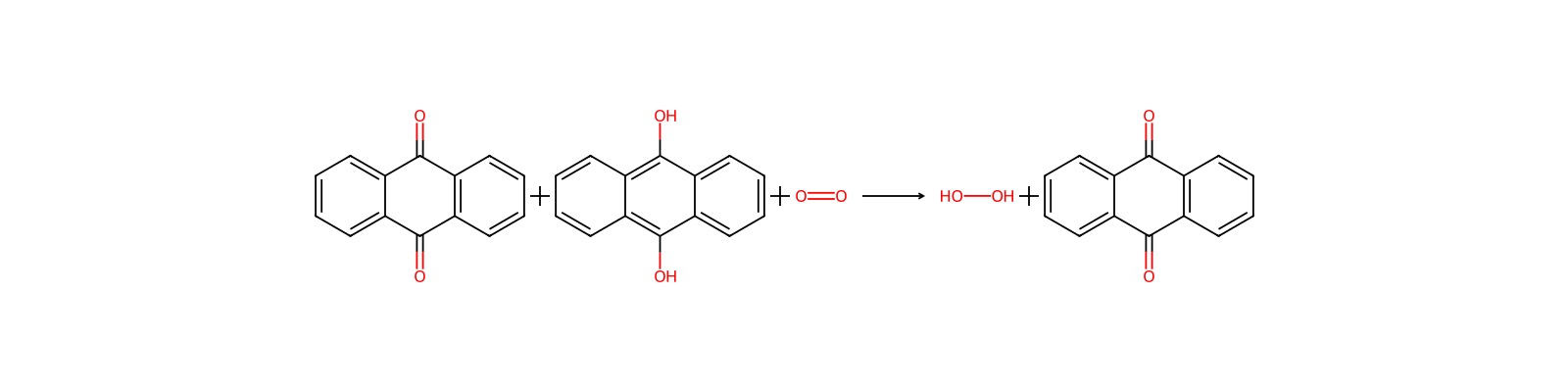
用途蒽醌绝大部分用于染料方面,但用作制纸浆的蒸解助剂的用量已在迅速增加。(1)用于染料的生产 以蒽醌为原料,经磺化、氯化、硝化等,可得到范围很广的染料中间体,用于生产蒽醌系分散染料、酸性染料、还原染料、反应染料等,形成色谱全、性能好的染料类别。据统计,蒽醌染料有四百多个品种,在合成染料领域中占有很重要的地位。(2)用作造纸制浆蒸煮剂 在碱法蒸煮液中只需加入少量蒽醌,即可加快脱木素的速度,缩短蒸煮时间,提高纸浆得率,减少废液负荷。目前使用蒽醌添加剂的造纸厂越来越多。蒽醌作为蒸煮添加剂的消费量增长得很快。蒽醌还有其他的应用领域。蒽醌化合物可用于高浓度过氧化氢的生产;在化肥工业中用以制造脱硫剂蒽醌二磺酸钠。在印染工业中用作拔染助剂。
制备方法
生产方法在第一次世界大战前,蒽醌产量很小,仅有以重铬酸钠将蒽氧化为蒽醌的一种生产方法。20世纪40年代发展了蒽的气相催化氧化法。目前,在美国广泛采用苯酐法。近年来,又发展了萘醌法和苯乙烯法。1.蒽气相催化氧化法蒽氧化法是以精蒽为原料,以空气作氧化剂,五氧化二钒为催化剂,进行气相催化氧化,反应器有固定床和硫化床两种类型。 我国蒽醌生产厂大多采用固定床反应器,用含量大于90%的精蒽,熔化后用300℃左右的热空气以1560立方米/h的流速带出汽化精蒽,在热风管道中混合后通过固定床催化氧化的列管反应器,总收率达80%-85%。原料消耗定额:精蒽(90%)1260kg/t。氧化蒽醌所用原料精蒽来自煤焦油蒸馏,不含无机离子。氧化蒽醌的生产过程中,主要采用蒸馏和气相催化氧化,没有废水废气产生,不会产生氯离子、硫酸根离子和铁离子等,所以氧化蒽醌在用作高档染料方面具有竞争优势。其缺点是原料精蒽受煤焦油产品的制约。2.苯酐法 以苯酐、苯为原料,以三氯化铝为催化剂,进行付-克(Friedel-Crafts)反应,然后用浓硫酸脱水生成蒽醌。苯酐法又分为溶剂法、球磨法和气相缩合法。我国大多采用溶剂法,即以过量的苯为溶剂。此法原料易得,可以从石油做起,具有反应温度低、设备简单、副反应少等优点。缺点是污染严重,三氯化铝废酸水不易处理,而且生产成本高。我国合成蒽醌均采用苯酐法。原料消耗定额:苯酐768kg/t、纯苯700kg/t、硫酸(98%)1364kg/t、三氯化铝1554kg/t、发烟硫酸1000kg/t。3.萘醌法以萘醌和丁二烯为原料,以氯化亚铜为催化剂,进行缩合反应、脱氢后得蒽醌。由于石油化工的飞速发展,提供了此法所用的大量原料丁二烯和萘醌。该法具有消耗低、三废少等优点,在日本和美国萘醌法已达到相当规模,有发展前途。日本川崎公司使用此法生产。我国科研部门进行过大量研究,虽然小式、中式均已成功,但未工业化生产。该法的缺点是萘醌和丁二烯本身价格较高,目前,由于反应动力学研究不够,催化剂性能不佳,经常出现床层飞温烧床,操作弹性小。4.苯乙烯法 由苯乙烯先进行二聚反应,然后氧化成邻苯酰基苯甲酸,再环合成蒽醌。该方法的优点是原料易得,没有苯酐法的铝盐废水引起的公害问题,产品成本较低。但反应条件较苛刻,技术复杂,设备要求高,是德国BASF研究的新成果,但目前还未放大到工业生产规模。此外,日本三井化学公司获得了以甲苯为原料制备蒽醌的专利。由于工艺简单、原料便宜,引起了人们的关注。
生产方法精蒽氧化法气相固定床氧化法 将精蒽加入气化室加热气化后与空气混合,二者比例为1︰(50~100)。混合气体进入氧化室,在V2O5催化下于(389±2) ℃下氧化,经薄壁冷凝后即得产品。液相氧化法 将精蒽计量后加入反应釜,再加入三氯苯在搅拌下溶解。然后滴加硝酸,控制反应温度105~110 ℃,将副产物NO排除,反应6~8 h后,减压蒸出溶剂,冷却结晶。得产品。此法设备腐蚀严重。苯酐法 将苯酐计量后加入反应釜,加苯在搅拌下加热熔解。加热至370~470 ℃,使混合气通过硅铝催化剂进行气相缩合。得产品。羧基合成法 将计量的苯加入反应釜,在4.88 MPa下通CO,于200 ℃反应4 h,一直通到CO压力不再下降,反应结束。经处理得产品。
上下游产品信息
上游原料
下游产品
试剂价格
- HY-N0354R · 50 mg
- 蒽醌Anthraquinone (Standard) — 330元
- HY-N0354 · 25 g
- 蒽醌Anthraquinone — 100元
供应商50 家
国药集团化学试剂有限公司86-21-63210123 · [email protected]
北京华美互利生物化工010-56205725 · [email protected]
梯希爱(上海)化成工业发展有限公司021-67121386 · [email protected]
衢州润东化工有限公司0570-8789886 18892685668 · [email protected]
上海阿拉丁生化科技股份有限公司400-6206333 13167063860 · [email protected]
泰安环宇化工有限公司13176825516; 13176825516
爱斯特(成都)生物制药股份有限公司+86-28-85122536 85324413 · [email protected]
上海如吉生物科技发展有限公司+86-21-65211385-8001 36031160 · [email protected]
韶远科技(上海)有限公司021-50795510 4000665055 · [email protected]
科瑞迪化学400-821-5857 021-64326257 · [email protected]
Syntechem Co.,Ltd[email protected]
上海迈瑞尔生化科技有限公司4006356688 18621169109 · [email protected]
武汉易泰科技有限公司上海分公司18930552037 · [email protected]
大连美仑生物技术有限公司0411-62910999 13889544652 · [email protected]
阿法埃莎(中国)化学有限公司400-6106006 · [email protected]
太原市瑞和丰科贸有限公司+86 351 7031519 · [email protected]
安耐吉化学&3A(安徽泽升科技股份有限公司)400-0056266 · [email protected]
上海瀚鸿科技股份有限公司021-54306202 13764082696 · [email protected]
天津万象恒远科技有限公司15722085254 · [email protected]
上海景颜化工科技有限公司13817811078 · [email protected]
Pure Chemistry Scientific Inc.001-857-928-2050 or 1-888-588-9418 · [email protected]
济南瑞朗化工有限公司0531-80993178 15621249788
合肥天健化工有限公司551-65418679 15856988503;15837135945 · [email protected]
孝感深远化工有限公司15527621225; 15527621225 · [email protected]
云南西力生物技术股份有限公司0871-65217109 · [email protected]
山东省立帆化工有限公司17864861555 · [email protected]
山东西亚化学有限公司13355009207 13355009207 · [email protected]
玛雅试剂+86 (573) 82222445 (0)18006601000 452520369 · [email protected]
四川库利南科技有限公司400-1166-196 18981987031 · [email protected]
天津希恩思生化科技有限公司400 638 7771 · [email protected]
北京泰亚杰科技有限公司021-33690831-8001 13552411790;18616022633 · [email protected]
上海源叶生物科技有限公司13636370518 · [email protected]
艾科试剂4008-755-333 18080918076 · [email protected]
上海思域化工科技有限公司86-21-34053660 · [email protected]
赛默飞世尔科技(中国)有限公司800-810-5118 · [email protected]
北京伊诺凯科技有限公司400-810-7969 010-59572699 · [email protected]
江苏艾康生物医药研发有限公司025-66113011 13913916777 · [email protected]
上海健超生物科技有限公司150-2103-5486 18017383231 · [email protected]
TCI AMERICA800-4238616 · [email protected]
TOKYO CHEMICAL INDUSTRY CO., LTD.03-36680489 · [email protected]
TCI Europe320-37350700 · [email protected]
上海贤鼎生物科技有限公司4009209199 · [email protected]
上海陶素生化科技有限公司021-33632979 · [email protected]
上海倍卓生物科技有限公司021-61119791,13386096464 · [email protected]
上海将来实业股份有限公司400-0066400 13621662912 · [email protected]
上海将来实业股份有限公司021-61552785 · [email protected]
安徽科迪达化工有限公司0554-2106669 · [email protected]
日照力德士化工有限公司010-51268198 · [email protected]
上海爱蝶实业有限公司021-58957966 18930537195 · [email protected]
四川省维克奇生物科技有限公司028-81700200 18116577057 · [email protected]
相关反应
202 条



关联笔记
加载中…