
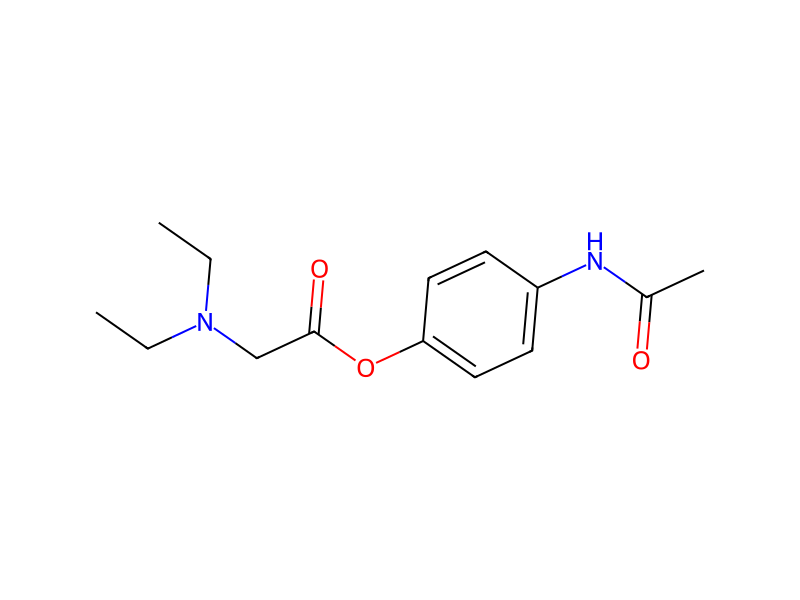
基本信息
- 标准SMILES
CCN(CC)CC(=O)Oc1ccc(NC(C)=O)cc1- InChIKey
QTGAJCQTLIRCFL-UHFFFAOYSA-N- 分子式
- C14H20N2O3
- 平均分子量
- 264.32 g/mol
- 单同位素质量
- 264.1473925
概述
Propacetamol is an alpha-amino acid ester.
名称与标识
- 首选名称
- Propacetamol
- IUPAC
- (4-acetamidophenyl) 2-(diethylamino)acetate
- 中文名
- 丙帕他莫
- 英文名
- Propacetamol
- 分子式
- C14H20N2O3
- 分子量
- 264.32
名称与别名
Propacetamol66532-85-2PropacetamolumDTXSID30578005CHW4JMR82DTXCID70315894-acetamidophenyl 2-(diethylamino)acetateRefChem:176249N02BE05N, N-diethylglycine 4'-hydroxyacetanilide ester266-390-1(4-acetamidophenyl) 2-(diethylamino)acetate
展开更多名称
丙帕他莫盐酸丙帕他莫化合物 PROPACETAMOLN,N-二乙甘氨酸4-(乙酰胺基)苯酯二乙胺基乙酸 4-(乙酰胺基)苯酯盐酸盐PropacetamoPro-DafalganPropacatemolPropacetamol USP/EP/BP4-Acetamidophenyl N,N-diethylglycinate4-acetamidophenyl N,N-diethylaminoacetateN,N-Diethylglycine 4-(acetylamino)phenyl ester(Diethylamino)acetic acid 4-(acetylamino)phenyl
Propacetamol [INN]Glycine, N,N-diethyl-, 4-(acetylamino)phenyl esterPropacetamol (INN)Propacetamolum [Latin]EINECS 266-390-1Propacetamol [INN:BAN]UNII-5CHW4JMR82Propacetamol (Standard)
数据库标识
- CAS
66532-85-2- PubChem CID
- 68865
- DTXSID
DTXSID3057800- ChEMBL
CHEMBL1851805- ChEBI
CHEBI:135089- UNII
- 5CHW4JMR82
- EC Number
- 266-390-1
- Nikkaji
- J32.504J
性质
结构计算性质
- XLogP
- 1.1
- 极性表面积
- 58.6 Ų
- 氢键供体
- 1
- 氢键受体
- 4
- 可旋转键
- 7
- 重原子
- 19
- 形式电荷
- 0
- 复杂度
- 295
实验与物化性质
Chemical ClassesOther Uses -> Pharmaceuticals
DrugsPharmaceuticals -> Listed in ZINC15
SolubilitySoluble
Boiling Point434.5ºC at 760 mmHg
物理化学性质
- 熔点
- 55 · 55-57 °C
- 沸点
- 434.5 · 434.5±30.0 °C(Predicted)
- 密度
- 1.132 · 1.132±0.06 g/cm3(Predicted)
- 储存条件
- -20 °C · Store at -20°C
- 溶解度
- 2 O · H2O : 100 mg/mL (378.33 mM; Need ultrasonic)
- 酸度系数(pKa)
- 14.2 · 14.20±0.70(Predicted)
- 形态
- Solid
- 颜色
- White to off-white
- CAS 数据库
- 66532 · 66532-85-2(CAS DataBase Reference)
化学性质
粘稠油。盐酸丙帕他莫(Propacetamol Hydrochloride):C14H20N2O3HCl。[66532-86-3]。溶于水。熔点228℃。
安全与法规
危害信息
Hazards SummaryAllergic contact dermatitis reported in nurses (contact and airborne dermatitis); [Kanerva, p. 1829]
毒理信息
Adverse EffectsSkin Sensitizer - An agent that can induce an allergic reaction in the skin.
Drug Induced Liver Injury
Drug-Induced Liver Injury Severity and Toxicity (DILIst)
Propacetamol
DILI Positive
DOI:10.1016/j.drudis.2019.09.022
化学与工业
药理信息
ATC Code
N - Nervous system
QN - Nervous system
Protein BindingPropacetamol is very rapidly converted into paracetamol and this later component tends to present a very negligible binding to plasma proteins.
Pharmacodynamics
Propacetamol is hydrolyzed to paracetamol and then it presents a weak inhibition of COX-1 and COX-2 which is translated into a low anti-inflammatory activity. Therefore, in high inflammatory conditions, such as rheumatoid arthritis, these agents show limited in vivo suppression of inflammation and platelet activity. The formation of N-arachidonoylphenolamine, donates paracetamol with analgesic and antipyretic properties.
Mechanism of Action
As propacetamol is a prodrug, its mechanism of action is directly linked to the activity of paracetamol. The mechanism of action of paracetamol is described by the inhibition of prostaglandin synthesis. This inhibition is attained by inhibition of COX-1 and COX-2 in an environment where arachidonic acid and peroxides are kept low. It is considered that paracetamol presents a very complex mechanism of action involving effects in the peripheral system, described by direct COX inhibition; the central system, characterized by inhibition of COX, serotonergic descending neuronal pathway, L-arginine/NO pathway and cannabinoid system; and a redox mechanism. In the brain and spinal cord, paracetamol can combine with arachidonic acid to form N-arachidonoylphenolamine. This metabolite is an activator of capsaicin receptor (TRPV1) and cannabinoid CB1.
Biological Half-LifeThe half-life of propacetamol is of 3.6 h.
Metabolism/Metabolites
After administration, propacetamol is completely converted by plasma esterases into N, N-diethylglycine and paracetamol. The latest is the active metabolite. It is reported that the active metabolite of propacetamol can be transformed to N-acetil-p-benzoquinone imine by CYP2E1 which is a hepatotoxic metabolite.
MeSH Pharmacological Classification
Compounds capable of relieving pain without the loss of CONSCIOUSNESS.
Anti-inflammatory agents that are non-steroidal in nature. In addition to anti-inflammatory actions, they have analgesic, antipyretic, and platelet-inhibitory actions. They act by blocking the synthesis of prostaglandins by inhibiting cyclooxygenase, which converts arachidonic acid to cyclic endoperoxides, precursors of prostaglandins. Inhibition of prostaglandin synthesis accounts for their analgesic, antipyretic, and platelet-inhibitory actions; other mechanisms may contribute to their anti-inflammatory effects.
Absorption, Distribution and Excretion
The bioavailability of 2g of propacetamol is similar to the bioavailability found in 1 g of intravenous paracetamol. Peak plasma concentration is obtained as and from the end of infusion. Pharmacokinetic analysis with intravenous propacetamol showed a significantly higher and earlier maximum plasma concentration than orally administered paracetamol. The Cmax, Tmax and AUC are 12.72 mcg/ml, 0.25 h and 25.5 mcg.h/ml. After infusion with propacetamol, significant concentrations of paracetamol are observed in cerebrospinal fluid.
The metabolites of propacetamol are mainly excreted in the urine. From the elimination rate, 90% of the administered dose is excreted in 24 hours mainly as glucuronide and sulfate conjugates. Less than 5% is eliminated as unchanged paracetamol.
The volume of distribution of propacetamol is 1.29 l/kg.
The clearance rate of propacetamol is 0.28 l.h/kg.
用途与制造
UsesThis pro-drug of acetaminophen is administered intravenously. [Kanerva, p. 1829]
应用领域
概述丙帕他莫为对乙酰氨基酚的前体药物,临床应用其盐酸盐,经静脉注射或肌内注射进入人体后,可迅速被血浆酯酶水解生成游离态对乙酰氨基酚,克服了对乙酰氨基酚的不稳定性,发挥解热、镇痛等药理作用。丙帕他莫产生的镇痛作用与阿片类药物相似,但无中枢神经系统抑制作用,故不会引起呼吸抑制、恶心呕吐等不良反应,具有非成瘾性及高效镇痛的特点;作为新型非甾体类解热镇痛药,其作用机制不同于传统非甾体类药物,具有较小的肾不良反应、胃肠道不良反应及血液作用,其处方既简单又安全,值得在临床上推广使用。
用途解热镇痛药,在体内转化为扑热息痛而产生作用。用于治疗各种疾病的疼痛和发热症状。
制备方法
生产方法对乙酰胺基苯酚溶于二甲基甲酰胺,冰浴和搅拌下滴加氯乙酰氯,在室温下搅拌。缓慢升温至70℃。冰浴冷却,加水。滤集结晶,用丙酮重结晶,得氯乙酸(4一乙酰胺基)苯酯,收率31.9%。将其溶入丙酮,冰浴冷却下加入过量二乙胺,回流。过滤除去二乙胺盐酸盐,滤液减压浓缩。加入水,乙醚萃取,干燥,通入氯化氢。滤集固体,无水乙醇重结晶,得白色针状的盐酸丙帕他莫结晶,收率50.5%,熔点118.5~120℃。总收率16.1%。上述方法也可如下进行:对乙酰胺基苯酚、碳酸钾和丙酮混合,在5~8℃下滴加氯乙酰氯,室温反应后回流。冷至40℃加入碘化钾和二乙胺,回流。冷至室温过滤,滤液减压浓缩后,加入无水乙醇,通氯化氢至不再有固体析出。过滤,无水乙醇重结晶,得白色针状的盐酸丙帕他莫结晶,熔点118~120℃,总收率可达46.8%。
上下游产品信息
上游原料
试剂价格
- HY-145453R · 5 mg
- 丙帕他莫Propacetamol (Standard) — 280元
- HY-145453R · 10 mg
- 丙帕他莫Propacetamol (Standard) — 424元
供应商39 家
北京华美互利生物化工010-56205725 · [email protected]
HubeiwidelychemicaltechnologyCo.,Ltd18627774460 · [email protected]
湖北金梭生物科技有限公司00123456789 · [email protected]
Dayang Chem (Hangzhou) Co.,Ltd.+86-0571-88938639 17705817739 · [email protected]
浙江珲达生物科技有限公司0571-89903022 18679456698 · [email protected]
LGM Pharma1-(800)-881-8210 · [email protected]
湖南瑞威尔生物科技有限公司15608648206 13297919155 · [email protected]
江西瑞威尔生物科技有限公司18502728206 · [email protected]
太原市瑞和丰科贸有限公司+86 351 7031519 · [email protected]
武汉菲越生物科技有限公司027-87002654 15827563343
上海隆盛化工有限公司58099637 13585536065 · [email protected]
孝感深远化工有限公司15527621225; 15527621225 · [email protected]
宝鸡缔都医药化工有限公司029-81145305 17791533577 · [email protected]
Xiamen AmoyChem Co., Ltd+86-86-5926051114 · [email protected]
四川省维克奇生物科技有限公司028-81700200 18116577057 · [email protected]
武汉峰耀同辉化学制品有限公司027-87466205 15377579727 · [email protected]
湖北恒绿源科技有限公司027-88188016 18717196322 · [email protected]
厦门志信化学有限公司+86-5922680277 +86-13806087780 · [email protected]
湖南瑞威尔生物科技有限公司19359985961 · [email protected]
广州新长实医药生物科技有限公司19066311943 · [email protected]
山东永信生物科技有限公司15866604075 · [email protected]
湖南瑞威尔生物科技有限公司18502762003
湖北健楚生物医药有限公司027-027-65021350 18164064948
深圳市祥根生物医药有限公司0755-28967200 13631290199 · [email protected]
杭州洁汉化工有限公司+86-571-86217390; +8618058761490 · [email protected]
心邀(深圳)生物科技有限公司0755-89880280 · [email protected]
武汉峰耀同辉化学制品有限公司027-87466105 15377573527 · [email protected]
厦门盈融达化工有限公司+86-0592-6210733 · [email protected]
成都圣美凯生物科技有限公司028-85157043 15882256948 · [email protected]
XIAMEN AMITY INDUSTRY AND TRADE CO., LTD.+8618950047208 · [email protected]
TargetMol中国(陶术生物)4008200310 15002144251 · [email protected]
SUZHOU SENFEIDA CHEMICAL CO.,LTD+86-0512-83500002 +86-15195660023 · [email protected]
Mainchem Co., Ltd.+86-86-05926210733 · [email protected]
重庆卡兰医药有限公司[email protected]
吉林省吉创致远医药有限公司19543148466 · [email protected]
上海药领医药科技合伙企业(有限合伙)400-6181121 18616383988 · [email protected]
武汉汇百信科技有限公司17364282875 · [email protected]
上海博拓生物科技有限公司16621358918 · [email protected]
Dideu Industries Group Limited+8617392712697 · [email protected]
相关反应
1 条
关联笔记
加载中…