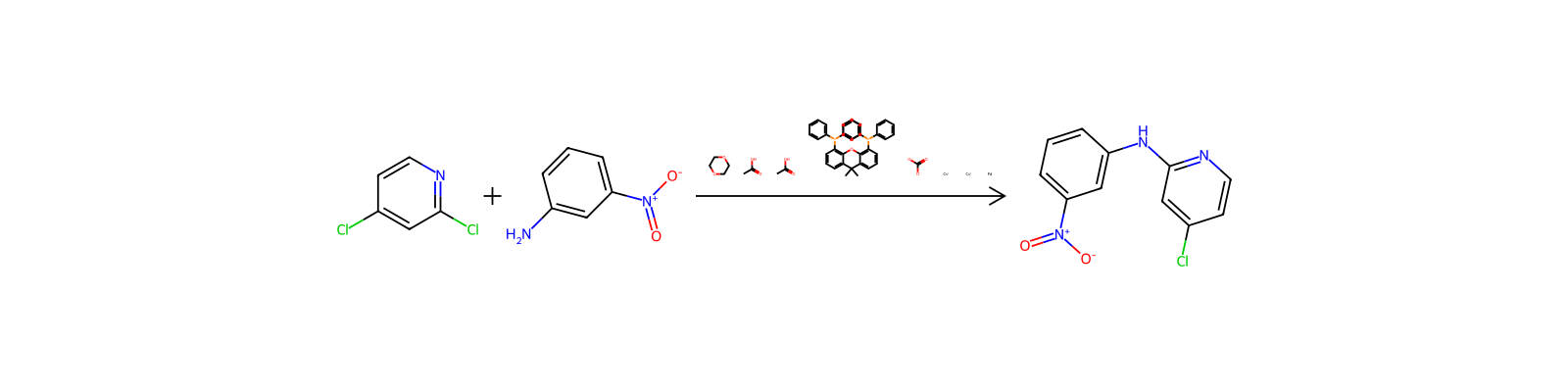
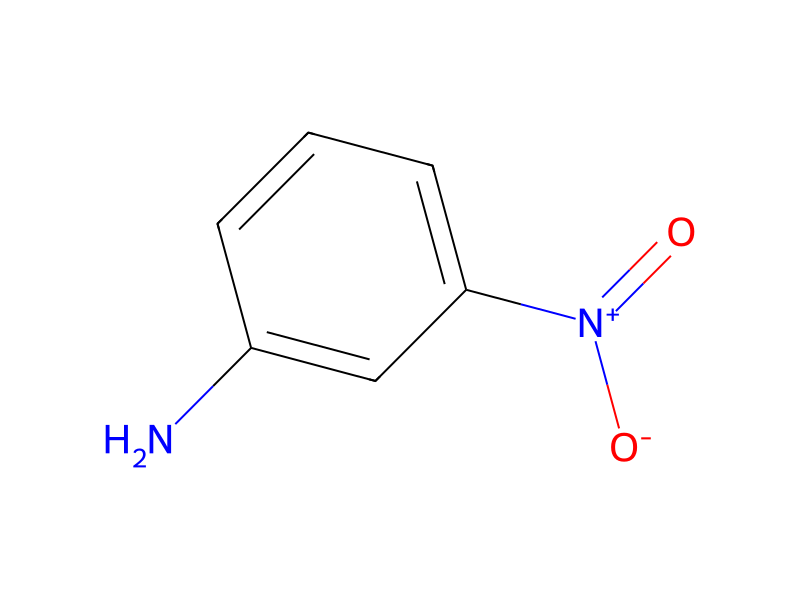
基本信息
- 标准SMILES
Nc1cccc([N+](=O)[O-])c1- InChIKey
XJCVRTZCHMZPBD-UHFFFAOYSA-N- 分子式
- C6H6N2O2
- 平均分子量
- 138.12 g/mol
- 单同位素质量
- 138.04292743
概述
M-nitroaniline appears as yellow needles or yellow powder. (NTP, 1992)
名称与标识
- 首选名称
- 3-Nitroaniline
- IUPAC
- 3-nitroaniline
- 中文名
- 3-硝基苯胺
- 英文名
- 3-Nitroaniline
- 分子式
- C6H6N2O2
- 分子量
- 138.12
名称与别名
3-Nitroaniline99-09-2M-NITROANILINEBenzenamine, 3-nitro-3-Nitrobenzenaminem-NitranilineFast Orange Base RNitranilin3-Aminonitrobenzene1-Amino-3-nitrobenzeneFast Orange R BaseDevol Orange R
展开更多名称
間硝苯胺耐晒橙R间硝基苯胺间氨基硝基苯3-硝基苯胺间硝基二苯胺间硝基苯胺标准溶液间硝基苯胺,99%间硝基苯胺,98%3-硝基苯胺,98%3-Nitroanilinci37030c.i.370303-Nitroaniazobasemna
Azobase MNADaito Orange Base Rm-Nitrophenylaminem-Aminonitrobenzenem-NitroaminobenzeneAniline, m-nitro-Fast Orange M BaseFast Orange R Salt
数据库标识
- CAS
99-09-2- PubChem CID
- 7423
- DTXSID
DTXSID6025725- ChEMBL
CHEMBL14068- UNII
- CM50SM561T
- EC Number
- 202-729-1
- Nikkaji
- J3.991H
性质
结构计算性质
- XLogP
- 1.4
- 极性表面积
- 71.8 Ų
- 氢键供体
- 1
- 氢键受体
- 3
- 可旋转键
- 0
- 重原子
- 10
- 形式电荷
- 0
- 复杂度
- 132
实验与物化性质
Chemical ClassesNitrogen Compounds -> Nitroanilines
SpringerMaterials Properties13C nuclear magnetic resonance spectrum
LogP
log Kow = 1.37
1.37
1.43
OdorBurning sweet odor
Density
0.9011 at 77 °F (NTP, 1992) - Less dense than water; will float
0.9011 at 25 °C/4 °C
1.4 g/cm³
0.9011 @25 °C
Color/Form
Yellow crystals from water
YELLOW RHOMBIC NEEDLES
Solubility
less than 1 mg/mL at 72.5 °F (NTP, 1992)
Slightly soluble in benzene; soluble in ethanol, ether, acetone; very soluble in methanol
Soluble in chloroform
1 g/20 mL alcohol; 1 g/18 mL ether; 1 g/11.5 mL methanol
In water, 1,200 mg/L at 24 °C
Solubility in water, g/100ml at 25 °C: 0.089
Flash Point199 °C
Boiling Point
581 to 585 °F at 760 mmHg (decomposes) (NTP, 1992)
306 °C, decomposes
306.4 °C @760 [mm Hg]
Decomposition
When heated to decomp it emits toxic fumes of /nitrogen oxides/.
306 °C
Melting Point
237 °F (NTP, 1992)
114 °C
Heat of fusion at melting point = 23.6 kJ/mol
114 °C
114 °C
Vapor Pressure
1 mmHg at 246.7 °F ; 760 mmHg at 582.3 °F (NTP, 1992)
0.0000956 [mmHg]
9.56X10⁻⁵ mm Hg at 25 °C
Vapor pressure, Pa at 25 °C: 0.005
0.0000362 [mm Hg] @25 °C
物理化学性质
- 熔点
- 111 · 111-114 °C (lit.)
- 沸点
- 306 °C · 306 °C
- 密度
- 0 · 0,901 g/cm3
- 蒸气压
- 1 mm · 1 mm Hg ( 119 °C)
- 折射率
- 1.6396 · 1.6396 (estimate)
- 闪点
- 196 °C · 196 °C
- 储存条件
- 30 °C · Store below +30°C.
- 溶解度
- 1.25 g/l · 1.25g/l
- 色指数
- 37030 · 37030
- 形态
- Crystals, Crystalline Powder and/or Chunks
- 酸度系数(pKa)
- 2.466 · 2.466(at 25℃)
- 颜色
- Yellow to ochre-yellow to orange
- 比重
- 0.901 · 0.901
- 水溶解性
- 1.25 g/L · 1.25 g/L
- 比热容
- 1.15 J/ · Cp(crystal): 1.15 J/(g·K), at 25℃
- Merck
- 14 · 14,6581
- BRN
- 636962 · 636962
- Henry's Law Constant
- 1.93 x · 1.93 x 10-5 atmm3/mol at 25 °C (approximate - calculated from water solubility and vapor pressure)
- InChI
- 1S/C6H6N2O2/c7-5-2-1-3-6(4-5)8(9)10/h1-4H,7H2
- InChIKey
- XJCVRTZCHMZPBD-UHFFFAOYSA-N
- SMILES
- Nc1cccc(c1)[N+]([O-])=O
- CAS 数据库
- 99 · 99-09-2(CAS DataBase Reference)
- NIST化学物质信息
- m-Nitroaniline(99-09-2)
- EPA化学物质信息
- m-Nitroaniline (99-09-2)
化学性质
黄色针状结晶或粉末。 微溶于水,溶于乙醇、乙醚、甲醇。
安全与法规
GHS分类
GHS Classification
Danger
H301: Toxic if swallowed [Danger Acute toxicity, oral]
P260, P261, P262, P264, P270, P271, P273, P280, P301+P316, P302+P352, P304+P340, P316, P319, P321, P330, P361+P364, P403+P233, P405, and P501 (click each P-code to see the statement)
Danger
H301+H311+H331 (97.9%): Toxic if swallowed, in contact with skin or if inhaled [Danger Acute toxicity, oral; acute toxicity, dermal; acute toxicity, inhalation]
P260, P261, P262, P264, P270, P271, P273, P280, P301+P316, P302+P352, P304+P340, P316, P319, P321, P330, P361+P364, P403+P233, P405, and P501 (click each P-code to see the statement)
危害信息
Regulatory Information
Chemical: Benzenamine, 3-nitro-
Status: Active Update: 27-04-2016 https://echa.europa.eu/registration-dossier/-/registered-dossier/16880
3-Nitroaniline: Does not have an individual approval but may be used under an appropriate group standard
DOT LabelPoison
Fire Hazards
Flash point data for this chemical are not available; however, it is probably combustible. (NTP, 1992)
Combustible. Many reactions may cause fire or explosion. Finely dispersed particles form explosive mixtures in air.
Health Hazards
SYMPTOMS: Symptoms of exposure to this compound may include cyanosis and liver damage. When inhaled or ingested, this compound may cause headache, flushing of the face, difficult breathing, nausea, vomiting, weakness, drowsiness, irritability and dermatitis. Structurally similar chemicals may cause methemoglobinemia.
Hazards Summary
m-Nitroaniline is in the ACGIH table of Industrial Chemicals for Which Methemoglobin Formation is the Principal Cause of Toxicity. It emits toxic fumes of nitrogen oxides when heated. Methemoglobinemia has been reported after acute exposure and liver injury after chronic exposure. m-Nitroaniline is toxic after ingestion, inhalation, and skin exposure. [HSDB] Can induce methemoglobinemia; [ICSC]
Reactive GroupNitro, Nitroso, Nitrate, and Nitrite Compounds, Organic
EC ClassificationSymbol: T; R: 23/24/25-33-52/53; S: (1/2)-28-36/37-45-61; Note: C
UN ClassificationUN Hazard Class: 6.1; UN Pack Group: II
Special Reports
Santodonato J et al; Monographs on Human Exposure to Chemicals in the Workplace: Nitroanilines 1-26 (1985). This report summarizes and evaluates toxicologic information relevant to an occupational hazard assessment of nitroanilines, including chemical and physical properties, production and use, extent of occupational exposure, pharmacokinetics, animal carcinogenicity and mutagenicity, and epidemiological studies.
TSCA Requirements
Pursuant to section 8(d) of TSCA, EPA promulgated a model Health and Safety Data Reporting Rule. The section 8(d) model rule requires manufacturers, importers, and processors of listed chemical substances and mixtures to submit to EPA copies and lists of unpublished health and safety studies. Benzenamine, 3-nitro, is included on this list.
Reactivity Profile
Thermal stability of this compound is reduced by various impurities. This compound may be sensitive to prolonged exposure to light. This compound may react explosively with ethylene oxide at 266 °F. It is incompatible with acids (nitric, sulfuric), acid chlorides, acid anhydrides, chloroformates and strong oxidizing agents. (NTP, 1992). Unstable when heated.
Chemical DangersOn combustion, forms toxic fumes of nitrogen oxides. Reacts with strong acids, strong oxidants and strong reducing agents. Reacts with organic materials in the presence of moisture. This generates fire hazard.
安全与防护
Fire Fighting
Fires involving this material can be controlled with a dry chemical, carbon dioxide or Halon extinguisher. A water spray may also be used. (NTP, 1992)
Use water spray, powder, foam, carbon dioxide. In case of fire: keep drums, etc., cool by spraying with water. Combat fire from a sheltered position.
First Aid Measures
Fresh air, rest. Artificial respiration may be needed. Refer for medical attention.
Remove contaminated clothes. Rinse skin with plenty of water or shower. Refer for medical attention .
First rinse with plenty of water for several minutes (remove contact lenses if easily possible), then refer for medical attention.
Induce vomiting (ONLY IN CONSCIOUS PERSONS!). Refer for medical attention .
First Aid
EYES: First check the victim for contact lenses and remove if present. Flush victim's eyes with water or normal saline solution for 20 to 30 minutes while simultaneously calling a hospital or poison control center. Do not put any ointments, oils, or medication in the victim's eyes without specific instructions from a physician. IMMEDIATELY transport the victim after flushing eyes to a hospital even if no symptoms (such as redness or irritation) develop.
Safe StorageSeparated from strong acids, strong oxidants, combustible substances, reducing agents and food and feedstuffs. Dry.
Exposure Control and Personal ProtectionBiological Exposure Indices (BEI) [ACGIH] - Methemoglobin in blood = 1.5% of hemoglobin during or at end of shift. [ACGIH]
Fire Fighting Procedures
In case of fire: keep drums, etc., cool by spraying with water. Combat fire from a sheltered position. Powder, water spray, foam, carbon dioxide.
If material on fire or involved in fire: Extinguish fire using agent suitable for type of surrounding fire (Material itself does not burn or burns with difficulty.) Use water in flooding quantities as fog. Use water foam, dry chemical, or carbon dioxide. /Nitroanilines/
Wear positive pressure self-contained breathing apparatus when fighting fires involving this material. /Nitroanilines/
Storage ConditionsProtect against physical damage to containers and prevent from moisture contacts.
Cleanup Methods
1. Ventilate area of spill. 2. For small quantities, sweep onto paper or other suitable material, place in an appropriate container & burn in a safe place (such as a fume hood). Large quantities may be reclaimed; however, if this is not practical, dissolve in a flammable solvent (such as alcohol) & atomize in a suitable combustion chamber equipped with an appropriate effluent gas cleaning device. /Nitroaniline/
Nonfire Spill Response
SMALL SPILLS AND LEAKAGE: Should a spill occur while you are handling this chemical, FIRST REMOVE ALL SOURCES OF IGNITION, then you should dampen the solid spill material with 60-70% ethanol and transfer the dampened material to a suitable container. Use absorbent paper dampened with 60-70% ethanol to pick up any remaining material. Seal the absorbent paper, and any of your clothes, which may be contaminated, in a vapor-tight plastic bag for eventual disposal. Solvent wash all contaminated surfaces with 60-70% ethanol followed by washing with a soap and water solution. Do not reenter the contaminated area until the Safety Officer (or other responsible person) has verified that the area has been properly cleaned.
Disposal Methods
SRP: The most favorable course of action is to use an alternative chemical product with less inherent propensity for occupational exposure or environmental contamination. Recycle any unused portion of the material for its approved use or return it to the manufacturer or supplier. Ultimate disposal of the chemical must consider: the material's impact on air quality; potential migration in soil or water; effects on animal, aquatic, and plant life; and conformance with environmental and public health regulations.
Spillage Disposal
Personal protection: particulate filter respirator adapted to the airborne concentration of the substance. Do NOT let this chemical enter the environment. Sweep spilled substance into covered containers. If appropriate, moisten first to prevent dusting. Carefully collect remainder.
Preventive Measures
PREVENT DISPERSION OF DUST! Do not eat, drink, or smoke during work. Wash hands before eating.
SRP: The scientific literature for the use of contact lenses in industry is conflicting. The benefit or detrimental effects of wearing contact lenses depend not only upon the substance, but also on factors including the form of the substance, characteristics and duration of the exposure, the uses of other eye protection equipment, and the hygiene of the lenses. However, there may be individual substances whose irritating or corrosive properties are such that the wearing of contact lenses would be harmful to the eye. In those specific cases, contact lenses should not be worn. In any event, the usual eye protection equipment should be worn even when contact lenses are in place.
AVOID BREATHING DUST; AVOID CONTACT WITH SKIN, EYES, CLOTHING.
SRP: Contaminated protective clothing should be segregated in such a manner so that there is no direct personal contact by personnel who handle, dispose, or clean the clothing. Quality assurance to ascertain the completeness of the cleaning procedures should be implemented before the decontaminated protective clothing is returned for reuse by the workers. Contaminated clothing should not be taken home at end of shift, but should remain at employee's place of work for cleaning.
For more Preventive Measures (Complete) data for 3-NITROANILINE (7 total), please visit the HSDB record page.
毒理信息
Ecotoxicity Values
LC50 Oryzias ladipes (Orange-red killfish) 158 mg/L/24 hr, 71 mg/L/48 hr, 69 mg/L/72 hr, 67 mg/L/96 hr; semi-static.
LC50 Oryzias ladipes (Orange-red killfish) 96 mg/L/48 hours; static.
EC50; Species: Chlorella pyrenoidosa (Green algae, 2x10+6 cell/mL); Conditions: freshwater, static, 22 °C, pH 7.4; Concentration: 58000 ug/L for 72 hr; Effect: population growth inhibition />98% purity/
EC50; Species: Daphnia magna (Water flea, 24 hr); Conditions: freshwater, static, 18-20 °C, pH 8.0-8.3, dissolved oxygen 8.1-9.7 mg/L; Concentration: 6770 ug/L for 24 hr (95% confidence interval: 3990-11000 ug/L); Effect: intoxication, immobilization />98% purity/
For more Ecotoxicity Values (Complete) data for 3-NITROANILINE (12 total), please visit the HSDB record page.
Environmental Fate
TERRESTRIAL FATE: Based on a classification scheme(1), Koc values of 44(2) and 87(3), indicate that 3-nitroaniline is expected to have very high to high mobility in soil(SRC). However, anilines are expected to bind strongly to humus or organic matter in soils due to the high reactivity of the aromatic amino group(7,8), suggesting that mobility may be much lower in some soils(SRC). Volatilization of 3-nitroaniline from moist soil surfaces is not expected to be an important fate process(SRC) given a Henry's Law constant of 7.9X10⁻⁹ atm-cu m/mole(4). 3-Nitroaniline is not expected to volatilize from dry soil surfaces(SRC) based upon a vapor pressure of 9.56X10⁻⁵ mm Hg(5). 3-Nitroaniline was determined to be non-biodegradable using the Japanese MITI protocol(6), indicating that biodegradation is not an important environmental fate process in soil(SRC).
AQUATIC FATE: Based on a classification scheme(1), Koc values of 44(2) and 87(3) indicate that 3-nitroaniline is not expected to adsorb to suspended solids and sediment(SRC). Volatilization from water surfaces is not expected(4) based upon a Henry's Law constant of 7.9X10⁻⁹ atm-cu m/mole(5). According to a classification scheme(6), BCFs of <10(7,8), suggest bioconcentration in aquatic organisms is low(SRC). 3-Nitroaniline is not expected to undergo hydrolysis in the environment due to the lack of functional groups that hydrolyze under environmental conditions(2). Aromatic amines react relatively rapidly in natural water with photochemically produced oxidants such as hydroxyl radicals and alkoxy radicals(9); half-lives of aniline are on the order of 30 hr of sunlight for hydroxyl radicals and 19 hr of sunlight for alkoxy radicals(9); reactions with 3-nitroaniline are likely to be somewhat slower due to the presence of the nitro function(SRC). 3-Nitroaniline was determined to be non-biodegradable using the Japanese MITI protocol(8), indicating that biodegradation is not an important environmental fate process in water(SRC).
ATMOSPHERIC FATE: According to a model of gas/particle partitioning of semivolatile organic compounds in the atmosphere(1), 3-nitroaniline, which has a vapor pressure of 9.56X10⁻⁵ mm Hg at 25 °C(2), will exist in both the vapor and particulate phases in the ambient atmosphere. Vapor-phase 3-nitroaniline is degraded in the atmosphere by reaction with photochemically-produced hydroxyl radicals(SRC); the half-life for this reaction in air is estimated to be 41 hours(SRC), calculated from its rate constant of 9.4X10⁻¹² cu cm/molecule-sec at 25 °C(SRC) that was derived using a structure estimation method(3). Particulate-phase 3-nitroaniline may be removed from the air by wet or dry deposition(SRC). 3-Nitroaniline does absorb light at wavelengths >290 nm(4) and therefore may be susceptible to direct photolysis by sunlight(SRC).
Adverse EffectsOccupational hepatotoxin - Secondary hepatotoxins: the potential for toxic effect in the occupational setting is based on cases of poisoning by human ingestion or animal experimentation.
Exposure RoutesThe substance can be absorbed into the body by inhalation of its vapour, through the skin and by ingestion.
Ecotoxicity Excerpts
/AQUATIC SPECIES/ The LC50 (96 hr) values and the bioconcentration factors (BCF) for nine anilines (aniline; 2-, 3-, 4-chloroaniline; 2-, 3-, 4-nitroaniline; 2,4- and 3,4-dichloroaniline) in the zebrafish (Brachydanio rerio) were determined. Biotransformation products of anilines in the zebrafish were analyzed by HPLC. The aim of the investigations was to find relationships between accumulation/elimination/metabolism and toxicity on the one hand and between chemical structure and biotransformation on the other. ... A good correlation of log BCF and of log Pow with log LC50 /was found/. This concurs with the assumption that the internal dose determines the toxicological effect. All anilines investigated, with the exception of 2- and 4-nitroaniline, were transformed into the corresponding acetanilides. The toxicity of the compounds was not altered by biotransformation. ...
Signs and Symptoms
Blue lips, fingernails and skin. Headache. Dizziness. Nausea. Confusion. Convulsions. Laboured breathing. Unconsciousness.
MAY BE ABSORBED! Further see Inhalation.
Further see Inhalation.
Effluent ConcentrationsRaw wastewater collected from a US dye manufacturing plant on the Black River in July 1976 contained 270 ppb nitroaniline (isomers unspecified); the final treated effluent contained no detectable levels of nitroaniline(1).
ICSC Environmental DataThe substance is harmful to aquatic organisms.
Medical Surveillance
Routine checking of lips, tongue, and nail beds of exposed personnel for signs of cyanosis. /Protect/ from exposure those individuals with anemia, cardiovascular, or pulmonary diseases.
Consider the points of attack (blood, heart, lungs and liver) in preplacement and periodic physical examinations. /4-Nitroaniline/
Routine checking of lips, tongue and nail beds of exposed personnel for signs of cyanosis. /Protect/ from exposure those individuals with anemia, cardiovascular or pulmonary diseases.
Soil Adsorption/Mobility
Soil adsorption studies using four silt loam soils and a 2-hour adsorption period determined a mean log Kom of 1.70 which corresponds to a Koc of 87 for 3-nitroaniline(1). 3-Nitroaniline had a measured log Koc of 1.64 which corresponds to a Koc value of 44(2). According to a classification scheme(3), these Koc values suggest that 3-nitroaniline is expected to have very high to high mobility in soil(SRC). 3-Nitroaniline was found to have a Kd value of 3.5 L/kg in homoionic K+ Montmorillonite type soil(4). However, anilines are expected to bind strongly to humus or organic matter in soils due to the high reactivity of the aromatic amino group(5,6), suggesting that mobility may be much lower in some soils(SRC).
Human Toxicity Excerpts
/SIGNS AND SYMPTOMS/ Acute exposure can cause methemoglobinemia, cyanosis. Chronic exposure may cause liver damage
/SIGNS AND SYMPTOMS/ Symptomatology: 1. Lips, tongue, and mucous membranes navy blue to black; skin slate gray, all without signs of cardiac or pulmonary insufficiency. 2. Severe headache, nausea, sometimes vomiting, dryness of throat. 3. Central nervous symptoms: confusion, ataxia, vertigo, tinnitus, weakness, disorientation, lethargy, drowsiness, and finally, coma. Convulsions may occur but appear to be uncommon. 4. Cardiac effects: heart blocks, arrhythmias, and shock. 5. Death, although uncommon, is usually due to cardiovascular collapse and not resp paralysis. 6. Urinary signs and symptoms may incl painful micturition, hematuria, hemoglobinuria, and renal insufficiency (usually mild). 7. A late acute hemolytic episode should be anticipated at 6 to 8 days after ingestion. /Aniline/
/OTHER TOXICITY INFORMATION/ ... Powerful methemoglobin former with attendant hemolytic effect..
/OTHER TOXICITY INFORMATION/ On prolonged and excessive exposures it may ... cause liver damage. ... Its vapors are highly toxic as well.
Artificial Pollution Sources3-Nitroaniline's production and use as an intermediate in the synthesis of dyes and pigments(1) may result in its release to the environment through various waste streams(SRC).
法规信息
TSCA Requirements
Pursuant to section 8(d) of TSCA, EPA promulgated a model Health and Safety Data Reporting Rule. The section 8(d) model rule requires manufacturers, importers, and processors of listed chemical substances and mixtures to submit to EPA copies and lists of unpublished health and safety studies. Benzenamine, 3-nitro, is included on this list.
安全数据
- F
- 8
- wgk
- 2
- tsca
- TSCA listed
- 毒性
- Acute LD50 for guinea pigs 450 mg/kg, mice 308 mg/kg, quail 562 mg/kg, rats 535 mg/kg (quoted, RTECS, 1985).
- RTECS号
- BY6825000
- 包装类别
- II
- 危险等级
- 6.1
- 存储类别
- 6.1A - Combustible acute toxic Cat. 1 and 2very toxic hazardous materials
- 安全说明
- 28-36/37-45-61-28A
- 海关编码
- 29214210
- 自燃温度
- 521℃
- 危险品标志
- T
- 危险性类别
- Acute Tox. 3 DermalAcute Tox. 3 InhalationAcute Tox. 3 OralAquatic Chronic 3STOT RE 2 Oral
- 危险类别码
- 23/24/25-33-52/53
- 毒害物质数据
- 99-09-2(Hazardous Substances Data)
- 危险品运输编号
- UN 1661 (NITROANILINES (o-, m-, p-))
毒性防护
急性毒性口服-大鼠LD50: 535 毫克/公斤;口服-小鼠LD50: 308 毫克/公斤
包装储运
可燃性危险特性遇明火可燃;燃烧产生有毒氮氧化物烟雾;与氧化剂反应
储运特性库房通风低温干燥; 与氧化剂、酸类、食品添加剂分开存放
灭火剂二氧化碳、泡沫、砂土、雾状水
化学与工业
药理信息
Mechanism of Action
THE RELATIVE MUTAGENIC ACTIVITIES OF AMINOANILINES HAVE BEEN ATTEMPTED TO BE RELATED TO PARAMETERS REFLECTING POTENTIAL FOR N-HYDROXYLATION AND STABILITY OF THE ARYLNITRENIUM IONS. THE NITRO GROUPS DEACTIVATE THE AMINE GROUP N-HYDROXYLATION AND THE EPOXIDATION, & NO ACTIVE PRODUCTS FROM CYTOCHROME P450 WOULD BE PREDICTED. THE ACTIVITY OF THE NITRO DERIVATIVES IS PRESUMED TO BE DUE TO TRANSFORMATION OF THE NITRO GROUP ITSELF TO AN ACTIVE MUTAGENIC SPECIES BY OTHER ENZYME SYSTEMS.
Metabolism/Metabolites
M-NITROANILINE YIELDS 2-AMINO-4-NITROPHENOL, M-PHENYLENEDIAMINE, & 4-AMINO-2-NITROPHENOL IN RABBIT; YIELDS M-NITROANILINE-N-GLUCOSIDE IN BEAN. /FROM TABLE/
... A simplified version of the isolated vascularly perfused rat small intestine was developed ... with 1,3-dinitrobenzene (1,3-DNB) as a model xenobiotic. Both 3-nitroaniline (3-NA) and 3-nitroacetanilide (3-NAA) were formed and absorbed following intralumenal doses of 1,3-DNB (1.8 or 4.2 umol) to isolated vascularly perfused rat small intestine. Dose, fasting, or antibiotic pretreatment had no effect on the absorption and metabolism of 1,3-DNB in this model system. The failure of antibiotic pretreatment to alter the metabolism of 1,3-DNA indicated that 1,3-DNB metabolism was mammalian rather than microfloral in origin. ...
... 1,3-Dinitrobenzene (1,3-DNB), which is known to undergo reductive biotransformation in an intact, oxygenated isolated perfused intestinal preparation, was used as a model substrate for reductive enzymes of the small intestine of the rat. Subcellular fractions from duodenal, jejunal, and ileal regions of rat small intestinal mucosa were used to characterize the enzyme source(s) of those reductive reactions of 1,3-DNB that are relevant in the oxygenated intestinal tissue. 1,3-DNB was reduced to 3-nitroaniline (3-NA) by cytosol from duodenum and jejunum. The rate of reduction was 2 times faster when incubations contained duodenal rather than jejunal cytosol. Jejunal cytosol-catalyzed reduction of 1,3-DNB was supported by hypoxanthine, NADPH, or NADH. Duodenal microsomes catalyzed the reduction of 1,3-DNB to 3-NA in the presence of supplemental NADPH or NADH; however, the reaction was very slow. Jejunal microsomes, ileal microsomes, and ileal cytosol failed to catalyze the reduction of 1,3-DNB. Studies with chemical inhibitors suggested possible roles for DT diaphorase, glutathione reductase, or xanthine oxidase in the jejunal cytosol-catalyzed reaction. Purified, commercially available xanthine oxidase (from buttermilk) catalyzed the reduction of 1,3-DNB to 3-NA when supplemented with NADH or hypoxanthine.
The metabolism of 1,3-dinitrobenzene by rat testicular subcellular fractions (microsomes, cytosol or 9000 x g supernatant (S-9)) was studied. The effects of NADPH, oxygen, glutathione (GSH) and carbon monoxide upon the rate of metabolism were determined. Three metabolites were identified, and characterised as 3-nitrosonitrobenzene, 3-nitrophenylhydroxylamine and 3-nitroaniline by co-chromatography with authentic standards. ...
The metabolism of radiolabeled dinitrobenzene isomers was compared in hepatocytes and hepatic subcellular fractions isolated from male rats. Under aerobic conditions, reduction was the major metabolic pathway for m-dinitrobenzene and p-dinitrobenzene in hepatocytes with m-nitroaniline and p-nitroaniline accounting for 74.0 and 81.0%, respectively, of the radioactivity present after a 30 min incubation. The major metabolite of o-nitrobenzene in similar incubations was S-(2-nitrophenyl)glutathione which represented 48.1% of the total radioactivity. o-Nitroaniline accounted for 29.5% of the radioactivity.
Absorption, Distribution and ExcretionIT IS READILY ABSORBED THROUGH INTACT SKIN ... .
用途与制造
Uses
Used as a color test for pine wood and in the synthesis of organic chemicals; [HSDB]
COLOR TEST FOR PINE WOOD.
3-Nitroaniline is used as a diazo component (Fast Orange R Base) in azo dyes (e.g., C.I. Disperse Yellow 5 and C.I. Acid Orange 18).
Used as dye intermediate
U.S. Imports
(1972) 4.42X10+7 GRAMS
(1975) 4.51X10+7 GRAMS (PRINCPL CUSTMS DISTS)
U.S. Production
(1972) PROBABLY GREATER THAN 4.54X10+5 GRAMS
Production volumes for non-confidential chemicals reported under the Inventory Update Rule. [Table#4050]
Methods of Manufacturing
PARTIAL REDUCTION OF 1,3-DINITROBENZENE WITH SODIUM SULFIDE.
From aniline by nitration after acetylation, with subsequent removal of acetyl group by hydrolysis; from m-nitrobenzoic acid.
1,3-Dinitrobenzene is added to warm water containing magnesium sulfate. An aqueous solution of sodium hydrogen sulfide (6 molar equivalents) is added gradually to the vigorously stirred emulsion, and reduction is completed by heating to 90 °C. The 3-nitroaniline produced solidifies on cooling and is separated by filtration.
General Manufacturing InformationBenzenamine, 3-nitro-: ACTIVE
应用领域
用途用作医药及染料中间体
用途用于有机合成及松木颜色的检验,也用作染料中间体
用途3-硝基苯胺用作染料中间体及及用于有机合成,也用于松木颜色的检验,酸碱指示剂,pH6.8(无色)-8.6(黄)。
制备方法
生产方法以硝基苯为原料,以硝酸和硫酸配成混酸进行硝化生成间二硝基苯,经亚硫酸精制,得间二硝基苯成品。用硫磺和硫化钠为原料,制取多硫化钠,用多硫化钠将间二硝基苯还原成间硝基苯胺,反应产物经重结晶、过滤得成品。原料消耗定额:硝基苯1319kg/t、硝酸845kg/t、硫酸2050kg/t、硫化钠707kg/t、硫磺271kg/t。
上下游产品信息
上游原料
下游产品
试剂价格
- N0117 · 25g
- 3-硝基苯胺3-Nitroaniline — 190元
- N0117 · 100G
- 3-硝基苯胺3-Nitroaniline — 690元
供应商34 家
上海莉凯化工技术有限公司16628776521 · [email protected]
邹平创新药业有限公司13561560789 · [email protected]
武汉市聚舜化工有限公司027-02783261126 18971318572 · [email protected]
广东大小化工有限公司1866-171603 18666171603 · [email protected]
湖北斯麦尔医药科技有限公司15527913960 · [email protected]
北京京土恒盛化工科技有限公司00-13911456598 13911456598 · [email protected]
上海麦克林生化科技股份有限公司15221275939 15221275939 · [email protected]
上海乾劲化工科技有限公司021-20900665 17321230821 · [email protected]
杭州杰恒化工有限公司0571-87396432 · [email protected]
湖北烯诚新材料有限公司13419687235 13419687235
艾吉析科技(上海)有限公司17721401538;17717235263 17721401538 · [email protected]
上海阿拉丁生化科技股份有限公司6206333 13167063860 · [email protected]
盐城市绿氟精细化工贸易有限公司17887358129 · [email protected]
上海源叶生物科技有限公司13636370518 · [email protected]
舟山广兴化学有限公司15698059122 15698059122 · [email protected]
山东英朗化工有限公司15763463371 15265310975 · [email protected]
上海炎泽化工有限公司19901447308 19962611955 · [email protected]
邹平创新药业有限公司13561560789 · [email protected]
上海吉至生化科技有限公司021-4009004166/18616739031 18616739031 · [email protected]
北京迈瑞达科技有限公司010-82387566 · [email protected]
武汉裕清嘉衡药业有限公司027-83855389 13545340383 · [email protected]
湖南秉航新材料有限公司0731-85567275 19313119732 · [email protected]
XIAMEN AMITY INDUSTRY AND TRADE CO., LTD.+8618950047208 · [email protected]
湖北中隆康盛精细化工有限公司027-027-83850178 18162590268 · [email protected]
唐缘生命科学(上海)有限公司400-618-1121 17316483629 · [email protected]
上海先臣化工有限公司+86-021-64606569 +86-18049800532 · [email protected]
上海宝杨宝欣生物科技有限公司021-56698539 19921169802 · [email protected]
湖北奕化新材料科技有限公司17754433341 18086038039
山东众泰合化工有限公司13223931914 13864082898 · [email protected]
邹平铭远进出口贸易有限公司86-13605431940 13605431940 · [email protected]
腾鸿(山东)新材料有限公司1555-2555846 18265060865 · [email protected]
上海阿摩尔生物科技有限公司13370042665 18916960931 · [email protected]
山东彬睿特新材料有限公司0533-2866658 15615638350 · [email protected]
Dideu Industries Group Limited+8617392712697 · [email protected]
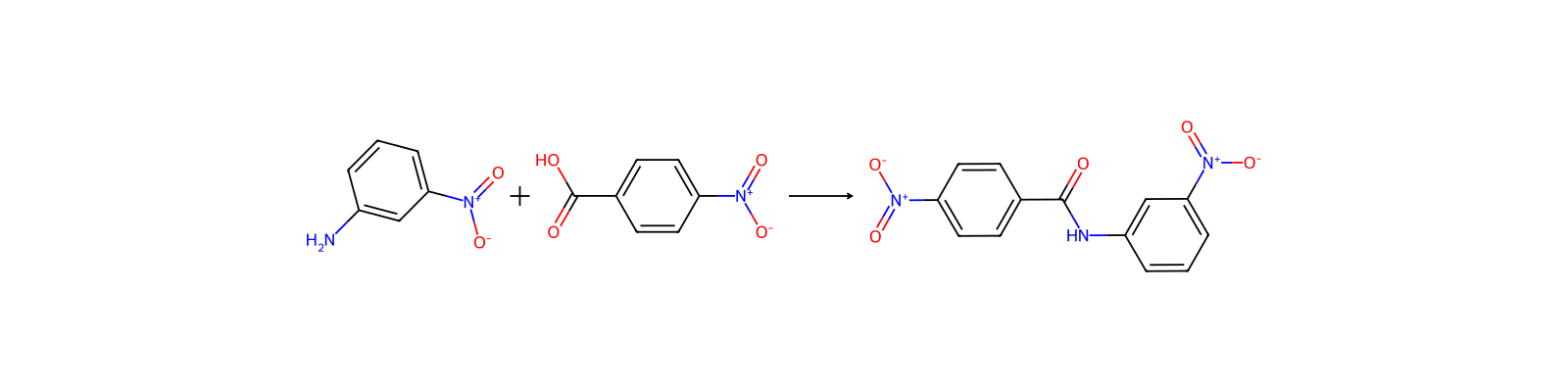
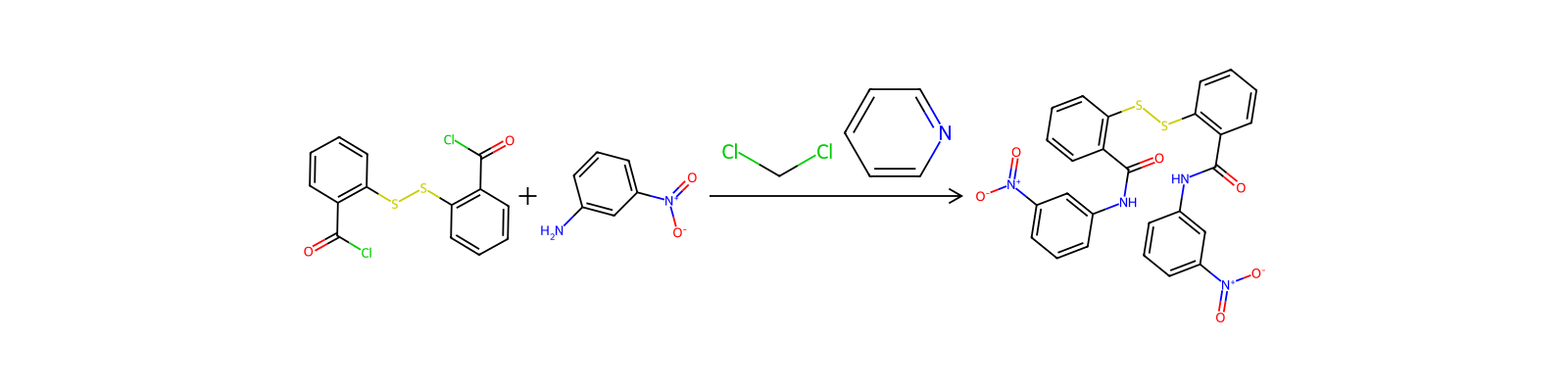
相关反应
307 条


关联笔记
加载中…