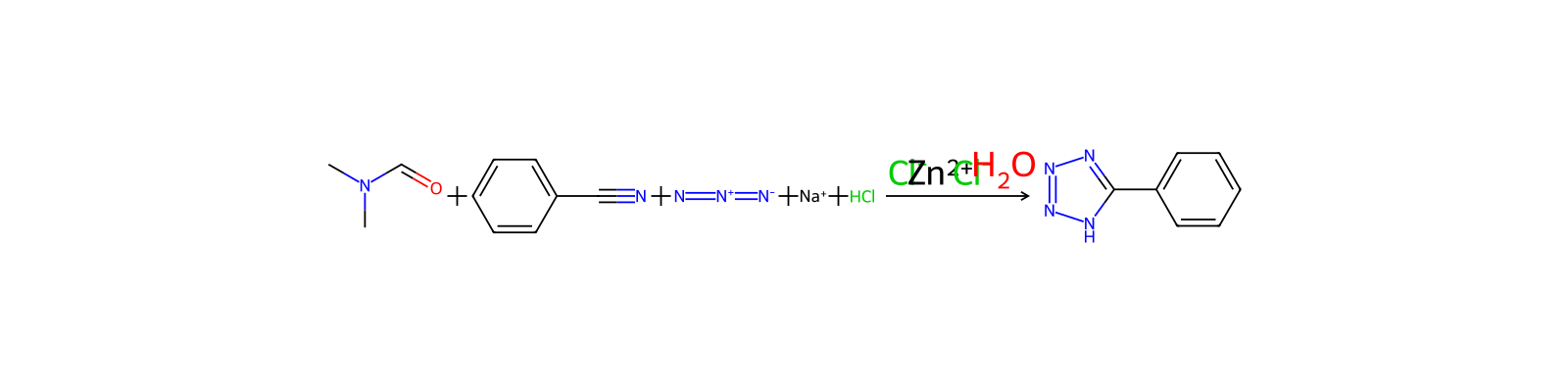
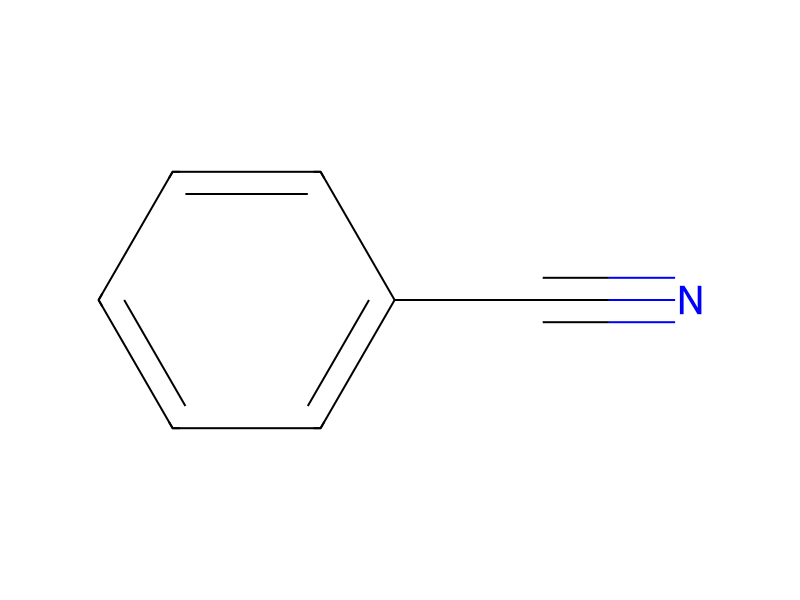
基本信息
- 标准SMILES
N#Cc1ccccc1- InChIKey
JFDZBHWFFUWGJE-UHFFFAOYSA-N- 分子式
- C7H5N
- 平均分子量
- 103.12 g/mol
- 单同位素质量
- 103.04219916
概述
Benzonitrile appears as a clear colorless liquid with an almond-like odor. Flash point 161 °F. Denser (at 8.4 lb / gal) than water and slightly soluble in water. Used as a specialty solvent and to make other chemicals.
名称与标识
- 首选名称
- Benzonitrile
- IUPAC
- benzonitrile
- 中文名
- 苯甲腈
- 英文名
- Benzonitrile
- 分子式
- C7H5N
- 分子量
- 103.12
名称与别名
BENZONITRILE100-47-0Phenyl cyanideCyanobenzeneBenzenenitrileBenzoic acid nitrileBenzene, cyano-BenzenecarbonitrilePhenylcyanideFenylkyanidDTXSID70214919V9APP5H5S
展开更多名称
苯腈苯脂氰苯苯氰苯基腈苯甲腈氰化苯苯基氰氰代苯氰基苯BNFBBenzonitrilBRNBenzontrile3BNBRR2BNCGRP-10
C6H5-CNNSC-8039DTXCID001491CHEBI:27991RefChem:5590benzonitrile;phenyl cyanide202-855-7Fenylkyanid [Czech]
数据库标识
- CAS
100-47-0- PubChem CID
- 7505
- DTXSID
DTXSID7021491- ChEMBL
CHEMBL15819- ChEBI
CHEBI:27991- UNII
- 9V9APP5H5S
- EC Number
- 202-855-7
- Nikkaji
- J3.590D
性质
结构计算性质
- XLogP
- 1.6
- 极性表面积
- 23.8 Ų
- 氢键供体
- 0
- 氢键受体
- 1
- 可旋转键
- 0
- 重原子
- 8
- 形式电荷
- 0
- 复杂度
- 103
实验与物化性质
Chemical Classes
Nitrogen Compounds -> Nitriles
Flammable agents - 2nd degree
SpringerMaterials Properties13C nuclear magnetic resonance spectrum
FragrancesFragrance Ingredient (Benzonitrile) -> IFRA transparency List
LogP
log Kow = 1.56
1.56
OdorOdor of volatile oil of almond
TasteSharp taste
Density
1.01 at 77 °F (USCG, 1999) - Denser than water; will sink
1.0093 g/cu cm at 15 °C
Relative density (water = 1): 1.0
1.01 @ 15°C
Viscosity1.054 centistokes at 100 °F
Color/Form
Liquid
Colorless oil
Solubility
1 to 5 mg/mL at 73 °F (NTP, 1992)
In water, 2000 mg/L at 25 °C
Miscible with common organic solvents
Miscible with ethanol; very soluble in acetone, benzene; soluble in carbon tetrachloride
Solubility in water, g/100ml at 22 °C: 0.1-0.5 (poor)
CorrosivityWill attack some plastics
Flash Point
161 °F (NTP, 1992)
167 °F
70 °C (158 def F) (Closed cup)
75 °C c.c.
物理化学性质
- 熔点
- -13 °C · -13 °C (lit.)
- 沸点
- 191 °C · 191 °C (lit.)
- 密度
- 1.01 · 1.01
- 蒸气密度
- 3.6 · 3.6 (vs air)
- 蒸气压
- 1 hPa · 1 hPa at 20 °C
- 折射率
- 20 · n20/D 1.528(lit.)
- 闪点
- 161 °F · 161 °F
- 储存条件
- 30 °C · Store below +30°C.
- 溶解度
- 1 % · Insoluble in cold water. 1% soluble in boiling water. Miscible with alcohol and oils, but not soluble in liquid paratlirt. Poorly soluble in Propylene glycol.
- 形态
- Liquid
- 颜色
- Clear colorless to slightly yellow
- 相对极性
- 0.333 · 0.333
- 气味 (Odor)
- Almond-like.
- 爆炸极限值(explosive limit)
- 1.4 · 1.4-7.2%(V)
- 水溶解性
- 10 g/L · 10 g/L (100 ºC)
- 热导率
- 0.148 W/ · 0.148 W/(m·K) at 25 ℃
- 比热容
- 1.6 J/ · Cp(liquid): 1.6 J/(g·K), at 25℃
- 最大波长(λmax)
- 300 nm · λ: 300 nm Amax: 1.0λ: 310 nm Amax: 0.40λ: 335 nm Amax: 0.03λ: 360-400 nm Amax: 0.01
- Merck
- 14 · 14,1097
- BRN
- 506893 · 506893
- Henry's Law Constant
- 3.5 · 3.5×10-1 mol/(m3Pa) at 25℃, Brockbank (2013)
- 暴露限值
- 14 ppm · NIOSH: IDLH 14 ppm(25 mg/m3)
- 介电常数
- 26 · 26.0(20℃)
- 稳定性
- Stable. Incompatible with strong bases, strong acids, strong oxidizing agents, strong reducing agents. Air-sensitive. Combustible.
- 主要应用
- food and beverages
- 化妆品成分功效
- PERFUMING
- InChI
- 1S/C7H5N/c8-6-7-4-2-1-3-5-7/h1-5H
- InChIKey
- JFDZBHWFFUWGJE-UHFFFAOYSA-N
- SMILES
- N#Cc1ccccc1
- LogP
- 1.5 at · 1.5 at 20℃
- 表面张力
- 38.33 mN/m · 38.33mN/m at 298.15K
- CAS 数据库
- 100 · 100-47-0(CAS DataBase Reference)
- NIST化学物质信息
- Benzonitrile(100-47-0)
- EPA化学物质信息
- Benzonitrile (100-47-0)
化学性质
无色油状液体。有苦杏仁气味,味苦涩。 微溶于冷水,100℃在水中的溶解度为1%;与常用有机溶剂混溶。
安全与法规
GHS分类
GHS Classification
Warning
H302: Harmful if swallowed [Warning Acute toxicity, oral]
P264, P270, P280, P301+P317, P302+P352, P317, P321, P330, P362+P364, and P501 (click each P-code to see the statement)
This chemical does not meet GHS hazard criteria for 1.9% (11 of 575) of reports.
Warning
H302 (98.1%): Harmful if swallowed [Warning Acute toxicity, oral]
危害信息
Regulatory Information
Chemical: Benzonitrile
Status: Active Update: 18-05-2022 https://echa.europa.eu/registration-dossier/-/registered-dossier/14352
Benzonitrile: Does not have an individual approval but may be used under an appropriate group standard
The New Jersey Worker and Community Right to Know Act requires public and private employers to provide information about hazardous substances at their workplaces. (N.J.S.A. 34:5A-1 et. seq.)
Other Safety InformationIMAP assessments - Benzonitrile: Human health tier II assessment
DOT LabelPoison
Fire Hazards
Special Hazards of Combustion Products: Toxic hydrogen cyanide and oxides of nitrogen may form in fire. (USCG, 1999)
· Combustible material: may burn but does not ignite readily.
Combustible. Gives off irritating or toxic fumes (or gases) in a fire. Above 75 °C explosive vapour/air mixtures may be formed.
Fire Potential... Combustible but burns with difficulty.
Health Hazards
Benzonitrile may enter the human body by ingestion, absorption through the skin, or inhalation. The earliest symptoms of cyano compound intoxication may be weakness, headaches, confusion, and occasionally nausea and vomiting. The respiratory rate and depth will usually be increased at the beginning and at later stages become slow and gasping. Blood pressure is usually normal, especially in the mild or moderately severe cases, although the pulse rate is usually more rapid than normal. (USCG, 1999)
· Highly toxic, may be fatal if inhaled, ingested or absorbed through skin.
Hazards Summary
Highly toxic; [Quick CPC] When burned, benzonitrile releases hydrogen cyanide and nitrogen oxides. Unlike the other nitriles, benzonitrile, an aromatic compound, does not release cyanide in the body after ingestion, inhalation, or skin absorption. Its acts as a uncoupler similar to the toxicity of pentachlorophenol. [HSDB; Goldfrank, p. 179] A skin, eye, and respiratory tract irritant; [ICSC] Causes contact urticaria; [Kanerva, p. 219] See Pentachlorophenol.
DOT ID and Guide2224 152
Reactive GroupNitriles
EC ClassificationSymbol: Xn; R: 21/22; S: (2)-23
UN ClassificationUN Hazard Class: 6.1; UN Pack Group: II
Special ReportsOPDYKE DL J; FOOD COSMET TOXICOL 17(SUPPL): 723-5 (1979). REVIEW WITH 28 REF ON PHENYLCYANIDE INCLUDING TOXICITY, INHALATION, IRRITATION, SENSITIZATION, METAB, PHARMACOLOGY, & EFFECT ON ISOLATED TISSUE & PROTEINS.
安全与防护
Fire Fighting
Excerpt from ERG Guide 152 [Substances - Toxic (Combustible)]:
Use powder, AFFF, foam, carbon dioxide. In case of fire: keep drums, etc., cool by spraying with water.
First Aid Measures
Fresh air, rest. Artificial respiration may be needed. Refer for medical attention.
Remove contaminated clothes. Rinse skin with plenty of water or shower. Refer for medical attention .
First rinse with plenty of water for several minutes (remove contact lenses if easily possible), then refer for medical attention.
Rinse mouth. Rest. Refer for medical attention .
Accidental Release Measures
· CALL 911. Then call emergency response telephone number on shipping paper. If shipping paper not available or no answer, refer to appropriate telephone number listed on the inside back cover.
· ELIMINATE all ignition sources (no smoking, flares, sparks or flames) from immediate area.
First Aid
EYES: First check the victim for contact lenses and remove if present. Flush victim's eyes with water or normal saline solution for 20 to 30 minutes while simultaneously calling a hospital or poison control center. Do not put any ointments, oils, or medication in the victim's eyes without specific instructions from a physician. IMMEDIATELY transport the victim after flushing eyes to a hospital even if no symptoms (such as redness or irritation) develop.
General First Aid:
Safe StorageSeparated from food and feedstuffs. Well closed. Keep in a well-ventilated room.
Firefighting HazardsSpecial hazards arising from the substance or mixture: Carbon oxides, nitrogen oxides (NOx)
Exposure Control and Personal Protection· Wear positive pressure self-contained breathing apparatus (SCBA).
Fire Fighting Procedures
Foam, dry chemical, carbon dioxide. Water may be ineffective. Cool exposed containers with water. Wear goggles & self-contained breathing apparatus.
If material on fire or involved in fire: Do not extinguish fire unless flow can be stopped. Use water in flooding quantities as fog. Solid streams of water may be ineffective. Cool all affected containers with flooding quantities of water. Apply water from as far a distance as possible. Use "alcohol" foam, dry chemical or carbon dioxide.
Evacuation: If fire becomes uncontrollable or container is exposed to direct flame, evacuate for a radius of 1500 feet. If material leaking (not on fire), downwind evacuation must be considered.
Suitable extinguishing media: Use water spray, alcohol-resistant foam, dry chemical or carbon dioxide.
For more Fire Fighting Procedures (Complete) data for BENZONITRILE (6 total), please visit the HSDB record page.
Storage Conditions
Conditions for safe storage, including any incompatibilities: Keep container tightly closed in a dry and well-ventilated place. Containers which are opened must be carefully resealed and kept upright to prevent leakage. Hygroscopic: Handle and store under inert gas.
Cleanup Methods
Remove all ignition sources. Ventilate area of spill or leak. Absorb liquids in vermiculite, dry sand, earth, or a similar material adn deposit in sealed containers. it maybe nessary to contain and dispose of this chemical as a hazardous waste.
Accidental Release Measures. Personal precautions, protective equipment and emergency procedures: Use personal protective equipment. Avoid breathing vapours, mist or gas. Ensure adequate ventilation. Remove all sources of ignition. Beware of vapours accumulating to form explosive concentrations. Vapours can accumulate in low areas. Environmental precautions: Prevent further leakage or spillage if safe to do so. Do not let product enter drains. Discharge into the environment must be avoided. Methods and materials for containment and cleaning up: Contain spillage, and then collect with an electrically protected vacuum cleaner or by wet-brushing and place in container for disposal according to local regulations. Keep in suitable, closed containers for disposal.
Nonfire Spill ResponseExcerpt from ERG Guide 152 [Substances - Toxic (Combustible)]:
Disposal Methods
SRP: The most favorable course of action is to use an alternative chemical product with less inherent propensity for occupational harm/injury/toxicity or environmental contamination. Recycle any unused portion of the material for its approved use or return it to the manufacturer or supplier. Ultimate disposal of the chemical must consider: the material's impact on air quality; potential migration in soil or water; effects on animal and plant life; and conformance with environmental and public health regulations.
Mix with calcium hypochlorite and flush to sewer with water or incinerate.
The following wastewater treatment technology has been investigated for benzonitrile: Concentration process: Biological treatment.
Waste treatment methods. Product: This combustible material may be burned in a chemical incinerator equipped with an afterburner and scrubber. Offer surplus and non-recyclable solutions to a licensed disposal company. Contact a licensed professional waste disposal service to dispose of this material. Contaminated packaging: Dispose of as unused product.
SRP: Wastewater from contaminant suppression, cleaning of protective clothing/equipment, or contaminated sites should be contained and evaluated for subject chemical or decomposition product concentrations. Concentrations shall be lower than applicable environmental discharge or disposal criteria. Alternatively, pretreatment and/or discharge to a permitted wastewater treatment facility is acceptable only after review by the governing authority and assurance that "pass through" violations will not occur. Due consideration shall be given to remediation worker exposure (inhalation, dermal and ingestion) as well as fate during treatment, transfer and disposal. If it is not practicable to manage the chemical in this fashion, it must be evaluated in accordance with EPA 40 CFR Part 261, specifically Subpart B, in order to determine the appropriate local, state and federal requirements for disposal.
毒理信息
Body Burden
Benzonitrile was qualitatively detected in 3 of 12 samples of human milk collected from volunteers in Bayonne, NJ, Jersey City, NJ, Bridgeville, PA, and Baton Rouge, LA(1). Benzonitrile was detected in 24.6% of 387 of expired air samples collected from healthy, urban human adults; the mean concentration in expired air was 0.105 ng/L(2).
Treatment
Antidotes to cyanide poisoning include hydroxocobalamin and sodium nitrite, which release the cyanide from the cytochrome system, and rhodanase, which is an enzyme occurring naturally in mammals that combines serum cyanide with thiosulfate, producing comparatively harmless thiocyanate. Oxygen therapy can also be administered. (L97)
Interactions
Benzonitrile was tested for anticonvulsant effect in mice and gave protection against pentylenetetrazole-induced convulsions.
The extent of cyanide liberation and the effect of carbon tetrachloride pretreatment on the mortality of /mice/ differed among nitriles. Benzonitrile toxicity was clearly enhanced.
When sodium thiosulfate was given in multiple injections, it protected mice against death by propionitrile.
The toxic mechanism of nitriles and the effect of metabolic modifiers in mice were studied in relation to their physicochemical properties. All the test nitriles liberated cyanide both in vivo and in vitro, with the exception of benzonitrile, although the extent of liberation and the effect of carbon tetrachloride pretreatment on the mortality of animals differed among nitriles. From these results, test compounds were tentatively divided into 3 groups. In group 1, acute toxicity was greatly reduced by carbon tetrachloride pretreatment, in group 2, toxicity was not significantly changed or was somewhat enhanced, and in group 3, benzonitrile only, toxicity was clearly enhanced. The amount of cyanide was higher at death in the brains of mice given group 1 compounds, the level being comparable to that found in mice killed by dosing with potassium cyanide. The relation between log (1/LD50) and log p for the compounds in group 1 fitted a parabolic plot, while that for compounds in group 2 was linear. For most nitriles, the in vitro metabolism was inhibited when the incubation mixture contained either SKF-525A, carbon monoxide, or microsomes from mice treated with carbon tetrachloride. When mice were dosed with ethyl alcohol, metabolic enhancement of nitriles was seen compared with the control. However, ethyl alcohol, when added to the incubation mixture, inhibited the in vitro metabolism of nitriles. /Nitriles/
Health Effects
Exposure to high levels of cyanide for a short time harms the brain and heart and can even cause coma, seizures, apnea, cardiac arrest and death. Chronic inhalation of cyanide causes breathing difficulties, chest pain, vomiting, blood changes, headaches, and enlargement of the thyroid gland. Skin contact with cyanide salts can irritate and produce sores. (L96, L97)
Ecotoxicity Values
EC50; Species: Daphnia magna (Water Flea) age < or =24 hr; Conditions: freshwater, static, 20-22 °C, pH 7.6-7.7; Concentration: 200000 ug/L for 24 hr; Effect: intoxication, immobilization /formulation/
LC50; Species: Oryzias latipes (Japanese Medaka) length 2 cm, weight 0.2 g; Conditions: freshwater, static, 25 °C; Concentration: 27000 ug/L for 24 hr
LC50; Species: Oryzias latipes (Japanese Medaka) length 2 cm, weight 0.2 g; Conditions: freshwater, static, 25 °C; Concentration: 15000 ug/L for 48 hr
Environmental Fate
TERRESTRIAL FATE: Based on a classification scheme(1), an estimated Koc value of 150(SRC), determined from a log Kow of 1.56(2) and a regression-derived equation(3), indicates that benzonitrile is expected to have moderate mobility in soil(SRC). Volatilization of benzonitrile from moist soil surfaces is expected to be an important fate process(SRC) given an estimated Henry's Law constant of 5.21X10⁻⁵ atm-cu m/mole (SRC), derived from its vapor pressure, 0.768 mm Hg(4), and water solubility of 2000 mg/L(5). Benzonitrile is not expected to volatilize from dry soil surfaces(SRC) based upon its vapor pressure(4). Benzonitrile achieved 88% degradation after 8, 10, and 12.5 hours in char-amended soil, soil and washed-char-amended soil slurries, respectively(6), indicating that biodegradation may be an important environmental fate process in soil(SRC).
AQUATIC FATE: Based on a classification scheme(1), an estimated Koc value of 150(SRC), determined from a log Kow of 1.56(2) and a regression-derived equation(3), indicates that benzonitrile is not expected to adsorb to suspended solids and sediment(SRC). Volatilization from water surfaces is expected(4) based upon an estimated Henry's Law constant of 5.21X10⁻⁵ atm-cu m/mole(SRC), derived from its vapor pressure, 0.768 mm Hg(5), and water solubility of 2000 mg/L(6). Using this Henry's Law constant and an estimation method(4), volatilization half-lives for a model river and model lake are 20 and 9 days, respectively(SRC). According to a classification scheme(7), an estimated BCF of 5(SRC), from its log Kow(2) and a regression-derived equation(3), suggests the potential for bioconcentration in aquatic organisms is low(SRC). Utilizing the Japanese MITI test, 63% of the Theoretical BOD was reached in 2 weeks(8) indicating that biodegradation is an important environmental fate process in water(SRC).
ATMOSPHERIC FATE: According to a model of gas/particle partitioning of semivolatile organic compounds in the atmosphere(1), benzonitrile, which has a measured vapor pressure of 0.768 mm Hg at 25 °C(2), is expected to exist solely as a vapor in the ambient atmosphere(SRC). Vapor-phase benzonitrile is degraded in the atmosphere by reaction with photochemically-produced hydroxyl radicals(SRC); the half-life for this reaction in air is estimated to be 31 days(SRC), calculated from its rate constant of 3.30X10⁻¹³ cu cm/molecule-sec at 25 °C(3). Benzonitrile absorbs light at wavelengths >290 nm(4) and, therefore, may be susceptible to direct photolysis by sunlight(SRC).
Food Survey Values
Benzonitrile was qualitatively detected in the volatile components of baked potatoes(1), roasted filbert nuts(2), chickpeas(3), and meat(4).
Benzonitrile is found in milk products, roasted filberts and peanuts, and cooked trassi.
Adverse EffectsNephrotoxin - The chemical is potentially toxic to the kidneys in the occupational setting.
Exposure Routes
The substance can be absorbed into the body by inhalation, through the skin and by ingestion.
Oral (L96) ; inhalation (L96) ; dermal (L96)
Milk Concentrations
Benzonitrile was qualitatively detected in 3 of 12 samples of human milk collected from volunteers in Bayonne, NJ, Jersey City, NJ, Bridgeville, PA, and Baton Rouge, LA(1).
Benzonitrile is found in milk products.
Toxicity Summary
IDENTIFICATION AND USE: Benzonitrile is a colorless liquid. It is used as intermediate for rubber chemicals; solvent for nitrile rubber, specialty lacquers, and many resins and polymers, and for many anhydrous metallic salts. HUMAN EXPOSURE AND TOXICITY: Benzonitrile was tested at a concentration of 2% in petrolatum on 27 volunteers in a mixed panel, and was found to produce no sensitization reactions after 48 hr close patch test. Extensive reddening and blister formation resulted from accidental exposure of human skin to benzonitrile. Following an occupational accident in which a worker's head and clothing were drenched with benzonitrile, the worker suffered severe respiratory distress and tonic convulsions between periods of unconsciousness which lasted for 75 min. Thereafter he gradually recovered, but several years later he experienced episodes of unconsciousness which might have been related to the benzonitrile exposure. ANIMAL STUDIES: CNS depression signs and changes in blood cholinesterase activity were observed in rats and mice in an inhalation study with benzonitrile. Indication of cumulative effects of benzonitrile were reported. Toxic signs included sluggishness, unsteady gait, a comatose state, convulsions of limb muscles, and death. Benzonitrile produced mild eye irritation and no skin irriation in albino rabbits. Benzonitrile applied full strength to intact or abraded rabbit skin for 24 hr under occlusion was moderately irritating. When benzonitrile was administered orally to rats in a single lethal dose (2 g/kg), cytochrome oxidase activity of the liver, kidneys, and heart was increased by 2-4 times. The nitrile initially increased the hippuric acid and NH3 and decreased the glucuronides of the urine. Rhodanides in the blood remained unchanged. Certain responses of rats following exposure to benzonitrile vapor exhibited age-rated differences. Erythrocyte and leukocyte counts and hemoglobin , albumin and gamma-globulin levels decreased while alpha1-, alpha2- and beta-globulin levels increased earlier and were compensated far more rapidly in adult rats than in juvenile or older animals. Both, nitrobenzene and benzonitrile applied to V79 cells, induced mostly kinetochor (CREST)-positive micronuclei, thus characterising the chromosomal effects as aneugenic. Benzonitrile was tested for anticonvulsant effect in mice and gave protection against pentylenetetrazole-induced convulsions.
Organic nitriles decompose into cyanide ions both in vivo and in vitro. Consequently the primary mechanism of toxicity for organic nitriles is their production of toxic cyanide ions or hydrogen cyanide. Cyanide is an inhibitor of cytochrome c oxidase in the fourth complex of the electron transport chain (found in the membrane of the mitochondria of eukaryotic cells). It complexes with the ferric iron atom in this enzyme. The binding of cyanide to this cytochrome prevents transport of electrons from cytochrome c oxidase to oxygen. As a result, the electron transport chain is disrupted and the cell can no longer aerobically produce ATP for energy. Tissues that mainly depend on aerobic respiration, such as the central nervous system and the heart, are particularly affected. Cyanide is also known produce some of its toxic effects by binding to catalase, glutathione peroxidase, methemoglobin, hydroxocobalamin, phosphatase, tyrosinase, ascorbic acid oxidase, xanthine oxidase, succinic dehydrogenase, and Cu/Zn superoxide dismutase. Cyanide binds to the ferric ion of methemoglobin to form inactive cyanmethemoglobin. (L97)
Signs and Symptoms
Confusion. Headache. Laboured breathing. Nausea. Unconsciousness. Vomiting. Weakness.
Redness.
Redness. Pain.
Further see Inhalation.
Cyanide poisoning is identified by rapid, deep breathing and shortness of breath, general weakness, giddiness, headaches, vertigo, confusion, convulsions/seizures and eventually loss of consciousness. (L96, L97)
法规信息
Atmospheric Standards
This action promulgates standards of performance for equipment leaks of Volatile Organic Compounds (VOC) in the Synthetic Organic Chemical Manufacturing Industry (SOCMI). The intended effect of these standards is to require all newly constructed, modified, and reconstructed SOCMI process units to use the best demonstrated system of continuous emission reduction for equipment leaks of VOC, considering costs, non air quality health and environmental impact and energy requirements. Benzonitrile is produced, as an intermediate or a final product, by process units covered under this subpart.
CERCLA Reportable Quantities
Persons in charge of vessels or facilities are required to notify the National Response Center (NRC) immediately, when there is a release of this designated hazardous substance, in an amount equal to or greater than its reportable quantity of 5000 lb or 2270 kg. The toll free number of the NRC is (800) 424-8802. The rule for determining when notification is required is stated in 40 CFR 302.4 (section IV. D.3.b).
Clean Water Act Requirements
Benzonitrile is designated as a hazardous substance under section 311(b)(2)(A) of the Federal Water Pollution Control Act and further regulated by the Clean Water Act Amendments of 1977 and 1978. These regulations apply to discharges of this substance. This designation includes any isomers and hydrates, as well as any solutions and mixtures containing this substance.
安全数据
- wgk
- 2
- tsca
- TSCA listed
- 毒性
- LDLo orl-rat: 720 mg/kg AMRL** TR-74-78,74
- RTECS号
- DI2450000
- 包装类别
- II
- 危险等级
- 6.1
- 存储类别
- 6.1A - Combustible acute toxic Cat. 1 and 2very toxic hazardous materials
- 安全说明
- 23
- 海关编码
- 29269090
- 自燃温度
- 550 °C
- 危险品标志
- Xn
- 危险性类别
- Acute Tox. 4 DermalAcute Tox. 4 Oral
- 危险类别码
- 21/22-38
- 毒害物质数据
- 100-47-0(Hazardous Substances Data)
- 危险品运输编号
- UN 2224
- 立即威胁生命和健康浓度
- 14 ppm (66 mg/m3)
毒性防护
急性毒性口服- 大鼠 LDL0: 720 毫克/ 公斤; 口服- 小鼠 LD50: 971 毫克/ 公斤
刺激数据皮肤- 兔子 500 毫克/ 24小时 中度
职业标准STEL 1 毫克/ 立方米
包装储运
可燃性危险特性较易燃; 高热放出有毒氮氧化物和氰化物气体
储运特性库房通风低温干燥; 与氧化剂、酸类、食品添加剂分开存放
灭火剂干粉、泡沫、二氧化碳、砂土; 禁用酸碱灭火剂
化学与工业
药理信息
Metabolism/Metabolites
Aromatic cyanides or nitriles can be metabolized by hydrolysis of the cyanide group to give the corresponding carboxylic acid. This reaction is only a minor pathway, the major metabolic transformation being aromatic hydroxylation. Benzonitrile /by hydrolation yields/ benzamide /which by hydrolysis yields/ benzoic acid and ammonia.
Benzonitrile yields o-hydroxybenzonitrile, m-hydroxybenzonitrile, and p-hydroxybenzonitrile in rabbits.
Benzonitrile is mainly hydroxylated in vivo to cyanophenols, a small amount being hydrolyzed to benzoic acid. ... In rabbit, 50% of a dose of 150 mg/kg was converted to conjugated cyanophenols and 10% of the benzonitrile fed was excreted as benzoic acid. Hydrogen cyanide is not a metabolite of benzonitrile ... and cyanide was not found to be formed by benzonitrile either in vivo or in vitro. ... The in vivo microsomal hydroxylation of specifically deuterated benzonitrile in the rat yielded mainly 4-hydroxybenzonitrile with 41% retention of deuterium.
Organic nitriles are converted into cyanide ions through the action of cytochrome P450 enzymes in the liver. Cyanide is rapidly absorbed and distributed throughout the body. Cyanide is mainly metabolized into thiocyanate by either rhodanese or 3-mercaptopyruvate sulfur transferase. Cyanide metabolites are excreted in the urine. (L96)
用途与制造
Uses
Used as a solvent and intermediate in industries making drugs, perfumes, dyes, rubber, textiles, resins, and specialty lacquers; [HSDB]
Textiles (Fiber & Fabric Manufacturing) [Category: Industry]
Synthesis of benzoquanamine; additive in nickel-plating baths; for separating naphthalene and alkylphthalenes from non-aromatics by azetropic distillation; as jet-fuel additive; in cotton bleaching baths; as a drying additive for acrylic fibers; in the removal of titanium tetrachloride and vanadium oxytrichloride from silicon tetrachloride.
Intermediate for rubber chemicals; solvent for nitrile rubber, specialty lacquers, and many resins and polymers, and for many anhydrous metallic salts.
In perfumes at a maximum level of 0.2% in the final product
Solvent
U.S. Exports(1984) 9.72X10+9 g /Nitriles & their derivatives, NSPF/
U.S. Imports(1984) 6.76X10+7 g
U.S. Production
(1972) PROBABLY GREATER THAN 4.54X10+5 G
(1975) PROBABLY GREATER THAN 4.5X10+5 G
Non-confidential 2012 Chemical Data Reporting (CDR) information on the production and use of chemicals manufactured or imported into the United States. Chemical: Benzonitrile. National Production Volume: Withheld.
Methods of Manufacturing
Prepared by heating Na benzenesulfonate with NaCN or by adding benzenediazonium chloride solution to a hot aqueous NaCN solution containing CuSO4 and distilling.
From benzoic acid by heating with lead thiocyanate.
... The reaction of benzoic acid (or substituted benzoic acid) with urea at 220-240 °C in the presence of a metallic catalyst.
Benzonitrile can be produced in high yield by the vapor-phase catalytic ammoxidation of toluene.
For more Methods of Manufacturing (Complete) data for BENZONITRILE (6 total), please visit the HSDB record page.
Formulations/Preparations
99.5% min wt/water content of 0.40% max
Grades of purity: Pure, 99+%
Use ClassificationFragrance Ingredients
General Manufacturing InformationBenzonitrile: ACTIVE
应用领域
用途苯甲腈通常用作合成多种芳族化合物的前体,并与过渡金属形成稳定的配位络合物。
用途用作农药、染料中间体及溶剂抗氧剂等
用途主要用作苯代三聚氰胺等高级涂料的中间体,也是合成农药、脂肪族胺、苯甲酸的中间体,并可作为腈基橡胶、树脂、聚合物和涂料等的溶剂。苄腈衍生的系列中间体主要是:苄基胺、苯甲酰胺、硫代苯甲酰胺、卤代酰亚胺、亚胺酸酯、硫代亚胺酸酯、偕胺肟、肼等等。
用途主要用于棉及维/棉混纺织物的染色
用途中间体,溶剂。
制备方法
合成方法苯甲腈合成方法有:卤代苯氰化反应、卤代甲苯与氨反应、苯甲酸与尿素反应、苯甲醛的氰化反应等方法。其中,以苯甲醛和盐酸羟胺为原料制备苯甲腈,反应条件温和,生产成本低,最具有工业化应用前景。
生产方法1.苯甲酸法 苯甲酸经氨化而得。催经剂为氧化铝,反应温度250~350℃。2.氨氧化法 在氨存在的条件下,用空气氧化甲苯而得。甲苯通过钒铬催化剂,在350℃气相氨氧化反应,再经精馏而得成品。原料消耗定额:甲苯2000kg/t、氨1200kg/t。其他方法还有苯胺盐酸盐与亚硝酸重氮化后,再与氰化亚铜作用;苯甲酰胺与二氯亚砜反应,都可以制得苄腈。上述方法中,氰化亚铜可由硫酸铜和氰化钾作用而得。例如,将60g硫酸铜、50g氰化钾和90ml水制成氰化亚铜溶液,预热至60~70℃,在激烈搅拌下分批加入18.6g苯胺、50ml盐酸、16g亚硝酸钠和125ml制得的重氮盐冷溶液,反应温度不超过60~70℃,分离得到生成的苄腈16g,产率77%。
上下游产品信息
上游原料
下游产品
试剂价格
- A11173 · 100g
- 苯甲腈, 99% Benzonitrile, 99% — 363元
- 44691 · 100ml
- 苯腈Benzonitrile, for HPLC, Thermo Scientific Chemicals — 475元
供应商50 家
国药集团化学试剂有限公司86-21-63210123 · [email protected]
梯希爱(上海)化成工业发展有限公司021-67121386 · [email protected]
上海阿拉丁生化科技股份有限公司400-6206333 13167063860 · [email protected]
Shandong chuangyingchemical Co., Ltd.18853181302 · [email protected]
山东艾斯曼新材料有限公司13698626386 13698626386
武汉欣扬瑞和化学科技有限公司153-07155313 15307155313 · [email protected]
爱斯特(成都)生物制药股份有限公司+86-28-85122536 85324413 · [email protected]
Dayang Chem (Hangzhou) Co.,Ltd.+86-0571-88938639 17705817739 · [email protected]
Ark Pharm, Inc.847-367-3680 · [email protected]
上海迈瑞尔生化科技有限公司4006356688 18621169109 · [email protected]
上海晶抗生物工程有限公司021-54721350 13524668266 · [email protected]
阿法埃莎(中国)化学有限公司400-6106006 · [email protected]
安耐吉化学&3A(安徽泽升科技股份有限公司)400-0056266 · [email protected]
武汉卡诺斯科技有限公司027-83238443 15327105076 · [email protected]
上海瀚鸿科技股份有限公司021-54306202 13764082696 · [email protected]
黑龙江彩晴生物科技有限公司13357813287
上海沃化化工有限公司021-57681602-802 17302146015 · [email protected]
合肥天健化工有限公司551-65418679 15856988503;15837135945 · [email protected]
山东西亚化学有限公司13355009207 13355009207 · [email protected]
玛雅试剂+86 (573) 82222445 (0)18006601000 452520369 · [email protected]
四川库利南科技有限公司400-1166-196 18981987031 · [email protected]
天津希恩思生化科技有限公司400 638 7771 · [email protected]
Xiamen AmoyChem Co., Ltd+86-86-5926051114 · [email protected]
南京维奥化工有限公司Please Send Email 18652950785 · [email protected]
斯百全化学(上海)有限公司021-021-021-67601398-809-809-809 15221380277 · [email protected]
艾科试剂4008-755-333 18080918076 · [email protected]
上海思域化工科技有限公司86-21-34053660 · [email protected]
赛默飞世尔科技(中国)有限公司800-810-5118 · [email protected]
北京伊诺凯科技有限公司400-810-7969 010-59572699 · [email protected]
TCI AMERICA800-4238616 · [email protected]
TOKYO CHEMICAL INDUSTRY CO., LTD.03-36680489 · [email protected]
TCI Europe320-37350700 · [email protected]
上海湄水化工科技有限公司021-60549325 18616193163
安徽科迪达化工有限公司0554-2106669 · [email protected]
日照力德士化工有限公司010-51268198 · [email protected]
上海爱蝶实业有限公司021-58957966 18930537195 · [email protected]
成都零六生物科技有限公司400-1166-196 13458535857 · [email protected]
广拓化学(上海)有限公司021-60899189-8001 18918189673 · [email protected]
上海恒岳化工科技有限公司51691706 13391095697 · [email protected]
上海麦克林生化科技股份有限公司15221275939 15221275939 · [email protected]
上海乾劲化工科技有限公司021-20900665 17321230821 · [email protected]
杭州杰恒化工有限公司0571-87396432 · [email protected]
上海纳谦化学科技有限公司13598610367 13598610367 · [email protected]
上海兴鲁化工科技有限公司02120970332 · [email protected]
成都润泽本土化工有限公司13096311329 028-88469284 616445927 · [email protected]
上海容立化学科技有限公司021-69992220 13701886816 · [email protected]
池州凯隆进出口贸易有限公司[email protected]
Sigma-Aldrich西格玛奥德里奇(上海)贸易有限公司021-61415566 800-8193336 · [email protected]
九鼎化学(上海)科技有限公司4009209199 · [email protected]
厦门志信化学有限公司+86-5922680277 +86-13806087780 · [email protected]
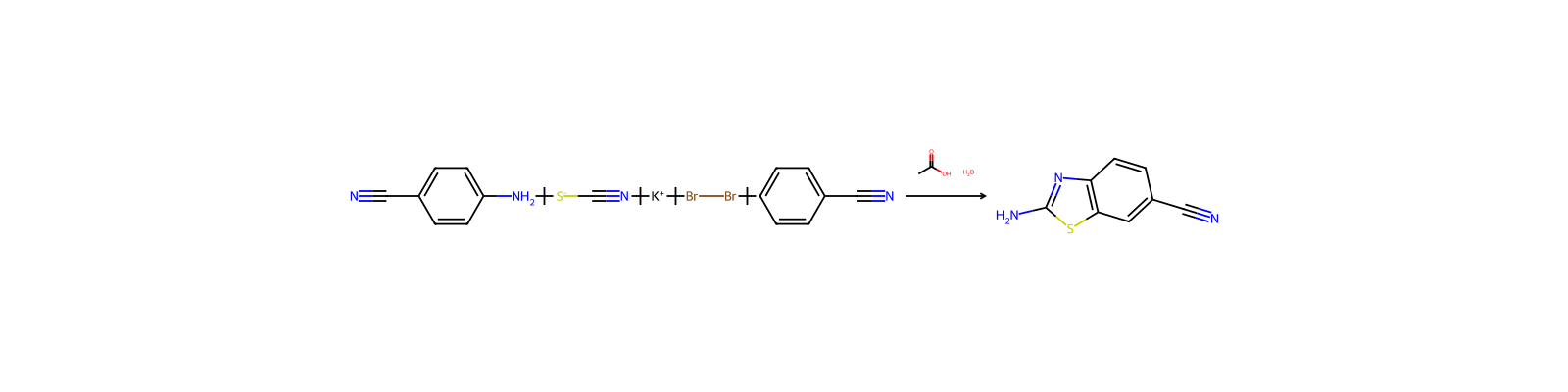
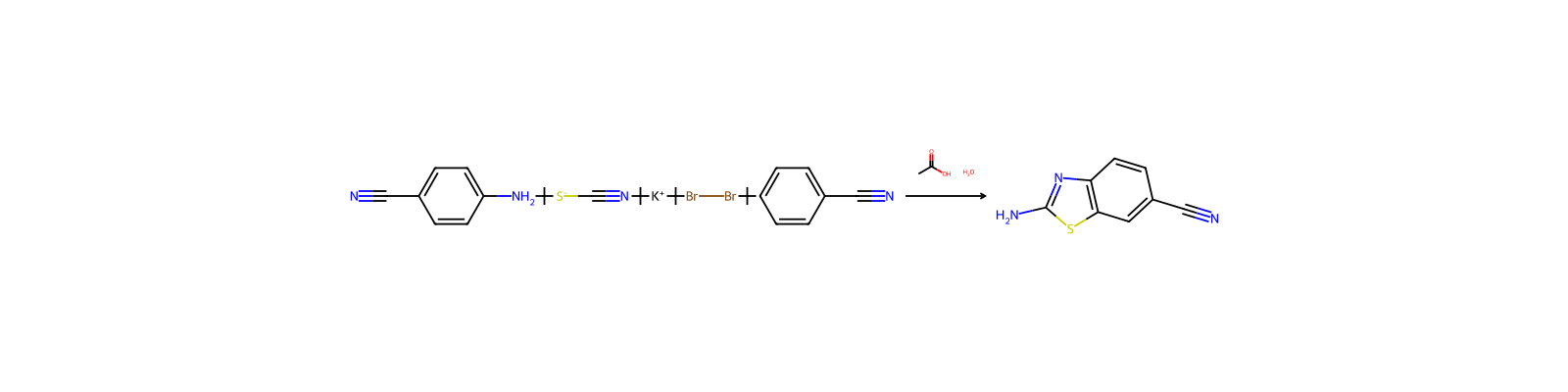
相关反应
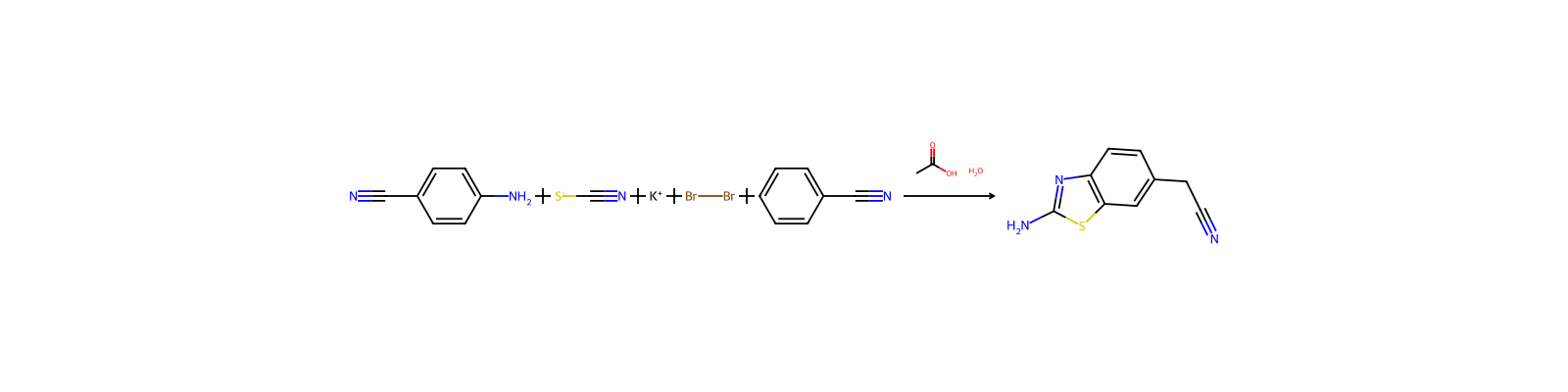
508 条




关联笔记
加载中…