
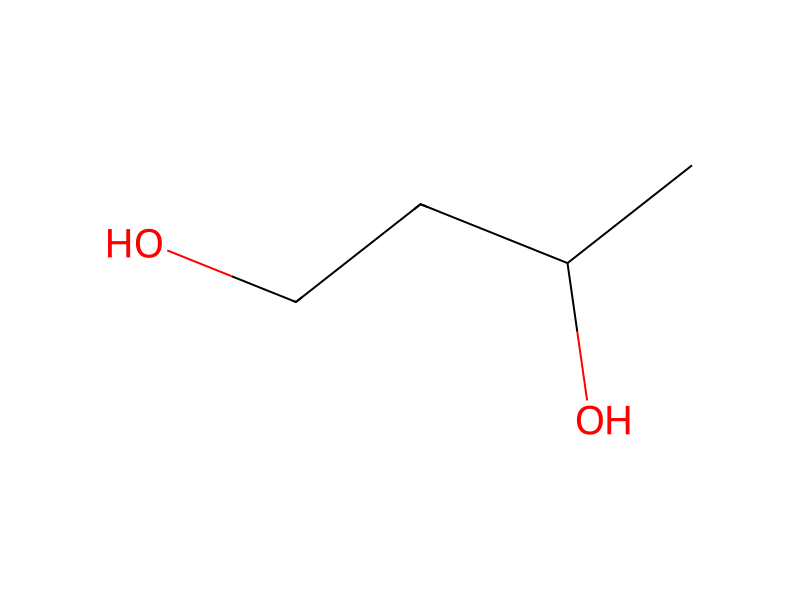
基本信息
- 标准SMILES
CC(O)CCO- InChIKey
PUPZLCDOIYMWBV-UHFFFAOYSA-N- 分子式
- C4H10O2
- 平均分子量
- 90.12 g/mol
- 单同位素质量
- 90.06807956
概述
Butane-1,3-diol is a butanediol compound having two hydroxy groups in the 1- and 3-positions. It is a glycol and a butanediol.
名称与标识
- 首选名称
- 1,3-Butanediol
- IUPAC
- butane-1,3-diol
- 中文名
- 1,3-丁二醇
- 英文名
- 1,3-Butanediol
- 分子式
- C4H10O2
- 分子量
- 90.12
名称与别名
1,3-BUTANEDIOLButane-1,3-diol107-88-01,3-Butylene glycolButylene glycol1,3-Dihydroxybutanebeta-Butylene glycolMethyltrimethylene glycol1-Methyl-1,3-propanediol1,3 Butylene glycol1,3-Butandiol(RS)-1,3-Butandiol
展开更多名称
间丁二醇丁间二醇白桦树汁白桦树液BD代理3-丁二醇1,3-丁二1.3二丁醇1,3一丁二醇1,3-丁二醇BDBUTAN-1,3-DIOL(±)-butane-1,3-diol(3S)-butane-1,3-diol
1,3-ButylenglykolCaswell No. 128GGDTXSID8026773NSC-4021453XUS85K0RABRN 1731276AI3-11077DTXCID306773
数据库标识
- CAS
107-88-0- PubChem CID
- 7896
- DTXSID
DTXSID8026773- ChEMBL
CHEMBL1231501、CHEMBL3186475- ChEBI
CHEBI:52683- UNII
- 3XUS85K0RA
- EC Number
- 203-529-7
- Nikkaji
- J5.066K
性质
结构计算性质
- XLogP
- -0.4
- 极性表面积
- 40.5 Ų
- 氢键供体
- 2
- 氢键受体
- 2
- 可旋转键
- 2
- 重原子
- 6
- 形式电荷
- 0
- 复杂度
- 28.7
实验与物化性质
PolymersOther Classes -> Alcohols and Polyols, Other
Cosmetics
Cosmetic ingredients (Butylene Glycol) -> CIR (Cosmetic Ingredient Review)
Humectant; Solvent
FragrancesFragrance Ingredient (1,3-Butanediol) -> IFRA transparency List
LogP
-0.290
-0.79
Odor
Practically odorless
Odorless when pure
TasteSweet flavor with bitter aftertaste
Food AdditivesFLAVORING AGENT OR ADJUVANT, SOLVENT OR VEHICLE -> FDA Substance added to food
Density
1.0053 g/cu cm at 20 °C
Relative density (water = 1): 1.00
1.006 @ 20°C
Flavoring AgentsEU Flavoring substances
Viscosity96 cSt at 25 °C
Color/Form
Viscous liquid
Pure compound is colorless
Solubility
Miscible with water
Practically insoluble in aliphatic hydrocarbons, benzene, toluene, carbon tetrachloride, ethanolamines, mineral and linseed oil; soluble in acetone, methyl ethyl ketone, ethanol, dibutyl phthalate, castor oil
Slightly soluble in ether
1000 mg/mL at 25 °C
Solubility in water: good
物理化学性质
- 熔点
- -54 °C · -54 °C
- 沸点
- 203 · 203-204 °C(lit.)
- 密度
- 1.005 g/mL · 1.005 g/mL at 25 °C(lit.)
- 蒸气密度
- 3.1 · 3.1 (20 °C, vs air)
- 蒸气压
- 0.06 mm · 0.06 mm Hg ( 20 °C)
- 折射率
- 20 · n20/D 1.44(lit.)
- 闪点
- 250 °F · 250 °F
- 储存条件
- 30 °C · Store below +30°C.
- 溶解度
- 500 g/lMiscible · >500g/lMiscible
- 酸度系数(pKa)
- 14.83 · 14.83±0.20(Predicted)
- 形态
- Liquid
- 颜色
- Clear colorless to yellow, may discolor to brown on storage
- 比重
- 1.004 · 1.004 – 1.007
- 气味 (Odor)
- odorless
- PH值
- 6.1 · 6.1 (500g/l, H2O, 20℃)
- 酸碱指示剂变色ph值范围
- 6 · 6 - 7 at 20 °C
- 爆炸极限值(explosive limit)
- 1.9 · 1.9-12.6%(V)
- 水溶解性
- SOLUBLE
- 敏感性
- Hygroscopic
- Merck
- 14 · 14,1567
- BRN
- 1731276 · 1731276
- Henry's Law Constant
- 7 · 7.0×103 mol/(m3Pa) at 25℃, Burkholder et al. (2019)
- 稳定性
- Stable. Flammable. Hygroscopic - protect from air and moisture. Incompatible with strong oxidizing agents.
- 化妆品成分功效
- SKIN CONDITIONINGSOLVENTVISCOSITY CONTROLLINGHUMECTANTFRAGRANCE
- InChI
- 1S/C4H10O2/c1-4(6)2-3-5/h4-6H,2-3H2,1H3
- InChIKey
- PUPZLCDOIYMWBV-UHFFFAOYSA-N
- SMILES
- CC(O)CCO
- LogP
- -0.9 at · -0.9 at 25℃
- CAS 数据库
- 107 · 107-88-0(CAS DataBase Reference)
- NIST化学物质信息
- 1 · 1,3-Butanediol(107-88-0)
- EPA化学物质信息
- 1 · 1,3-Butylene glycol (107-88-0)
化学性质
透明无色吸湿性粘稠液体,具较弱特殊滋味。几乎无气味。沸点207.5℃,相对密度(4:1.0059,折射率(nD20)1.4401,凝固点<-50℃,闪点121.1℃。有一定抑菌作用。可混溶于水、丙酮,溶于乙醚。
安全与法规
GHS分类
GHS Classification
This chemical does not meet GHS hazard criteria for 46.2% (1160 of 2513) of reports.
Warning
H226 (51.2%): Flammable liquid and vapor [Warning Flammable liquids]
P210, P233, P240, P241, P242, P243, P280, P303+P361+P353, P370+P378, P403+P235, and P501 (click each P-code to see the statement)
Aggregated GHS information provided per 2513 reports by companies from 8 notifications to the ECHA C&L Inventory.
危害信息
Regulatory Information
Chemical: 1,3-Butanediol
Commission Regulation (EC) No 1565/2000 (Repealed by Com. Implementing Reg. (EU) No 872/2012)
1,3-Butanediol is listed on the EPA's Chemical Data Reporting (CDR) system. Manufacturers and importers of 1,3-Butanediol are required to report information about their production and use of this chemical to the EPA under the Toxic Substances Control Act (TSCA). (40 eCFR Part 711)
Status: Active Update: 20-04-2023 https://echa.europa.eu/registration-dossier/-/registered-dossier/14962
1,3-Butylene glycol: Does not have an individual approval but may be used under an appropriate group standard
Fire HazardsCombustible.
Fire PotentialCombustible when exposed to heat or flame.
Hazards SummaryToxic if ingest large amounts; [CHRIS] A skin, eye, and respiratory tract irritant; [ICSC] An efficient antimicrobial agent, inhibiting gram-negative and gram-positive microorganisms, molds, and yeasts. [HSDB] A mild irritant; [MSDSonline]
FDA Requirements
1,3-Butanediol is an indirect food additive for use only as a component of adhesives.
1,3-Butylene glycol is a food additive permitted in feed and drinking water of animals.
1,3-Butylene glycol is a food additive permitted for direct addition to food for human consumption, as long as 1) the quantity of the substance added to food does not exceed the amount reasonably required to accomplish its intended physical, nutritive, or other technical effect in food, and 2) any substance intended for use in or on food is of appropriate food grade and is prepared and handled as a food ingredient.
1,3-Butylene glycol (1,3-butanediol) may be safely used in food in accordance with the following prescribed conditions: (a) The substance meets the following specifications: (1) 1,3-Butylene glycol content: Not less than 99 percent. (2) Specific gravity at 20/20 °C: 1.004 to 1.006. (3) Distillation range: 200 deg-215 °C. (b) It is used in the minimum amount required to perform its intended effect. (c) It is used as a solvent for natural and synthetic flavoring substances except where standards of identity issued under section 401 of the act preclude such use.
EPA Safer ChemicalChemical: 1,3-Butanediol
FIFRA Requirements
As the federal pesticide law FIFRA directs, EPA is conducting a comprehensive review of older pesticides to consider their health and environmental effects and make decisions about their continued use. Under this pesticide reregistration program, EPA examines newer health and safety data for pesticide active ingredients initially registered before November 1, 1984, and determines whether the use of the pesticide does not pose unreasonable risk in accordance to newer safety standards, such as those described in the Food Quality Protection Act of 1996. Pesticides for which EPA had not issued Registration Standards prior to the effective date of FIFRA '88 were divided into three lists based upon their potential for human exposure and other factors, with List B containing pesticides of greater concern than those on List C, and with List C containing pesticides of greater concern than those on List D. Butylene glycol is found on List D. Case No: 4016; Case Status: No products containing the pesticide are actively registered ... The case /is characterized/ as "cancelled." Under FIFRA, pesticide producers may voluntarily cancel their registered products. EPA also may cancel pesticide registrations if registrants fail to pay required fees or make/meet certain reregistration commitments, or if EPA reaches findings of unreasonable adverse effects.; Active ingredient (AI): Butylene glycol; AI Status: The active ingredient is no longer contained in any registered pesticide products ... "cancelled."
Atmospheric Standards
This action promulgates standards of performance for equipment leaks of Volatile Organic Compounds (VOC) in the Synthetic Organic Chemical Manufacturing Industry (SOCMI). The intended effect of these standards is to require all newly constructed, modified, and reconstructed SOCMI process units to use the best demonstrated system of continuous emission reduction for equipment leaks of VOC, considering costs, non air quality health and environmental impact and energy requirements. 1,3-Butylene glycol is produced, as an intermediate or a final product, by process units covered under this subpart.
NFPA Hazard Classification
1 - Materials that, under emergency conditions, can cause significant irritation.
1 - Materials that must be preheated before ignition can occur. Materials require considerable preheating, under all ambient temperature conditions, before ignition and combustion can occur.
0 - Materials that in themselves are normally stable, even under fire conditions.
Toxic Combustion ProductsSpecial hazards arising from the substance or mixture: carbon oxides.
Hazard Classes and CategoriesFlam. Liq. 3 (51.2%)
Skin, Eye, and Respiratory Irritations
A tiny drop /of 1,3-butanediol/ applied to the human eye causes immediate severe stinging ... .
... /1,3-Butanediol/ is not irritating to human skin or mucous membranes.
A skin and eye irritant.
安全与防护
Fire FightingUse water spray, powder, alcohol-resistant foam, carbon dioxide.
First Aid Measures
Fresh air, rest.
Remove contaminated clothes. Rinse and then wash skin with water and soap.
First rinse with plenty of water for several minutes (remove contact lenses if easily possible), then refer for medical attention.
Rinse mouth. Give one or two glasses of water to drink. Rest.
Fire Fighting Procedures
Suitable extinguishing media: Use water spray, alcohol-resistant foam, dry chemical or carbon dioxide.
Advice for firefighters: Wear self-contained breathing apparatus for fighting if necessary.
To fight fire, use foam, alcohol foam, CO2, dry chemical.
Cleanup Methods
Soak up with inert absorbent material and dispose of as hazardous wast. Keep in suitable, closed containers for disposal.
Personal precautions, protective equipment and emergency procedures: Use personal protective equipment. Avoid breathing vapors, mist, or gas. Ensure adequate ventilation.
Do not let product enter drains.
Disposal Methods
SRP: Recycle any unused portion of the material for its approved use or return it to the manufacturer or supplier. Ultimate disposal of the chemical must consider: the material's impact on air quality; potential migration in air, soil or water; effects on animal, aquatic and plant life; and conformance with environmental and public health regulations. If it is possible or reasonable use an alternative chemical product with less inherent propensity for occupational harm/injury/toxicity or environmental contamination.
Spillage DisposalCollect leaking and spilled liquid in sealable containers as far as possible. Wash away remainder with plenty of water.
Preventive Measures
Avoid contact with skin and eyes. Avoid inhalation of vapor or mist.
Keep container tightly closed in a dry and well-ventilated place.
SRP: The scientific literature for the use of contact lenses by industrial workers is inconsistent. The benefits or detrimental effects of wearing contact lenses depend not only upon the substance, but also on factors including the form of the substance, characteristics and duration of the exposure, the uses of other eye protection equipment, and the hygiene of the lenses. However, there may be individual substances whose irritating or corrosive properties are such that the wearing of contact lenses would be harmful to the eye. In those specific cases, contact lenses should not be worn. In any event, the usual eye protection equipment should be worn even when contact lenses are in place.
Gloves must be inspected prior to use. Use proper glove removal technique (without touching glove's outer surface) to avoid skin contact with this product. Dispose of contaminated gloves after use in accordance with applicable laws and good laboratory practices. Wash and dry hands.
Eye PreventionWear safety spectacles.
Fire PreventionNO open flames.
Inhalation RiskNo indication can be given about the rate at which a harmful concentration of this substance in the air is reached on evaporation at 20 °C.
Skin PreventionProtective gloves.
Ingestion PreventionDo not eat, drink, or smoke during work.
毒理信息
Interactions
1,3-Butanediol and phlorhizin were used to induce ketonemia and hypoglycemia in steers. Oral administration of butanediol increased blood beta-hydroxybutyrate (BHB) and plasma nonesterified fatty acids (NEFA) and decreased serum glucose. Subcutaneous injections of phlorhizin, given in addition to butanediol orally, further increased NEFA and BHB concentrations and decreased glucose. Dietary niacin supplementation of steers given phlorhizin and butanediol caused serum glucose concentration to increase and blood BHB and plasma NEFA concentrations to decrease.
Evidence previously reported suggest that 1,3-butanediol (BD) enhances the hepatotoxic effect of a single small dose of carbon tetrachloride (CCl4) in a dose-related manner. The present study provides additional information concerning the quantitative relationship between the severity of the ketotic state produced by BD and the magnitude of the potentiation observed and emphasizes the use of ketone bodies (KB) to predict the potential hazard of the BD-CCl4 interaction. Liver damage was modulated in male Sprague-Dawley rats by varying the concentration of the BD solutions ingested prior to a CCl4 challenge (0.1 ml/kg, i.p.). These data were compared to ketone bodies in plasma, hepatic tissue and urine. BD produced a dose-dependent metabolic ketosis observable at dosages between 1.1 and 9.9 g/kg per day given for 7 days. Plasma and liver data correlated well together. Concomitantly, potentiation of the CCl4-induced liver injury was also dose-related for the same dosage range; the minimum effective dosage of BD for potentiation was estimated as 1.1 g/kg per day. The linear correlations between hepatic or plasma KB values and the indices of hepatic dysfunction (ALT, OCT) were highly significant. Using a semiquantitative method, a correlation was also found for the urinary KB data. These results suggest that plasma KB concentrations might be useful for predicting possible potentiation of the hepatonecrotic effect of CCl4 by BD.
For 28 days, four steers received l,3-butanediol, which causes ketonemia, and phlorizin, which causes glucosuria. Steers also were fasted for 9 days. Effects of treatments on concentrations of metabolites in blood and liver and on kinetics of glucose metabolism were determined. Treatments were: control, control with dietary butanediol plus injected phlorizin, and fasting. Fasting caused hypoinsulinemia and decreased liver glycogen by 60%. Butanediol plus phlorizin and fasting caused 18% and 19% decreases of plasma glucose and 2.5- and 6-fold increses of free fatty acid concentrations in blood plasma. Glucose irreversible loss averaged 371, 541, and 182 g/day during control, butanediol plus phlorizin treatment, and fasting. Butanediol plus phlorizin increased-liver ketone body concentrations, caused glucosuria, ketonuria, and ketonemia, but did not affect insulin, glucagon, or growth hormone concentrations in plasma or triglyceride and glycogen contents in liver. Steers given butane plus phlorizin did not show all the usual signs of lactation ketosis, but the treatment still offers promise for studying causes and effects of ketosis.
Rats maintained on 1,3-butanediol exhibit potentiated cholestatic responses to taurolithocholate or manganese-bilirubin injections; with alpha-naphthylisothiocyanate, the hyperbilirubinemia is enhanced but not the depression in bile flow.
Ecotoxicity ValuesEC50; Species: Lemna gibba (Inflated Duckweed); Conditions: freshwater, static, 27.5 °C; Concentration: 113.78 mM for 7 days; Effect: decreased population, inhibition of frond growth /formulation/
Environmental Fate
TERRESTRIAL FATE: Based on a classification scheme(1), an estimated Koc value of 1(SRC), determined from a structure estimation method(2), indicates that 1,3-butanediol is expected to have very high mobility in soil(SRC). Volatilization of 1,3-butanediol from moist soil surfaces is not expected(SRC) given an estimated Henry's Law constant of 2.4X10⁻⁹ atm-cu m/mole(SRC), based upon its vapor pressure, 0.02 mm Hg(3), and assigned value for water solubility, 1X10+6 mg/L (miscible)(4). 1,3-Butanediol is not expected to volatilize from dry soil surfaces(SRC) based upon its vapor pressure(3). 1,3-Butanediol is expected to be readily biodegraded based on modified Sturm test results of 80.5% in 28 days(5).
AQUATIC FATE: Based on a classification scheme(1), an estimated Koc value of 1(SRC), determined from a structure estimation method(2), indicates that 1,3-butanediol is not expected to adsorb to suspended solids and sediment(SRC). Volatilization from water surfaces is not expected(3) based upon an estimated Henry's Law constant of 2.4X10⁻⁹ atm-cu m/mole(SRC), derived from its vapor pressure, 0.02 mm Hg(4), and assigned value for water solubility, 1X10+6 mg/L (miscible)(5). 1,3-Butanediol is not expected to undergo hydrolysis in the environment due to the lack of functional groups that hydrolyze under environmental conditions(3). According to a classification scheme(6), an estimated BCF of 3(SRC), from an estimated log Kow of -0.29(2) and a regression-derived equation(2), suggests the potential for bioconcentration in aquatic organisms is low(SRC). 1,3-Butanediol is expected to be readily biodegraded based on modified Sturm test results of 80.5% in 28 days(7).
ATMOSPHERIC FATE: According to a model of gas/particle partitioning of semivolatile organic compounds in the atmosphere(1), 1,3-butanediol, which has a vapor pressure of 0.02 mm Hg at 25 °C(2), is expected to exist solely as a vapor in the ambient atmosphere. Vapor-phase 1,3-butanediol is degraded in the atmosphere by reaction with photochemically-produced hydroxyl radicals(SRC); the half-life for this reaction in air is estimated to be 12 hours(SRC), calculated from its rate constant of 3.32X10⁻¹¹ cu cm/molecule-sec at 25 °C(3). 1,3-Butanediol does not contain chromophores that absorb at wavelengths >290 nm(4) and, therefore, is not expected to be susceptible to direct photolysis by sunlight(SRC).
Food Survey Values
1,3-Butanediol was detected at <0.1 mg/kg in paprika oleoresin extracted from the Capsicum frutescens pepper obtained from Murcia, Spain(1). 1,3-Butanediol was detected in honey from Indiana and Ohio, the amount increased in some products adulterated with high fructose corn syrup(2).
Adverse EffectsNeurotoxin - Acute solvent syndrome
Exposure RoutesThe substance can be absorbed into the body by inhalation of its vapour.
Toxicity Summary
Safe in the present practices of use and concentration. Ingredient, concentration, and use information are available in documents discoverable at https://cir-reports.cir-safety.org
IDENTIFICATION AND USE: 1,3-Butanediol is an odorless, colorless, viscous liquid with a sweet flavor and bitter aftertaste. It is used as an intermediate in manufacture of polyester plasticizers; humectant for cellophane, tobacco; and in the cosmetic and pharmaceutical industry as a glycerin substitute.1,3-Butanediol also has some mold inhibiting action. It is not registered for current pesticide use in the U.S., but approved pesticide uses may change periodically and so federal, state and local authorities must be consulted for currently approved uses. HUMAN EXPOSURE AND TOXICITY: 1,3-Butanediol is not irritating to human skin or mucous membranes. When applied to the human eye it causes immediate severe stinging, but irrigation with water brings rapid complete relief. ANIMAL STUDIES: Eye irritation occurred in one individual, although its irritant potency in rabbits appeared low. It was of low acute oral toxicity to rodents. No treatment-related effects on mortality, body weight gain, organ weights, hematology, histopathology or neoplastic changes were observed in rats fed 1,3-butanediol in the diet at 1, 3 or 10% (~ 643, 1960 or 6230 mg/kg-bw/day for males or ~ 844, 2330 or 7300 mg/kg-bw/day for females) for two years. Feeding studies in which 1,3-butylene glycol replaced carbohydrate as an energy source found central nervous system effects in rats, dogs and calves. 1,3-Butanediol decreased glucose and increased beta-hydroxybutyrate in lactating goats fed 1,3-butanediol in their diets.1,3-Butylene glycol was fetotoxic when fed to rats during pregnancy, and a multigeneration feeding study in rats gave some indication of reduced male fertility. No genotoxic activity (dominant lethality or chromosomal damage) was seen in rats treated orally.
Signs and Symptoms
Cough.
Redness.
Stinging sensation. Redness.
Ongoing Test Status
EPA has released the first beta version (version 0.5) of the Interactive Chemical Safety for Sustainability (iCSS) Dashboard. The beta version of the iCSS Dashboard provides an interactive tool to explore rapid, automated (or in vitro high-throughput) chemical screening data generated by the Toxicity Forecaster (ToxCast) project and the federal Toxicity Testing in the 21st century (Tox21) collaboration. /The title compound was tested by ToxCast and/or Tox21 assays; Click on the "Chemical Explorer" button on the tool bar to see the data./[USEPA; ICSS Dashboard Application; Available from, as of April 22, 2015: http://actor.epa.gov/dashboard/]
Effluent Concentrations
1,3-Butanediol was qualitatively detected in water samples collected from an advanced waste treatment facility in Pomona, CA on Sep 25, 1974(1). 1,3-Butanediol was detected in wastewater from one of two olive oil processing sludge ponds in the months of Dec 1987, and Oct, Nov and Dec 1988; processing plants were located in Spain(2).
Soil Adsorption/Mobility
Using a structure estimation method based on molecular connectivity indices(1), the Koc of 1,3-butanediol can be estimated to be 1(SRC). According to a classification scheme(2), this estimated Koc value suggests that 1,3-butanediol is expected to have very high mobility in soil.
Human Toxicity Excerpts
/HUMAN EXPOSURE STUDIES/ The dermal safety of a 50% aqueous solution of 1,3-butylene glycol was evaluated using patch tests in 200 volunteers aged 6 to 67 years. Visible skin changes signifying reaction to injury were observed in 1 of the subjects. Challenge applications produced no reactions in any of the subjects.
/HUMAN EXPOSURE STUDIES/ ...Human volunteers tolerated a diet containing up to 10% of 1,3-butanediol for 5 to 7 days with no adverse effects as judged by blood tests; however, there was a slight decrease in blood glucose levels.
/SIGNS AND SYMPTOMS/ A tiny drop /of 1,3-butanediol/ applied to the human eye causes immediate severe stinging, but irrigation with water brings rapid complete relief.
/SIGNS AND SYMPTOMS/ ... /1,3-Butanediol/ is not irritating to human skin or mucous membranes.
法规信息
FDA Requirements
1,3-Butanediol is an indirect food additive for use only as a component of adhesives.
1,3-Butylene glycol is a food additive permitted in feed and drinking water of animals.
1,3-Butylene glycol is a food additive permitted for direct addition to food for human consumption, as long as 1) the quantity of the substance added to food does not exceed the amount reasonably required to accomplish its intended physical, nutritive, or other technical effect in food, and 2) any substance intended for use in or on food is of appropriate food grade and is prepared and handled as a food ingredient.
1,3-Butylene glycol (1,3-butanediol) may be safely used in food in accordance with the following prescribed conditions: (a) The substance meets the following specifications: (1) 1,3-Butylene glycol content: Not less than 99 percent. (2) Specific gravity at 20/20 °C: 1.004 to 1.006. (3) Distillation range: 200 deg-215 °C. (b) It is used in the minimum amount required to perform its intended effect. (c) It is used as a solvent for natural and synthetic flavoring substances except where standards of identity issued under section 401 of the act preclude such use.
FIFRA Requirements
As the federal pesticide law FIFRA directs, EPA is conducting a comprehensive review of older pesticides to consider their health and environmental effects and make decisions about their continued use. Under this pesticide reregistration program, EPA examines newer health and safety data for pesticide active ingredients initially registered before November 1, 1984, and determines whether the use of the pesticide does not pose unreasonable risk in accordance to newer safety standards, such as those described in the Food Quality Protection Act of 1996. Pesticides for which EPA had not issued Registration Standards prior to the effective date of FIFRA '88 were divided into three lists based upon their potential for human exposure and other factors, with List B containing pesticides of greater concern than those on List C, and with List C containing pesticides of greater concern than those on List D. Butylene glycol is found on List D. Case No: 4016; Case Status: No products containing the pesticide are actively registered ... The case /is characterized/ as "cancelled." Under FIFRA, pesticide producers may voluntarily cancel their registered products. EPA also may cancel pesticide registrations if registrants fail to pay required fees or make/meet certain reregistration commitments, or if EPA reaches findings of unreasonable adverse effects.; Active ingredient (AI): Butylene glycol; AI Status: The active ingredient is no longer contained in any registered pesticide products ... "cancelled."
Atmospheric Standards
This action promulgates standards of performance for equipment leaks of Volatile Organic Compounds (VOC) in the Synthetic Organic Chemical Manufacturing Industry (SOCMI). The intended effect of these standards is to require all newly constructed, modified, and reconstructed SOCMI process units to use the best demonstrated system of continuous emission reduction for equipment leaks of VOC, considering costs, non air quality health and environmental impact and energy requirements. 1,3-Butylene glycol is produced, as an intermediate or a final product, by process units covered under this subpart.
安全数据
- F
- 3
- wgk
- 1
- tsca
- TSCA listed
- 毒性
- LD50 orally in Rabbit: 18610 mg/kg LD50 dermal Rabbit > 20000 mg/kg
- RTECS号
- EK0440000
- 存储类别
- 10 - Combustible liquids
- 安全说明
- 24/25
- 海关编码
- 29053920
- 自燃温度
- 741 °F
- 毒害物质数据
- 107-88-0(Hazardous Substances Data)
毒性防护
毒性ADl 0~4mg/kg(FAO/WHO,2001)。GRAS(FDA,§184.1278,§173.220,GMP为限,2000)。LD5023g/kg(大鼠,经口)。
急性毒性口服- 大鼠 LD50: 18610 毫克/ 公斤; 口服- 小鼠 LD50: 12980 毫克/ 公斤
刺激数据皮肤- 兔子 500 毫克/ 24小时 轻度; 眼睛 -兔子 500 毫克/ 24小时 轻度
包装储运
爆炸物危险特性与空气混合可爆
可燃性危险特性易燃; 燃烧产生刺激烟雾
储运特性库房通风低温干燥; 防火; 与氧化剂分开存放
灭火剂干粉、泡沫、二氧化碳
化学与工业
药理信息
Metabolism/Metabolites
Butanediol is metabolized by the liver... beta-hydroxybutyric acid /a main metabolite/ is further metabolized in the tricarboxylic acid cycle to carbon dioxide, which accounts for about 90% of the dose administered. In other studies... in which rats were fed 1,3-butanediol for 3 to 7 weeks, it was found that the blood level of beta-hydroxybutyrate, was also higher than normal.
R- and S-1,3-butylene glycol are taken up by the isolated liver of fed or starved rats at the same rate. R-1,3-butylene glycol is mainly transformed to the physiological ketone bodies R-3-hydroxybutyrate and acetoacetate. Only 29-38&% of the S-enantiomer are converted into physiological ketone bodies. The S-enantiomer is further metabolised to S-3-hydroxybutyrate (not a natural compound), lipids and carbon dioxide. Based on these results it can be concluded that the test item is metabolised via physiological pathways, suggesting that it has a low potential to accumulate.
Cellular LocationsCytoplasm
用途与制造
Uses
CIR ingredient: Butylene Glycol
Used as an intermediate in the manufacture of polyester plasticizers; as a humectant for cellophane and tobacco; in polyurethanes and special polyester resins; in surface active agents; as a coupling agent; as a solvent; as a food additive and flavoring; in the cosmetics and pharmaceutical industries as a glycerin substitute; for deicing of aircraft; [HSDB]
For 1,3-butanediol (USEPA/OPP Pesticide Code: 042205) there are 0 labels match. /SRP: Not registered for current use in the U.S., but approved pesticide uses may change periodically and so federal, state and local authorities must be consulted for currently approved uses./
The active ingredient is no longer contained in any registered pesticide products ... "cancelled."
Intermediate in manufacture of polyester plasticizers; humectant for cellophane, tobacco. Has some mold inhibiting action.
Polyesters, polyurethanes, surface active agents; plasticizers, humectant, coupling agent, solvent, food additive, flavoring.
ImpuritiesCrude diol often contains acetaldehyde, butyraldehyde, crotonaldehyde, various oligomers of the aldehydes, as well as several acetals.
U.S. Production
2023: 25,000,000 - <40,000,000 lb
1,3-Butanediol is listed as a High Production Volume (HPV) chemical (65FR81686). Chemicals listed as HPV were produced in or imported into the U.S. in >1 million pounds in 1990 and/or 1994. The HPV list is based on the 1990 Inventory Update Rule. (IUR) (40 CFR part 710 subpart B; 51FR21438).
Consumer UsesSolvent
Industry UsesSolvent
Methods of Manufacturing
Acetaldol is prepared by acetaldehyde self-condensation in aqueous alkaline solutions. Acetaldehyde conversion cannot be carried higher than 66.6% because aldol and acetaldehyde combine to yield 2,6-dimethyl-1,3-dioxan-4-ol. The bound acetaldehyde is held so tenaciously that most commercial aldol is essentially equivalent to 2,6-dimethyl-1,3-dioxan-4-ol: Higher condensation products are often present. It is difficult to decompose 2,6-dimethyl-1,3-dioxan-4-ol into aldol without simultaneously dehydrating it to crotonaldehyde. Steam stripping is one of the most practical ways of removing the bound acetaldehyde. Aldol is led directly to a hydrogenation system where it is reduced in the presence of Raney nickel or other catalysts. Any of the acetaldehyde or 2,6-dimethyl-1,3-dioxan-4-ol left is reduced to ethanol and 2,4-dimethyl-1,3-dioxane, both of which are efficiency losses for the process. Low-boilers are striped from the hydrogenated product and pure 1,3-butylene glycol is obtained by distillation under reduced pressure.
Usually prepared by catalytic hydrogenation of aldol using Raney nickel.
From formaldehyde and propylene via pressure and a catalyst.
1,3-Butylene glycol can be recovered as a by-product of ethyl acetate manufactured through the Tischenko reaction of acetaldehyde.
Household ProductsInformation on 219 consumer products that contain Butylene glycol in the following categories is provided:
Use Classification
EPA Safer Chemical Functional Use Classes -> Solvents
Safer Chemical Classes -> Green circle - The chemical has been verified to be of low concern
Fragrance Ingredients
Food Additives -> CARRIER_SOLVENT -> JECFA Functional Classes
Food Additives -> CARRIER_SOLVENT -> JECFA Functional Classes
Food Additives -> CARRIER_SOLVENT -> JECFA Functional Classes
General Manufacturing Information
All Other Basic Organic Chemical Manufacturing
1,3-Butanediol: ACTIVE
1,3-Butylene glycol efficient antimicrobial agent, inhibiting gram-neg & gram-pos microorganisms, molds & yeasts. It is not sporicidal.
Produced as an intermediate in the manufacture of butadiene from acetadol. This process has, however, been abandoned by most companies.
应用领域
应用1,3-丁二醇,简称1,3-BDO,具有良好的吸湿性、无臭、低毒、水溶性好等特点,也具有二元醇的反应性。主要用于生产增塑剂,不饱和聚酯树脂,工业用脱水剂等;可用于化妆品中作为保湿剂,应用于化妆水、膏霜、乳液、凝胶、牙膏等产品中;也可用作纺织品、烟草和纸张的增湿剂和软化剂,乳酪或肉类的抗菌剂等。
用途载体溶剂(主要用于咖喱);香料。
用途1,3-丁二醇具有二元醇的反应性、无臭、低毒、水溶性好等特点,可用于以下主要方面:1.用作聚酯树酯、醇酸树脂的原料 用1,3-丁二醇或乙二醇混用制得的不饱和聚酯,有良好的耐水性、柔软性和耐冲击性。2.用作增塑剂的原料 由1,3-丁二醇和二元酸(己二酸)制得的聚酯系增塑剂,具有低挥发性、耐迁移性、耐肥皂水、耐溶剂和耐油性。3.用作聚氨酯涂料的原料 作为聚氨酯涂料用饱和聚酯的原料,所得产品在未道涂漆中可得到良好的耐水性,比使用其他二元醇的效果更好。4.用作湿润剂和柔软剂 1,3-丁二醇有优异的保湿性和低毒性,制成酯后,可用作香烟,赛璐珞、维尼纶薄膜、纸和纤维等的湿润和柔软剂。5.用作精细化学品的溶剂可用于化妆水、膏、霜及牙膏等的配方中。1,3-丁二醇也是医药、染料的中间体。
用途用作软润剂,也用于有机合成
用途制造聚氨基甲酸酯。表面活性剂、增塑剂、偶联剂、溶剂、食品添加剂和香料。
用途1,3-丁二醇具有二元醇的反应性、无臭、低毒、水溶性好等特点,主要用于有机合成,是聚酯树酯、醇酸树脂的原料,增塑剂的原料,聚氨酯涂料的原料,湿润剂和柔软剂,医药、染料的中间体。
制备方法
生产方法由乙醛在碱水中进行醇醛缩合成3-美基丁醛,再加氢还原而得1,3-丁二醇。 由丙烯与甲醛在硫酸存在下缩合而成。
生产方法目前全球1,3-丁二醇的生产方法包括化学合成和生物合成,其中化学合成法分为了乙醛缩合加氢法、丙烯和甲醛缩合水解法,以及双乙烯酮的一步法,其中乙炔缩合加氢法是目前主流的生产工艺。乙醛缩合加氢法:乙醛在碱性水溶液中自缩合生成3-羟基丁醛,然后通过加氢反应生成1,3-丁二醇。这个过程中可能会有副反应发生,导致乙醛的高聚物和其他副产物的生成。通过特定的催化剂和工艺条件,可以提高目标产物的收率并减少副产品的生成。丙烯与甲醛缩合水解工艺:丙烯和甲醛在酸性催化剂存在下发生普林斯加成反应,生成1,3-丁二醇及其副产品。这个过程通常涉及两步法,首先是丙烯和甲醛缩合制得4-甲基-1,3-二氧杂环己烷,其次是该中间体在甲醇存在下水解得到1,3-丁二醇。这个工艺可以通过调整反应条件和使用特定的催化剂来优化1,3-丁二醇的收率生物合成法:生物合成工艺是利用微生物发酵的方式生产1,3-丁二醇,这种方法相对环境友好,可以减少化学试剂的使用和废物的产生。常用的微生物菌株包括大肠杆菌和厌氧发酵菌株Clostridium,它们能够将可再生的原料如玉米渣、废弃粮食和木质纤维素等转化为1,3-丁二醇。
上下游产品信息
上游原料
下游产品
试剂价格
- HY-77490AR · 50 mg
- 1,3-丁二醇1,3-Butanediol (Standard) — 330元
- HY-77490AR · 100 mg
- 1,3-丁二醇1,3-Butanediol (Standard) — 500元
供应商50 家
国药集团化学试剂有限公司86-21-63210123 · [email protected]
北京华美互利生物化工010-56205725 · [email protected]
梯希爱(上海)化成工业发展有限公司021-67121386 · [email protected]
衢州润东化工有限公司0570-8789886 18892685668 · [email protected]
上海阿拉丁生化科技股份有限公司400-6206333 13167063860 · [email protected]
南通润丰石油化工有限公司66017690 19952660367 · [email protected]
爱斯特(成都)生物制药股份有限公司+86-28-85122536 85324413 · [email protected]
上海迈瑞尔生化科技有限公司4006356688 18621169109 · [email protected]
阿法埃莎(中国)化学有限公司400-6106006 · [email protected]
安耐吉化学&3A(安徽泽升科技股份有限公司)400-0056266 · [email protected]
北京绿百草科技发展有限公司010-61136123 · [email protected]
上海瀚鸿科技股份有限公司021-54306202 13764082696 · [email protected]
上海景颜化工科技有限公司13817811078 · [email protected]
嘉兴市艾森化工有限公司0573-85285100 18627885956 · [email protected]
上海比阳实业有限公司+86-15021878111 · [email protected]
武汉丰泰威远科技有限公司027-87465837 19945049750 · [email protected]
山东西亚化学有限公司13355009207 13355009207 · [email protected]
玛雅试剂+86 (573) 82222445 (0)18006601000 452520369 · [email protected]
四川库利南科技有限公司400-1166-196 18981987031 · [email protected]
天津希恩思生化科技有限公司400 638 7771 · [email protected]
Connect Chemicals GmbH+49 2102 2077 19 · [email protected]
北京泰亚杰科技有限公司021-33690831-8001 13552411790;18616022633 · [email protected]
上海源叶生物科技有限公司13636370518 · [email protected]
艾科试剂4008-755-333 18080918076 · [email protected]
上海思域化工科技有限公司86-21-34053660 · [email protected]
赛默飞世尔科技(中国)有限公司800-810-5118 · [email protected]
北京清露源科技有限公司+86 (10) 6333-0989 · [email protected]
上海健超生物科技有限公司150-2103-5486 18017383231 · [email protected]
TCI AMERICA800-4238616 · [email protected]
TOKYO CHEMICAL INDUSTRY CO., LTD.03-36680489 · [email protected]
TCI Europe320-37350700 · [email protected]
深圳振强药物研发有限公司0755-66853366 13670046396 · [email protected]
深圳康特腾科技有限公司86-0755-86635001 · [email protected]
上海倍卓生物科技有限公司021-61119791,13386096464 · [email protected]
湖北鑫源顺医药化工有限公司13971561712, 13995564702, 027-50664929 · [email protected]
上海湄水化工科技有限公司021-60549325 18616193163
上海将来实业股份有限公司021-61552785 · [email protected]
日照力德士化工有限公司010-51268198 · [email protected]
郑州阿尔法化工有限公司0371-53732842 15981811963 · [email protected]
美岚实业(上海)有限公司021-58958189 · [email protected]
上海爱蝶实业有限公司021-58957966 18930537195 · [email protected]
四川省维克奇生物科技有限公司028-81700200 18116577057 · [email protected]
成都零六生物科技有限公司400-1166-196 13458535857 · [email protected]
广拓化学(上海)有限公司021-60899189-8001 18918189673 · [email protected]
上海恒岳化工科技有限公司51691706 13391095697 · [email protected]
上海麦克林生化科技股份有限公司15221275939 15221275939 · [email protected]
上海有朋化工有限公司021-69005955 13701776567 · [email protected]
北京海力扬化学科技有限公司13718199399 · [email protected]
北京欣赛维化学科技有限公司010-56218822 13717722232 · [email protected]
四川海诺威科技有限公司13708085536 13708085536 · [email protected]
相关反应
57 条


关联笔记
加载中…