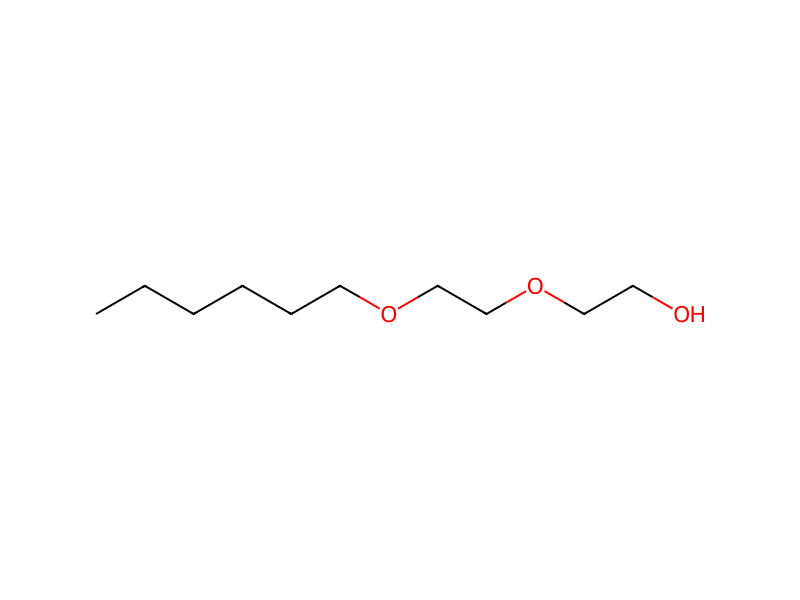
基本信息
- 标准SMILES
CCCCCCOCCOCCO- InChIKey
GZMAAYIALGURDQ-UHFFFAOYSA-N- 分子式
- C10H22O3
- 平均分子量
- 190.28 g/mol
- 单同位素质量
- 190.15689456
概述
Diethylene glycol n-hexyl ether is a water-white liquid. (USCG, 1999)
名称与标识
- 首选名称
- Diethylene glycol monohexyl ether
- IUPAC
- 2-(2-hexoxyethoxy)ethanol
- 中文名
- 二乙二醇单己醚
- 英文名
- 2-(2-HEXYLOXYETHOXY)ETHANOL
- 分子式
- C10H22O3
- 分子量
- 190.28
名称与别名
展开更多名称
数据库标识
- CAS
112-59-4- PubChem CID
- 8199
- DTXSID
DTXSID4026921- ChEMBL
CHEMBL2131110- UNII
- Z6X09N6YJL
- EC Number
- 203-988-3
- Nikkaji
- J36.821K
性质
结构计算性质
- XLogP
- 1.7
- 极性表面积
- 38.7 Ų
- 氢键供体
- 1
- 氢键受体
- 3
- 可旋转键
- 10
- 重原子
- 13
- 形式电荷
- 0
- 复杂度
- 86.2
实验与物化性质
LogP
log Kow = 1.70
1.70
1.7
Density
0.9346 at 68 °F (USCG, 1999) - Less dense than water; will float
0.9346 at 25 °C/4 °C
Relative density (water = 1): 0.935
0.935 @25 °C
Solubility
In water, 17,000 mg/L at 20 °C
Solubility in water, g/100ml at 20 °C: 1.7
Flash Point
285 °F (USCG, 1999)
Flash point equals 285 °F
271 °F (OPEN CUP)
140.6 °C o.c.
Boiling Point
498.4 °F at 760 mmHg (USCG, 1999)
boiling point equals 498 ° F
258 °C at 760 mm Hg; 192 °C at 100 mm Hg
259.1 °C
259.1 °C @760 [mm Hg]
Melting Point
-27.4 °F (USCG, 1999)
-28 °C
-33.3 °C
-33.3 °C
物理化学性质
- 熔点
- -40 °C · -40 °C (lit.)
- 沸点
- 260 °C · 260 °C (lit.)
- 密度
- 0.935 g/mL · 0.935 g/mL at 25 °C (lit.)
- 蒸气压
- 0.01 hPa · <0.01 hPa (20 °C)
- 折射率
- 20 · n20/D 1.4381(lit.)
- 闪点
- 230 °F · >230 °F
- 储存条件
- 30 °C · Store below +30°C.
- 溶解度
- 17 g/l · 17g/l
- 形态
- clear liquid
- 酸度系数(pKa)
- 14.37 · 14.37±0.10(Predicted)
- 颜色
- Colorless to Light yellow
- PH值
- 5 · 5-7 (200g/l, H2O, 20℃)
- 爆炸极限值(explosive limit)
- 1.1 · 1.1-6.3%(V)
- 水溶解性
- Soluble in water.
- 敏感性
- Hygroscopic
- BRN
- 1743959 · 1743959
- Henry's Law Constant
- 5.7 · 5.7×102 mol/(m3Pa) at 25℃, Duchowicz et al. (2020)
- InChI
- 1S/C10H22O3/c1-2-3-4-5-7-12-9-10-13-8-6-11/h11H,2-10H2,1H3
- InChIKey
- GZMAAYIALGURDQ-UHFFFAOYSA-N
- SMILES
- CCCCCCOCCOCCO
- LogP
- 1.7 · 1.7
- CAS 数据库
- 112 · 112-59-4(CAS DataBase Reference)
- EPA化学物质信息
- Diethylene glycol monohexyl ether (112-59-4)
安全与法规
GHS分类
GHS Classification
Danger
H312: Harmful in contact with skin [Warning Acute toxicity, dermal]
P264+P265, P280, P302+P352, P305+P354+P338, P317, P321, P362+P364, and P501 (click each P-code to see the statement)
Danger
H312 (100%): Harmful in contact with skin [Warning Acute toxicity, dermal]
P261, P264+P265, P271, P280, P302+P352, P304+P340, P305+P354+P338, P317, P319, P321, P362+P364, P403+P233, P405, and P501 (click each P-code to see the statement)
危害信息
Regulatory Information
Chemical: Ethanol, 2-[2-(hexyloxy)ethoxy]-
Ethanol, 2-[2-(hexyloxy)ethoxy]- is listed on the EPA's Chemical Data Reporting (CDR) system. Manufacturers and importers of Ethanol, 2-[2-(hexyloxy)ethoxy]- are required to report information about their production and use of this chemical to the EPA under the Toxic Substances Control Act (TSCA). (40 eCFR Part 711)
REACH registered substance: 2-(2-hexyloxyethoxy)ethanol (EC: 203-988-3)
Diethylene glycol mono-N-hexyl ether: Does not have an individual approval but may be used under an appropriate group standard
Fire Hazards
Special Hazards of Combustion Products: Irritating vapors and toxic gases, such as carbon dioxide and carbon monoxide, may be formed when involved in fire. (USCG, 1999)
Combustible.
Hazards Summary
A skin and eye irritant; [CAMEO] Acute health effects are not expected unless workers are exposed to mist or heated liquid; [CHEMINFO] Dermal LD50 (rabbits) = 2000 mg/kg; In oral or dermal doses > 800-1000 mg/kg/day, causes CNS depression, liver and kidney injury, but no significant developmental toxicity; No effects on fertility at 1000 mg/kg/day; [Reference #1] See GLYCOL ETHERS.
Reactivity Profile
Ethers, such as DIETHYLENE GLYCOL N-HEXYL ETHER can act as bases. They form salts with strong acids and addition complexes with Lewis acids. The complex between diethyl ether and boron trifluoride is an example. Ethers may react violently with strong oxidizing agents. In other reactions, which typically involve the breaking of the carbon-oxygen bond, ethers are relatively inert.
安全与防护
Fire Fighting
Fire Extinguishing Agents Not to Be Used: Water.
Use water spray, powder, foam, carbon dioxide.
First Aid Measures
Fresh air, rest.
Remove contaminated clothes. Rinse skin with plenty of water or shower.
First rinse with plenty of water for several minutes (remove contact lenses if easily possible), then refer for medical attention.
Rinse mouth. Give one or two glasses of water to drink.
Disposal Methods
SRP: The most favorable course of action is to use an alternative chemical product with less inherent propensity for occupational exposure or environmental contamination. Recycle any unused portion of the material for its approved use or return it to the manufacturer or supplier. Ultimate disposal of the chemical must consider: the material's impact on air quality; potential migration in soil or water; effects on animal, aquatic, and plant life; and conformance with environmental and public health regulations.
Preventive Measures
SRP: The scientific literature for the use of contact lenses in industry is conflicting. The benefit or detrimental effects of wearing contact lenses depend not only upon the substance, but also on factors including the form of the substance, characteristics and duration of the exposure, the uses of other eye protection equipment, and the hygiene of the lenses. However, there may be individual substances whose irritating or corrosive properties are such that the wearing of contact lenses would be harmful to the eye. In those specific cases, contact lenses should not be worn. In any event, the usual eye protection equipment should be worn even when contact lenses are in place.
...BECAUSE OF ITS TOXICITY, /IT/ SHOULD BE HANDLED WITH CARE & CAUTION TO PREVENT EYE CONTACT. IT WOULD SEEM WISE ALSO TO EXERCISE CARE TO AVOID PROLONGED OR REPEATED INHALATION EXPOSURE, ESP IF IT IS HANDLED HOT OR IF OPERATIONS CALL FOR AGITATED OR NEBULIZATION SO THAT FOG OR MIST IS GENERATED.
毒理信息
Environmental Fate
TERRESTRIAL FATE: Based on a classification scheme(1), an estimated Koc value of 200(SRC), determined from a log Kow of 1.70(2) and a regression-derived equation(3), indicates that diethylene glycol hexyl ether is expected to have moderate mobility in soil(SRC). Volatilization of diethylene glycol hexyl ether from moist soil surfaces is not expected to be an important fate process(SRC) given an estimated Henry's Law constant of 1.7X10⁻⁸ atm-cu m/mole(SRC), derived from its vapor pressure, 1.18X10⁻³ mm Hg(4), and water solubility, 1.7X10+4 mg/L(5). Diethylene glycol hexyl ether is not expected to volatilize from dry soil surfaces(SRC) based upon its vapor pressure(4). Biodegradation of diethylene glycol hexyl ether may take place based on a study using pure culture Pseudomonas sp 4-5-3 which degraded diethylene glycol hexyl ether 34% in 7 days at 30 °C(6).
AQUATIC FATE: Based on a classification scheme(1), an estimated Koc value of 200(SRC), determined from a log Kow of 1.70(2) and a regression-derived equation(3), indicates that diethylene glycol hexyl ether is expected to adsorb to suspended solids and sediment(SRC). Volatilization from water surfaces is not expected(3) based upon an estimated Henry's Law constant of 1.7X10⁻⁸ atm-cu m/mole(SRC), derived from its vapor pressure, 1.18X10⁻³ mm Hg(4), and water solubility, 1.7X10+4 mg/L(5). According to a classification scheme(6), an estimated BCF of 4(SRC), from its log Kow(2) and a regression-derived equation(7), suggests the potential for bioconcentration in aquatic organisms is low(SRC). Biodegradation of diethylene glycol hexyl ether may take place based on a study using pure culture Pseudomonas sp 4-5-3 which degraded diethylene glycol hexyl ether 34% in 7 days at 30 °C(8).
ATMOSPHERIC FATE: According to a model of gas/particle partitioning of semivolatile organic compounds in the atmosphere(1), diethylene glycol hexyl ether, which has an estimated vapor pressure of 1.18X10⁻³ mm Hg at 25 °C(2), is expected to exist solely as a vapor in the ambient atmosphere. Vapor-phase diethylene glycol hexyl ether is degraded in the atmosphere by reaction with photochemically-produced hydroxyl radicals(SRC); the half-life for this reaction in air is estimated to be 9.5 hours(SRC), calculated from its rate constant of 4.0X10⁻¹¹ cu cm/molecule-sec at 25 °C(SRC) that was derived using a structure estimation method(3). Alcohols and ethers do not contain chromophores that absorb at wavelengths >290 nm and therefore diethylene glycol hexyl ether is not expected to be susceptible to direct photolysis by sunlight(4).
Signs and Symptoms
Redness. Pain.
Redness. Pain.
Abdominal pain. Nausea. Vomiting. Diarrhoea.
Soil Adsorption/Mobility
The Koc of diethylene glycol hexyl ether is estimated as 200(SRC), using a log Kow of 1.70(1) and a regression-derived equation(2). According to a classification scheme(3), this estimated Koc value suggests that diethylene glycol hexyl ether is expected to have moderate mobility in soil(SRC).
Human Toxicity Excerpts
/SIGNS AND SYMPTOMS/ IT IS MILDLY TO MODERATELY IRRITATING TO THE SKIN BUT SHOULD CAUSE NO SERIOUS INJURY UNLESS THE EXPOSURE IS PROLONGED & SEVERE.
/SIGNS AND SYMPTOMS/ 1. CENTRAL NERVOUS DEPRESSION... 3. NAUSEA, VOMITING, & SOMETIMES DIARRHEA. 4. ...HEADACHE. LATER ABDOMINAL & LUMBAR PAIN & COSTOVERTEBRAL ANGLE TENDERNESS. 5. TRANSIENT POLYURIA & THEN OLIGURIA, PROGRESSING TO ANURIA. 6. ACUTE RENAL FAILURE... /DIETHYLENE GLYCOL & ITS MONOETHERS/
/SIGNS AND SYMPTOMS/ ... PATHOLOGICAL LESIONS MAY APPEAR IN BRAIN, LUNGS, LIVER, MENINGES & HEART. /DIETHYLENE GLYCOL & ITS MONOETHERS/
Environmental Bioconcentration
An estimated BCF of 4 was calculated in fish for diethylene glycol hexyl ether(SRC), using a log Kow of 1.70(1) and a regression-derived equation(2). According to a classification scheme(3), this BCF suggests the potential for bioconcentration in aquatic organisms is low(SRC).
Volatilization from Water/Soil
The Henry's Law constant for diethylene glycol hexyl ether is estimated as 1.7X10⁻⁸ atm-cu m/mole(SRC) derived from its vapor pressure, 1.18X10⁻⁸ mm Hg(1), and water solubility, 1.7X10+4 mg/L(2). This Henry's Law constant indicates that diethylene glycol hexyl ether is expected to be essentially nonvolatile from water surfaces(3). Diethylene glycol hexyl ether is not expected to volatilize from dry soil surfaces(SRC) based upon its vapor pressure(1).
Non-Human Toxicity Excerpts
/LABORATORY ANIMALS: Acute Exposure/ RATS EXPOSED TO ESSENTIALLY SATURATED VAPORS GENERATED AT ROOM TEMPERATURE FOR 8 HR EXPERIENCED NO SIGNIFICANT ILL EFFECTS & ALL SURVIVED.[Bingham, E.; Cohrssen, B.; Powell, C.H.; Patty's Toxicology Volumes 1-9 5th ed. John Wiley & Sons. New York, N.Y. (2001)., p. V7 209]
/LABORATORY ANIMALS: Acute Exposure/ IT IS SEVERELY IRRITATING TO THE EYE AND MAY CAUSE MARKED CORNEAL INJURY WHICH MAY BE SLOW IN HEALING.[Bingham, E.; Cohrssen, B.; Powell, C.H.; Patty's Toxicology Volumes 1-9 5th ed. John Wiley & Sons. New York, N.Y. (2001)., p. V7 208]
/LABORATORY ANIMALS: Acute Exposure/ The acute handling hazards of /diethylene glycol monohexyl ether (DGHE)/ was investigated. Acute peroral LD50 values in the rat were ... 4.92 mL/kg (males) and 3.73 mL/kg (females). Acute percutaneous LD50 values in the rabbit were 2.14 mL/kg (males) and 2.37 mL/kg (females). There were neither deaths nor signs of toxicity or irritancy during or following a 6-hr exposure of rats to a statically generated substantially saturated vapor atmosphere from ... DGHE at ambient temperature. Occluded dermal application with 0.5 ml test material for 4-hr in rabbits produced moderate inflammation of several days duration, and half of the animals developed necrosis; ... there was minor erythema and edema of about 24-hr duration. In the more demanding conditions of the acute percutaneous toxicity study (24-hr occlusions with up to 4.0 mL/kg) ... DGHE produced persistent erythema, edema, necrosis, and ecchymoses. Rabbit eye irritation studies showed severe effects (conjunctivitis and corneal injury).[Ballantyne B and Myers RC; Vet Hum Toxicol 29 (5): 361-6 (1987)]
/GENOTOXICITY/ Diethylene glycol monohexyl ether (DEGHE) was investigated for the potential to produce genotoxic effects using three in vitro and two in vivo tests. No mutagenic activity occurred in either the absence or presence of metabolic activation with a Salmonella typhimurium reverse assay using strains TA98, TA100, TA1535, TA1537 and TA1538. In a Chinese hamster ovary (CHO) forward gene mutation test (HGPRT locus) there was an increase in the mutation frequencies, which were relatively small compared with the solvent control values, somewhat inconsistent between duplicate cultures and occurred particularly in the presence of metabolic activation. Linear regression analysis indicated a marginally significant trend for dosage versus mutation frequency, suggesting that DEGHE was weakly positive in this test. A sister chromatid exchange test in CHO cells showed no significant dosage-related effects in the presence or absence of metabolic activation. A peripheral blood micronucleus test in mice by dosing with an ip injection of DEGHE did not show any potential for DEGHE to increase the incidence of micronucleated polychromatophilic erythrocytes. In a first femoral bone marrow chromosome aberration test in the rat by peroral dosing, DEGHE did not cause any increase in aberrations for 12-hr and 24-hr samples with males and females or with females at 48-hr sampling. However, with males at 48 hr the two lowest doses showed an increased number of aberrations, but not at the high doses. A repeat study in males with a larger number of doses and 24-h and 48-h samples did not replicate this finding. It is concluded that DEGHE may have limited weak mutagenic activity in vitro but is devoid of clastogenic potential.[Ballantyne B and Vergnes JS; J Appl Toxicol 21 (6): 449-60 (2001)]
Environmental Abiotic Degradation
The rate constant for the vapor-phase reaction of diethylene glycol hexyl ether with photochemically-produced hydroxyl radicals has been estimated as 4.0X10⁻¹¹ cu cm/molecule-sec at 25 °C(SRC) using a structure estimation method(1). This corresponds to an atmospheric half-life of about 9.5 hours at an atmospheric concentration of 5X10+5 hydroxyl radicals per cu cm(1). Diethylene glycol hexyl ether is not expected to undergo hydrolysis in the environment due to the lack of functional groups that hydrolyze under environmental conditions(2). Alcohols and ethers do not contain chromophores that absorb at wavelengths >290 nm and therefore diethylene glycol hexyl ether is not expected to be susceptible to direct photolysis by sunlight(3).
安全数据
- wgk
- 1
- tsca
- TSCA listed
- 毒性
- LD50 orally in Rabbit: 2400 mg/kg LD50 dermal Rabbit 1395 mg/kg
- RTECS号
- KL2625000
- 存储类别
- 10 - Combustible liquids
- 安全说明
- 26-36/37-46-36/37/39
- 海关编码
- 29094400
- 自燃温度
- 210 °C
- 危险品标志
- Xn
- 危险性类别
- Acute Tox. 4 DermalEye Dam. 1
- 危险类别码
- 21-41-38
- 毒害物质数据
- 112-59-4(Hazardous Substances Data)
化学与工业
用途与制造
Uses
Used as a solvent for coatings and degreasing; [HSDB]
Metal Degreasing [Category: Clean]
High-boiling solvent
SOLVENT (EG, FOR SURFACE COATINGS & CLEANING SOLNS)
U.S. Production
2023: 1,000,000 - <8,500,000 lb
(1979) PROBABLY GREATER THAN 4.54X10+6 GRAMS
(1981) PROBABLY GREATER THAN 4.54X10+6 GRAMS
Production volumes for non-confidential chemicals reported under the Inventory Update Rule. [Table#5440]
(2006): 1,612 million lb annual capacity /Glycol ethers/
This chemical is listed as a High Production Volume (HPV) (65FR81686). Chemicals listed as HPV were produced in or imported into the U.S. in >1 million pounds in 1990 and/or 1994. The HPV list is based on the 1990 Inventory Update Rule. (IUR) (40 CFR part 710 subpart B; 51FR21438).
Methods of Manufacturing
REACTION OF ETHYLENE OXIDE WITH 1-HEXANOL (PRODUCT IS ISOLATED FROM THE REACTION MIXT BY VACUUM DISTILLATION); REACTION OF DIETHYLENE GLYCOL WITH 1-HEXANOL
Ethylene glycol monoethers are usually produced by reaction of ethylene oxide with the appropriate alcohol. A mixture of homologues is obtained ... The glycol monoethers can be converted to diethers by alkylation with common alkylating agents, such as dimethyl sulfate or alkyl halides ( Williamson synthesis). Glycol dimethyl ethers are formed by treatment of dimethyl ether with ethylene oxide. /Ethylene Glycol Monoethers/
Use Classification
EPA Safer Chemical Functional Use Classes -> Solvents
Safer Chemical Classes -> Yellow triangle - The chemical has met Safer Choice Criteria for its functional ingredient-class, but has some hazard profile issues
General Manufacturing Information
All Other Basic Organic Chemical Manufacturing
Ethanol, 2-[2-(hexyloxy)ethoxy]-: ACTIVE
应用领域
用途二乙二醇单己醚为醚类衍生物,可用作真漆、油漆、树脂、染料、油类和润滑油的溶剂,也用作偶合和分散剂。
制备方法
制备先将二乙二醇单己醚与氢氧化钠反应制得醇钠,制成的醇钠以四丁基溴化铵作相转移催化剂,再在氯甲烷的作用下进行合成反应,生成二乙二醇甲己醚,具体操作如下。向装有温度计、回流冷凝器和搅拌器的四颈烧瓶中加入70g的二乙二醇单己醚(C10H22O3),再加入一定摩尔比的碱,搅拌下加入一定比例的催化剂四丁基溴化铵(C16H36BrN)。打开Y型连接管和储罐的阀门,通氯甲烷并将温度升至反应温度,进行醚缩合反应,反应时间3.5h。在实验过程中,记录通气时的温度、阀门开度的大小,同时要记录各个时间段的实验现象。反应结束后,加入40mL水进行水洗,搅拌的同时并通过外界水浴降温,温度降至常温后,停止搅拌,静置一会,用胶头滴管取上层澄清液于样品瓶中,通过岛津CC-14B气相色谱仪打气相色谱,根据气相色谱,用面积归一法计算二乙二醇单己醚的转化率。
上下游产品信息
上游原料
试剂价格
- B20774 · 500ml
- 二乙二醇单正己醚, 97% Diethylene glycol mono-n-hexyl ether, 97% — 335元
- D0501 · 25ML
- 二乙二醇单己醚Diethylene Glycol Monohexyl Ether — 130元
供应商50 家
相关反应
当前筛选下没有反应记录。
关联笔记
加载中…