1,3-二氯-5,5-二甲基海因
二氯海因 · 3-二氯-5 · 二氯海因片剂 · 二氯二甲基海因 · 乙内酰脲杂质5 · 二氯海因-27 · 二氯海因(DCDMH) · 二氯海因/二氯二甲基海因
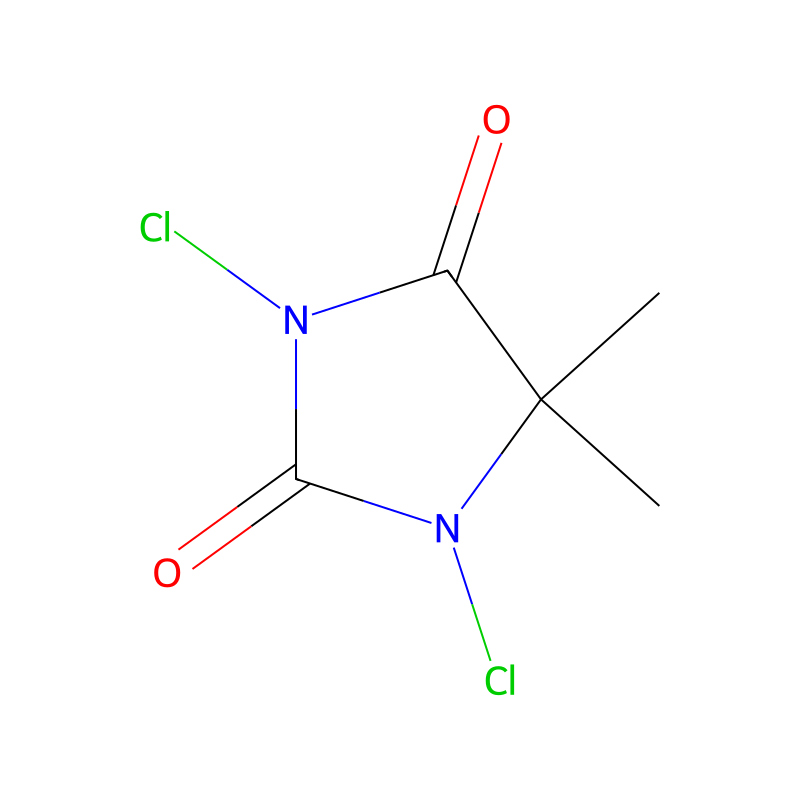
标识与物理属性
| CAS No. | 118-52-5 |
|---|---|
| 分子式 | C5H6Cl2N2O2 |
| 平均分子量 | 197.02 g/mol |
| 单同位素质量 | 195.98063279 g/mol |
| SMILES | CC1(C)C(=O)N(Cl)C(=O)N1Cl |
| InChIKey | KEQGZUUPPQEDPF-UHFFFAOYSA-N |
| PubChem CID | 8360 |
| ChEMBL | CHEMBL1899986 |
| EC No. | 204-258-7 |
| DTXSID | DTXSID4024985 |
| 中文名 | 1,3-二氯-5,5-二甲基海因 |
化学与物理性质
| XLogP | 1.1 |
|---|---|
| 极性表面积 | 40.6 |
| 氢键供体 | 0 |
| 氢键受体 | 2 |
| 可旋转键 | 0 |
| 重原子 | 11 |
| 形式电荷 | 0 |
| 复杂度 | 229 |
| 物质类别 | Nitrogen Compounds -> Other Nitrogen Compounds |
| pH | pH of aqueous soln about 4.44.4 (H2O)(HSDB) |
| SpringerMaterials Properties | Nuclear quadrupole resonance spectroscopy |
| 气味 | Chlorine-like odor |
| 密度 | 1.5 at 68 °F (NTP, 1992) - Denser than waterwill sink1.5 at 20 °C/20 °C1,5 g/cm3 |
| Color/Form | Four-sided, pointed prisms from chloroformWhite powder |
| 溶解性 | Reaction (NTP, 1992)Solubility (at 25 °C): 12.5% in carbon tetrachloride, 14% in chloroform, 30% in methylene chloride, 32.0% in ethylene dichloride, 17% in sym-tetrachlorethane, 9.2% in benzeneIn water, 0.5 g/L at 20 °C1.3 g/L at 40 °C.0.2%water: soluble0.21% at 25°C(lit.)0.21 g/100 mL (25 ºC) |
| Corrosivity | PRESUMABLY LESS CORROSIVE THAN HYPOCHLORITE SOLUTIONS WITH SAME CONCN OF AVAILABLE CHLORINE |
| 闪点 | 346 °F (NIOSH, 2024)171 °C |
| 沸点 | Sublimes at 212 °F (NTP, 1992)212 ° (sublimes)214.7±23.0 °C(Predicted) |
| Decomposition | When heated to decomposition it emits toxic vapors of /nitrogen oxide and hydrogen chloride/. |
| 熔点 | 270 °F (NTP, 1992)132 °C132-134 °C (lit.) |
| 蒸气压 | 0.003Pa |
| 折射率 | 1.5720 (estimate) |
| 储存条件 | Keep in dark place,Sealed in dry,Room Temperature |
| pKa(酸度系数) | -3.44±0.40(Predicted) |
| 形态 | Crystalline Powder |
| 颜色 | White |
| 敏感性 | Moisture Sensitive |
| Merck | 14,3065 |
| 升华点 | 100 ºC |
| BRN | 146013 |
| 亨利常数 | 9.9×100 mol/(m3Pa) at 25℃, HSDB (2015) |
| 暴露限值 | ACGIH:TLV-TWA 0.2 mg/m3TLV-STEL 0.4 mg/m3OSHA:PEL-TWA 0.2 mg/m3NIOSH:REL-TWA 0.2 mg/m3REL-STEL 0.4 mg/m3 |
| 稳定性 | Stable, but a strong oxidizer - contact with combustible material may lead to fire. Incompatible with reducing agents, acids, strong bases. Moisture sensitive. |
| InChI | 1S/C5H6Cl2N2O2/c1-5(2)3(10)8(6)4(11)9(5)7/h1-2H3 |
| InChIKey | KEQGZUUPPQEDPF-UHFFFAOYSA-N |
| SMILES | CC1(C)N(Cl)C(=O)N(Cl)C1=O |
| LogP(油水分配系数) | -0.94 |
| CAS 数据库 | 118-52-5(CAS DataBase Reference) |
| EPA化学物质信息 | 1,3-Dichloro-5,5-dimethylhydantoin (118-52-5) |
安全与法规
| GHS 分类 | DangerH272 (53.1%): May intensify fireoxidizer [Danger Oxidizing liquidsOxidizing solids]P210, P220, P233, P260, P261, P264, P264+P265, P270, P271, P272, P273, P280, P284, P301+P317, P301+P330+P331, P302+P352, P302+P361+P354, P304+P340, P305+P351+P338, P305+P354+P338, P316, P319, P321, P330, P332+P317, P333+P317, P337+P317, P342+P316, P362+P364, P363, P370+P378, P391, P403, P403+P233, P405, and P501 (click each P-code to see the statement)Aggregated GHS information provided per 130 reports by companies from 15 notifications to the ECHA C&L Inventory. Each notification may be associated with multiple companies.WarningH302: Harmful if swallowed [Warning Acute toxicity, oral] |
|---|---|
| 法规信息 | Chemical: 2,4-Imidazolidinedione, 1,3-dichloro-5,5-dimethyl-2,4-Imidazolidinedione, 1,3-dichloro-5,5-dimethyl- is listed on the EPA's Chemical Data Reporting (CDR) system. Manufacturers and importers of 2,4-Imidazolidinedione, 1,3-dichloro-5,5-dimethyl- are required to report information about their production and use of this chemical to the EPA under the Toxic Substances Control Act (TSCA). (40 eCFR Part 711)Dantochlor (BCDMH) is listed in the dataset of EPA Human Health Benchmarks for Pesticides under the Safe Drinking Water Act (40 eCFR 141)Status: Active Update: 02-04-2020 https://echa.europa.eu/registration-dossier/-/registered-dossier/181811,3-Dichloro-5,5-dimethylhydantoin: Does not have an individual approval but may be used under an appropriate group standard |
| 运输标签(DOT) | Oxidizer |
| 火灾危害 | Flash point data for this chemical are not available. It is probably combustible. (NTP, 1992) |
| 火灾可能性 | ... /It is/ combustible with evolution of chlorine at 210 °C. |
| 健康危害 | Excerpt from NIOSH Pocket Guide for 1,3-Dichloro-5,5-dimethylhydantoin: |
| 危害概述 | Hypochlorous acid is released upon contact with water. A concentration of 10 ppm is the maximum level recommended to prevent respiratory irritation when used to sanitize swimming pools. A worker exposed to a concentration exceeding 0.2 mg/m3 complained of cough and chest discomfort. [ACGIH] Corrosive to skin and eyesMay cause respiratory sensitization[Sigma-Aldrich MSDS] |
| 反应性基团 | Acyl Halides, Sulfonyl Halides, and Chloroformates |
| FIFRA 要求 | As the federal pesticide law FIFRA directs, EPA is conducting a comprehensive review of older pesticides to consider their health and environmental effects and make decisions about their future use. Under this pesticide reregistration program, EPA examines health and safety data for pesticide active ingredients initially registered before November 1, 1984, and determines whether they are eligible for reregistration. In addition, all pesticides must meet the new safety standard of the Food Quality Protection Act of 1996. Pesticides for which EPA had not issued Registration Standards prior to the effective date of FIFRA, as amended in 1988, were divided into three lists based upon their potential for human exposure and other factors, with List B containing pesticides of greater concern and List D pesticides of less concern. Dichloro-5,5-dimethylhydantoin is found on List C. Case No: 3055Pesticide type: fungicide, herbicide, antimicrobialCase Status: OPP is reviewing data from the pesticide's producers regarding its human health and/or environmental effects, or OPP is determining the pesticide's eligibility for reregistration and developing the Reregistration Eligibility Decision (RED) document.Active ingredient (AI): dichloro-5,5-dimethylhydantoinData Call-in (DCI) Date(s): 05/03/93AI Status: The producers of the pesticide has made commitments to conduct the studies and pay the fees required for reregistration, and are meeting those commitments in a timely manner. |
| Reactivity Alerts | Strong Oxidizing Agent |
| OSHA Standards | Permissible Exposure Limit: Table Z-1 8-hr Time Weighted Avg: 0.2 mg/cu m.Vacated 1989 OSHA PEL TWA 0.2 mg/cu mSTEL 0.4 mg/cu m is still enforced in some states. |
| Reactivity Profile | 1,3-DICHLORO-5,5-DIMETHYLHYDANTOIN reacts violently with xylene. It is incompatible with strong acids, easily oxidized materials, ammonia salts and sulfides. It will react with water or steam to produce toxic and corrosive fumes. At a pH of 9, it decomposes completely. (NTP, 1992) |
| Flammable Limits | Combustible Solid |
| 消防 | Fires involving this material can be controlled with a dry chemical, carbon dioxide or Halon extinguisher. (NTP, 1992) |
| 急救 | EYES: First check the victim for contact lenses and remove if present. Flush victim's eyes with water or normal saline solution for 20 to 30 minutes while simultaneously calling a hospital or poison control center. Do not put any ointments, oils, or medication in the victim's eyes without specific instructions from a physician. IMMEDIATELY transport the victim after flushing eyes to a hospital even if no symptoms (such as redness or irritation) develop.(General first aid procedures) |
| 储存条件 | Safe Storage of Pesticides. Always store pesticides in their original containers, complete with labels that list ingredients, directions for use, and first aid steps in case of accidental poisoning. Never store pesticides in cabinets with or near food, animal feed, or medical supplies. Do not store pesticides in places where flooding is possible or in places where they might spill or leak into wells, drains, ground water, or surface water. |
| 清理方法 | Absorb the spills with paper towels or the like materials. Place in hood to evaporate. Dispose by burning the towel.If a spill occurs, clean it up promptly. Don't wash it away. Instead, sprinkle the spill with sawdust, vermiculite, or kitty litter. Sweep it into a plastic garbage bag, and dispose of it as directed on the pesticide product label.After Applying a Pesticide, Indoors or Outdoors. To remove pesticide residues, use a bucket to rinse tools or equipment three times, including any containers or utensils that you used when mixing the pesticide. Then pour the rinsewater into the pesticide sprayer and reuse the solution by applying it according to the pesticide product label directions. After applying any pesticide wash your hands and any other parts of your body that may have come in contact with the pesticide..To prevent tracking pesticides inside, remove or rinse your boots or shoes before entering your home. Wash any clothes that have been exposed to a lot of pesticide separately from your regular wash. |
| 非火灾泄漏应对 | SMALL SPILLS AND LEAKAGE: Should a spill occur while you are handling this chemical, FIRST REMOVE ALL SOURCES OF IGNITION, then you should dampen the solid spill material with 60-70% ethanol and transfer the dampened material to a suitable container. Use absorbent paper dampened with 60-70% ethanol to pick up any remaining material. Seal the absorbent paper, and any of your clothes, which may be contaminated, in a vapor-tight plastic bag for eventual disposal. Solvent wash all contaminated surfaces with 60-70% ethanol followed by washing with a soap and water solution. Do not reenter the contaminated area until the Safety Officer (or other responsible person) has verified that the area has been properly cleaned. |
| 处置方法 | SRP: The most favorable course of action is to use an alternative chemical product with less inherent propensity for occupational exposure or environmental contamination. Recycle any unused portion of the material for its approved use or return it to the manufacturer or supplier. Ultimate disposal of the chemical must consider: the material's impact on air qualitypotential migration in soil or watereffects on animal, aquatic, and plant lifeand conformance with environmental and public health regulations.Safe Disposal of Pesticides. The best way to dispose of small amounts of excess pesticides is to use them - apply them - according to the directions on the label. If you cannot use them, ask your neighbors whether they have a similar pest control problem and can use them. If all of the remaining pesticide cannot be properly used, check with your local solid waste management authority, environmental agency, or health department to find out whether your community has a household hazardous waste collection program or a similar program for getting rid of unwanted, leftover pesticides. These authorities can also inform you of any local requirements for pesticide waste disposal.Safe Disposal of Pesticides. An empty pesticide container can be as hazardous as a full one because of residues left inside. Never reuse such a container. When empty, a pesticide container should be rinsed carefully three times and the rinsewater thoroughly drained back onto the sprayer or the container previously used to mix the pesticide. Use the rinsewater as a pesticide, following label directions. Replace the cap or closure securely. Dispose of the container according to label instructions. Do not puncture or burn a pressurized container like an aerosol - it could explode. Do cut or puncture other empty pesticide containers made of metal or plastic to prevent someone from reusing them. Wrap the empty container and put it in the trash after you have rinsed it. |
| Preventive Measures | SRP: The scientific literature for the use of contact lenses in industry is conflicting. The benefit or detrimental effects of wearing contact lenses depend not only upon the substance, but also on factors including the form of the substance, characteristics and duration of the exposure, the uses of other eye protection equipment, and the hygiene of the lenses. However, there may be individual substances whose irritating or corrosive properties are such that the wearing of contact lenses would be harmful to the eye. In those specific cases, contact lenses should not be worn. In any event, the usual eye protectionequipment should be worn even when contact lenses are in place.The worker should immediately wash the skin when it becomes contaminated.Work clothing that becomes wet or significantly contaminated should be removed and replaced.Workers whose clothing may have become contaminated should change into uncontaminated clothing before leaving the work premises.For more Preventive Measures (Complete) data for 1,3-DICHLORO-5,5-DIMETHYLHYDANTOIN (9 total), please visit the HSDB record page. |
| Isolation and Evacuation | Excerpt from ERG Guide 140 [Oxidizers]: |
| Respirator Recommendations | NIOSH/OSHA |
| Threshold Limit Values (TLV) | 0.2 [mg/m3]0.4 [mg/m3]8 hr Time Weighted Avg (TWA): 0.2 mg/cu m15 min Short Term Exposure Limit (STEL): 0.4 mg/cu m.0.2 mg/m³ [1979]0.4 mg/m³ [1979] |
| Permissible Exposure Limit (PEL) | 0.2 [mg/m3]0.2 mg/m³TWA 0.2 mg/m3 See Appendix G |
| Recommended Exposure Limit (REL) | 0.2 mg/m³0.4 mg/m³TWA 0.2 mg/m3 ST 0.4 mg/m3 |
| 靶器官 | Eyes, respiratory system |
| 生态毒性数值 | LC50 Anas platyrhynchos (Mallard duck) diet >5620 ppm/8 daysLC50 Colinus virginianus (Bobwhite quail) diet >5620 ppm/8 daysLD50 Colinus virginianus (Bobwhite quail, adult) oral 1715 mg/kgEC50 Daphnia magna (Water flea, age <24 hrintoxication, immobilization) 0.84 ppm/48 hr (95% confidence limit: 0.77-0.91 ppm)staticFor more Ecotoxicity Values (Complete) data for 1,3-DICHLORO-5,5-DIMETHYLHYDANTOIN (12 total), please visit the HSDB record page. |
| 环境归趋 | TERRESTRIAL FATE: Based on a classification scheme(1), an estimated Koc value of 140(SRC), determined from a water solubility of 500 mg/L(2) and a regression-derived equation(3), indicates that 1,3-dichloro-5,5-dimethylhydantoin is expected to have high mobility in soil(SRC). Volatilization of 1,3-dichloro-5,5-dimethylhydantoin from moist soil surfaces may be an important fate process(SRC) given an estimated Henry's Law constant of 1.0X10⁻⁶ atm-cu m/mole(SRC), using a fragment constant estimation method(4). 1,3-Dichloro-5,5-dimethylhydantoin is not expected to volatilize from dry soil surfaces(SRC) based upon an estimated vapor pressure of 2.4X10⁻⁵ mm Hg(SRC), determined from a fragment constant method(5). Biodegradation data were not available(SRC, 2006).AQUATIC FATE: Based on a classification scheme(1), an estimated Koc value of 140(SRC), determined from a water solubility of 500 mg/L(2) and a regression derived equation(3), indicates that 1,3-dichloro-5,5-dimethylhydantoin is not expected to adsorb to suspended solids and sediment(SRC). Volatilization from water surfaces is expected(3) based upon an estimated Henry's Law constant of 1.0X10⁻⁶ atm-cu m/mole(SRC), developed using a fragment constant estimation method(4). Using this Henry's Law constant and an estimation method(3), volatilization half-lives for a model river and model lake are 50 and 370 days, respectively(SRC). According to a classification scheme(5), an estimated BCF of 19(SRC), from its water solubility(2)and a regression-derived equation(3), suggests the potential for bioconcentration in aquatic organisms is low(SRC). Upon exposure to water 1,3-dichloro-5,5-dimethylhydantoin will slowly release hypochlorous acid. At pH 9 nitrogen chloride is formed from 1,3-dichloro-5,5-dimethylhydantoin solutions(6). Biodegradation data were not available(SRC, 2006).ATMOSPHERIC FATE: According to a model of gas/particle partitioning of semivolatile organic compounds in the atmosphere(1), 1,3-dichloro-5,5-dimethylhydantoin, which has an estimated vapor pressure of 2.4X10⁻⁵ mm Hg at 25 °C(SRC), determined from a fragment constant method(2), will exist in both the vapor and particulate phases in the ambient atmosphere. Vapor-phase 1,3-dichloro-5,5-dimethylhydantoin is degraded in the atmosphere by reaction with photochemically-produced hydroxyl radicals(SRC)the half-life for this reaction in air is estimated to be 5 days(SRC), calculated from its rate constant of 3.1X10⁻¹² cu cm/molecule-sec at 25 °C(SRC) that was derived using a structure estimation method(3). Particulate-phase 1,3-dichloro-5,5-dimethylhydantoin may be removed from the air by wet or dry deposition(SRC). 1,3-Dichloro-5,5-dimethylhydantoin does not contain chromophores that absorb at wavelengths >290 nm and therefore is not expected to be susceptible to direct photolysis by sunlight(SRC). |
| 不良影响 | Dermatotoxin - Skin burns. |
| 暴露途径 | inhalation, ingestion, skin and/or eye contact |
| Signs and Symptoms | irritation eyes, mucous membrane, respiratory system |
| Soil Adsorption/Mobility | The Koc of 1,3-dichloro-5,5-dimethylhydantoin is estimated as 140(SRC) using a water solubility of 500 mg/L(1) and a regression-derived equation(2). According to a classification scheme(3), this estimated Koc value suggests that 1,3-dichloro-5,5-dimethylhydantoin is expected to have high mobility in soil. |
| Human Toxicity Excerpts | /SIGNS AND SYMPTOMS/ Local tissue injury is the only recognized toxic action./CASE REPORTS/ An operator at a reactor station of a chemical company, who was exposed at a concentration of DCDMH exceeding a time weighted average of 0.2 mg/cu m, experienced cough and chest discomfort. |
| Artificial Pollution Sources | 1,3-Dichloro-5,5-dimethylhydantoin's production and use as a chlorinating agent, disinfectant, industrial deodorant, active ingredient in laundry bleaches, intermediate for drug, amino acid and insecticide synthesis as well as a stabilizer and catalyst for polymers(1) may result in its release to the environment through various waste streams(SRC). Its use in water treatment(1) will result in its direct release to the environment(SRC). |
| Environmental Bioconcentration | An estimated BCF of 19 was calculated for 1,3-dichloro-5,5-dimethylhydantoin(SRC), using water solubility of 500 mg/L(1) and a regression-derived equation(2). According to a classification scheme(3), this BCF suggests the potential for bioconcentration in aquatic organisms is low. |
| Volatilization from Water/Soil | The Henry's Law constant for 1,3-dichloro-5,5-dimethylhydantoin is estimated as 1.0X10⁻⁶ atm-cu m/mole(SRC) using a fragment constant estimation method(1). This Henry's Law constant indicates that 1,3-dichloro-5,5-dimethylhydantoin is expected to volatilize from water surfaces(2). Based on this Henry's Law constant, the volatilization half-life from a model river (1 m deep, flowing 1 m/sec, wind velocity of 3 m/sec)(2) is estimated as 50 days(SRC). The volatilization half-life from a model lake (1 m deep, flowing 0.05 m/sec, wind velocity of 0.5 m/sec)(2) is estimated as 370 days(SRC). 1,3-Dichloro-5,5-dimethylhydantoin's Henry's Law constant indicates that volatilization from moist soil surfaces may occur(SRC). 1,3-Dichloro-5,5-dimethylhydantoin is not expected to volatilize from dry soil surfaces(SRC) based upon a an estimated vapor pressure of 2.4X10⁻⁵ mm Hg(SRC), determined from a fragment constant method(3). |
| Non-Human Toxicity Excerpts | /LABORATORY ANIMALS: Acute Exposure/ Acute oral LD50 for rats of both sexes was found to be 542 + or - 84 mg/kg when DCDMH was administered as a 10% aqueous suspension. Hemorrhages of the gastrointestinal tract were usually found at necropsy of the rats dying within 48 hr after being dosed./LABORATORY ANIMALS: Subchronic or Prechronic Exposure/ Rats were able to tolerate aqueous solutions of DCDMH maintained at 20 ppm "available chlorine" given orally over a 30 day test period/LABORATORY ANIMALS: Chronic Exposure or Carcinogenicity/ Dimethylhydantoin (purity = 98.9%) was fed in diet to Beagle dogs (4/sex/dose) at 0, 4000, 12000 and 40000 ppm for one-year. Chronic NOEL = 12000 ppm (Adrenal cortical hypertrophy was increased and correlated with increased relative adrenal weight for males at 40000 ppm. Adrenal hypertrophy was diffuse/bilateral and involved zona fasciculata cells. Body weight values were not statistically significantly decreased, but were generally lower in both sexes at 40000 ppm relative to the controls.) NOEL = 12000 ppm. /5,5-dimethylhydantoin//LABORATORY ANIMALS: Chronic Exposure or Carcinogenicity/ ... 5,5-Dimethylhydantoin (DMH) in Rats, Dantoin (DMH, purity = 99.8%) was fed in diet to CD rats (60/sex/dose) at 0 (2 control groups), 100, 300, or 1000 mg/kg/day for 104 weeks. Diets were adjusted periodically for DMH concentration to maintain the doses with separate diets for males and females. Chronic NOEL = 300 mg/kg/day (Survival time relative to controls was decreased in both sexes at 1000 mg/kg/day, however it was statistically significantly decreased only in males. Bodyweights were statistically significantly lower (9-14%) in females at 1000 mg/kg late in the study. Body weight gains were significantly decreased (compared to both controls) in males at 1000 mg/kg. No effects were observed in relation to hematology, clinical chemistry, urinalysis, ophthalmology, organ weights or pathology.) Oncogenic NOEL >1000 mg/kg/day (There were no treatment-related tumorigenic effects at any dose.) /5,5-Dimethylhydantoin/For more Non-Human Toxicity Excerpts (Complete) data for 1,3-DICHLORO-5,5-DIMETHYLHYDANTOIN (9 total), please visit the HSDB record page. |
| 水危害等级(WGK) | 3 |
| TSCA 清单状态 | TSCA listed |
| 毒性 | LD50 oral in rabbit: 1520mg/kg |
| RTECS 号 | MU0700000 |
| 包装类别 | II |
| 危险类别 | 5.1Acute Tox. 4 OralAquatic Acute 1Aquatic Chronic 1Ox. Sol. 2Skin Irrit. 2Skin Sens. 1 |
| 储存类别 | 5.1B - Oxidizing hazardous materials |
| 安全说明(S) | 26-36-45-36/37/39-17-61 |
| 海关编码 | 29332100 |
| 危险品标志 | Xn,C,O,N |
| 危险类别码(R) | 22-36/37/38-34-8-50-43-31-20/21/22 |
| 毒害物质数据 | 118-52-5(Hazardous Substances Data) |
| 职业暴露等级(OEB) | C |
| 职业暴露限值(OEL) | TWA: 0.2 mg/m3, STEL: 0.4 mg/m3 |
| 运输编号(UN) | UN 1479 5.1/PG 2 |
| 立即危及生命和健康浓度 | 5 mg/m3 |
急性毒性
口服-大鼠 LD50: 542 毫克/ 公斤
刺激数据
皮肤-兔 500 毫克/24小时 重度
职业标准
TWA 0.2 毫克/立方米; STEL 0.6 毫克/立方米
可燃性危险特性
助燃; 火场释放有毒氯化物, 氮氧化物烟雾
储运特性
库房通风低温干燥; 与食品、碱类、氧化剂分开储运
灭火剂
二氧化碳,化学干粉、泡沫
用途与应用
简介
二氯二甲基海因又名 1,3-二氯-5,5-二甲基海因、1,3-二氯-5,5-二甲基乙内酰脲、二氯海因、DCDMH 等,英文名称 1,3-Dichloro-5,5-dimethylhydantoin、1,3-dichloro-5,5-dimethyl-2,4-imidazolidinedione、Dactin、Halane 等,,白色四面棱柱体结晶粉末 (工业产品有粒状和片状等多种规格),有轻微的氯刺激性气味,容易吸潮,吸潮后部分水解。 易溶于氯仿、二氯甲烷、四氯化碳、二氯乙烯、对称四氯乙烷、苯等有机溶剂和浓硫酸中。加热至沸点时变为 棕色且迅速燃烧。
应用
二氯二甲基海因是一种新型的氯代酰亚胺类消毒杀菌剂及漂白剂,主要用作水处理剂、消毒杀菌剂、水果保鲜剂等,具有高效、广谱、安全、稳定的特点,能强烈杀灭真菌、细菌、病毒和藻类。广泛应用于游泳池消毒、饮用水消毒、水产养殖、废水及工业循环水处理、餐具消毒、食品与化妆品生产设备消毒、医药卫生及娱乐场所环境消毒等领域。
用途
主要作为杀菌、灭藻剂,可有效杀灭各种细菌、真菌、病毒、藻类、肝炎病毒等
用途
一种氯胺型广谱高效消毒杀菌剂
制备与合成方法
制备
步骤1:5,5-二甲基海因的合成。1)碳铵加热合成法 反应瓶中加入 46 ml(0.5 mol)丙酮氰醇、30 ml 水,加热,搅拌下在 20 min 内分次加入 80 g(0.7 mol) 碳铵,然后分段控温,反应 2 h,反应完,趁热将反应液 倾入烧杯中,冷却后过滤,得到白色固体产物 44.8 g,产率 70 %,m.p.180.4182.8 ℃,滤液经浓缩处理,得到 黄色固体,经重结晶 、过滤 、烘干,得到浅黄色固体 9.8 g,收率 15 %,m.p.180182 ℃,总产率 85 %。或将上述 所得滤液不经浓缩处理,直接作下一次反应的溶液,操 作步骤同上,如此反应循环重复使用五次,单次产率为 82 %95 %。 步骤2:5,5-二甲基海因的产品纯化。将装有 20 ml 蒸馏水的烧杯置于 80 ℃水浴中恒温,加入粗产品至接近饱和(约 22.07 g),然后冰浴冷却重结 晶,干燥,即得无色针状或白色粉末产品 20.14 g,回收率 为91.3 %。此滤液可回收利用。 步骤3:1,3-二氯-5,5-二甲基海因的合成 在装有机械搅拌:、回流冷凝管和滴液漏斗的 250 ml 三颈瓶中加入 8.25 g(0.206 mol)氢氧化钠及 5 ml 水,搅拌溶解,冷至 010 ℃,缓慢引入氯气 2.24 l(约 0.10 mol),完毕后,加入 12.8 g(0.10 mol)5,5-二甲基 海因固体,搅拌反应 5 min 后,再缓慢引入氯气 2.46 l (约0.11 mol)保持,完毕后继续 搅拌反应 20 min,冷却过滤,粗产品用 100 ml 水洗涤三 次,抽干,50 ℃以下真空干燥得淡黄色固体或白色固体 18.0 g,产率为 91%。