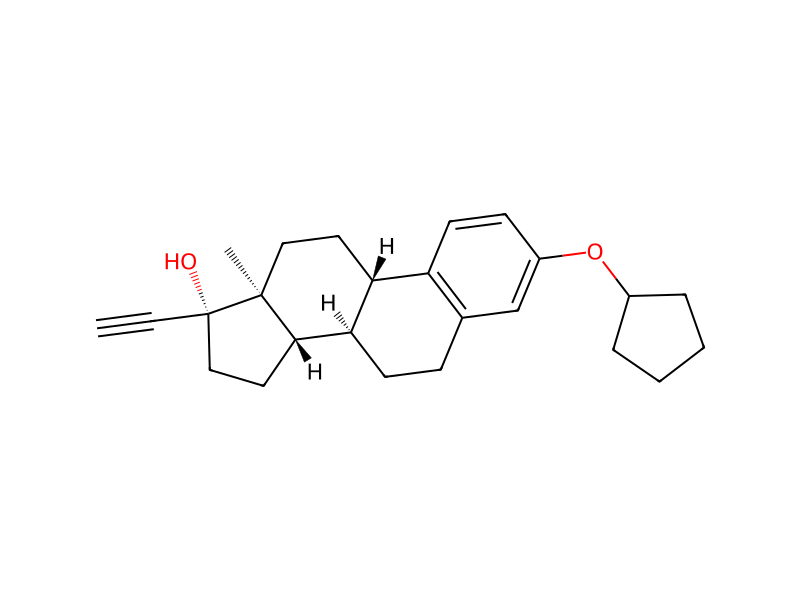
基本信息
- 标准SMILES
C#C[C@]1(O)CC[C@H]2[C@@H]3CCc4cc(OC5CCCC5)ccc4[C@H]3CC[C@@]21C- InChIKey
PWZUUYSISTUNDW-VAFBSOEGSA-N- 分子式
- C25H32O2
- 平均分子量
- 364.5 g/mol
- 单同位素质量
- 364.24023026
概述
Quinestrol is a 17-hydroxy steroid and a terminal acetylenic compound. It has a role as a xenoestrogen. It is functionally related to a 17beta-estradiol.
名称与标识
- 首选名称
- Quinestrol
- IUPAC
- (8R,9S,13S,14S,17R)-3-cyclopentyloxy-17-ethynyl-13-methyl-7,8,9,11,12,14,15,16-octahydro-6H-cyclopenta[a]phenanthren-17-ol
名称与别名
展开更多名称
数据库标识
- CAS
152-43-2- PubChem CID
- 9046
- DTXSID
DTXSID6046553- ChEMBL
CHEMBL1201165- ChEBI
CHEBI:8716- UNII
- JR0N7XD5GZ
- EC Number
- 205-803-1
- Nikkaji
- J5.865C
性质
结构计算性质
- XLogP
- 5.3
- 极性表面积
- 29.5 Ų
- 氢键供体
- 1
- 氢键受体
- 2
- 可旋转键
- 3
- 重原子
- 27
- 形式电荷
- 0
- 复杂度
- 613
实验与物化性质
Human Drugs
FDA approved drugs -> Active ingredient
FDA approved drugs -> Active ingredient
安全与法规
GHS分类
GHS Classification
Danger
H302 (60.9%): Harmful if swallowed [Warning Acute toxicity, oral]
P203, P260, P261, P263, P264, P270, P271, P280, P301+P317, P302+P352, P304+P340, P317, P318, P321, P330, P362+P364, P405, and P501 (click each P-code to see the statement)
Aggregated GHS information provided per 64 reports by companies from 4 notifications to the ECHA C&L Inventory. Each notification may be associated with multiple companies.
危害信息
毒理信息
Toxicity Summary
Estrogens diffuse into their target cells and interact with a protein receptor (the estrogen receptor). Estrogen interacts with a target cell receptor. When the estrogen receptor has bound its ligand it can enter the nucleus of the target cell, and regulate gene transcription which leads to formation of messenger RNA. The mRNA interacts with ribosomes to produce specific proteins that express the effect of estradiol upon the target cell. Estrogens increase the hepatic synthesis of sex hormone binding globulin (SHBG), thyroid-binding globulin (TBG), and other serum proteins and suppress follicle-stimulating hormone (FSH) from the anterior pituitary. Target cells include the female reproductive tract, the mammary gland, the hypothalamus, and the pituitary. Estrogens increase the hepatic synthesis of sex hormone binding globulin (SHBG), thyroid-binding globulin (TBG), and other serum proteins and suppress follicle-stimulating hormone (FSH) from the anterior pituitary. The combination of an estrogen with a progestin suppresses the hypothalamic-pituitary system, decreasing the secretion of gonadotropin-releasing hormone (GnRH).
化学与工业
药理信息
Pharmacodynamics
Quinestrol is the 3-cyclopentyl ether of ethinyl estradiol (the active metabolite). After gastrointestinal absorption, it is stored in adipose tissue where it is slowly released and metabolized principally to the parent compound, ethinyl estradiol. Ethinyl estradiol is a synthetic derivative of the natural estrogen estradiol.
Mechanism of Action
Estrogens diffuse into their target cells and interact with a protein receptor (the estrogen receptor). Estrogen interacts with a target cell receptor. When the estrogen receptor has bound its ligand it can enter the nucleus of the target cell, and regulate gene transcription which leads to formation of messenger RNA. The mRNA interacts with ribosomes to produce specific proteins that express the effect of estradiol upon the target cell. Estrogens increase the hepatic synthesis of sex hormone binding globulin (SHBG), thyroid-binding globulin (TBG), and other serum proteins and suppress follicle-stimulating hormone (FSH) from the anterior pituitary. Target cells include the female reproductive tract, the mammary gland, the hypothalamus, and the pituitary. Estrogens increase the hepatic synthesis of sex hormone binding globulin (SHBG), thyroid-binding globulin (TBG), and other serum proteins and suppress follicle-stimulating hormone (FSH) from the anterior pituitary. The combination of an estrogen with a progestin suppresses the hypothalamic-pituitary system, decreasing the secretion of gonadotropin-releasing hormone (GnRH).
Metabolism/Metabolites
Metabolized principally to the parent compound, ethinyl estradiol. Ethinyl estradiol is metabolized in the liver. Quantitatively, the major metabolic pathway for ethinyl estradiol, both in rats and in humans, is aromatic hydroxylation, as it is for the natural estrogens.
Metabolized principally to the parent compound, ethinyl estradiol. Ethinyl estradiol is metabolized in the liver. Quantitatively, the major metabolic pathway for ethinyl estradiol, both in rats and in humans, is aromatic hydroxylation, as it is for the natural estrogens.
MeSH Pharmacological Classification
Compounds that interact with ESTROGEN RECEPTORS in target tissues to bring about the effects similar to those of ESTRADIOL. Estrogens stimulate the female reproductive organs, and the development of secondary female SEX CHARACTERISTICS. Estrogenic chemicals include natural, synthetic, steroidal, or non-steroidal compounds.
用途与制造
相关反应
当前筛选下没有反应记录。
关联笔记
加载中…