Sodium pyruvate, BioXtra, >=99%
HCID 10154024
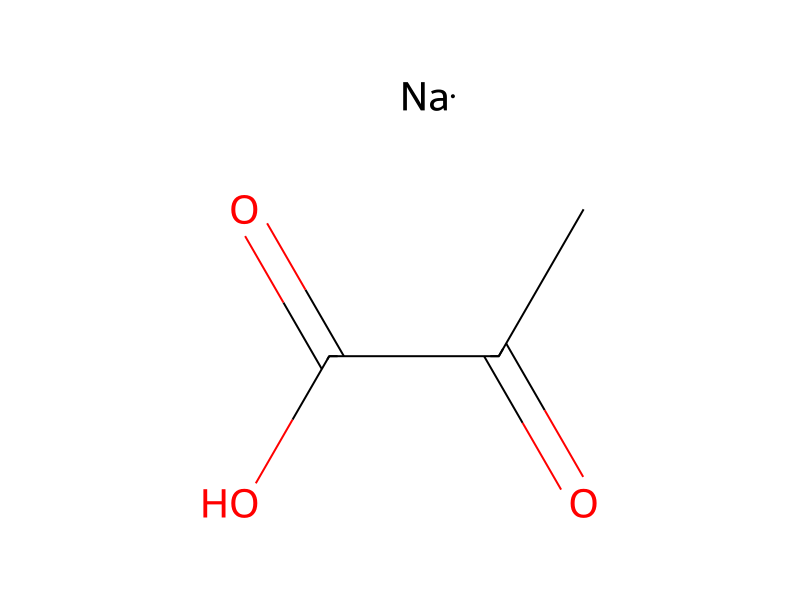
Basic information
- CAS
113-24-6- Standard SMILES
CC(=O)C(=O)O.[Na]- InChIKey
DAQHMCWYXJEOCG-UHFFFAOYSA-N- Molecular formula
- C3H4NaO3
- Average molar mass
- 111.05 g/mol
Names & identifiers
- Preferred name
- Sodium pyruvate, BioXtra, >=99%
- English name
- Sodium pyruvate
- Molecular formula
- C3H5NaO3
- Molecular weight
- 112.06
Names & synonyms
Sodium pyruvate, p.a., 99%SCHEMBL30123187Sodium pyruvate, BioXtra, >=99%Sodium pyruvate, purum, >=99.0% (NT)Sodium pyruvate, ReagentPlus(R), >=99%Sodium pyruvate, SAJ special grade, >=95.0%Sodium pyruvate, Vetec(TM) reagent grade, 98%Sodium pyruvate, powder, BioXtra, suitable for mouse embryoSodium pyruvate, Hybri-Max(TM), powder, suitable for hybridomaSodium pyruvate, anhydrous, free-flowing, Redi-Dri(TM), ReagentPlus(R), >=99%Sodium pyruvate, powder, BioReagent, suitable for cell culture, suitable for insect cell culture, >=99%PYRUVATE
Show more names
PYRUVIC ACID SODIUM SALTSODIUM 2-OXOPROPANOATEpyruvic acid sodiumSodiuM pyruvat2-KETOPROPIONIC ACID SODIUM SALTPYR NAp.A.,100gbinrongsuannaSodium pyruate
Database identifiers
- CAS
113-24-6- PubChem CID
- 10154024
Properties
Computed structural properties
- Topological polar surface area
- 54.4 Ų
- Hydrogen bond donors
- 1
- Hydrogen bond acceptors
- 3
- Rotatable bonds
- 1
- Heavy atoms
- 7
- Formal charge
- 0
- Complexity
- 84
Physicochemical properties
- Melting point
- 300 °C · >300 °C (lit.)
- Boiling point
- 300 ℃ · >300℃
- Density
- 1 · 1,267g/cm
- vapor pressure
- 0 Pa · 0Pa at 20℃
- refractive index
- 1 · 1,426-1,43
- storage temp.
- 2 · 2-8°C
- solubility
- 2 O: · H2O: 100 mg/mL
- form
- solution
- color
- White to Pale Yellow
- PH
- pH(100g/l, 25℃) : 4.0~8.0
- biological source
- synthetic (organic)
- Water Solubility
- Soluble in water.
- BRN
- 3568341 · 3568341
- Stability
- Stable. Incompatible with strong oxidizing agents.
- Cosmetics Ingredients Functions
- SKIN CONDITIONING
- InChI
- 1S/C3H4O3.Na/c1-2(4)3(5)6;/h1H3,(H,5,6);/q;+1/p-1
Safety & regulation
Safety information is for reference only and does not replace the supplier’s Safety Data Sheet (SDS), applicable regulations, or professional assessment.
Safety data
- PPE
- Eyeshields, Gloves, type N95 (US)
- wgk
- 3
- tsca
- TSCA listed
- hs_code
- 29183000
- risk_code
- 36/38-36/37/38
- Signal word
- Warning
- Symbol(GHS)
- GHS07
- hazard_code
- Xi
- safety_code
- 37/39-26-24/25-36
- Storage Class
- 11 - Combustible Solids
- Hazard statements
- H317-H319
- REACH Registrations
- Active
- Hazard Classifications
- Eye Irrit. 2Skin Sens. 1B
- Precautionary statements
- P280-P302+P352-P305+P351+P338
Chemistry & industry
Applications
DescriptionSodium pyruvate is the sodium salt of pyruvate. It is frequently supplemented to the cell culture medium to act as a source of energy since it is a key intermediate during the production of the high-energy ATP molecules inside cells. For example, it can be used as a carbon source for bacteria. It may also protect cell against hydrogen peroxide, an oxidant to scavenger oxygen radicals. It is an important metabolic intermediate in many essential metabolic pathways such as carbohydrate metabolism. For example, it is converted into acetyl coenzyme A and enters into the TCA cycle (Kreb’s cycle) in organisms. It is also involved in the amino acid metabolism in organisms.
UsesIntermediate in sugar metabolism and in enzymatic carbohydrate degradation (alcoholic fermentation) where it is converted to acetaldehyde and CO2 by carboxylase. In muscle, Pyruvic acid (derived from glycogen) is reduced to lactic acid during exertion, which is reoxidized and partially retransformed to glycogen during rest. The liver can convert Pyruvic acid to alanine by amination. A diagnostic agent for Parkinson disease
UsesSodium pyruvate is used in cell culture media as an additional source of energy. It acts as an antioxidant and finds protective effects against oxygen radicals. It serves as an intermediate in many metabolic pathways such as sugar metabolism. It is converted into acetyl coenzyme A and enters the trichloroacetic acid cycle. In addition, it is involved with amino acid metabolism and initiates the Kreb's cycle. It plays an important role as a free radical scavenger.
General DescriptionSodium pyruvate (SP) is a simplest keto-acid. It crystallizes as very thin plates and belongs to the monoclinic system. Its utility in Knoevenagel condensation carried out in an aqueous medium has been examined. The standard molar enthalpy of formation and molar enthalpy of dissolution of SP at infinite dilution have been obtained. Its efficacy in treating mitochondrial DNA depletion syndromes has been investigated.
Preparation methods
PreparationThe preparation of sodium pyruvate is as follows:Synthesis of pyruvate, a salt of a compound of formula (II) by ozonolysis of methacrylic acid, a compound of formula (II) A solution of methacrylic acid obtained in Example la or lb (15.31 g, 178 mmol) in dichloromethane/methanol (5 % methanol, 50 ml) was cooled to -78 0C and a stream of ozone was passed through until the solution turned blue. Dimethylsulfide (12.41 g, 200 mmol) was added and the mixture was allowed to reach room temperature. Excess dimethylsulfide was removed by passing a stream of nitrogen through the reaction mixture. The reaction mixture was evaporated in vacuo at 30 0C. To the residue was added water (100 ml) and then slowly added a solution of aq. NaOH (IM, 178 ml). The mixture was concentrated and left for crystallisation at 4 °C. The white crystalline material obtained was filtered and washed with acetone (3x100 ml). Yield: 14.50 g (92 %). Purity: 95 %.
Related reactions
0 records
No related reactions yet