2,4-Diaminoazobenzene
HCID 10317
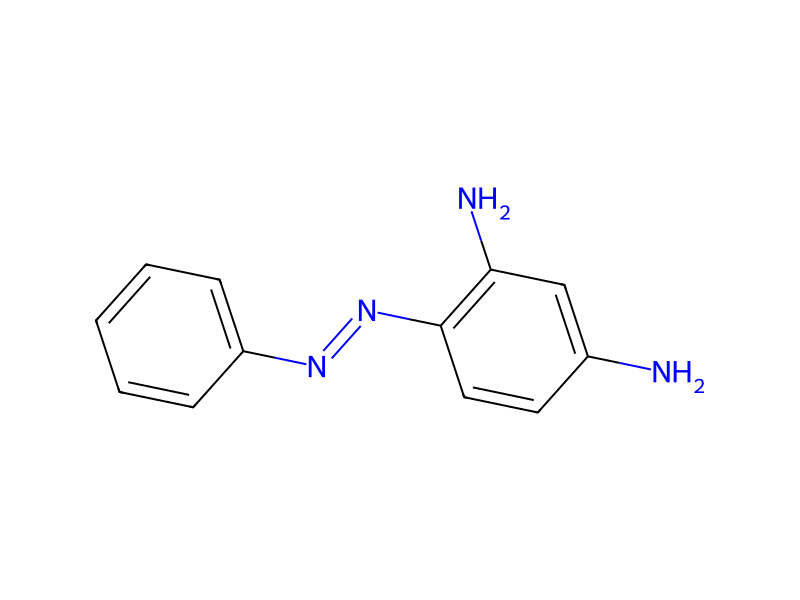
Basic information
- CAS
495-54-5- Standard SMILES
Nc1ccc(N=Nc2ccccc2)c(N)c1- InChIKey
IWRVPXDHSLTIOC-UHFFFAOYSA-N- Molecular formula
- C12H12N4
- Average molar mass
- 212.25 g/mol
- Monoisotopic mass
- 212.10619638
Overview
Chrysoidine free base is a member of azobenzenes.
Names & identifiers
- Preferred name
- 2,4-Diaminoazobenzene
- IUPAC
- 4-phenyldiazenylbenzene-1,3-diamine
- English name
- 2,4-Diaminoazobenzene
- Molecular formula
- C12H12N4
- Molecular weight
- 212.25
Names & synonyms
2,4-DIAMINOAZOBENZENE495-54-5Solvent Orange 3Chrysoidine Y Base NewAzobenzene-2,4-diamine2,4-Diaminoazobenzenm-Phenylenediamine, 4-(phenylazo)-4-(Phenylazo)-1,3-phenylenediamineNSC 32732,4-Diaminoazobenzen [Czech]Chrysoidine (free base)Chrysoidin A
Show more names
azodianilineAzohelazoanilineC.I.11270:1Oil Orange YFat Brown GGOranz zasadita 2
Chrysoidine (Salt/Mix)C.I. Basic Orange 2 (Salt/Mix)RefChem:82274IWRVPXDHSLTIOC-FOCLMDBBSA-NChrysoidine free baseChrysoidine Y Base1,3-Benzenediamine, 4-(phenylazo)-Chrysoidine Base
Database identifiers
- CAS
495-54-5、768311-59-7- PubChem CID
- 10317
- DTXSID
DTXSID4043856- ChEMBL
CHEMBL1623562、CHEMBL1739417- ChEBI
CHEBI:34640- UNII
- IP3X2567YP
- EC Number
- 207-803-7
Properties
Computed structural properties
- XLogP
- 2.3
- Topological polar surface area
- 76.8 Ų
- Hydrogen bond donors
- 2
- Hydrogen bond acceptors
- 4
- Rotatable bonds
- 2
- Heavy atoms
- 16
- Formal charge
- 0
- Complexity
- 235
Experimental & physicochemical properties
Chemical ClassesDyes -> Azo Dyes
SpringerMaterials PropertiesDiamagnetic susceptibility
Vapor Pressure0.00000152 [mmHg]
Physical Description
Wet Solid
Solid; [Sigma-Aldrich MSDS]
Collision Cross Section149.6 Ų [M-H]- [CCS Type: DT; Buffer gas: N2; Ionization: ESI-; Dataset: TOXCAST; Source Identifier: DTXSID0024559]
Physicochemical properties
- Melting point
- 117 · 117~123℃
- Boiling point
- 342.09 °C · 342.09°C (rough estimate)
- Density
- 1.139 · 1.1390
- vapor pressure
- 0 Pa · 0Pa at 25℃
- refractive index
- 1.5 · 1.5000 (estimate)
- solubility
- Acetonitrile (Slightly), Chloroform (Slightly), Methanol (Slightly)
Safety & regulation
Safety information is for reference only and does not replace the supplier’s Safety Data Sheet (SDS), applicable regulations, or professional assessment.
GHS classification
GHS Classification
Warning
H302: Harmful if swallowed [Warning Acute toxicity, oral]
P203, P264, P270, P273, P280, P301+P317, P302+P352, P318, P321, P330, P332+P317, P362+P364, P391, P405, and P501 (click each P-code to see the statement)
This chemical does not meet GHS hazard criteria for 0.3% (1 of 374) of reports.
Warning
H302 (99.7%): Harmful if swallowed [Warning Acute toxicity, oral]
Hazard information
Regulatory Information
Chemical: 1,3-Benzenediamine, 4-(phenylazo)-
1,3-Benzenediamine, 4-(2-phenyldiazenyl)- is listed on the EPA's Chemical Data Reporting (CDR) system. Manufacturers and importers of 1,3-Benzenediamine, 4-(2-phenyldiazenyl)- are required to report information about their production and use of this chemical to the EPA under the Toxic Substances Control Act (TSCA). (40 eCFR Part 711)
REACH registered substance: 4-(phenylazo)benzene-1,3-diamine (EC: 207-803-7)
1,3-Benzenediamine, 4-(phenylazo)-: Does not have an individual approval but may be used under an appropriate group standard
Other Safety InformationIMAP assessments - Chrysoidine base and its salts: Human health tier II assessment
Hazards SummaryA moderate eye irritant; [RTECS] An irritant; Harmful by ingestion; [Sigma-Aldrich MSDS]
Hazard Classes and Categories
Acute Tox. 4 (99.7%)
Acute toxicity - category 4
Muta. 2
Safety data
- tsca
- TSCA listed
Chemistry & industry
Uses & manufacturing
Uses
Used for dyeing silk and cotton and as a biological stain; [Merck Index]
Textiles (Printing, Dyeing, or Finishing) [Category: Industry]
U.S. Production2023: 40,280 lb
Industry UsesDye
Household ProductsInformation on 8 consumer products that contain Solvent Orange 3 in the following categories is provided:
General Manufacturing Information
Synthetic Dye and Pigment Manufacturing
1,3-Benzenediamine, 4-(2-phenyldiazenyl)-: ACTIVE
Applications
UsesDyeing silk and cotton. Biological stain.
Preparation methods
Preparationaniline diazotization, and Benzene-1,3-diamine coupling.
Upstream & downstream products
Upstream raw materials
Downstream products
Additional notes
DefinitionChEBI: Chrysoidine free base is a member of azobenzenes.
Related reactions
0 records
No related reactions yet