HomeMCPWorkbenchSkills
HomeWorkbenchNotificationsMe
llms.txt · MCP GuidePrivacy Policy · Terms of Service · Supportv1.8.3
  1. Home
  2. /Compound

Diphenylacetylene

HCID 10390
New reaction
Print
Basic informationOverviewNames & identifiersPropertiesSafety & regulationChemistry & industryRelated reactionsCompound notes
Substructure searchFind similar structures

Basic information

CAS
501-65-5
Standard SMILES
C(#Cc1ccccc1)c1ccccc1
InChIKey
JRXXLCKWQFKACW-UHFFFAOYSA-N
Molecular formula
C14H10
Average molar mass
178.23 g/mol
Monoisotopic mass
178.07825032

Overview

Biphenylacetylene is an arylacetylene that is acetylene in which the hydrogens are replaced by phenyl groups. It has a role as a fluorochrome. It is a member of benzenes and an arylacetylene.

Names & identifiers

Preferred name
Diphenylacetylene
IUPAC
2-phenylethynylbenzene
English name
Diphenylacetylene
Molecular formula
C14H10
Molecular weight
178.23

Names & synonyms

DIPHENYLACETYLENE501-65-5TolanDiphenylethyneTolane1,2-Diphenylacetylene2-phenylethynylbenzeneBiphenylacetyleneBenzene, 1,1'-(1,2-ethynediyl)bis-1,1'-ethyne-1,2-diyldibenzeneY70JA8HB75CHEBI:51579
Show more names
Diphenilethyneethyne,diphenyl-1,2-DIPHENYL ETHYNE
DTXSID4060109NSC-5185RefChem:134661DTXCID3040778207-926-61,2-diphenylethynediphenyl acetyleneEthyne, diphenyl-

Database identifiers

CAS
501-65-5
PubChem CID
10390
DTXSID
DTXSID4060109
ChEMBL
CHEMBL223309
ChEBI
CHEBI:51579
UNII
Y70JA8HB75
EC Number
207-926-6
Nikkaji
J6.193J

Properties

Computed structural properties

XLogP
4.8
Topological polar surface area
0 Ų
Hydrogen bond donors
0
Hydrogen bond acceptors
0
Rotatable bonds
2
Heavy atoms
14
Formal charge
0
Complexity
193

Experimental & physicochemical properties

Chemical ClassesOther Classes -> Aromatic Hydrocarbons
SpringerMaterials PropertiesSchoenflies notation
LogP4.78
Physical DescriptionSolid; [Merck Index] White crystalline powder; [Acros Organics MSDS]

Physicochemical properties

Melting point
59 · 59-61 °C (lit.)
Boiling point
170 °C/19 · 170 °C/19 mmHg (lit.)
Density
0.99 g/mL · 0.99 g/mL at 25 °C (lit.)
refractive index
1.6415 · 1.6415 (estimate)
Flash point
170 °C/19mm · 170°C/19mm
storage temp.
2 · Sealed in dry,2-8°C
form
Crystalline Powder and Chunks
color
Light yellow to brownish

Safety & regulation

Safety information is for reference only and does not replace the supplier’s Safety Data Sheet (SDS), applicable regulations, or professional assessment.

GHS classification

GHS Classification · 4 items

Warning

H315 (100%): Causes skin irritation [Warning Skin corrosion/irritation]

P261, P264, P264+P265, P271, P280, P302+P352, P304+P340, P305+P351+P338, P319, P321, P332+P317, P337+P317, P362+P364, P403+P233, P405, and P501 (click each P-code to see the statement)

The GHS information provided by 1 company from 1 notification to the ECHA C&L Inventory.

Hazard information

Regulatory InformationBenzene, 1,1'-(1,2-ethynediyl)bis-: Does not have an individual approval but may be used under an appropriate group standard
Hazards SummaryMay cause irritation; [Acros Organics MSDS] See Phenylacetylene.
Hazard Classes and CategoriesSkin Irrit. 2 (100%)
CSL Reaction Information · 6 items

CSL00138

NITROBENZENE + DIPHENYLACETYLENE + ALUMINUM CHLORIDE

Aluminum chloride-nitrobenzene mixtures explode with existence of diphenylacetylene

Explosive

M (up to 100g)

Dissolve aluminum chloride in nitrobenzene in the presence of an oxidizable organic component should always be conducted initially on a small scale and with proper shielding in the event of an explosion.

Safety data

PPE
Eyeshields, Gloves, type N95 (US)
wgk
3
tsca
TSCA listed
hs_code
2902909000
Signal word
Warning

Chemistry & industry

Uses & manufacturing

UsesUsed as a starting material for polymerizations; [REPROTOX]
General Manufacturing InformationBenzene, 1,1'-(1,2-ethynediyl)bis-: ACTIVE
Applications · 2 items

UsesOrganic synthesis, purified grade, primary fluor or wavelength shifter in soluble scintillators.

UsesDiphenylacetylene is often used as a building block in organic and organometallic chemistry. It acts as dienophile and under goes Diels-Alder reaction with tetraphenylcyclopentadienone to prepare hexaphenylbenzene. It acts as a precursor in the preparation of 3-alkoxycyclopropene by reacting with benzal chloride in the presence of potassium t-butoxide.

Upstream & downstream products

Upstream raw materials

IodobenzenePalladium (II) AcetateAcetonitrileEthanolPotassium hydroxideCalcium chlorideCuprous iodidetrans-StilbeneTriethylamineHexadecyl trimethyl ammonium bromide(Formylmethylene)triphenylphosphorane

Related reactions

75 records
New reaction record
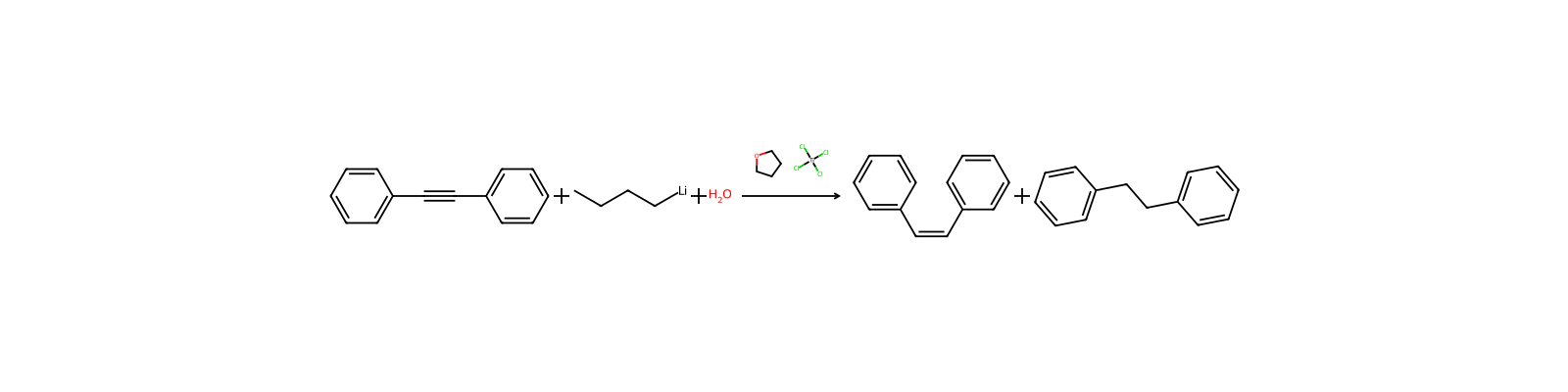
HRID 119950 reaction equation
HRID 119950As product
HRID 143811 reaction equation
HRID 143811As product
HRID 152727 reaction equation
HRID 152727As product
HRID 152775 reaction equation
HRID 152775As product
HRID 164088 reaction equation
HRID 164088As product
HRID 303343 reaction equation
HRID 303343As product
HRID 351959 reaction equation
HRID 351959As reactant
HRID 351960 reaction equation
HRID 351960As reactant
PreviousPage 1 of 10

Compound notes

On this pageBasic informationOverviewNames & identifiersPropertiesSafety & regulationChemistry & industryRelated reactionsCompound notes
Specific Gravity
0.99 · 0.99
Water Solubility
Miscible with ether and hot alcohol. Immiscible with water.
Specific Heat Capacity
1.27 J/ · Cp(crystal): 1.27 J/(g·K), at 25℃
ex/em
373 · λex 373, 354, 338 nm; λem 425, 404 nm in EtOH
Merck
14 · 14,9504
BRN
606478 · 606478
Stability
Stable. Combustible. Incompatible with strong oxidizing agents.
InChI
1S/C14H10/c1-3-7-13(8-4-1)11-12-14-9-5-2-6-10-14/h1-10H
InChIKey
JRXXLCKWQFKACW-UHFFFAOYSA-N
SMILES
c1ccc(cc1)C#Cc2ccccc2
CAS DataBase Reference
501 · 501-65-5(CAS DataBase Reference)
FDA UNII
70 JA8HB75 · Y70JA8HB75
NIST Chemistry Reference
Diphenylethyne(501-65-5)
EPA Substance Registry System
1 · Benzene, 1,1'-(1,2-ethynediyl)bis- (501-65-5)
UNSPSC Code
12352100 · 12352100
NACRES
22 · NA.22
Symbol(GHS)
7 · GHS07
Signal word
Warning
Hazard statements
315 · H315-H335-H319
Precautionary statements
264 · P264-P280-P302+P352-P321-P332+P313-P362-P264-P280-P305+P351+P338-P337+P313P
PPE
95 · Eyeshields, Gloves, type N95 (US)
Safety Statements
24 · 24/25-22
WGK Germany
3 · 3
TSCA
TSCA listed
HS Code
2902909000 · 2902909000
Storage Class
11 · 11 - Combustible Solids
Symbol(GHS)
GHS07
safety_code
24/25-22
Storage Class
11 - Combustible Solids
Hazard statements
H315-H335-H319
Precautionary statements
P264-P280-P302+P352-P321-P332+P313-P362-P264-P280-P305+P351+P338-P337+P313P
Benzyl bromide
Tetrahydrofuran
Palladium chloride
1,2-Diphenylethylenediamine
Bromine
Dichloromethane
Triphenylphosphine
N,N-Dimethylacetamide
Phenylacetylene
Lithium chloride

Additional notes

DefinitionChEBI: An arylacetylene that is acetylene in which the hydrogens are replaced by phenyl groups.