
uspto-grants-2010_06 · 10.6084/m9.figshare.5104873.v1 · US07727979B2
查看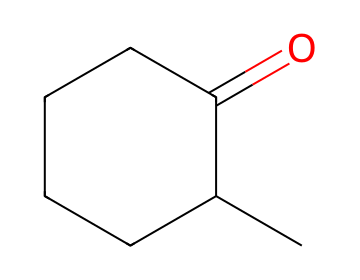
IDENTITY
COMPUTED
PROPERTIES
Acetone-like odor
Odor: characteristic: quality: peppermintlike
Weak, peppermint-like odor.
0.93 (USCG, 1999) - Less dense than water; will float
0.925 at 20 °C/4 °C
0.924-0.926
0.93
0.92 @25 °C
0.93
Water-white to pale yellow liquid
Colorless liquid
Colorless liquid.
Insoluble (NIOSH, 2024)
Insol in water; sol in alcohol and ether
insoluble in water; soluble in ether
Miscible at room temperature (in ethanol)
Insoluble
118 °F (USCG, 1999)
118 °F
118 °F
118 °F
329 °F at 760 mmHg (USCG, 1999)
165.1 °C
162-163 °C
329 °F
165.1 °C @760 [mm Hg]
325 °F
When heated to decomposition it emits acrid smoke and fumes.
-6.8 °F (USCG, 1999)
-14 °C
6.8 °F
-14 °C
7 °F
3.86 (air = 1)
Odor Threshold Low: 0.5 [ppm];Odor threshold from CHEMINFO
1 mmHg (NIOSH, 2024)
2.25 [mmHg]
1 mmHg
1 mmHg
1.444-1.450
GHS
Warning
H226: Flammable liquid and vapor [Warning Flammable liquids];H332: Harmful if inhaled [Warning Acute toxicity, inhalation]
P210, P233, P240, P241, P242, P243, P261, P271, P280, P303+P361+P353, P304+P340, P317, P370+P378, P403+P235, and P501 (click each P-code to see the statement)
Warning
HAZARDS
Chemical: Cyclohexanone, 2-methyl-
Regulation (EC) No 1334/2008 (amended)
Status: Active Update: 17-05-2022 https://echa.europa.eu/registration-dossier/-/registered-dossier/33492
Cyclohexanone, 2-methyl-: HSNO Approval: HSR001199 Approved with controls
The New Jersey Worker and Community Right to Know Act requires public and private employers to provide information about hazardous substances at their workplaces. (N.J.S.A. 34:5A-1 et. seq.)
Evaluation - Chemicals that are unlikely to require further regulation to manage risks to human health
Flammable Liquid
Special Hazards of Combustion Products: Irritating vapors and toxic gases, such as carbon monoxide, may be formed when involved in fire. (USCG, 1999)
MODERATE FIRE RISK.
May cause irritation of the eyes, nose and throat. Prolonged or repeated contact may cause dermatitis. (USCG, 1999)
TLV Basis is liver effects and CNS impairment. TLV-TWA is 20 ppm for Methylcyclohexanone (mixture of the 3 isomers), CAS number 1331-22-2. Causes liver toxicity in feeding study of rats. [ACGIH] A skin, eye, and respiratory tract irritant; [CAMEO]
2297 128
Ketones
Highly Flammable
Permissible Exposure Limit: Table Z-1 8-hr Time Weighted Avg: 100 ppm (460 mg/cu m). Skin designation.
Vacated 1989 OSHA PEL TWA 50 ppm (230 mg/cu m); STEL 75 ppm (345 mg/cu m), skin designation, is still enforced in some states.
Contact with strong oxidizers may cause fires and explosions (USCG, 1999).
SAFETY
Excerpt from ERG Guide 128 [Flammable Liquids (Water-Immiscible)]:;CAUTION: The majority of these products have a very low flash point. Use of water spray when fighting fire may be inefficient. CAUTION: For mixtures containing alcohol or polar solvent, alcohol-resistant foam may be more effective.;SMALL FIRE: Dry chemical, CO2, water spray or regular foam. If regular foam is ineffective or unavailable, use alcohol-resistant foam.;LARGE FIRE: Water spray, fog or regular foam. If regular foam is ineffective or unavailable, use alcohol-resistant foam. Avoid aiming straight or solid streams directly onto the product. If it can be done safely, move undamaged containers away from the area around the fire.;FIRE INVOLVING TANKS, RAIL TANK CARS OR HIGHWAY TANKS: Fight fire from maximum distance or use unmanned master stream devices or monitor nozzles. Cool containers with flooding quantities of water until well after fire is out. For petroleum crude oil, do not spray water directly into a breached tank car. This can lead to a dangerous boil over. Withdraw immediately in case of rising sound from venting safety devices or discoloration of tank. ALWAYS stay away from tanks in direct contact with flames. For massive fire, use unmanned master stream devices or monitor nozzles; if this is impossible, withdraw from area and let fire burn. (ERG, 2024)
Excerpt from NIOSH Pocket Guide for o-Methylcyclohexanone:;Eye: IRRIGATE IMMEDIATELY - If this chemical contacts the eyes, immediately wash (irrigate) the eyes with large amounts of water, occasionally lifting the lower and upper lids. Get medical attention immediately.;Skin: SOAP WASH PROMPTLY - If this chemical contacts the skin, promptly wash the contaminated skin with soap and water. If this chemical penetrates the clothing, promptly remove the clothing and wash the skin with soap and water. Get medical attention promptly.;Breathing: RESPIRATORY SUPPORT - If a person breathes large amounts of this chemical, move the exposed person to fresh air at once. If breathing has stopped, perform artificial respiration. Keep the affected person warm and at rest. Get medical attention as soon as possible.;Swallow: MEDICAL ATTENTION IMMEDIATELY - If this chemical has been swallowed, get medical attention immediately. (NIOSH, 2024)
(General first aid procedures);Eye: Irrigate immediately - If this chemical contacts the eyes, immediately wash (irrigate) the eyes with large amounts of water, occasionally lifting the lower and upper lids. Get medical attention immediately.;Skin: Soap wash promptly - If this chemical contacts the skin, promptly wash the contaminated skin with soap and water. If this chemical penetrates the clothing, promptly remove the clothing and wash the skin with soap and water. Get medical attention promptly.;Breathing: Respiratory support;Swallow: Medical attention immediately - If this chemical has been swallowed, get medical attention immediately.
Absorb on paper. Evaporate on a glass or iron dish in hood. Burn the paper.
Excerpt from ERG Guide 128 [Flammable Liquids (Water-Immiscible)]:;ELIMINATE all ignition sources (no smoking, flares, sparks or flames) from immediate area. All equipment used when handling the product must be grounded. Do not touch or walk through spilled material. Stop leak if you can do it without risk. Prevent entry into waterways, sewers, basements or confined areas. A vapor-suppressing foam may be used to reduce vapors. Absorb or cover with dry earth, sand or other non-combustible material and transfer to containers. Use clean, non-sparking tools to collect absorbed material.;LARGE SPILL: Dike far ahead of liquid spill for later disposal. Water spray may reduce vapor, but may not prevent ignition in closed spaces. (ERG, 2024)
Incineration
Spray into the furnace. Incineration will become easier by mixing with a more flammable solvent.
SRP: The scientific literature for the use of contact lenses in industry is conflicting. The benefit or detrimental effects of wearing contact lenses depend not only upon the substance, but also on factors including the form of the substance, characteristics and duration of the exposure, the uses of other eye protection equipment, and the hygiene of the lenses. However, there may be individual substances whose irritating or corrosive properties are such that the wearing of contact lenses would be harmful to the eye. In those specific cases, contact lenses should not be worn. In any event, the usual eye protection equipment should be worn even when contact lenses are in place.
The worker should immediately wash the skin when it becomes contaminated.
Work clothing that becomes wet or significantly contaminated should be removed and replaced.
Excerpt from ERG Guide 128 [Flammable Liquids (Water-Immiscible)]:;IMMEDIATE PRECAUTIONARY MEASURE: Isolate spill or leak area for at least 50 meters (150 feet) in all directions.;LARGE SPILL: Consider initial downwind evacuation for at least 300 meters (1000 feet).;FIRE: If tank, rail tank car or highway tank is involved in a fire, ISOLATE for 800 meters (1/2 mile) in all directions; also, consider initial evacuation for 800 meters (1/2 mile) in all directions. (ERG, 2024)
NIOSH;Up to 500 ppm:;(APF = 10) Any supplied-air respirator*;Up to 600 ppm:;(APF = 25) Any supplied-air respirator operated in a continuous-flow mode*;(APF = 50) Any self-contained breathing apparatus with a full facepiece;(APF = 50) Any supplied-air respirator with a full facepiece;Emergency or planned entry into unknown concentrations or IDLH conditions:;(APF = 10,000) Any self-contained breathing apparatus that has a full facepiece and is operated in a pressure-demand or other positive-pressure mode;(APF = 10,000) Any supplied-air respirator that has a full facepiece and is operated in a pressure-demand or other positive-pressure mode in combination with an auxiliary self-contained positive-pressure breathing apparatus;Escape:;(APF = 50) Any air-purifying, full-facepiece respirator (gas mask) with a chin-style, front- or back-mounted organic vapor canister;Any appropriate escape-type, self-contained breathing apparatus;Important additional information about respirator selection
20.0 [ppm]
8 hr Time Weighted Avg (TWA): 50 ppm; 15 min Short Term Exposure Limit (STEL): 75 ppm. Skin.
50 ppm [1970]
75 ppm [1970]
100.0 [ppm]
100 ppm (460 mg/m³)
TWA 100 ppm (460 mg/m3) [skin] See Appendix G
75 [ppm]
100 [ppm]
600 [ppm]
50 ppm (230 mg/m³)
75 ppm (345 mg/m³)
TWA 50 ppm (230 mg/m3) ST 75 ppm (345 mg/m3) [skin]
TOXICITY
Skin, respiratory system, liver, kidneys, central nervous system
Neurotoxin - Acute solvent syndrome;Occupational hepatotoxin - Secondary hepatotoxins: the potential for toxic effect in the occupational setting is based on cases of poisoning by human ingestion or animal experimentation.
inhalation, skin absorption, ingestion, skin and/or eye contact
In Animals: irritation eyes, mucous membrane; narcosis; dermatitis
IT HAS LOW TOXICITY FROM ABSORPTION THROUGH SKIN.
METHYLCYCLOHEXANONE IS NOT CONSIDERED A HAZARDOUS MATERIAL IN INDUSTRY; ITS CHIEF POTENTIAL IS /CNS DEPRESSION/ @ HIGH CONCN & IRRITATION @ LOWER LEVELS.
Nervous system disturbances - /CNS depression/
CONCN OF 450 PPM WERE IRRITATING TO EYES & RESP PASSAGES OF MICE. @ 2500 PPM RABBITS & CATS BECAME VERY SLEEPY, WITH DIFFICULT & IRREGULAR RESP, & UNCERTAIN & STAGGERING GAIT. ... SLIGHT CONJUNCTIVAL CONGESTION IN RABBITS REPEATEDLY EXPOSED @ 514 PPM /WAS FOUND/, BUT NO SYMPTOMS @ 182 PPM. EXPOSURE AT 2890 PPM FOR 4 HR WAS FATAL TO THREE OF SIX RATS.
Inhalation, ingestion, skin and eye contact.
...TLV OF 100 PPM SHOULD PROTECT AGAINST NARCOTIC EFFECTS, BUT...IN ORDER TO PREVENT EYE & RESP IRRITATION /ALSO/...TLV OF 50 PPM IS RECOMMENDED.
LCLo (rat) = 2,800 ppm/4H
LD50 Rabbit oral 1-1.25 g/kg
LD50 Rat oral 2.14 ml/kg
REGULATORY
Chemical: Cyclohexanone, 2-methyl-
Regulation (EC) No 1334/2008 (amended)
Status: Active Update: 17-05-2022 https://echa.europa.eu/registration-dossier/-/registered-dossier/33492
Cyclohexanone, 2-methyl-: HSNO Approval: HSR001199 Approved with controls
The New Jersey Worker and Community Right to Know Act requires public and private employers to provide information about hazardous substances at their workplaces. (N.J.S.A. 34:5A-1 et. seq.)
PHARMACOLOGY
WHEN A KETONE /METHYLCYCLOHEXANONE/ CAN BE REDUCED TO YIELD 2 PRODUCTS (IE, CIS- & TRANS-ALCOHOL), THE THERMODYNAMICALLY MORE STABLE ALC (ONE HAVING 2 EQUATORIAL SUBSTITUENTS) WAS ALWAYS FOUND TO PREDOMINATE. ...IN VIVO, MORE STABLE ALC REPRESENTED ABOUT 70% OF 2 PRODUCTS.
Cytoplasm;Extracellular
USES
Used as a rust remover and a solvent to make lacquers, varnishes, and plastics; [ACGIH]
Painting (Solvents) [Category: Paint];Plastic Composites Manufacturing [Category: Industry]
SOLVENT; LACQUERS
Rust remover
(1972) PROBABLY GREATER THAN 4.54X10+5 GRAMS
OXIDATION (DEHYDROGENATION) OF 2-METHYLCYCLOHEXANOL
...BY HIGH-TEMPERATURE, CATALYTIC HYDROGENATION OF CRESOLS OR BY THE DEHYDROGENATION OF METHYLCYCLOHEXANOL.
Flavouring Agent -> FLAVOURING_AGENT -> JECFA Functional Classes
Flavoring Agents -> JECFA Flavorings Index
Flavouring Agent -> FLAVOURING_AGENT -> JECFA Functional Classes
Cyclohexanone, 2-methyl-: ACTIVE
ALIASES
REACTIONS
uspto-grants-2010_06 · 10.6084/m9.figshare.5104873.v1 · US07727979B2
查看
uspto-grants-2010_06 · 10.6084/m9.figshare.5104873.v1 · US07727979B2
查看
uspto-grants-2010_06 · 10.6084/m9.figshare.5104873.v1 · US07727979B2
查看
uspto-grants-2010_06 · 10.6084/m9.figshare.5104873.v1 · US07727979B2
查看
uspto-grants-2010_06 · 10.6084/m9.figshare.5104873.v1 · US07727979B2
查看
uspto-grants-2016_09 · 10.6084/m9.figshare.5104873.v1 · US09447039B2
查看
uspto-grants-1978_12 · 10.6084/m9.figshare.5104873.v1 · US04128560
查看
Training data from https://doi.org/10.1039/C8SC04228D (9/10) · 10.1039/C8SC04228D
查看