Licarbazepine
HCID 114709
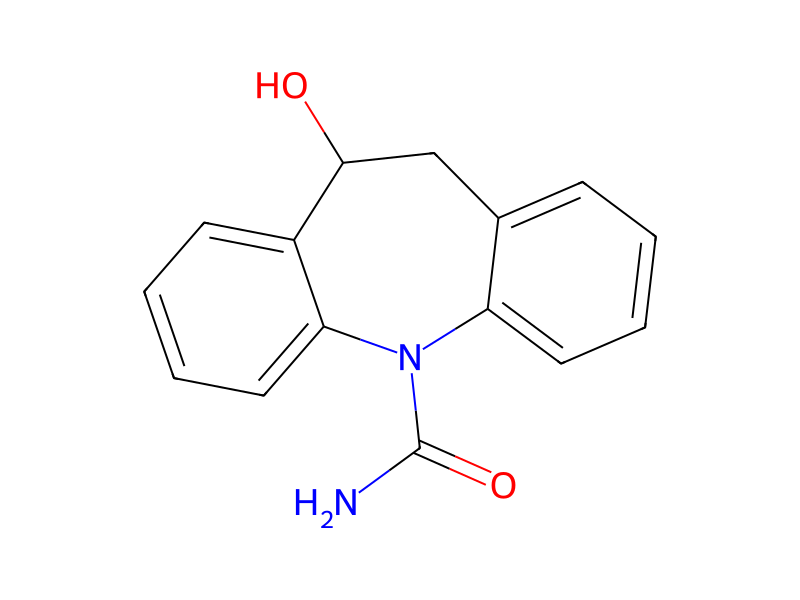
Basic information
- CAS
29331-92-8- Standard SMILES
NC(=O)N1c2ccccc2CC(O)c2ccccc21- InChIKey
BMPDWHIDQYTSHX-UHFFFAOYSA-N- Molecular formula
- C15H14N2O2
- Average molar mass
- 254.28 g/mol
- Monoisotopic mass
- 254.10552769
Overview
Licarbazepine is a dibenzoazepine that is 5H-dibenzo[b,f]azepine, reduced across the C-10,11 positions and carrying a carbamoyl substituent at the azepine nitrogen and a hydroxy function at C-10. A voltage-gated sodium channel blocker with anticonvulsant and mood-stabilizing effects, it is related to oxcarbazepine and is an active metabolite of oxcarbazepine. It has a role as an anticonvulsant, a sodium channel blocker and a drug allergen. It is a carboxamide, a dibenzoazepine and a member of ureas. It is functionally related to a carbamazepine.
Names & identifiers
- Preferred name
- Licarbazepine
- IUPAC
- 5-hydroxy-5,6-dihydrobenzo[b][1]benzazepine-11-carboxamide
- English name
- 10,11-Dihydro-10-hydroxycarbazepine
- Molecular formula
- C15H14N2O2
- Molecular weight
- 254.28
Names & synonyms
Licarbazepine29331-92-810-HydroxycarbazepinelicarbazepinaXFX1A5KJ3Vlicarbazepinum10,11-Dihydro-10-hydroxy-5H-dibenz(b,f)azepine-5-carboxamideCHEBI:70110,11-Dihydro-10-hydroxy-5H-dibenz[b,f]azepine-5-carboxamideDTXSID50865484RefChem:153361DTXCID70813886
Show more names
BIA 2-005GP 47779-d3BIA 2-005-d3icarbazepineHydroxycarbamazepineLicarbazepine Racemate10,11-Dihydro-10-hydroxyLicarbazepine (Standard)
10,11-MHD10-hydroxy-10,11-dihydro-5H-dibenzo[b,f]azepine-5-carboxamide10,11-Dihydro-10-hydroxycarbamazepine10-Hydroxycarbamazepine10-OH-CarbazepineGP 4777910,11-Dihydro-10-hydroxy Carbamazepine10,11-DIHYDRO-10-HYDROXYCARBAZEPINE
Database identifiers
- CAS
29331-92-8- PubChem CID
- 114709
- DTXSID
Properties
Computed structural properties
- XLogP
- 1.4
- Topological polar surface area
- 66.6 Ų
- Hydrogen bond donors
- 2
- Hydrogen bond acceptors
- 2
- Rotatable bonds
- 0
- Heavy atoms
- 19
- Formal charge
- 0
- Complexity
- 347
Experimental & physicochemical properties
Drugs
Pharmaceuticals -> Antiepileptics
Pharmaceuticals
Physicochemical properties
- Melting point
- 186 · 186-189°C
- Boiling point
- 431.3 · 431.3±55.0 °C(Predicted)
- Density
- 1.336 · 1.336
- Flash point
- 2 ℃ · 2℃
- storage temp.
- -20 °C · -20°C
- solubility
- 100 mM · Soluble to 100 mM in DMSO and to 50 mM in ethanol
- form
- Solid
- pka
- 13.75 · 13.75±0.20(Predicted)
- color
- White to off-white
- BRN
- 1540211 · 1540211
- Major Application
- forensics and toxicologypharmaceutical (small molecule)
- InChI
- 1S/C15H14N2O2/c16-15(19)17-12-7-3-1-5-10(12)9-14(18)11-6-2-4-8-13(11)17/h1-8,14,18H,9H2,(H2,16,19)
Safety & regulation
Safety information is for reference only and does not replace the supplier’s Safety Data Sheet (SDS), applicable regulations, or professional assessment.
GHS classification
GHS Classification
This chemical does not meet GHS hazard criteria for 1.7% (1 of 60) of reports.
Danger
H302 (31.7%): Harmful if swallowed [Warning Acute toxicity, oral]
P233, P260, P261, P264, P270, P271, P272, P273, P280, P284, P301+P317, P302+P352, P304+P340, P321, P330, P333+P317, P342+P316, P362+P364, P391, P403, and P501 (click each P-code to see the statement)
Aggregated GHS information provided per 60 reports by companies from 5 notifications to the ECHA C&L Inventory. Each notification may be associated with multiple companies.
Hazard information
Hazard Classes and CategoriesAcute Tox. 4 (31.7%)
Safety data
- wgk
- 3
- ridadr
- UN 3077 9 / PGIII
- risk_code
- 51/53-36-20/21/22-11
- Signal word
- Danger
- Symbol(GHS)
- GHS09
- hazard_code
- N,Xn,F
- safety_code
- 61-36/37-26-16
- Storage Class
- 11 - Combustible Solids
- Hazard statements
- H411
- Hazard Classifications
- Aquatic Chronic 2
- Precautionary statements
- P273-P391-P501
Chemistry & industry
Pharmacology
Metabolism/Metabolites10-hydroxycarbazepine has known human metabolites that include (2S,3S,4S,5R)-6-[(11-carbamoyl-5,6-dihydrobenzo[b][1]benzazepin-5-yl)oxy]-3,4,5-trihydroxyoxane-2-carboxylic acid.
Tissue LocationsKidney
Metabolite PathwaysCarbamazepine Metabolism Pathway
Uses & manufacturing
UsesUse (kg) in Switzerland (2009): >750
Applications
UsesA metabolite of Oxcarbazepine
UsesA labelled metabolite of Oxcarbazepine
Uses10,11-dihydro-10-hydroxy Carbamazepinee is the active metabolite of oxcarbazepine . Oxcarbazepine is rapidly and almost completely converted to 10,11-dihydro-10-hydroxycarbamazepine, which then demonstrates anticonvulsant efficacy by modulating several ion channels and receptors. 10,11-dihydro-10-hydroxy Carbamazepine is reported to inhibit both voltage-gated Na+ and Ca2+ channels, to potentiate voltage-gated K+ channels, to antagonize adenosine A1 receptors, to increase dopaminergic transmission, and to inhibit glutamate release.
Upstream & downstream products
Upstream raw materials
Related reactions
0 records
No related reactions yet