
uspto-grants-2010_06 · 10.6084/m9.figshare.5104873.v1 · US07727749B2
查看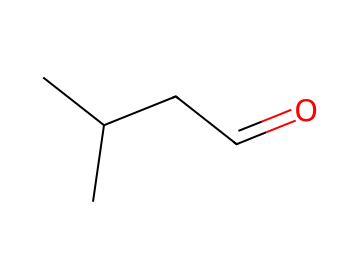
IDENTITY
COMPUTED
PROPERTIES
1.31
Apple-like odor
POWERFUL PENETRATING, ACRID ODOR
AT VERY LOW LEVELS THE FLAVOR IS WARM, HERBACEOUS, SLIGHTLY FRUIT, AND NUT-LIKE
0.785 at 68 °F (USCG, 1999) - Less dense than water; will float
0.7977 g/cu cm at 20 °C
Relative density (water = 1): 0.8
0.795-0.815 (20 °C/20 °C)
0.58 mPa.S at 20 °C
0.725 mm²/s at 20 °C
Colorless liquid
Slightly soluble in water; soluble in ethanol, ethyl ether
Miscible with alcohol, ether
SOL IN PROPYLENE GLYCOL AND OILS
In water, 1,400 mg/L at 20 °C
14 mg/mL at 20 °C
Solubility in water, g/100ml: 2 (poor)
55 °F (est.) (USCG, 1999)
48 °F (9 °C) open cup
-3 °C c.c.
198.5 °F at 760 mmHg (USCG, 1999)
92.5 °C
90.00 to 93.00 °C. @ 760.00 mm Hg
92.5 °C
92-93 °C
Disaster hazard: slight; when heated, it emits acrid fumes.
-60 °F (USCG, 1999)
-51 °C
-51 °C
-51 °C
2.96 (Air = 1)
Relative vapor density (air = 1): 3.0
GHS
This chemical does not meet GHS hazard criteria for < 0.1% (1 of 1824) of reports.
Danger
H225 (> 99.9%): Highly Flammable liquid and vapor [Danger Flammable liquids];H317 (84.9%): May cause an allergic skin reaction [Warning Sensitization, Skin];H319 (> 99.9%): Causes serious eye irritation [Warning Serious eye damage/eye irritation];H335 (85.5%): May cause respiratory irritation [Warning Specific target organ toxicity, single exposure; Respiratory tract irritation];H411 (83.6%): Toxic to aquatic life with long lasting effects [Hazardous to the aquatic environment, long-term hazard]
P210, P233, P240, P241, P242, P243, P261, P264+P265, P271, P272, P273, P280, P302+P352, P303+P361+P353, P304+P340, P305+P351+P338, P319, P321, P333+P317, P337+P317, P362+P364, P370+P378, P391, P403+P233, P403+P235, P405, and P501 (click each P-code to see the statement)
Aggregated GHS information provided per 1824 reports by companies from 25 notifications to the ECHA C&L Inventory. Each notification may be associated with multiple companies.;Reported as not meeting GHS hazard criteria per 1 of 1824 reports by companies.;There are 24 notifications provided by 1823 of 1824 reports by companies with hazard statement code(s).;Information may vary between notifications depending on impurities, additives, and other factors. The percentage value in parenthesis indicates the notified classification ratio from companies that provide hazard codes. Only hazard codes with percentage values above 10% are shown. For more detailed information, please visit ECHA C&L website.
HAZARDS
Chemical: Butanal, 3-methyl-
Regulation (EC) No 1831/2003 (amended)
Butanal, 3-methyl- is listed on the EPA's Chemical Data Reporting (CDR) system. Manufacturers and importers of Butanal, 3-methyl- are required to report information about their production and use of this chemical to the EPA under the Toxic Substances Control Act (TSCA). (40 eCFR Part 711)
Status: Active Update: 04-11-2020 https://echa.europa.eu/registration-dossier/-/registered-dossier/13620
3-Methylbutyraldehyde: Does not have an individual approval but may be used under an appropriate group standard
The New Jersey Worker and Community Right to Know Act requires public and private employers to provide information about hazardous substances at their workplaces. (N.J.S.A. 34:5A-1 et. seq.)
Flammable Liquid
Excerpt from ERG Guide 129 [Flammable Liquids (Water-Miscible / Noxious); polymerization hazard]:;HIGHLY FLAMMABLE: Will be easily ignited by heat, sparks or flames. Vapors may form explosive mixtures with air. Vapors may travel to source of ignition and flash back. Most vapors are heavier than air. They will spread along the ground and collect in low or confined areas (sewers, basements, tanks, etc.). Vapor explosion hazard indoors, outdoors or in sewers. Those substances designated with a (P) may polymerize explosively when heated or involved in a fire. Runoff to sewer may create fire or explosion hazard. Containers may explode when heated. Many liquids will float on water. (ERG, 2024)
Highly flammable. Vapour/air mixtures are explosive.
Inhalation causes chest discomfort, nausea, vomiting, and headache. Contact of liquid with eyes or skin causes irritation. Ingestion causes irritation of mouth and stomach. (USCG, 1999)
A mild skin irritant; [RTECS] Highly flammable and peroxidizable; A skin and eye irritant; [CAMEO] A severe eye irritant, based on animal studies; [CHEMINFO] Safe when used in food as a flavoring agent; [JECFA] An irritant; May cause liver impairment; [MSDSonline]
Isovaleraldehyde is a food additive permitted for direct addition to food for human consumption as a synthetic flavoring substance and adjuvant in accordance with the following conditions: 1) the quantity added to food does not exceed the amount reasonably required to accomplish its intended physical, nutritive, or other technical effect in food, and 2) when intended for use in or on food it is of appropriate food grade and is prepared and handled as a food ingredient.
Aldehydes
UN Hazard Class: 3; UN Pack Group: II
European Commission, ESIS; IUCLID Dataset, 3-Methylbutanal (590-86-3). (2000 CD-ROM edition).[Available from, as of January 14, 2009: http://esis.jrc.ec.europa.eu/]
Organization for Economic Cooperation and Development; Screening Information Data Set for 3-Methylbutanal, 590-86-3 (March 2000).[Available from, as of January 14, 2009: http://www.chem.unep.ch/irptc/sids/OECDSIDS/sidspub.html]
Section 8(a) of TSCA requires manufacturers of this chemical substance to report preliminary assessment information concerned with production, exposure, and use to EPA as cited in the preamble in 51 FR 41329. Effective date 9/30/91; Reporting date: 11/27/91.
Pursuant to section 8(d) of TSCA, EPA promulgated a model Health and Safety Data Reporting Rule. The section 8(d) model rule requires manufacturers, importers, and processors of listed chemical substances and mixtures to submit to EPA copies and lists of unpublished health and safety studies. Butanal, 3-methyl- is included on this list. Effective date 9/30/91; Sunset date: 6/30/98.
Highly Flammable;Polymerizable;Peroxidizable Compound
ISOVALERALDEHYDE is an aldehyde. Aldehydes are frequently involved in self-condensation or polymerization reactions. These reactions are exothermic; they are often catalyzed by acid. Aldehydes are readily oxidized to give carboxylic acids. Flammable and/or toxic gases are generated by the combination of aldehydes with azo, diazo compounds, dithiocarbamates, nitrides, and strong reducing agents. Aldehydes can react with air to give first peroxo acids, and ultimately carboxylic acids. These autoxidation reactions are activated by light, catalyzed by salts of transition metals, and are autocatalytic (catalyzed by the products of the reaction). The addition of stabilizers (antioxidants) to shipments of aldehydes retards autoxidation.
SAFETY
Fire Extinguishing Agents Not to Be Used: Water may be ineffective.;Fire Extinguishing Agents: Dry chemical, foam, carbon dioxide (USCG, 1999)
Use dry sand, carbon dioxide, dry powder. NO water. In case of fire: keep drums, etc., cool by spraying with water.
Fresh air, rest.
Rinse and then wash skin with water and soap.
Rinse with plenty of water (remove contact lenses if easily possible).
Rinse mouth. Do NOT induce vomiting.
INHALATION: remove victim to fresh air; apply artificial respiration if required; get medical attention.;EYES: flush with water for at least 15 min.;SKIN: wipe off, wash well with soap and water.;INGESTION: induce vomiting; get medical attention. (USCG, 1999)
Fireproof. Well closed. Store in an area without drain or sewer access. Provision to contain effluent from fire extinguishing.
If material on fire or involved in fire: Do not extinguish fire unless flow can be stopped. Use water in flooding quantities as fog. Solid streams of water may be ineffective. Cool all affected containers with flooding quantities of water. Use "alcohol" foam, dry chemical or carbon dioxide. Keep run-off water out of sewers and water sources.
Materials which are toxic as stored or which can decompose into toxic components...should be stored in a cool, well ventilated place, out of the direct rays of the sun, away from areas of high fire hazard, and should be periodically inspected. Incompatible materials should be isolated...
Excerpt from ERG Guide 129 [Flammable Liquids (Water-Miscible / Noxious); polymerization hazard]:;ELIMINATE all ignition sources (no smoking, flares, sparks or flames) from immediate area. All equipment used when handling the product must be grounded. Do not touch or walk through spilled material. Stop leak if you can do it without risk. Prevent entry into waterways, sewers, basements or confined areas. A vapor-suppressing foam may be used to reduce vapors. Absorb or cover with dry earth, sand or other non-combustible material and transfer to containers. Use clean, non-sparking tools to collect absorbed material.;LARGE SPILL: Dike far ahead of liquid spill for later disposal. Water spray may reduce vapor, but may not prevent ignition in closed spaces. (ERG, 2024)
SRP: The most favorable course of action is to use an alternative chemical product with less inherent propensity for occupational exposure or environmental contamination. Recycle any unused portion of the material for its approved use or return it to the manufacturer or supplier. Ultimate disposal of the chemical must consider: the material's impact on air quality; potential migration in soil or water; effects on animal, aquatic, and plant life; and conformance with environmental and public health regulations.
Remove all ignition sources. Evacuate danger area! Consult an expert! Personal protection: filter respirator for organic gases and vapours adapted to the airborne concentration of the substance. Do NOT let this chemical enter the environment. Collect leaking liquid in sealable containers. Absorb remaining liquid in sand or inert absorbent. Then store and dispose of according to local regulations. Do NOT wash away into sewer.
Personnel protection: Avoid breathing vapors. Keep upwind. Wear appropriate chemical protective gloves, boots and goggles. Do not handle broken packages unless wearing appropriate personal protective equipment If contact with the material anticipated, wear appropriate chemical protective clothing.
If material not on fire and not involved in fire: Keep sparks, flames, and other sources of ignition away. Keep material out of water sources and sewers. Build dikes to contain flow as necessary. Attempt to stop leak if without undue personnel hazard. Use water spray to knock-down vapors.
SRP: The scientific literature for the use of contact lenses in industry is conflicting. The benefit or detrimental effects of wearing contact lenses depend not only upon the substance, but also on factors including the form of the substance, characteristics and duration of the exposure, the uses of other eye protection equipment, and the hygiene of the lenses. However, there may be individual substances whose irritating or corrosive properties are such that the wearing of contact lenses would be harmful to the eye. In those specific cases, contact lenses should not be worn. In any event, the usual eye protection equipment should be worn even when contact lenses are in place.
Excerpt from ERG Guide 129 [Flammable Liquids (Water-Miscible / Noxious); polymerization hazard]:;IMMEDIATE PRECAUTIONARY MEASURE: Isolate spill or leak area for at least 50 meters (150 feet) in all directions.;LARGE SPILL: Consider initial downwind evacuation for at least 300 meters (1000 feet).;FIRE: If tank, rail tank car or highway tank is involved in a fire, ISOLATE for 800 meters (1/2 mile) in all directions; also, consider initial evacuation for 800 meters (1/2 mile) in all directions. (ERG, 2024)
Wear safety spectacles.
TOXICITY
Isovaleraldehyde markedly inhibited acetaldehyde oxidation in rat liver and was the most potent inhibitor of oxidation of various mitochondrial substrates.
LC50; Species: Pimephales promelas (Fathead minnow, age 30 days, mean length 20.4 mm, mean weight 0.127 g); Conditions: flow through, 23.9 °C pH 7.58, hardness 49.3 mg/L CaCO3, alkalinity 47.8 mg/L CaCO3, dissolved oxygen 6.9 mg/L; Concentration: 3.25 mg/L for 96 hr (95% confidence limit: 2.98-3.54 mg/L) /97.3% purity/
EC50; Species: Pimephales promelas (Fathead minnow, age 30 days, mean length 20.4 mm, mean weight 0.127 g); Conditions: flow through, 23.9 °C pH 7.58, hardness 49.3 mg/L CaCO3, alkalinity 47.8 mg/L CaCO3, dissolved oxygen 6.9 mg/L; Concentration: 3.25 mg/L for 96 hr (95% confidence limit: 2.98-3.54 mg/L); Effect: Affected fish lost schooling behavior, swam near the surface, were hyperactive, had increased respiration and edema. Equilibrium loss was not observed prior to death. /97.3% purity/
LC50; Species Leuciscus idus (Ide); Conditions: static; Concentration 53 mg/L for 96 hr
LC50; Species Poecilia reticulata (Guppy); Conditions: semi-static; Concentration 13.3 mg/L for 14 days
For more Ecotoxicity Values (Complete) data for 3-METHYLBUTANAL (11 total), please visit the HSDB record page.
TERRESTRIAL FATE: Based on a classification scheme(1), an estimated Koc value of 23(SRC), determined from a water solubility of 1.4X10+4 mg/L(2) and a regression-derived equation(3), indicates that 3-methylbutanal is expected to have very high mobility in soil(SRC). Volatilization of 3-methylbutanal from moist soil surfaces is expected to be an important fate process(SRC) given an estimated Henry's Law constant of 4.0X10⁻⁴ atm-cu m/mole(SRC), derived from its vapor pressure, 50 mm Hg(4), and its water solubility(2). 3-Methylbutanal is expected to volatilize from dry soil surfaces(SRC) based upon its vapor pressure(4). A theoretical oxygen demand of 16.1% after 24 hrs in a waste treatment plant(5) suggests that biodegradation may be an important environmental fate process in soil(SRC).
AQUATIC FATE: Based on a classification scheme(1), an estimated Koc value of 23(SRC), determined from a water solubility of 1.4X10+4 mg/L(2) and a regression-derived equation(3), indicates that 3-methylbutanal is not expected to adsorb to suspended solids and sediment(SRC). Volatilization from water surfaces is expected(3) based upon a Henry's Law constant of 4.0X10⁻⁴ atm-cu m/mole(SRC), derived from its vapor pressure, 50 mm Hg(4), and water solubility(2). Using this Henry's Law constant and an estimation method(3), volatilization half-lives for a model river and model lake are 5 hours and 4 days, respectively(SRC). According to a classification scheme(5), an estimated BCF of 3(SRC), from its water solubility(2) and a regression-derived equation(3), suggests the potential for bioconcentration in aquatic organisms is low(SRC). 3-Methylbutanal is not expected to undergo hydrolysis in the environment due to the lack of functional groups that hydrolyze under environmental conditions(3). A theoretical oxygen demand of 16.1% after 24 hrs in a waste treatment plant(6) suggests that biodegradation may be an important environmental fate process in water(SRC).
ATMOSPHERIC FATE: According to a model of gas/particle partitioning of semivolatile organic compounds in the atmosphere(1), 3-methylbutanal, which has a vapor pressure of 50 mm Hg at 25 °C(2), is expected to exist solely as a vapor in the ambient atmosphere. Vapor-phase 3-methylbutanal is degraded in the atmosphere by reaction with photochemically-produced hydroxyl radicals(SRC); the half-life for this reaction in air is estimated to be 14 hours(SRC), calculated from rate constants of 2.78X10⁻¹¹(3) and 2.74X10⁻¹¹(4) cu cm/molecule-sec at 25 °C. Vapor-phase 3-methylbutanal is also degraded in the atmosphere by reaction with photochemically-produced nitrate radicals; the half-life for this reaction in air is estimated to be 44 hours(SRC), calculated from rate constant of 1.82X10⁻¹⁴ cu cm/sec(3). Aliphatic aldehydes absorb available solar radiation and dissociate to produce free radical fragments(5); therefore 3-methylbutanal may be susceptible to direct photolysis by sunlight(SRC).
3-Methylbutanal has been detected in coffee aroma(1), in the extract of edible Korean Chamchwi(2), in blue cheese aroma(3), as a flavor constituent in gari(4), as a volatile component of Beaufort cheese(5), in cured pork(6), in bacon pork, smoke, and flavor(7) in roasted filberts(8), in chick pea(9), in volatiles from pork, mutton, chicken and beef(10) in beef sukiyaki from the beef and soy sauce(11), in Italian-type dry-cured ham(12), and in fried chicken(13). 3-Methylbutanal has also been detected as a flavor volatile from cooked sweet corn at the following concns: canned cream corn (10 ppb), canned kernel (19 ppb), frozen kernel (7 ppb), and fresh kernel (<4 ppb)(14). 3-Methylbutanal has been found as a volatile component of scrambled eggs using eggs from the supermarket packed in polystyrene (122 ng/g), fresh eggs, not stored (126 ng/g), and fresh eggs stored in polystyrene for two weeks (16 ng/g)(15). 3-Methylbutanal was also found as a volatile component of polystyrene egg cartons(15). 3-Methylbutanal was found in popcorn using wet extraction method at 1200 ug/kg and dry extraction method at 430 ug/kg(16). Commercial rice cakes were found to contain 440-620 ppb of 3-methylbutanal(17). 3-Methylbutanal was measured at 9720 ng/g, 77,100 ng/g, 22,100 ng/g and 12,400 ng/g in anchovy paste, big eyed herring paste, hair tail viscera paste, and shrimp paste, respectively(18). 3-Methylbutanal was detected in whole and ground musty sorghum with direct helium-purge method and with supercritical fluid extraction method(19).
Occupational hepatotoxin - Secondary hepatotoxins: the potential for toxic effect in the occupational setting is based on cases of poisoning by human ingestion or animal experimentation.
ENVIRONMENTAL: 3-Methylbutanal was detected, not quantified, in cold storage, store bought milk in Australia(1).
Sore throat. Cough.
Redness.
Redness.
3-Methylbutanal was found in biodegradable household waste headspace and in of mixed household waste headspace at concns of <0.1 mg/cu m(1). 3-Methylbutanal was found in highway tunnels in Tuscarora; light duty trucks emitted 0.01 mg/km traveled or 0.150 mg/L fuel used, heavy duty trucks emitted 0.103 mg/km traveled or 0.325 mg/L fuel used(2). Laboratory scale composting emissions contained 3-methylbutanal after two days(3). 3-Methylbutanal was measured in the emissions of gasoline powered motor vehicles at a rate of 250 ug/km and 22,080 ug/km for catalyst equipped engines and non-catalyst equipped engines(4). 3-Methylbutanal was detected in the off gas from 12 weeks of aerobic composting at a concn of 4.0 mg/cu m and after 3 week anaerobic/2 week aerobic composting at a concn of 1.0-5.5 mg/cu m(5). 3-Methylbutanal was detected but not quantified in the emissions of kitchen waste, kitchen waste exudate, stored food exudate, building materials with microbial growth(6), garbage truck headspace, waste headspace in the laboratory, and other waste exudate(7). 3-Methylbutanal was detected in the emissions of cookstoves in China using wheat crop residue, wood, coal, kerosene, liquid propane gas, and natural gas at concns of 8.2, 6.8, 2.8, 9.3, 11.5, and 4.2 mg/kg, respectively(8). 3-Methylbutanal has been reported in exhaust gases from gasoline engines(9). 3-Methylbutanal is emitted at a rate of 5 mg/km in heavy-duty diesel exhaust, sampled in Stockholm, Sweden(10).
The substance is toxic to aquatic organisms. It is strongly advised not to let the chemical enter into the environment.
The Koc of 3-methylbutanal is estimated as 23(SRC), using a water solubility of 1.4X10+4 mg/L(1) and a regression-derived equation(2). According to a classification scheme(3), this estimated Koc value suggests that 3-methylbutanal is expected to have very high mobility in soil.
3-Methylbutanal occurs in orange, lemon, peppermint, and other essential oils(1).
URBAN/SUBURBAN: 3-Methylbutanal, was not detected at Patission Street, Athens, Greece nor Likovrisi, Greece, sampled from June to December 2000(1). 3-Methylbutanal was detected at average concns of 3.426-20.627 ug/cu m in Rio de Janeiro, Brazil Oct 1999 to Nov 2000(2). 3-Methylbutanal was detected in 13 of 13 samples taken across the US (3 in LA, 4 in TX, 5 in VT, 1 in NJ) from Sept 1996 to Aug 1997 at <1 ppb(3). 3-Methylbutanal was detected in 4 of 8 winter and 2 of 18 summer samples at 0.0-0.10 ppb and 0.01-0.08 ppb taken in the greater Boston, MA area in 1993(4). 3-Methylbutanal was detected in Santiago, Chile atmospheric samples at <0.04-0.19 ppbv in Nov 2003(5). 3-Methylbutanal has been found in air at avg concns of 0.22, 0.04, and 0.04 ppb on two busy streets and a calm street in Stockholm, Sweden(6).
INDOOR AIR: 3-Methylbutanal was detected in 13 of 14 winter and 7 of 26 summer samples at 0.04-1.1 ppb and 0.0-1.0 ppb taken in the greater Boston, MA area in 1993(1). 3-Methylbutanal was detected in indoor and outdoor air from suburban New Jersey residential microenvironments at mean concns of 0.37 ppb indoors (kitchen area) and 0.41 ppb outdoors (backyard)(2).
RURAL/REMOTE: 3-Methylbutanal was detected on a small island in Stockholm, Sweden and a recreation area 12 km from Stockholm at 0.05 ppb(1).
REGULATORY
Chemical: Butanal, 3-methyl-
Regulation (EC) No 1831/2003 (amended)
Butanal, 3-methyl- is listed on the EPA's Chemical Data Reporting (CDR) system. Manufacturers and importers of Butanal, 3-methyl- are required to report information about their production and use of this chemical to the EPA under the Toxic Substances Control Act (TSCA). (40 eCFR Part 711)
Status: Active Update: 04-11-2020 https://echa.europa.eu/registration-dossier/-/registered-dossier/13620
3-Methylbutyraldehyde: Does not have an individual approval but may be used under an appropriate group standard
The New Jersey Worker and Community Right to Know Act requires public and private employers to provide information about hazardous substances at their workplaces. (N.J.S.A. 34:5A-1 et. seq.)
Isovaleraldehyde is a food additive permitted for direct addition to food for human consumption as a synthetic flavoring substance and adjuvant in accordance with the following conditions: 1) the quantity added to food does not exceed the amount reasonably required to accomplish its intended physical, nutritive, or other technical effect in food, and 2) when intended for use in or on food it is of appropriate food grade and is prepared and handled as a food ingredient.
Section 8(a) of TSCA requires manufacturers of this chemical substance to report preliminary assessment information concerned with production, exposure, and use to EPA as cited in the preamble in 51 FR 41329. Effective date 9/30/91; Reporting date: 11/27/91.
Pursuant to section 8(d) of TSCA, EPA promulgated a model Health and Safety Data Reporting Rule. The section 8(d) model rule requires manufacturers, importers, and processors of listed chemical substances and mixtures to submit to EPA copies and lists of unpublished health and safety studies. Butanal, 3-methyl- is included on this list. Effective date 9/30/91; Sunset date: 6/30/98.
PHARMACOLOGY
...inhibits oxidation of other mitochondrial substrates, including acetaldehyde
...Isovaleraldehyde is also a degradation product of leucine that is associated with hepatic encephalopathy.
Aldehydes are readily oxidized to organic acids, which, in turn, can serve as substrates for fatty acid oxidation pathways and the Krebs cycle. ... Oxidation of aldehydes is catalyzed by aldehyde dehydrogenase, which has been found in the brain, erythrocytes, liver, kidney, heart, and placenta. /Aldehydes/
... The detoxification of aldehydes can be seen to proceed basically via two routes: (1) an oxidation to yield readily metabolized acids; (2) inactivation by reaction with sulfhydryl groups, particularly glutathione. Under conditions that either deplete glutathione levels, or that result in an inhibition of aldehyde dehydrogenase (for example, Antabuse treatment), the acute and chronic effects of aldehyde toxicity might be more fully expressed. /Aldehydes/
3-Methylbutanal is a volatile aldehyde which in the rat is derived, at least in part, from colonic bacterial breakdown of leucine. It has been proposed as a toxin in the pathogenesis of hepatic encephalopathy in man. The mean plasma 3-methylbutanal concentration in non-fasting patients with hepatic encephalopathy, 0.244 umol/liter (range 0-1.30) was not significantly different from the mean value in controls, 0.116 umol/liter (0-0.349). Oral leucine feeding resulted in significant increases in plasma 3-methylbutanal concentrations in both control subjects and patients with cirrhosis. Peak leucine and 3-methylbutanal values occurred at approximately the same time and usually within 120 min of leucine ingestion. Pre-treatment with neomycin had no effect on the results of leucine feeding. No changes occurred in the clinical condition or psychometric performance of patients with cirrhosis fed leucine despite increases in plasma 3-methylbutanal of up to 700% over basal values. In man plasma 3-methylbutanal, at least in part, derives from ingested leucine independently of the action of colonic bacteria.
The cytochrome P450-catalyzed formation of olefinic products from a series of xenobiotic aldehydes has been demonstrated. Isobutyraldehyde and trimethylacetaldehyde, but not propionaldehyde, are converted to the predicted olefinic products, suggesting a requirement for branching at the alpha carbon. In addition, the four C5 aldehydes of similar hydrophobicity were compared for their ability to undergo the reaction. The straight-chain valeraldehyde gave no olefinic products with five different rabbit liver microsomal P450 isozymes. However, increasing activity was seen with the other isomers in the order of isovaleraldehyde, 2-methylbutyraldehyde, and trimethylacetaldehyde, with all of the P450 cytochromes.
USES
Found in orange, lemon, peppermint, and other oils; [Merck Index] Used flavors, fragrances, and to make isovaleric acid, pharmaceuticals, and resins; [HSDB] Used to make pesticides, solvents, and softeners; [eChemPortal: SIDSUNEP]
Reported uses (PPM): (FEMA, 2005);Table: Reported uses (PPM): (FEMA, 2005) [Table#1746]
FLAVOR INGREDIENT; FRAGRANCE INGREDIENT IN PERFUMES; CHEM INT FOR ISOVALERIC ACID
Flavoring, perfumes, pharmaceuticals, synthetic resins.
2023: 75,000 - <500,000 lb;2022: 1,000,000 - <8,500,000 lb;2021: 75,000 - <500,000 lb;2020: 75,000 - <500,000 lb
Production volumes for non-confidential chemicals reported under the Inventory Update Rule. [Table#1745]
Fragrance
Intermediate
REACTION OF BUTENES WITH CARBON MONOXIDE AND HYDROGEN IN THE PRESENCE OF A COBALT CATALYST (OXO PROCESS), FOLLOWED BY SEPARATION OF ISOMERS; OXIDATION OF ISOAMYL ALCOHOL WITH SODIUM DICHROMATE AND SULFURIC ACID
Made by oxidation of isoamyl alcohol with Na2Cr2O7 and H2SO4.
3-Methylbutanal ... is prepared by hydroformylation of isobutene.
Information on 1 consumer products that contain Isopentanal in the following categories is provided:;• Auto Products
Fragrance Ingredients
Flavouring Agent -> FLAVOURING_AGENT -> JECFA Functional Classes
Flavoring Agents -> JECFA Flavorings Index
Flavouring Agent -> FLAVOURING_AGENT -> JECFA Functional Classes
All Other Basic Organic Chemical Manufacturing;Agriculture, Forestry, Fishing and Hunting
Butanal, 3-methyl-: ACTIVE
ALIASES
REACTIONS
uspto-grants-2010_06 · 10.6084/m9.figshare.5104873.v1 · US07727749B2
查看
uspto-grants-2008_09 · 10.6084/m9.figshare.5104873.v1 · US07427616B2
查看
uspto-grants-2013_09 · 10.6084/m9.figshare.5104873.v1 · US08524767B2
查看
uspto-grants-2013_09 · 10.6084/m9.figshare.5104873.v1 · US08524753B2
查看
uspto-grants-2013_09 · 10.6084/m9.figshare.5104873.v1 · US08524753B2
查看
uspto-grants-2013_09 · 10.6084/m9.figshare.5104873.v1 · US08536197B2
查看
uspto-grants-1997_04 · 10.6084/m9.figshare.5104873.v1 · US05616793
查看
uspto-grants-2016_09 · 10.6084/m9.figshare.5104873.v1 · US09440973B2
查看