HomeMCPWorkbenchSkills
HomeWorkbenchNotificationsMe
llms.txt · MCP GuidePrivacy Policy · Terms of Service · Supportv1.8.3
  1. Home
  2. /Compound

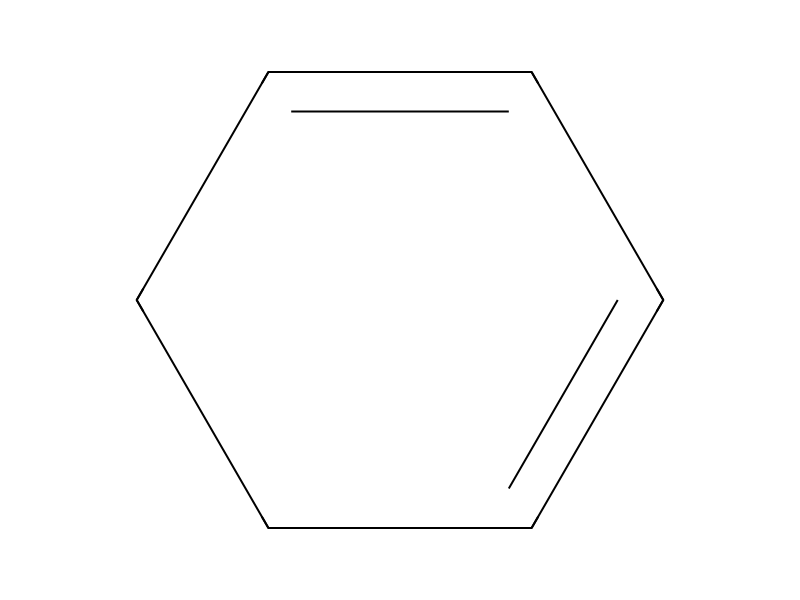
1,3-Cyclohexadiene

HCID 11605
New reaction
Print
Basic informationOverviewNames & identifiersPropertiesSafety & regulationChemistry & industryRelated reactionsCompound notes
Substructure searchFind similar structures

Basic information

CAS
29797-09-9
Standard SMILES
C1=CCCC=C1
InChIKey
MGNZXYYWBUKAII-UHFFFAOYSA-N
Molecular formula
C6H8
Average molar mass
80.13 g/mol
Monoisotopic mass
80.06260026

Overview

Cyclohexa-1,3-diene is a cyclohexadiene.

Names & identifiers

Preferred name
1,3-Cyclohexadiene
IUPAC
cyclohexa-1,3-diene
English name
cyclohexadiene
Molecular formula
C6H8
Molecular weight
80.13

Names & synonyms

1,3-CYCLOHEXADIENECyclohexa-1,3-diene592-57-4JV5W0EG5BPCHEBI:37610DTXSID30862259RefChem:72543DTXCID00811052209-764-1CYCLOHEXADIENE1,2-dihydrobenzeneCyclohexadiene-1,3
Show more names
1,3-cyclohexanedieneMFCD00001532cyclohexa-12,4-cyclohexadieneBENZENE, DIHYDRO-29797-09-9Dihydro-benzene; Cyclohexa-1,3-diene1,3-Cyclohexadiene (Stabilized with BHT)

Database identifiers

CAS
29797-09-9、592-57-4
PubChem CID
11605
DTXSID
DTXSID30862259
ChEBI
CHEBI:37610
UNII
JV5W0EG5BP
EC Number
209-764-1、249-853-2
Nikkaji
J1.855.158F、J1.855.159D、J94.915I

Properties

Computed structural properties

XLogP
2.5
Topological polar surface area
0 Ų
Hydrogen bond donors
0
Hydrogen bond acceptors
0
Rotatable bonds
0
Heavy atoms
6
Formal charge
0
Complexity
66

Experimental & physicochemical properties

Chemical ClassesOther Classes -> Aliphatics, Unsaturated
LogP2.47
DensityRelative density (water = 1): 0.84
SolubilitySolubility in water: none
Flash Point26 °C c.c.
Boiling Point81 °C
Melting Point-89 °C
Vapor DensityRelative vapor density (air = 1): 2.8 (calculated)
Vapor Pressure97.3 [mmHg]
Physical Description · 2 items

Colorless liquid; [ICSC] Unpleasant odor; [Alfa Aesar MSDS]

COLOURLESS LIQUID.

Physicochemical properties

Safety & regulation

Safety information is for reference only and does not replace the supplier’s Safety Data Sheet (SDS), applicable regulations, or professional assessment.

GHS classification

GHS Classification · 4 items

Danger

H225 (100%): Highly Flammable liquid and vapor [Danger Flammable liquids]

P210, P233, P240, P241, P242, P243, P261, P271, P280, P303+P361+P353, P304+P340, P319, P370+P378, P403+P233, P403+P235, P405, and P501 (click each P-code to see the statement)

Aggregated GHS information provided per 48 reports by companies from 5 notifications to the ECHA C&L Inventory. Each notification may be associated with multiple companies.

Hazard information

Regulatory Information · 2 items

Chemical: 1,3-Cyclohexadiene

1,3-Cyclohexadiene: Does not have an individual approval but may be used under an appropriate group standard

Fire HazardsFlammable. Above 26 °C explosive vapour/air mixtures may be formed.
Hazards SummaryMay form explosive peroxides on air exposure; A skin, eye, and respiratory tract irritant; [ICSC] Stabilized with BHT (CAS# 128-37-0); An irritant; [Alfa Aesar MSDS] See 1,4-Hexadiene.
UN ClassificationUN Hazard Class: 3; UN Pack Group: III
Chemical DangersThe substance can form explosive peroxides on exposure to air. Reacts with strong oxidants. This generates fire and explosion hazard.
Physical DangersThe vapour is heavier than air.
Packaging and LabellingAirtight.
Hazard Classes and Categories

Chemistry & industry

Uses & manufacturing

General Manufacturing Information1,3-Cyclohexadiene: ACTIVE

Additional notes

DefinitionChEBI: Cyclohexa-1,3-diene is a cyclohexadiene.

Related reactions

144 records
New reaction record
HRID 10152 reaction equation
HRID 10152As reactant
HRID 22632 reaction equation
HRID 22632As reactant
HRID 108222 reaction equation
HRID 108222As reactant
HRID 150671 reaction equation
HRID 150671As reactant
HRID 195166 reaction equation
HRID 195166As reactant
HRID 220238 reaction equation
HRID 220238As reactant
HRID 237829 reaction equation
HRID 237829As reactant
HRID 249646 reaction equation
HRID 249646As reactant
PreviousPage 1 of 18

Compound notes

On this pageBasic informationOverviewNames & identifiersPropertiesSafety & regulationChemistry & industryRelated reactionsCompound notes
Boiling point
80 · 80-89 °C(Press: 752 Torr)
Density
0.8409 g/cm3 · 0.8409 g/cm3
FDA UNII
7 Y6A5B2T62 · 7Y6A5B2T62
EPA Substance Registry System
Cyclohexadiene (29797-09-9)
Flam. Liq. 2 (100%)
Explosive Limits and PotentialExplosive limits , vol% in air:

Safety & protection

Fire FightingUse water spray, powder, foam, carbon dioxide. In case of fire: keep drums, etc., cool by spraying with water.
First Aid Measures · 4 items

Fresh air, rest.

Remove contaminated clothes. Rinse and then wash skin with water and soap.

First rinse with plenty of water for several minutes (remove contact lenses if easily possible), then refer for medical attention.

Do NOT induce vomiting. Refer for medical attention .

Safe StorageFireproof. Separated from strong oxidants. Cool. Keep in the dark. Well closed. Store only if stabilized.
Spillage Disposal · 1 item

Personal protection: filter respirator for organic gases and vapours adapted to the airborne concentration of the substance. Collect leaking liquid in sealable containers. Absorb remaining liquid in sand or inert absorbent. Then store and dispose of according to local regulations.

Eye PreventionWear safety spectacles.
Fire PreventionNO open flames, NO sparks and NO smoking. Above 26 °C use a closed system, ventilation and explosion-proof electrical equipment.
Inhalation RiskNo indication can be given about the rate at which a harmful concentration of this substance in the air is reached on evaporation at 20 °C.
Skin PreventionProtective gloves.
Ingestion PreventionDo not eat, drink, or smoke during work.
Inhalation PreventionUse ventilation.
Effects of Short Term ExposureThe substance is irritating to the eyes, skin and respiratory tract.

Toxicology

Exposure RoutesThe substance can be absorbed into the body by inhalation of its vapour.
Signs and Symptoms · 3 items

Sore throat.

Redness.

Redness.

Toxicity DataLC50 (mouse) = 45,000 mg/m3/2hr