HomeMCPWorkbenchSkills
HomeWorkbenchNotificationsMe
llms.txt · MCP GuidePrivacy Policy · Terms of Service · Supportv1.8.3
  1. Home
  2. /Compound

2-Nitroresorcinol

HCID 11760
New reaction
Print
Basic informationNames & identifiersPropertiesSafety & regulationChemistry & industryRelated reactionsCompound notes
Substructure searchFind similar structures

Basic information

CAS
601-89-8
Standard SMILES
O=[N+]([O-])c1c(O)cccc1O
InChIKey
ZLCPKMIJYMHZMJ-UHFFFAOYSA-N
Molecular formula
C6H5NO4
Average molar mass
155.11 g/mol
Monoisotopic mass
155.02185764

Names & identifiers

Preferred name
2-Nitroresorcinol
IUPAC
2-nitrobenzene-1,3-diol
English name
2-Nitroresorcinol
Molecular formula
C6H5NO4
Molecular weight
155.11

Names & synonyms

2-NITRORESORCINOL2-nitrobenzene-1,3-diol601-89-81,3-Benzenediol, 2-nitro-2-Nitro-1,3-benzenediolResorcinol, 2-nitro-1,3-Dihydroxy-2-nitrobenzene7DA96G63WUNSC 1542NSC-1542AI3-52603EINECS 210-010-9
Show more names
2-NITROSORCINOL2-Nitroresorcinol>2-nitro-3-benzenediol2-Nitroresorcinol 98%2-Nitroresorcinol, 97+%2-Nitroresorcinol, 98+%2-nitro-benzene-1,3-diol
DTXSID4060525Resorcinol, 2nitro1,3Benzenediol, 2nitroRefChem:4772341,3Dihydroxy2nitrobenzeneDTXCID9042758210-010-92,6-Dihydroxynitrobenzene

Database identifiers

CAS
601-89-8
PubChem CID
11760
DTXSID
DTXSID4060525
UNII
7DA96G63WU
EC Number
210-010-9
Nikkaji
J95.082C

Properties

Computed structural properties

XLogP
1.6
Topological polar surface area
86.3 Ų
Hydrogen bond donors
2
Hydrogen bond acceptors
4
Rotatable bonds
0
Heavy atoms
11
Formal charge
0
Complexity
145

Experimental & physicochemical properties

Chemical ClassesNitrogen Compounds -> Nitros, Aromatic
SpringerMaterials PropertiesSchoenflies notation
LogP1.56
Vapor Pressure0.0000227 [mmHg]
Physical DescriptionOrange crystalline powder; [Acros Organics MSDS]

Physicochemical properties

Melting point
81 · 81-83 °C (lit.)
Boiling point
234 °C · 234 °C
Density
1.5553 · 1.5553 (rough estimate)
refractive index
1.5423 · 1.5423 (estimate)
storage temp.
RT, stored under nitrogen
form
Crystalline Powder
pka
4.88 · 4.88±0.10(Predicted)

Safety & regulation

Safety information is for reference only and does not replace the supplier’s Safety Data Sheet (SDS), applicable regulations, or professional assessment.

GHS classification

GHS Classification · 4 items

Warning

H302 (95.7%): Harmful if swallowed [Warning Acute toxicity, oral]

P261, P264, P264+P265, P270, P271, P280, P301+P317, P302+P352, P304+P340, P305+P351+P338, P317, P319, P321, P330, P332+P317, P337+P317, P362+P364, P403+P233, P405, and P501 (click each P-code to see the statement)

Aggregated GHS information provided per 47 reports by companies from 6 notifications to the ECHA C&L Inventory. Each notification may be associated with multiple companies.

Hazard information

Hazards SummaryAn irritant; [Acros Organics MSDS] See 2,4-Dinitroresorcinol.
Hazard Classes and CategoriesAcute Tox. 4 (95.7%)

Safety data

PPE
dust mask type N95 (US), Eyeshields, Gloves
wgk
3
tsca
TSCA listed
ridadr
2811
hs_code
2908999090
risk_code
20/21/22-36/37/38
Signal word
Warning
Symbol(GHS)
GHS07
hazard_code
Xn,Xi
safety_code
26-36-24/25
hazard_class
6.1
Storage Class
11 - Combustible Solids
packing_group
III

Chemistry & industry

Uses & manufacturing

General Manufacturing Information1,3-Benzenediol, 2-nitro-: ACTIVE

Applications

Uses2-Nitroresorcinol is a good subject for detecting intramolecular hydrogen bonding. 2-Nitroresorcinol can be used as a starting material to prepare 4-Hydroxy-2-benzoxazolone, HBOA.

Upstream & downstream products

Upstream raw materials

4H-1-Benzopyran-4-one, 7-hydroxy-2,3-dimethyl-8-nitro-2,6-Dimethoxynitrobenzene 98%4',5'-Dinitrofluorescein7-Hydroxy-4-methyl-8-nitrocoumarin2,6-DimethylphenolSulfuric acidp-NitrosotolueneSodium nitrite1,2-DichloroethaneResorcinol

Downstream products

2,4-Dinitro-1,3-benzene diol4-nitroresorcinol

Related reactions

30 records
New reaction record
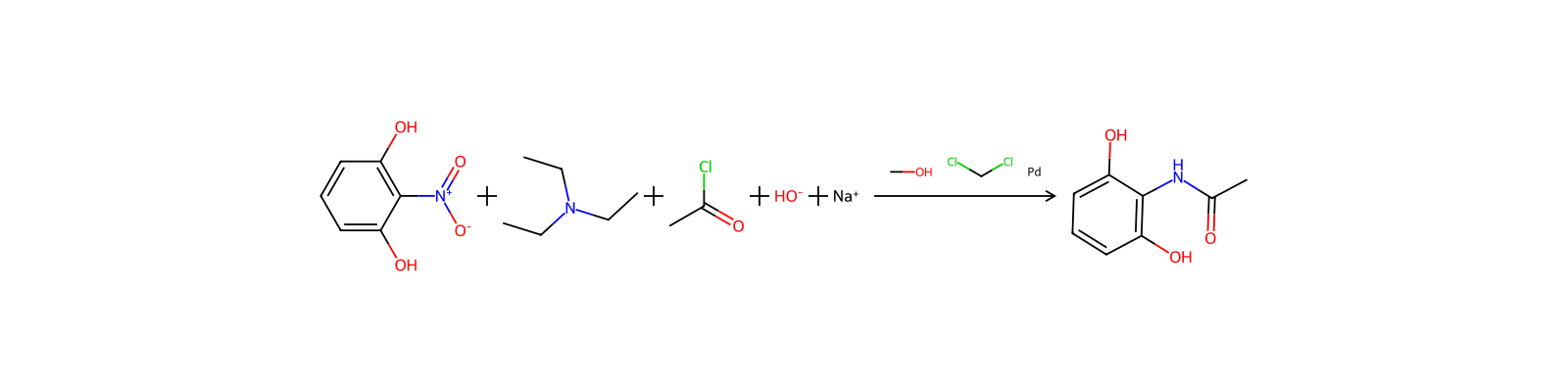
HRID 198506 reaction equation
HRID 198506As reactant
HRID 218817 reaction equation
HRID 218817As reactant
HRID 337341 reaction equation
HRID 337341As reactant
HRID 456403 reaction equation
HRID 456403As reactant
HRID 470982 reaction equation
HRID 470982As reactant
HRID 488686 reaction equation
HRID 488686As reactant
HRID 529228 reaction equation
HRID 529228As reactant
HRID 647225 reaction equation
HRID 647225As reactant
PreviousPage 1 of 4

Compound notes

On this pageBasic informationNames & identifiersPropertiesSafety & regulationChemistry & industryRelated reactionsCompound notes
color
Orange
Water Solubility
Slightly soluble in water. Solubility in methanol is almost transparent.
BRN
2048819 · 2048819
InChI
InChI=1S/C6H5NO4/c8-4-2-1-3-5(9)6(4)7(10)11/h1-3,8-9H
InChIKey
ZLCPKMIJYMHZMJ-UHFFFAOYSA-N
SMILES
C1(O)=CC=CC(O)=C1[N+]([O-])=O
CAS DataBase Reference
601 · 601-89-8(CAS DataBase Reference)
FDA UNII
7 DA96G63WU · 7DA96G63WU
NIST Chemistry Reference
2 · 2-Nitro-1,3-dihydroxybenzene(601-89-8)
EPA Substance Registry System
1 · 1,3-Benzenediol, 2-nitro- (601-89-8)
UNSPSC Code
12162002 · 12162002
Symbol(GHS)
7 · GHS07
Signal word
Warning
Hazard statements
302 · H302+H312+H332-H315-H319-H335
Precautionary statements
261 · P261-P280-P301+P312-P302+P352+P312-P304+P340+P312-P305+P351+P338
target organs
Respiratory system
PPE
95 · dust mask type N95 (US), Eyeshields, Gloves
Hazard Codes
Xn,Xi
Risk Statements
20 · 20/21/22-36/37/38
Safety Statements
26 · 26-36-24/25
RIDADR
2811 · 2811
WGK Germany
3 · 3
Autoignition Temperature
800 °F · 800 °F
TSCA
TSCA listed
HazardClass
6.1 · 6.1
PackingGroup
III
HS Code
2908999090 · 2908999090
Storage Class
11 · 11 - Combustible Solids
Hazard Classifications
4 DermalAcute · Acute Tox. 4 DermalAcute Tox. 4 InhalationAcute Tox. 4 OralEye Irrit. 2Skin Irrit. 2STOT SE 3
target organs
Respiratory system
Hazard statements
H302+H312+H332-H315-H319-H335
Hazard Classifications
Acute Tox. 4 DermalAcute Tox. 4 InhalationAcute Tox. 4 OralEye Irrit. 2Skin Irrit. 2STOT SE 3
Autoignition Temperature
800 °F
Precautionary statements
P261-P280-P301+P312-P302+P352+P312-P304+P340+P312-P305+P351+P338