C.I. Basic Brown 1
HCID 13981
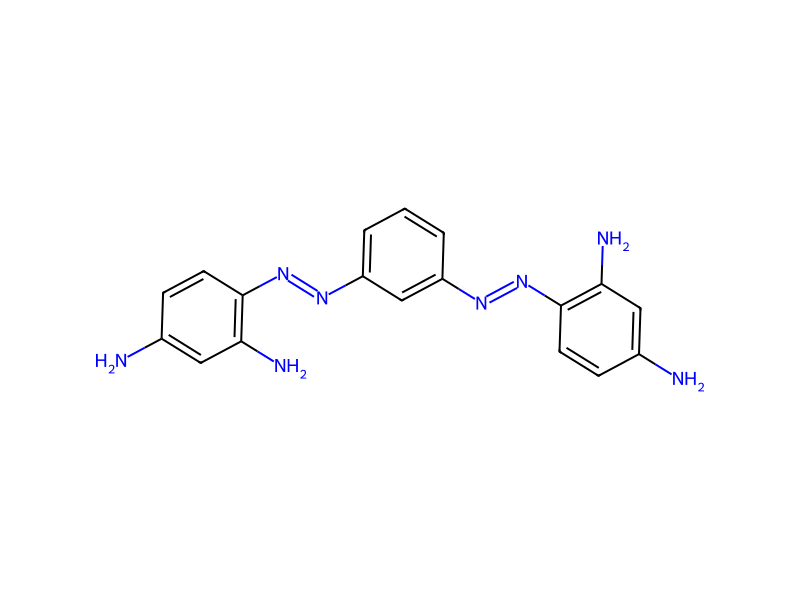
Basic information
- CAS
10114-58-6- Standard SMILES
Nc1ccc(N=Nc2cccc(N=Nc3ccc(N)cc3N)c2)c(N)c1- InChIKey
BDFZFGDTHFGWRQ-UHFFFAOYSA-N- Molecular formula
- C18H18N8
- Average molar mass
- 346.4 g/mol
- Monoisotopic mass
- 346.16544258
Overview
C.i. basic brown 1 is an odorless dark purple to blackish-brown powder. (NTP, 1992)
Names & identifiers
- Preferred name
- C.I. Basic Brown 1
- IUPAC
- 4-[[3-[(2,4-diaminophenyl)diazenyl]phenyl]diazenyl]benzene-1,3-diamine
- English name
- BismarkbrownG
- Molecular formula
- C18H18N8
- Molecular weight
- 346.38912
Names & synonyms
Bismarck Brown YC.I. Basic Brown 1Bismark brown Y baseBASIC BROWN GSolvent Brown 41EINECS 213-888-1911CR7FM6S1,3-Benzenediamine, 4,4'-(1,3-phenylenebis(azo))bis-1,3-Benzenediamine, 4,4'-[1,3-phenylenebis(azo)]bis-8005-77-4CI SOLVENT BROWN 414,4'-(1,3-Phenylenebis(azo))bisbenzene-1,3-diamine
Show more names
BismarkbrownGArlabas Brown RBISMARK GROWN GConbasic Brown ABismarck Brown YCBasazol Brown 43LPhenylene Brown JVesuvin Brown 3R.Dycosbasic Brown GTertrophene Brown G
1,3-Benzenediamine, 4,4'-(1,3-phenylenebis(2,1-diazenediyl))bis-C.I. 21000:14,4'-[1,3-Phenylenebis(azo)]bisbenzene-1,3-diamineM-PHENYLENEDIAMINE, 4,4'-(M-PHENYLENEBISAZO)BIS-4,4'-(1,3-PHENYLENEBIS(AZO))BIS(BENZENE-1,3-DIAMINE)1,3-Benzenediamine, 4,4'-[1,3-phenylenebis(2,1-diazenediyl)]bis-Bismarck Brown BBISMARCK BROWN G
Database identifiers
- CAS
10114-58-6、1052-38-6、8005-77-4
Properties
Computed structural properties
- XLogP
- 2.8
- Topological polar surface area
- 154 Ų
- Hydrogen bond donors
- 4
- Hydrogen bond acceptors
- 8
- Rotatable bonds
- 4
- Heavy atoms
- 26
- Formal charge
- 0
- Complexity
- 454
Experimental & physicochemical properties
Solubility1 to 10 mg/mL at 68 °F (NTP, 1992)
Melting PointStarts decomposing at approximately 428 °F (NTP, 1992)
Physical Description
C.i. basic brown 1 is an odorless dark purple to blackish-brown powder. (NTP, 1992)
Wet Solid; Liquid
Physicochemical properties
- EPA Substance Registry System
- 1 · C.I. Basic Brown 1 (8005-77-4)
Safety & regulation
Safety information is for reference only and does not replace the supplier’s Safety Data Sheet (SDS), applicable regulations, or professional assessment.
GHS classification
GHS Classification
This chemical does not meet GHS hazard criteria for 2.4% (3 of 123) of reports.
H413 (88.6%): May cause long lasting harmful effects to aquatic life [Hazardous to the aquatic environment, long-term hazard]
P273, and P501 (click each P-code to see the statement)
Aggregated GHS information provided per 123 reports by companies from 9 notifications to the ECHA C&L Inventory.
Hazard information
Regulatory Information
Chemical: 1,3-Benzenediamine, 4,4'-[1,3-phenylenebis(azo)]bis-
1,3-Benzenediamine, 4,4'-[1,3-phenylenebis(2,1-diazenediyl)]bis- is listed on the EPA's Chemical Data Reporting (CDR) system. Manufacturers and importers of 1,3-Benzenediamine, 4,4'-[1,3-phenylenebis(2,1-diazenediyl)]bis- are required to report information about their production and use of this chemical to the EPA under the Toxic Substances Control Act (TSCA). (40 eCFR Part 711)
REACH registered substance: 4,4'-[1,3-phenylenebis(azo)]bisbenzene-1,3-diamine (EC: 213-888-1)
Bismarck brown Y: Does not have an individual approval but may be used under an appropriate group standard
1,3-Benzenediamine, 4,4'-[1,3-phenylenebis(azo)]bis-: Does not have an individual approval but may be used as a component in a product covered by a group standard. It is not approved for use as a chemical in its own right.
Fire HazardsFlash point data for this chemical are not available; however, it is probably combustible. Dust may form explosive mixtures with air. (NTP, 1992)
Health HazardsACUTE/CHRONIC HAZARDS: When heated to decomposition this chemical emits toxic fumes of nitrogen oxides. (NTP, 1992)
Reactive GroupAzo, Diazo, Azido, Hydrazine, and Azide Compounds
Chemistry & industry
Uses & manufacturing
U.S. Production2023: 419,540 lb
Industry UsesDye
General Manufacturing Information
Synthetic Dye and Pigment Manufacturing
1,3-Benzenediamine, 4,4'-[1,3-phenylenebis(2,1-diazenediyl)]bis-: ACTIVE
Upstream & downstream products
Upstream raw materials
Additional notes
DefinitionChEBI: Basic brown 1 is a bis(azo) compound that is 1,1'-(1,3-phenylene)bis(diazene) in which both azene hydrogens are replaced by 2,4-diaminophenyl groups. A metachromatic dye which stains acid mucins yellow. It is also a constituent of Papanicolaou's EA solutions, used for cervical, and other smears. Its dihydrochloride salt is also a biological dye known as Bismark brown Y. It has a role as a fluorochrome and a histological dye. It is a bis(azo) compound, a member of azobenzenes, a tetramine and a substituted aniline.
Related reactions
0 records
No related reactions yet