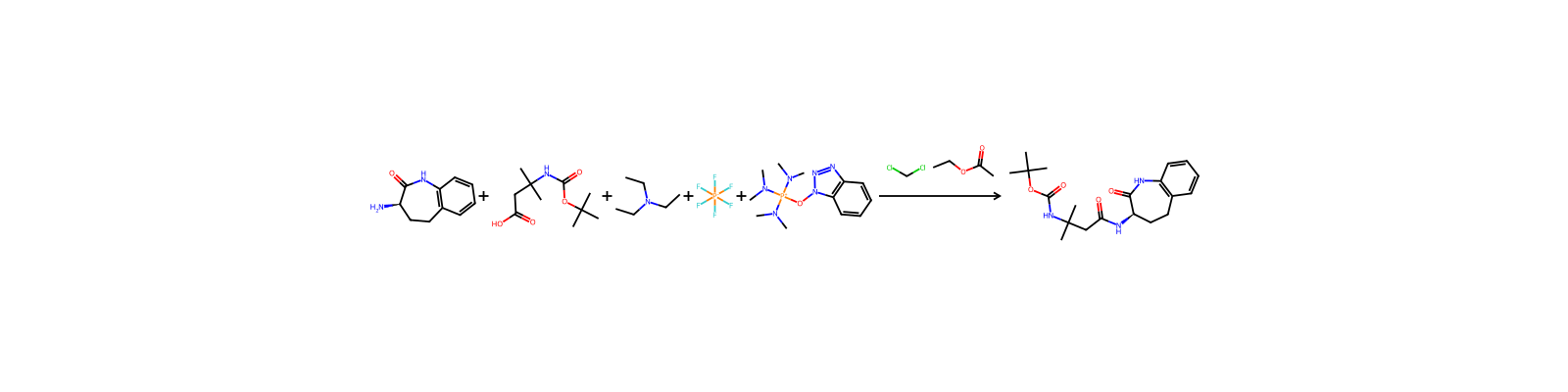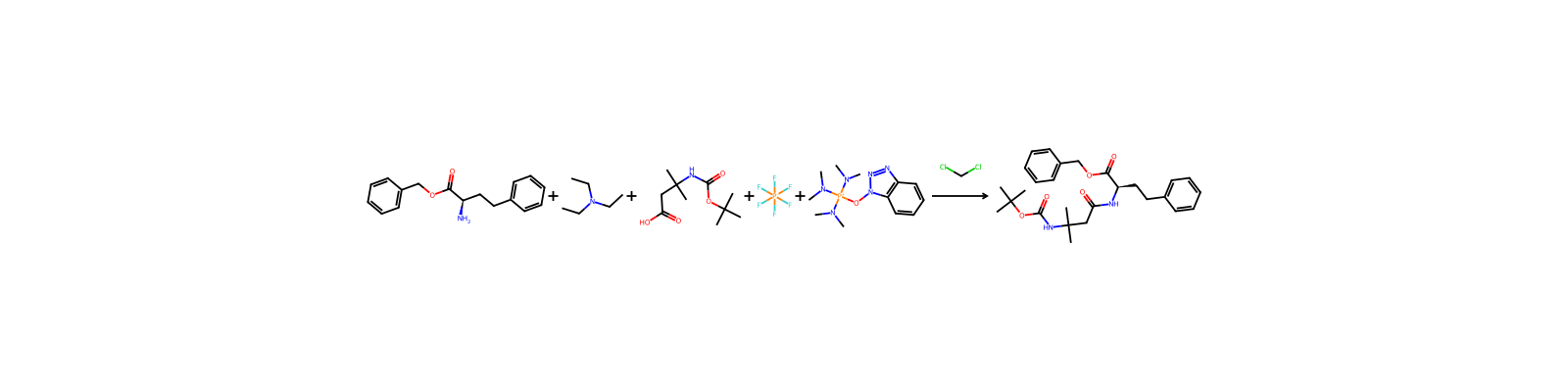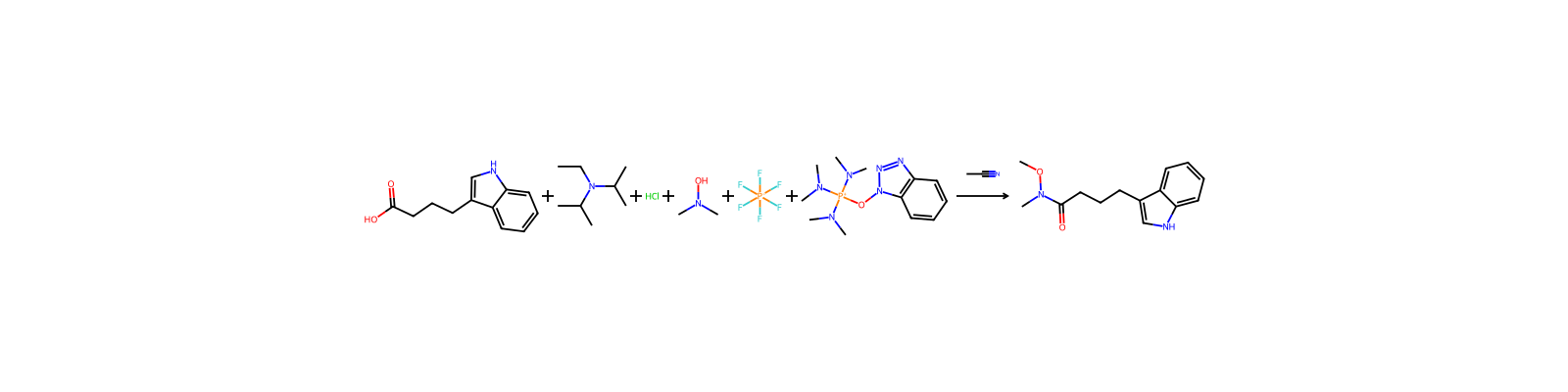
HRID 883As reactant
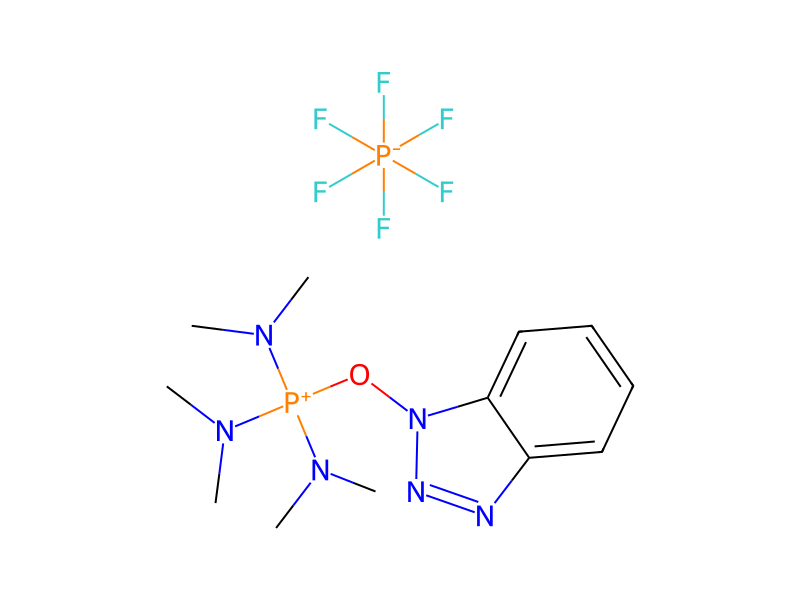
56602-33-6CN(C)[P+](On1nnc2ccccc21)(N(C)C)N(C)C.F[P-](F)(F)(F)(F)FMGEVGECQZUIPSV-UHFFFAOYSA-NSafety information is for reference only and does not replace the supplier’s Safety Data Sheet (SDS), applicable regulations, or professional assessment.
Danger
H228 (81.8%): Flammable solid [Danger Flammable solids]
P210, P240, P241, P261, P264, P264+P265, P271, P280, P302+P352, P304+P340, P305+P351+P338, P319, P321, P332+P317, P337+P317, P362+P364, P370+P378, P403+P233, P405, and P501 (click each P-code to see the statement)
Aggregated GHS information provided per 55 reports by companies from 13 notifications to the ECHA C&L Inventory. Each notification may be associated with multiple companies.
UsesPeptide coupling reagent which suppresses racemization.
Uses1H-Benzotriazol-1-yloxytris(dimethylamino)phosphonium hexafluorophosphate is used as a reagent for peptide coupling, lactonization, selective esterification, amidation of alfa amino acids without racemization and synthesis of magnolamide for antioxidative activity and catalyst for 9-acridinecaroboxamide derivative. It is also used as a precursor for the synthesis of phenyl esters of amino acids. It acts as a substitute for (Benzotriazol-1-yloxy)tris(dimethylamino)phosphonium hexafluorophosphate (BOP) reagent.
Uses1H-Benzotriazol-1-yloxytris(dimethylamino)phosphonium Hexafluorophosphate is a peptide coupling reagent. Can be used in the preparation of phenyl esters of amino acids which have been shown to be valuable as blocked derivatives of amino acids in the field of peptide synthesis.
PreparationTo vigorously stirred HMPA (15.0 g, 83.7 mmol) at 0 C°, a solution of triphosgene (11.28 g, 38.01 mmol) in dichloromethane (15 mL) was added over a period of 40 min. The ice bath was then removed and the mixture was stirred at room temperature. At various intervals, small aliquots were removed in order to follow the disappearance of the HMPA spectroscopically. After 3 h, the solvent was removed under reduced pressure to leave a residue. This residue was redissolved in dry dichloromethane (40 mL) and solid hydroxybenzotriazole monohydrate (12.76 g, 94.4 mmol) was added with stirring. The resulting solution was cooled to about 5 C° with an acetone/ice bath, whereupon triethylamine (8.42 g, 83.4 mmol) was added over a period of 15 min and stirring was continued at -5 C for 4 h. The residue was dissolved in water (50 mL) and mixed with a filtered solution of potassium hexafluorophosphate (16.68 g, 90.6 mmol) in water (120 mL) to give benzotriazolyl-N-oxytris(dimethylamino)phosphonium hexafluorophosphate 1317 (BOP) as a crystalline solid (28.91 g, 78%). Chloroformates 1319 and chlorides 1320 are also formed when secondary benzyl alcohols 1318 are treated with trichloromethyl chloroformate (diphosgene) in the presence of triethylamine. The distribution of products can be controlled. Reactions of tetrahydropyranylated alcohols 1321 with N,N-dimethylphosgeniminium chloride (‘‘Viehe salt’’) 1322 give the corresponding alkyl chloride 1300 in good yields [997]. This conversion can be conveniently accomplished by adding the ‘‘Viehe salt’’ (1.05 equiv.) as a solid to a solution of the THP-protected alcohol (1 equiv.) in anhydrous dichloromethane (0.3 m) under argon at 0 C°. After completion of the reaction and aqueous work-up, the crude alkyl chlorides are purified by column chromatography.
56602-33-6DTXSID60205170