Sulfuric acid, magnesium potassium salt (3:2:2)
HCID 159836
Completing data — refresh the page later to see the latest
Basic information
- CAS
13826-56-7- Standard SMILES
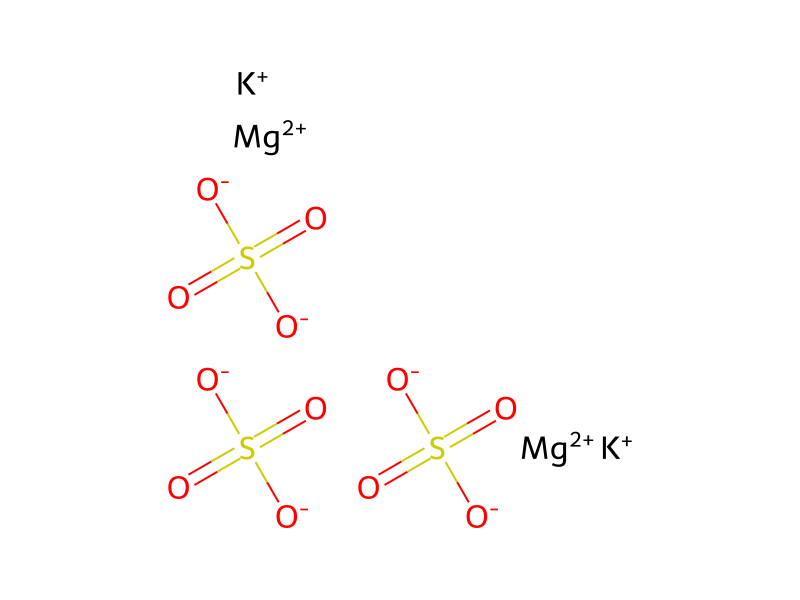
O=S(=O)([O-])[O-].O=S(=O)([O-])[O-].O=S(=O)([O-])[O-].[K+].[K+].[Mg+2].[Mg+2]- InChIKey
WZISDKTXHMETKG-UHFFFAOYSA-H- Molecular formula
- K2Mg2O12S3
- Average molar mass
- 415 g/mol
- Monoisotopic mass
- 413.7526853
Overview
Langbeinite is a mineral with formula of K2Mg2(S6+O4)3 or K2Mg2(SO4)3. The IMA symbol is Lbn.
Names & identifiers
- Preferred name
- Sulfuric acid, magnesium potassium salt (3:2:2)
- IUPAC
- dimagnesium;dipotassium;trisulfate
- English name
- dipotassium magnesium(+2) cation trisulfate
- Molecular formula
- H5KMgO4S
- Molecular weight
- 164.5
Names & synonyms
Potassium magnesium sulfateKalimagnesiaSul-Po-Mag13826-56-7Sulfuric acid, magnesium potassium salt (3:2:2)YI4N487572RefChem:175516MgK2(SO4)2241-811-1Langbeinite (Mg2K2(SO4)3)17855-14-0Langbeinite
Show more names
Ptassium magnesium sulfate
Dipotassium dimagnesium trisulfateSulphuric acid, magnesium potassium saltdimagnesium;dipotassium;trisulfatedipotassium magnesium(+2) cation trisulfateMagnesium potassium sulfateEINECS 241-811-1Dimagnesium dipotassium sulfateDTXSID4075037
Database identifiers
- CAS
13826-56-7、14977-37-8、17855-14-0- PubChem CID
- 159836
- DTXSID
DTXSID4075037- UNII
- YI4N487572
- EC Number
- 241-811-1
Properties
Computed structural propertiesFilling in
- Topological polar surface area
- 266 Ų
- Hydrogen bond donors
- 0
- Hydrogen bond acceptors
- 12
- Rotatable bonds
- 0
- Heavy atoms
- 19
- Formal charge
- 0
- Complexity
- 62.2
Experimental & physicochemical properties
Physical DescriptionLarge Crystals
Physicochemical properties
- Melting point
- 927 ℃ · 927℃ [HAW93]
- Density
- 2.829 · 2.829
- Water Solubility
- 100 g · g/100g H2O: 14.0 (0°C), 25.0 (20°C), 63.4 (80°C) [LAN05]
- EWG's Food Scores
- 1 · 1
- FDA UNII
- 4 N487572 · YI4N487572
- EPA Substance Registry System
- Dipotassium dimagnesium trisulfate (13826-56-7)
Safety & regulation
Safety information is for reference only and does not replace the supplier’s Safety Data Sheet (SDS), applicable regulations, or professional assessment.
GHS classification
GHS ClassificationNot Classified
Hazard information
Regulatory Information
Langbeinite (Mg2K2(SO4)3) is listed on the EPA's Chemical Data Reporting (CDR) system. Manufacturers and importers of Langbeinite (Mg2K2(SO4)3) are required to report information about their production and use of this chemical to the EPA under the Toxic Substances Control Act (TSCA). (40 eCFR Part 711)
Hazard Classes and CategoriesNot Classified
Chemistry & industry
Uses & manufacturing
U.S. Production2023: 890,000,000 lb
Consumer UsesSoil amendments (fertilizers)
Household Products
Information on 10 consumer products that contain Potassium magnesium sulfate in the following categories is provided:
Information on 9 consumer products that contain Potassium magnesium sulfate in the following categories is provided:
Applications
UsesDipotassium magnesium(+2) cation trisulfate is characterized by its rich nutrient content, excellent soil-improving effect, and effective promotion of crop growth. It is a multi-element potassium fertilizer, containing potassium, magnesium, sulfur, and trace elements such as calcium, boron, iron, and zinc. It can generally be used as a base fertilizer or as a top dressing. Magnesium in potassium magnesium sulfate is a constituent element of the porphyrin ring in chlorophyll and is crucial for chlorophyll structure formation. Without magnesium, the porphyrin ring and surrounding organic chains cannot combine to form chlorophyll, thus preventing photosynthesis. While potassium also promotes photosynthesis, excessive potassium can inhibit nitrogen and calcium absorption. Therefore, under the same conditions, it is more effective than potassium sulfate.
Related reactions
0 records
No related reactions yet