
Training data from https://doi.org/10.1039/C8SC04228D (8/10) · 10.1039/C8SC04228D
查看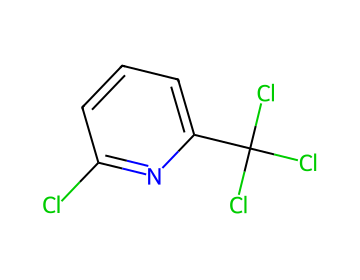
IDENTITY
COMPUTED
PROPERTIES
3.4
Relative density of the vapour/air-mixture at 20 °C (air = 1): 1.0
less than 0.1 mg/mL at 64 °F (NTP, 1992)
Solubility in water: none
Insoluble
100 °C c.c.
277 to 280 °F at 11 mmHg (NTP, 1992)
at 1.5kPa: 136 °C
277 to 280 °F at 11 mmHg
144.5 to 145.2 °F (NTP, 1992)
63 °C
145 °F
145 °F
0.0028 mmHg at 73 °F (NTP, 1992)
0.0048 [mmHg]
Vapor pressure, Pa at 23 °C:
0.003 mmHg at 73 °F
0.003 [mm Hg] @22.5 °C
(73 °F): 0.003 mmHg
Nitrapyrin appears as colorless crystals or off-white crystalline solid. (NTP, 1992)
Liquid
Colorless or white, crystalline solid with a mild, sweet odor; [NIOSH]
COLOURLESS-TO-WHITE CRYSTALS WITH CHARACTERISTIC ODOUR.
Colorless or white, crystalline solid with a mild, sweet odor.
Colorless or white, crystalline solid with a mild, sweet odor.
1463.6
GHS
Warning
H302: Harmful if swallowed [Warning Acute toxicity, oral];H411: Toxic to aquatic life with long lasting effects [Hazardous to the aquatic environment, long-term hazard]
P264, P270, P273, P301+P317, P330, P391, and P501 (click each P-code to see the statement)
Warning
HAZARDS
Chemical: Pyridine, 2-chloro-6-(trichloromethyl)-;Specific Information Requirement: Obligations to provide information apply. These obligations are:;1. A person introducing this chemical must tell us in writing within 28 calendar days if any of the following circumstances have occurred in relation to their introduction (importation or manufacture):;a. residues of the chemical are detected in food producing crops;;b. products containing the chemical are intended to be used by members of the public;;c. products containing the chemical are intended to be used in domestic settings;;d. the chemical is imported in solid form;;e. additional information becomes available that suggests residues of the chemical and/or its metabolites are detected in crops treated with the chemical as microcapsules;;f. products containing the chemical are intended to be applied by equipment other than low ground boom.;2. A person who introduces this chemical must tell us in writing within 28 calendar days if they become aware of any of the following circumstances, namely, that since the assessment under the Industrial Chemicals (Notification and Assessment) Act 1989:;a. the function or use of the chemical has changed, or is likely to change, significantly;;b. the amount of the chemical being introduced has increased, or is likely to increase, significantly;;c. in the case of a chemical not manufactured, or proposed to be manufactured, in Australia at the time of the assessmentâit has begun to be manufactured in Australia;;d. the method of manufacture of the chemical in Australia has changed, or is likely to change, in a way that may result in an increased risk of an adverse effect of the chemical on occupational health and safety, public health or the environment;;e. additional information has become available to the person as to an adverse effect of the chemical on occupational health and safety, public health or the environment.
Hazard Traits - Carcinogenicity; Developmental Toxicity;Authoritative List - Prop 65;Report - regardless of intended function of ingredient in the product
Pyridine, 2-chloro-6-(trichloromethyl)- is listed on the EPA's Chemical Data Reporting (CDR) system. Manufacturers and importers of Pyridine, 2-chloro-6-(trichloromethyl)- are required to report information about their production and use of this chemical to the EPA under the Toxic Substances Control Act (TSCA). (40 eCFR Part 711)
Nitrapyrin is listed in the dataset of EPA Human Health Benchmarks for Pesticides under the Safe Drinking Water Act (40 eCFR 141)
Status: Active Update: 27-07-2022 https://echa.europa.eu/registration-dossier/-/registered-dossier/23362;Status: Active Update: 18-07-2017 https://echa.europa.eu/registration-dossier/-/registered-dossier/20030
Nitrapyrin: Does not have an individual approval but may be used as a component in a product covered by a group standard. It is not approved for use as a chemical in its own right.
Poison
Flash point data for this compound are not available. It is probably combustible. (NTP, 1992)
Combustible. Gives off irritating or toxic fumes (or gases) in a fire.
Excerpt from NIOSH Pocket Guide for 2-Chloro-6-trichloromethyl pyridine:;Exposure Routes: Inhalation, skin absorption, ingestion, skin and/or eye contact;Symptoms: No adverse effects noted in ingestion studies with animals.;Target Organs: Eyes, skin (NIOSH, 2024)
Nitrapyrin has a low order of toxicity in dogs and rodents. No case reports of human occupational or other poisoning or controlled or epidemiologic studies were available for review to establish the TLV. [ACGIH] An eye, nose, and throat irritant; [NJ-HSFS] See Pyridine.
Amines, Phosphines, and Pyridines;Halogenated Organic Compounds;Aryl Halides
Symbol: Xn, N; R: 22-51/53; S: (2)-24-61
UN Hazard Class: 9; UN Pack Group: III
NITRAPYRIN is a base. Reacts exothermically with acids.
Decomposes on heating. This produces toxic fumes including chlorine and nitrogen oxides. Reacts with aluminium and magnesium.
Combustible Solid [Explosive]
Insoluble in water.
SAFETY
Fires involving this compound should be controlled with a dry chemical, carbon dioxide or Halon extinguisher. (NTP, 1992)
Use water spray, dry powder, carbon dioxide, foam.
Fresh air, rest.
Remove contaminated clothes. Rinse and then wash skin with water and soap. Refer for medical attention .
First rinse with plenty of water for several minutes (remove contact lenses if easily possible), then refer for medical attention.
Rinse mouth. Refer for medical attention .
EYES: First check the victim for contact lenses and remove if present. Flush victim's eyes with water or normal saline solution for 20 to 30 minutes while simultaneously calling a hospital or poison control center. Do not put any ointments, oils, or medication in the victim's eyes without specific instructions from a physician. IMMEDIATELY transport the victim after flushing eyes to a hospital even if no symptoms (such as redness or irritation) develop.;SKIN: IMMEDIATELY flood affected skin with water while removing and isolating all contaminated clothing. Gently wash all affected skin areas thoroughly with soap and water. If symptoms such as redness or irritation develop, IMMEDIATELY call a physician and be prepared to transport the victim to a hospital for treatment.;INHALATION: IMMEDIATELY leave the contaminated area; take deep breaths of fresh air. If symptoms (such as wheezing, coughing, shortness of breath, or burning in the mouth, throat, or chest) develop, call a physician and be prepared to transport the victim to a hospital. Provide proper respiratory protection to rescuers entering an unknown atmosphere. Whenever possible, Self-Contained Breathing Apparatus (SCBA) should be used; if not available, use a level of protection greater than or equal to that advised under Protective Clothing.;INGESTION: DO NOT INDUCE VOMITING. If the victim is conscious and not convulsing, give 1 or 2 glasses of water to dilute the chemical and IMMEDIATELY call a hospital or poison control center. Be prepared to transport the victim to a hospital if advised by a physician. If the victim is convulsing or unconscious, do not give anything by mouth, ensure that the victim's airway is open and lay the victim on his/her side with the head lower than the body. DO NOT INDUCE VOMITING. IMMEDIATELY transport the victim to a hospital. (NTP, 1992)
(General first aid procedures);Eye: Irrigate immediately - If this chemical contacts the eyes, immediately wash (irrigate) the eyes with large amounts of water, occasionally lifting the lower and upper lids. Get medical attention immediately.;Skin: Soap wash immediately - If this chemical contacts the skin, immediately wash the contaminated skin with soap and water. If this chemical penetrates the clothing, immediately remove the clothing, wash the skin with soap and water, and get medical attention promptly.;Breathing: Respiratory support;Swallow: Medical attention immediately - If this chemical has been swallowed, get medical attention immediately.
Provision to contain effluent from fire extinguishing. Separated from aluminium and magnesium. Store in an area without drain or sewer access.
SMALL SPILLS AND LEAKAGE: Should a spill occur while you are handling this chemical, FIRST REMOVE ALL SOURCES OF IGNITION, then you should dampen the solid spill material with ethanol and transfer the dampened material to a suitable container. Use absorbent paper dampened with ethanol to pick up any remaining material. Seal the absorbent paper, and any of your clothes, which may be contaminated, in a vapor-tight plastic bag for eventual disposal. Solvent wash all contaminated surfaces with ethanol followed by washing with a soap and water solution. Do not reenter the contaminated area until the Safety Officer (or other responsible person) has verified that the area has been properly cleaned.;STORAGE PRECAUTIONS: You should store this material in a refrigerator. (NTP, 1992)
Personal protection: particulate filter respirator adapted to the airborne concentration of the substance. Sweep spilled substance into covered plastic containers. If appropriate, moisten first to prevent dusting. Do NOT let this chemical enter the environment.
Excerpt from ERG Guide 154 [Substances - Toxic and/or Corrosive (Non-Combustible)]:;IMMEDIATE PRECAUTIONARY MEASURE: Isolate spill or leak area in all directions for at least 50 meters (150 feet) for liquids and at least 25 meters (75 feet) for solids.;SPILL: Increase the immediate precautionary measure distance, in the downwind direction, as necessary.;FIRE: If tank, rail tank car or highway tank is involved in a fire, ISOLATE for 800 meters (1/2 mile) in all directions; also, consider initial evacuation for 800 meters (1/2 mile) in all directions. (ERG, 2024)
Wear safety spectacles.
NO open flames.
A harmful contamination of the air will not or will only very slowly be reached on evaporation of this substance at 20 °C.
Protective gloves. Protective clothing.
PREVENT DISPERSION OF DUST!
TOXICITY
Eyes, skin
ACGIH Carcinogen - Not Classifiable.
The substance can be absorbed into the body in hazardous amounts through the skin and by ingestion. The substance can be absorbed into the body by inhalation.
inhalation, skin absorption, ingestion, skin and/or eye contact
Cough.
Redness.
No adverse effects noted in ingestion studies with animals.
Chemical: NITRAPYRIN
The substance is toxic to aquatic organisms. This substance does enter the environment under normal use. Great care, however, should be taken to avoid any additional release, for example through inappropriate disposal.
Nitrapyrin
No indication of carcinogenicity to humans (not listed by IARC).
0.16
OPP
0.03
OPP
Nitrapyrin
0.16
1100
Children
0.03
200
REGULATORY
Chemical: Pyridine, 2-chloro-6-(trichloromethyl)-;Specific Information Requirement: Obligations to provide information apply. These obligations are:;1. A person introducing this chemical must tell us in writing within 28 calendar days if any of the following circumstances have occurred in relation to their introduction (importation or manufacture):;a. residues of the chemical are detected in food producing crops;;b. products containing the chemical are intended to be used by members of the public;;c. products containing the chemical are intended to be used in domestic settings;;d. the chemical is imported in solid form;;e. additional information becomes available that suggests residues of the chemical and/or its metabolites are detected in crops treated with the chemical as microcapsules;;f. products containing the chemical are intended to be applied by equipment other than low ground boom.;2. A person who introduces this chemical must tell us in writing within 28 calendar days if they become aware of any of the following circumstances, namely, that since the assessment under the Industrial Chemicals (Notification and Assessment) Act 1989:;a. the function or use of the chemical has changed, or is likely to change, significantly;;b. the amount of the chemical being introduced has increased, or is likely to increase, significantly;;c. in the case of a chemical not manufactured, or proposed to be manufactured, in Australia at the time of the assessmentâit has begun to be manufactured in Australia;;d. the method of manufacture of the chemical in Australia has changed, or is likely to change, in a way that may result in an increased risk of an adverse effect of the chemical on occupational health and safety, public health or the environment;;e. additional information has become available to the person as to an adverse effect of the chemical on occupational health and safety, public health or the environment.
Hazard Traits - Carcinogenicity; Developmental Toxicity;Authoritative List - Prop 65;Report - regardless of intended function of ingredient in the product
Pyridine, 2-chloro-6-(trichloromethyl)- is listed on the EPA's Chemical Data Reporting (CDR) system. Manufacturers and importers of Pyridine, 2-chloro-6-(trichloromethyl)- are required to report information about their production and use of this chemical to the EPA under the Toxic Substances Control Act (TSCA). (40 eCFR Part 711)
Nitrapyrin is listed in the dataset of EPA Human Health Benchmarks for Pesticides under the Safe Drinking Water Act (40 eCFR 141)
Status: Active Update: 27-07-2022 https://echa.europa.eu/registration-dossier/-/registered-dossier/23362;Status: Active Update: 18-07-2017 https://echa.europa.eu/registration-dossier/-/registered-dossier/20030
Nitrapyrin: Does not have an individual approval but may be used as a component in a product covered by a group standard. It is not approved for use as a chemical in its own right.
USES
Used as a fertilizer additive to improve nitrogen in soil; [Merck Index, # 6574]
Nitrapyrin (trade name N-Serve) is used as an agricultural chemical. Nitrapyrin is currently registered by the U.S. Environmental Protection Agency (EPA) as a nitrification inhibitor to slow and reduce the loss of nitrogen from soil when used together with urea and other ammoniacal (ammonia containing) fertilizers.
2023: 1,000,000 - <5,000,000 lb;2022: 1,000,000 - <5,000,000 lb;2021: 1,000,000 - <5,000,000 lb;2020: 1,000,000 - <5,000,000 lb
Intermediate
NITROGEN STABILIZERS
Pesticide, Fertilizer, and Other Agricultural Chemical Manufacturing
Pyridine, 2-chloro-6-(trichloromethyl)-: ACTIVE
ALIASES
REACTIONS
Training data from https://doi.org/10.1039/C8SC04228D (8/10) · 10.1039/C8SC04228D
查看
uspto-grants-2001_11 · 10.6084/m9.figshare.5104873.v1 · US06320053B1
查看
uspto-grants-2001_11 · 10.6084/m9.figshare.5104873.v1 · US06320053B1
查看
uspto-grants-2001_11 · 10.6084/m9.figshare.5104873.v1 · US06320053B1
查看
uspto-grants-1981_04 · 10.6084/m9.figshare.5104873.v1 · US04260766
查看
uspto-grants-1981_04 · 10.6084/m9.figshare.5104873.v1 · US04260766
查看
uspto-grants-1985_02 · 10.6084/m9.figshare.5104873.v1 · US04499277
查看
uspto-grants-1985_02 · 10.6084/m9.figshare.5104873.v1 · US04499277
查看