
Training data from https://doi.org/10.1039/C8SC04228D (2/10) · 10.1039/C8SC04228D
查看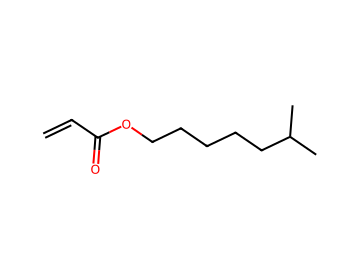
IDENTITY
COMPUTED
PROPERTIES
3.93
0.9 g/cm³
Relative density of the vapour/air-mixture at 20 °C (air = 1): 1.01
2 mm²/s at 25 °C
Solubility in water, g/100ml at 23 °C: 0.001 (very poor)
91 °C
91 °C c.c.
196.8 °C
Relative vapor density (air = 1): 6.4
0.15 [mmHg]
Vapor pressure, Pa at 25 °C: 133.3
Liquid; CBI
Colorless liquid; [CHEMINFO]
COLOURLESS LIQUID.
1219
1232;1232;1235
1480;1478
GHS
Warning
H315: Causes skin irritation [Warning Skin corrosion/irritation];H319: Causes serious eye irritation [Warning Serious eye damage/eye irritation];H335: May cause respiratory irritation [Warning Specific target organ toxicity, single exposure; Respiratory tract irritation];H400: Very toxic to aquatic life [Warning Hazardous to the aquatic environment, acute hazard];H410: Very toxic to aquatic life with long lasting effects [Warning Hazardous to the aquatic environment, long-term hazard]
P261, P264, P264+P265, P271, P273, P280, P302+P352, P304+P340, P305+P351+P338, P319, P321, P332+P317, P337+P317, P362+P364, P391, P403+P233, P405, and P501 (click each P-code to see the statement)
Warning
HAZARDS
Chemical: 2-Propenoic acid, isooctyl ester
2-Propenoic acid, isooctyl ester is listed on the EPA's Chemical Data Reporting (CDR) system. Manufacturers and importers of 2-Propenoic acid, isooctyl ester are required to report information about their production and use of this chemical to the EPA under the Toxic Substances Control Act (TSCA). (40 eCFR Part 711)
Status: Active Update: 20-07-2020 https://echa.europa.eu/registration-dossier/-/registered-dossier/2087
Isooctyl acrylate: Does not have an individual approval but may be used under an appropriate group standard
Combustible. Above 91 °C explosive vapour/air mixtures may be formed.
A skin, eye, and respiratory tract irritant; [eChemPortal: ESIS] Skin irritation reported in workers; No skin sensitization detected in animal studies; [AIHA] An irritant and lachrymator; May cause skin sensitization; [MSDSonline] See ACRYLIC RESINS (MONOMERS).
Symbol: Xi, N; R: 36/37/38-50/53; S: (2)-26-28-60-61
UN Hazard Class: 9; UN Pack Group: III
The substance may polymerize due to heating. Decomposes on heating. This produces acrid fumes (acrylic acid, acrolein).
Skin Irrit. 2 (98.7%);Eye Irrit. 2 (98.7%);STOT SE 3 (98.7%);Aquatic Acute 1 (99.8%);Aquatic Chronic 1 (98.7%)
Eye irritation - category 2;Specific target organ toxicity (single exposure) - category 3;Skin irritation - category 2;Hazardous to the aquatic environment (acute) - category 1;Hazardous to the aquatic environment (chronic) - category 1
Flammable liquids - Category 4;Specific target organ toxicity - Single exposure - Category 3 (Narcotic effects);Hazardous to the aquatic environment (Acute) - Category 1;Hazardous to the aquatic environment (Long-term) - Category 1
STOT SE 3;Skin Irrit. 2;Eye Irrit. 2;Aquatic Acute 1;Aquatic Chronic 1
SAFETY
Use water spray, dry powder, alcohol-resistant foam, carbon dioxide. In case of fire: keep drums, etc., cool by spraying with water.
Fresh air, rest.
Remove contaminated clothes. Rinse and then wash skin with water and soap.
Rinse with plenty of water (remove contact lenses if easily possible).
Rinse mouth. Give one or two glasses of water to drink. Seek medical attention if you feel unwell.
Provision to contain effluent from fire extinguishing. Store only if stabilized. Keep in the dark. Ventilation along the floor. Store in an area without drain or sewer access.
Personal protection: filter respirator for organic gases and vapours adapted to the airborne concentration of the substance. Do NOT let this chemical enter the environment. Collect leaking liquid in covered containers. Absorb remaining liquid in sand or inert absorbent. Then store and dispose of according to local regulations.
Wear safety spectacles.
NO open flames. Above 91 °C use a closed system and ventilation.
No indication can be given about the rate at which a harmful concentration of this substance in the air is reached on evaporation at 20 °C.
Protective clothing. Protective gloves.
AVOID ALL CONTACT!
Do not eat, drink, or smoke during work.
Use ventilation, local exhaust or breathing protection.
Repeated or prolonged contact may cause skin sensitization.
TOXICITY
Lacrimator (Lachrymator) - A substance that irritates the eyes and induces the flow of tears.;Skin Sensitizer - An agent that can induce an allergic reaction in the skin.
Cough.
Redness.
Redness.
Vomiting. Aspiration hazard!
The substance is very toxic to aquatic organisms. It is strongly advised not to let the chemical enter into the environment.
REGULATORY
Chemical: 2-Propenoic acid, isooctyl ester
2-Propenoic acid, isooctyl ester is listed on the EPA's Chemical Data Reporting (CDR) system. Manufacturers and importers of 2-Propenoic acid, isooctyl ester are required to report information about their production and use of this chemical to the EPA under the Toxic Substances Control Act (TSCA). (40 eCFR Part 711)
Status: Active Update: 20-07-2020 https://echa.europa.eu/registration-dossier/-/registered-dossier/2087
Isooctyl acrylate: Does not have an individual approval but may be used under an appropriate group standard
USES
Used as a concrete sealer polymerized at the job site and to make other acrylic polymers; [eChemPortal: SIDSUNEP] Used to make hypoallergenic skin adhesives in medical applications; [AIHA]
2023: 50,000,000 - <100,000,000 lb;2022: 50,000,000 - <100,000,000 lb;2021: 50,000,000 - <100,000,000 lb;2020: 50,000,000 - <100,000,000 lb
Monomers
Monomers;Binder;Photosensitive chemicals
Electrical Equipment, Appliance, and Component Manufacturing;Adhesive Manufacturing;Other (requires additional information);Miscellaneous Manufacturing
2-Propenoic acid, isooctyl ester: ACTIVE
ALIASES
REACTIONS
Training data from https://doi.org/10.1039/C8SC04228D (2/10) · 10.1039/C8SC04228D
查看
uspto-grants-2014_02 · 10.6084/m9.figshare.5104873.v1 · US08642616B2
查看
uspto-grants-2014_02 · 10.6084/m9.figshare.5104873.v1 · US08642616B2
查看
uspto-grants-2007_02 · 10.6084/m9.figshare.5104873.v1 · US07182955B2
查看
uspto-grants-2000_10 · 10.6084/m9.figshare.5104873.v1 · US06132760
查看
uspto-grants-2000_10 · 10.6084/m9.figshare.5104873.v1 · US06136807
查看
uspto-grants-2000_10 · 10.6084/m9.figshare.5104873.v1 · US06136807
查看
uspto-grants-1989_04 · 10.6084/m9.figshare.5104873.v1 · US04822706
查看