Elastase
HCID 168009926
Daten werden ergänzt – lade die Seite später neu, um den aktuellen Stand zu sehen
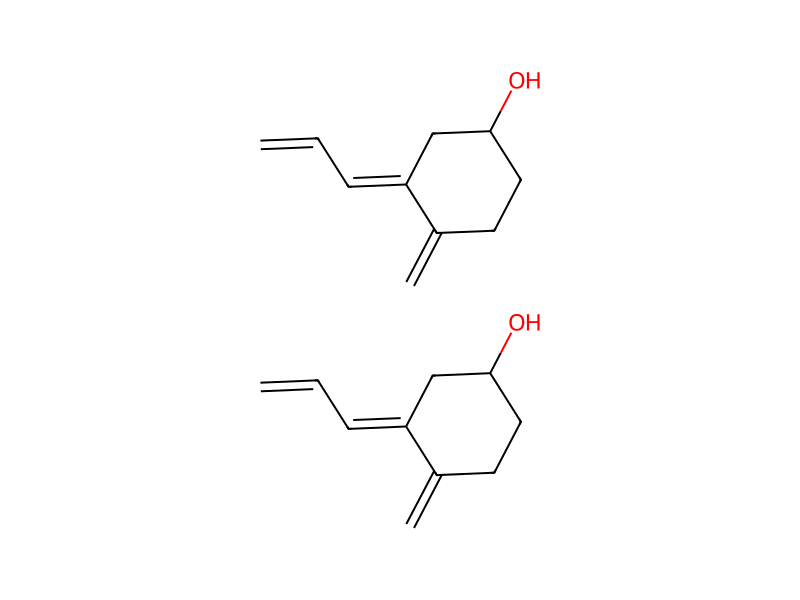
Grundinformationen
- CAS
81295-09-2- Standard-SMILES
C=CC=C1CC(O)CCC1=C.C=CC=C1CC(O)CCC1=C- InChIKey
DXPFIOMVMNHFEU-UHFFFAOYSA-N- Summenformel
- C20H28O2
- Durchschnittliche Molmasse
- 300,4 g/mol
Namen und Bezeichner
- Bevorzugter Name
- Elastase
- IUPAC
- 4-methylidene-3-prop-2-enylidenecyclohexan-1-ol
- Lokaler Name
- Elastase
- Englischer Name
- Elastase (human leucocytes)
- Molmasse
- 0
Namen und Synonyme
Elastase9004-06-2Elastase [JAN]Pancreatopeptidase ERefChem:590675Peptidase, pancreato-, EMatrix metalloproteinase-12Proteinase, bone marrow serineMMP 12DTXSID601010856EINECS 232-670-7E.C. 3.4.4.7
Weitere Namen anzeigen
elastase from human leukocytesELA2ELANEelaszymEiastaseElastase-2e.c.3.4.4.7Elastase ESEC 3.4.21.37EC 3.4.21.36
E.C. 3.4.2.1.11E.C. 3.4.21.11E.C. 3.4.21.36E.C. 3.4.21.37E.C. 3.4.24.65232-670-7(3Z)-4-methylidene-3-prop-2-enylidenecyclohexan-1-ol81295-09-2
Datenbank-Bezeichner
- CAS
81295-09-2、9004-06-2- PubChem CID
- 168009926
- EC Number
- 232-670-7、279-720-4
Eigenschaften
Berechnete StruktureigenschaftenWird ergänzt
- Polarare Oberfläche (TPSA)
- 40,5 Ų
- H-Brücken-Donoren
- 2
- H-Brücken-Akzeptoren
- 2
- Frei drehbare Bindungen
- 2
- Schwere Atome
- 22
- Formalladung
- 0
- Komplexität
- 201
Physikochemische Eigenschaften
- storage temp.
- -20 °C · -20°C
- Aggregatzustand
- lyophilized powder
- Farbe
- White to off-white
- Biologische Quelle
- rabbit
- Specific Activity
- 50 units/mg · ≥50units/mg protein (Bradford)
- CAS Datenbank
- 9004 · 9004-06-2
- EPA chemische Informationen
- Elastase (9004-06-2)
Sicherheit und Regulatorisches
Sicherheitsangaben dienen nur zur Orientierung und ersetzen weder das Sicherheitsdatenblatt (SDB) des Lieferanten noch geltende Vorschriften oder eine fachliche Bewertung.
GHS-Klassifizierung
GHS Classification
Danger
H315 (100%): Causes skin irritation [Warning Skin corrosion/irritation]
P233, P260, P261, P264, P264+P265, P271, P280, P284, P302+P352, P304+P340, P305+P351+P338, P319, P321, P332+P317, P337+P317, P342+P316, P362+P364, P403, P403+P233, P405, and P501 (click each P-code to see the statement)
Aggregated GHS information provided per 39 reports by companies from 2 notifications to the ECHA C&L Inventory. Each notification may be associated with multiple companies.
Gefahrenhinweise
Regulatory Information
XU - indicates a substance exempt from reporting under the Chemical Data Reporting Rule, (40 CFR 711).
Elastase: Does not have an individual approval but may be used under an appropriate group standard
Hazard Classes and CategoriesSkin Irrit. 2 (100%)
Sicherheitsdaten
- F
- 3-10
- wgk
- 3
- tsca
- TSCA listed
- hazard_code
- B
- Speicherklasse
- 11 - Combustible Solids
- Hazard Classifications
- Eye Irrit. 2Resp. Sens. 1Skin Irrit. 2STOT SE 3
Chemie und Industrie
Verwendung und Herstellung
General Manufacturing InformationElastase: ACTIVE
Anwendungen
VerwendenElastase from human leukocytes has been used: to measure serum elastase activityin proteolytic digestion of fibronectin and salivary glandsin neutrophil elastase (NE) activity assaycell-free NE digestion of E-cadherinscratch wound assayin a study that determined that fragments of Nle3-angiotensin(1-7) accelerate healing in dermal modelsElastase has been used to digest fibronectin. The results were compared with fibronectin digestion by crude human leukocyte homogenate to examine the presence of fibronectin peptides in saliva of patients with Sjgren′s syndrome. It has also been used as a reference to determine the elastase activity in cell lysates. This study examined the effect of all-trans retinoic acid on procoagulant and fibrinolytic activities of cultured blast cells. These blast cells were from patients with acute promyelocytic leukemia.
Vor- und nachgelagerte Produkte
Vorgelagerte Rohstoffe
Zugehörige Reaktionen
0
Noch keine zugehörigen Reaktionen