
uspto-grants-1988_02 · 10.6084/m9.figshare.5104873.v1 · US04725542
查看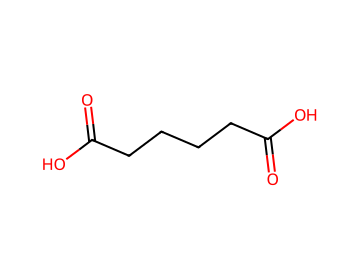
IDENTITY
COMPUTED
PROPERTIES
pH of saturated aqueous solution at 25 °C = 2.7; pH of 0.1% solution at 25 °C = 3.2
log Kow = 0.08
0.08
0.08
Odorless
TART TASTE
Sour tasting
1.36 at 68 °F (USCG, 1999) - Denser than water; will sink
1.360 g/cu cm at 25 °C
Bulk density: 640-800 kg/cu m
1.36 g/cm³
1.36
Viscosity of melt: 4.54 cP at 160 °C; 2.64 cP at 193 °C
Monoclinic prisms from ethyl acetate, water, or acetone and petroleum ether
White monoclinic prisms
White crystalline solid
Colorless
Slightly soluble in water. Freely soluble in ethanol
In water, 3.00X10+4 mg/L at 30 °C
In water, 0.633/100 parts (wt/wt) ether at 19 °C
In water, 160 g/100 mL boiling water
1.4 g/100 mL water at 10 °C
For more Solubility (Complete) data for ADIPIC ACID (7 total), please visit the HSDB record page.
Corrosion rate for ASTM grade 2 Titanium: 0.0 mm/yr at 232 °C for 67% (wt) concn.
Aqueous solutions of adipic acid are corrosive.
376 °F Combustible solid (USCG, 1999)
385 °F, 196 °C (closed cup)
196 °C c.c.
376 °F
337.5 °C at 760 mm Hg: 265 °C at 100 mm Hg: 240.5 °C at 40 mm Hg: 222 °Cat 20 mm Hg: 205.5 °C at 10 mm Hg; 191 °C at 5 mm Hg; 159.5 °C at 1.0 mm Hg
265.00 °C. @ 100.00 mm Hg
338 °C
Melts and may decompose to give volatile acidic vapors of valeric acid and other substances.
When heated to decomp it emits acrid smoke and fumes.
GHS
Warning
H319: Causes serious eye irritation [Warning Serious eye damage/eye irritation]
P264+P265, P280, P305+P351+P338, and P337+P317 (click each P-code to see the statement)
This chemical does not meet GHS hazard criteria for < 0.1% (2 of 5531) of reports.
HAZARDS
Chemical: Hexanedioic acid
Hexanedioic acid is listed on the EPA's Chemical Data Reporting (CDR) system. Manufacturers and importers of Hexanedioic acid are required to report information about their production and use of this chemical to the EPA under the Toxic Substances Control Act (TSCA). (40 eCFR Part 711)
Status: Active Update: 18-05-2023 https://echa.europa.eu/registration-dossier/-/registered-dossier/15464
Hexanedioic acid: Does not have an individual approval but may be used under an appropriate group standard
IMAP assessments - Hexanedioic acid: Human health tier II assessment;IMAP assessments - Hexanedioic acid: Environment tier I assessment
Class 9
Behavior in Fire: Melts and may decompose to give volatile acidic vapors of valeric acid and other substances. Dust may form explosive mixture with air. (USCG, 1999)
Combustible. Finely dispersed particles form explosive mixtures in air.
Combustible when exposed to heat or flame ...
Inhalation of vapor irritates mucous membranes of the nose and lungs, causing coughing and sneezing. Contact with liquid irritates eyes and has a pronounced drying effect on the skin; may produce dermatitis. (USCG, 1999)
A skin and eye irritant; Practically non-toxic; [CHEMINFO] Occupational asthma reported in a solderer and confirmed by broncho-provocation testing; [Malo] A functional disorder of the autonomic nervous system in workers exposed to adipic acid was reported in 1981. Otherwise, only irritant effects have been reported. [ACGIH] Insoluble in water; May absorb water from the air and corrode metals; Harmful to the environment; [CAMEO]
Substance added directly to human food affirmed as generally recognized as safe (GRAS).
Adipic acid used as a buffer and neutralizing agent in animal drugs, feeds, and related products is generally recognized as safe when used in accordance with good manufacturing or feeding practice.
Acids, Carboxylic
Symbol: Xi; R: 36; S: (2)
Chemical: Adipic acid; Green circle - The chemical has been verified to be of low concern based on experimental and modeled data.
ADIPIC ACID is a carboxylic acid. Carboxylic acids donate hydrogen ions if a base is present to accept them. They react in this way with all bases, both organic (for example, the amines) and inorganic. Their reactions with bases, called "neutralizations", are accompanied by the evolution of substantial amounts of heat. Neutralization between an acid and a base produces water plus a salt. Carboxylic acids with six or fewer carbon atoms are freely or moderately soluble in water; those with more than six carbons are slightly soluble in water. Soluble carboxylic acid dissociate to an extent in water to yield hydrogen ions. The pH of solutions of carboxylic acids is therefore less than 7.0. Many insoluble carboxylic acids react rapidly with aqueous solutions containing a chemical base and dissolve as the neutralization generates a soluble salt. Carboxylic acids in aqueous solution and liquid or molten carboxylic acids can react with active metals to form gaseous hydrogen and a metal salt. Such reactions occur in principle for solid carboxylic acids as well, but are slow if the solid acid remains dry. Even "insoluble" carboxylic acids may absorb enough water from the air and dissolve sufficiently in it to corrode or dissolve iron, steel, and aluminum parts and containers. Carboxylic acids, like other acids, react with cyanide salts to generate gaseous hydrogen cyanide. The reaction is slower for dry, solid carboxylic acids. Insoluble carboxylic acids react with solutions of cyanides to cause the release of gaseous hydrogen cyanide. Flammable and/or toxic gases and heat are generated by the reaction of carboxylic acids with diazo compounds, dithiocarbamates, isocyanates, mercaptans, nitrides, and sulfides. Carboxylic acids, especially in aqueous solution, also react with sulfites, nitrites, thiosulfates (to give H2S and SO3), dithionites (SO2), to generate flammable and/or toxic gases and heat. Their reaction with carbonates and bicarbonates generates a harmless gas (carbo
SAFETY
Excerpt from ERG Guide 171 [Substances (Low to Moderate Hazard)]:;CAUTION: Fire involving Safety devices (UN3268) and Fire suppressant dispersing devices (UN3559) may have a delayed activation and a risk of hazardous projectiles. Extinguish the fire at a safe distance.;SMALL FIRE: Dry chemical, CO2, water spray or regular foam.;LARGE FIRE: Water spray, fog or regular foam. Do not scatter spilled material with high-pressure water streams. If it can be done safely, move undamaged containers away from the area around the fire. Dike runoff from fire control for later disposal.;FIRE INVOLVING TANKS: Cool containers with flooding quantities of water until well after fire is out. Withdraw immediately in case of rising sound from venting safety devices or discoloration of tank. ALWAYS stay away from tanks in direct contact with flames. (ERG, 2024)
Use water spray, powder, foam, carbon dioxide. In case of fire: keep drums, etc., cool by spraying with water.
Fresh air, rest. Refer for medical attention.
Remove contaminated clothes. Rinse skin with plenty of water or shower.
First rinse with plenty of water for several minutes (remove contact lenses if easily possible), then refer for medical attention.
Rinse mouth. Rest. Refer for medical attention .
INHALATION: remove victim to fresh air; get medical attention if irritation persists.;EYES: flush with water for at least 15 min.;SKIN: flush with water. (USCG, 1999)
2.0 [mg/m3], inhalable fraction of the aerosol[German Research Foundation (DFG)]
Suitable extinguishing media: Use water spray, alcohol-resistant foam, dry chemical or carbon dioxide.
Wear self-contained breathing apparatus for firefighting if necessary.
Stop discharge if possible, keep people away. Shut off ignition sources. Call fire department. Avoid contact with solid and dust. Isolate and remove discharged material.
If material on fire or involved in fire: Use water in flooding quantities as fog. Solid streams of water may spread fire. Cool all affected containers with flooding quantities of water. Apply water from as far a distance as possible. Use foam, dry chemical, or carbon dioxide.
Conditions for safe storage, including any incompatibilities: Keep container tightly closed in a dry and well-ventilated place. Storage class (TRGS 510): Non Combustible Solids.
Storage temperature: ambient; venting: open
Accidental release measures. Personal precautions, protective equipment and emergency procedures: Use personal protective equipment. Avoid dust formation. Avoid breathing vapors, mist or gas. Ensure adequate ventilation. Evacuate personnel to safe areas. Avoid breathing dust.; Environmental precautions: Prevent further leakage or spillage if safe to do so. Do not let product enter drains. Discharge into the environment must be avoided.; Methods and materials for containment and cleaning up: Pick up and arrange disposal without creating dust. Sweep up and shovel. Keep in suitable, closed containers for disposal.
Environmental considerations- land spill: Dig a pit, pond, lagoon, or holding area to contain liquid or solid material. /SRP: If time permits, pits, ponds, lagoons, soak holes, or holding areas should be sealed with an impermeable flexible membrane liner./ Cover solids with a plastic sheet to prevent dissolving in rain or fire fighting water.
Environmental considerations- water spill: Use natural deep water pockets, excavated lagoons, or sand bag barriers to trap material at bottom. If dissolved, in region of 10 ppm or greater concentration, apply activated carbon at ten times the spilled amount. Remove trapped material with suction hoses. Use mechanical dredges or lifts to remove immobilized masses of pollutants and precipitates.
Electrochemical measurements have been made on the system Cu(2+), adipic acid, nitric acid (which models the effluent from adipic acid plants) to investigate the reasons for the observed low current efficiency for copper deposition from such soln. The most probable cause is a cathodic shift in the deposition potential of copper making the reduction of NO3- the preferred process. Depletion experiments have been carried out on real effluent in two three-dimensional cells, a bipolar trickle tower and a porous reticulated carbon bed. Each performs reasonably well and, while the current efficiencies are low (about 20%), the deposition is essentially mass-transfer controlled.
Neutralizing agents for acids and caustics: Rinse with dilute ... soda ash solution.
Excerpt from ERG Guide 171 [Substances (Low to Moderate Hazard)]:;Do not touch or walk through spilled material. Stop leak if you can do it without risk. Prevent dust cloud. For Asbestos, avoid inhalation of dust. Cover spill with plastic sheet or tarp to minimize spreading. Do not clean up or dispose of, except under supervision of a specialist.;SMALL DRY SPILL: With clean shovel, place material into clean, dry container and cover loosely; move containers from spill area.;SMALL SPILL: Pick up with sand or other non-combustible absorbent material and place into containers for later disposal.;LARGE SPILL: Dike far ahead of liquid spill for later disposal. Cover powder spill with plastic sheet or tarp to minimize spreading. Prevent entry into waterways, sewers, basements or confined areas. (ERG, 2024)
SRP: Recycle any unused portion of the material for its approved use or return it to the manufacturer or supplier. Ultimate disposal of the chemical must consider: the material's impact on air quality; potential migration in air, soil or water; effects on animal, aquatic and plant life; and conformance with environmental and public health regulations. If it is possible or reasonable use an alternative chemical product with less inherent propensity for occupational harm/injury/toxicity or environmental contamination.
Product: Offer surplus and non-recyclable solutions to a licensed disposal company. Contact a licensed professional waste disposal service to dispose of this material.
Contaminated packaging: Dispose of as unused product.
Adipic acid is a waste chemical stream constituent which may be subjected to ultimate disposal by controlled incineration.
For more Disposal Methods (Complete) data for ADIPIC ACID (6 total), please visit the HSDB record page.
Sweep spilled substance into covered plastic containers. If appropriate, moisten first to prevent dusting. Wash away remainder with plenty of water.
Precautions for safe handling: Further processing of solid materials may result in the formation of combustible dusts. The potential for combustible dust formation should be taken into consideration before additional processing occurs. Avoid formation of dust and aerosols. Provide appropriate exhaust ventilation at places where dust is formed.
Appropriate engineering controls: Handle in accordance with good industrial hygiene and safety practice. Wash hands before breaks and at the end of workday.
Gloves must be inspected prior to use. Use proper glove removal technique (without touching glove's outer surface) to avoid skin contact with this product. Dispose of contaminated gloves after use in accordance with applicable laws and good laboratory practices. Wash and dry hands.
If material not on fire and not involved in fire: Keep material out of water sources and sewers. Build dikes to contain flow as necessary.
For more Preventive Measures (Complete) data for ADIPIC ACID (9 total), please visit the HSDB record page.
Excerpt from ERG Guide 171 [Substances (Low to Moderate Hazard)]:;IMMEDIATE PRECAUTIONARY MEASURE: Isolate spill or leak area in all directions for at least 50 meters (150 feet) for liquids and at least 25 meters (75 feet) for solids.;SPILL: Increase the immediate precautionary measure distance, in the downwind direction, as necessary.;FIRE: If tank, rail tank car or highway tank is involved in a fire, ISOLATE for 800 meters (1/2 mile) in all directions; also, consider initial evacuation for 800 meters (1/2 mile) in all directions. (ERG, 2024)
TOXICITY
A group of mice received intravaginally, three time weekly, applications of a powdered mixture containing urea, adipic acid, and carboxymethyl cellulose. There was a high incidence of vaginal cancer after prolonged treatment. Experiments extended over one year, in which the three ingredients were given separately, yielded no tumors.
LC50; Species: Lepomis machrochirus (bluegill sunfish); Concentration: = < 330 mg/L for 24 hr /Conditions of bioassay not specified/
LC50; Species: Pimephales promelas (fathead minnow); Conditions: /static bioassay/; Concentration: >300 mg/L for 1 hr
LC50; Species: Pimephales promelas (fathead minnow); Conditions: /static bioassay/; Concentration: 172 mg/L for 24 hr
LC50; Species: Pimephales promelas (fathead minnow); Conditions: /static bioassay/; Concentration: 97 mg/L for 72-96 hr
For more Ecotoxicity Values (Complete) data for ADIPIC ACID (6 total), please visit the HSDB record page.
TERRESTRIAL FATE: Based on a classification scheme(1), an estimated Koc value of 24(SRC), determined from a structure estimation method(2), indicates that adipic acid is expected to have very high mobility in soil(SRC). The pKa values of adipic acid's two acid groups are 4.44 and 5.44(3), indicating that this compound will exist almost entirely in the anion form and anions generally do not adsorb more strongly to soils containing organic carbon and clay than their neutral counterparts(4). Volatilization of adipic acid from moist soil surfaces is not expected to be an important fate process(SRC) given an estimated Henry's Law constant of 1.8X10⁻¹² atm-cu m/mole(SRC) based upon its vapor pressure, 2.27X10⁻⁷ mm Hg(5), and water solubility, 2.43X10+4 mg/L(6). Adipic acid is not expected to volatilize from dry soil surfaces based on its vapor pressure(5). Biodegradation screening tests indicate that adipic acid is readily biodegradable in soil and water(7). An 84% conversion of adipic acid's carbon content to carbon dioxide was observed after 30 days aerobic incubation in a soil flask test(8).
AQUATIC FATE: Based on a classification scheme(1), an estimated Koc value of 24(SRC), determined from a structure estimation method(2), indicates that adipic acid is not expected to adsorb to suspended solids and sediment(SRC). Volatilization from water surfaces is not expected(3) based upon an estimated Henry's Law constant of 1.8X10⁻¹² atm-cu m/mole(SRC), derived from its vapor pressure, 2.27X10⁻⁷ mm Hg(4), and water solubility, 2.43X10+4 mg/L(5). According to a classification scheme(6), an estimated BCF of 3(SRC), from its log Kow of 0.08(7) and a regression-derived equation(2), suggests the potential for bioconcentration in aquatic organisms is low(SRC). Biodegradation screening tests indicate that adipic acid is readily biodegradable in soil and water(8). Adipic acid was rapidly degraded in a river die-away test using Main River (Germany) water with 50% and 90% degradation being achieved in 3.5 and 7 days, respectively, at concentration levels of 700 mg/L(9). Adipic acid is not expected to undergo hydrolysis in the environment due to the lack of functional groups that hydrolyze under environmental conditions(3).
ATMOSPHERIC FATE: According to a model of gas/particle partitioning of semivolatile organic compounds in the atmosphere(1), adipic acid, which has a vapor pressure of 2.27.4X10-7 mm Hg at 25 °C(2), will exist in both the vapor and particulate phases in the ambient atmosphere. Vapor-phase adipic acid is degraded in the atmosphere by reaction with photochemically-produced hydroxyl radicals(SRC); the half-life for this reaction in air is estimated to be 2.9 days(SRC), calculated from its rate constant of 5.6X10⁻¹² cu cm/molecule-sec at 25 °C that was derived using a structure estimation method(3). Particulate-phase adipic acid may be physically removed from the air by wet and dry deposition(SRC). Adipic acid has been detected in snow, sleet and rain precipitation(4).
Aerosol emission rates of adipic acid from frying hamburger meat was 1.6 mg/kg of meat cooked; emission rates from charbroiling hamburger was 9.1 mg/kg of meat cooked for extra-lean hamburger (approx. 10.0% fat) and 17.2 mg/kg of meat cooked for regular hamburger (approx. 21% fat)(1). An adipic acid emission rate of 200 mg/kg of meat cooked was reported for charbroiling(2). An adipic acid concentration of 15-129 ng/kg was reported for the fine particulate material emitted from Chinese cooking(3).
Asthma - Reversible bronchoconstriction (narrowing of bronchioles) initiated by the inhalation of irritating or allergenic agents.
The substance can be absorbed into the body by inhalation of its aerosol.
Safe in the present practices of use and concentration. Ingredient, concentration, and use information are available in documents discoverable at https://cir-reports.cir-safety.org
IDENTIFICATION AND USE: Adipic acid is white crystalline solid. The major markets for adipic acid include use as feedstocks for nylon 6,6 resins and fibers, polyester polyols and plasticzers. Nylon 6,6 fibers and engineering resins accounted for approximately 85% of total adipic acid consumption in 2011. Polyester polyols and plasticizers, which combined accounted for 24-32% of global adipic acid consumption in 2010 . Other applications documented for adipic acid are as a lubricant additive in coatings, and foams, and in shoe soles, as tanning agent in leather industry, pH regulator in processes such as in the production of cleaning agents, pelletizing agent in disinfectant pills for drinking water, additive in flue gas sulfurization, in the coating of dishwashing machine tablets and as an additive in chemicals. Adipic acid has been identified as being used in hydraulic fracturing as a gelling agent. HUMAN EXPOSURE AND TOXICITY: Adipic acid exhibits an asthma hazard index of 0.75 using the chemical asthma hazard assessment program. Substances with indices of >0.5 have a high probability of being an asthmagen. Threshold for irritation of the human eye was 20 mg/cu m. ANIMAL STUDIES: Adipic acid is slightly toxic on acute exposure but produces moderate to severe eye irritation in rabbits (20 mg/24 hr). High concentrations of adipic acid can cause persistent pulmonary structural and functional alterations. In both mice and rabbits, lethal doses produce signs of inactivity, stomach and intestinal distention, and irritation and hemorrhage of the intestines. A group of mice received intravaginally, three time weekly, applications of a powdered mixture containing urea, adipic acid, and carboxymethyl cellulose. There was a high incidence of vaginal cancer after prolonged treatment. Experiments extended over one year, in which the three ingredients were given separately, yielded no tumors. Adipic acid is not mutagenic in Salmonella typhimurium strains TA98, TA100, TA1535, TA
AIR INTAKE: (assume air concn of 0.1 ug/cu m): 2 ug(1); WATER INTAKE: insufficient data; FOOD INTAKE: insufficient data.
/AQUATIC SPECIES/ ... Adipic acid is slightly to moderately toxic to fish, daphnia, and algae in acute tests.
Adipic acid has identified as a component of tobacco(1).
Adipic acid occurrence in plants(1).[Table#697]
Cough. Sore throat.
Redness. Pain.
EPA has released the first beta version (version 0.5) of the Interactive Chemical Safety for Sustainability (iCSS) Dashboard. The beta version of the iCSS Dashboard provides an interactive tool to explore rapid, automated (or in vitro high-throughput) chemical screening data generated by the Toxicity Forecaster (ToxCast) project and the federal Toxicity Testing in the 21st century (Tox21) collaboration. /The title compound was tested by ToxCast and/or Tox21 assays; Click on the "Chemical Explorer" button on the tool bar to see the data./[USEPA; ICSS Dashboard Application; Available from, as of December 8, 2014: http://actor.epa.gov/dashboard/]
REGULATORY
Chemical: Hexanedioic acid
Hexanedioic acid is listed on the EPA's Chemical Data Reporting (CDR) system. Manufacturers and importers of Hexanedioic acid are required to report information about their production and use of this chemical to the EPA under the Toxic Substances Control Act (TSCA). (40 eCFR Part 711)
Status: Active Update: 18-05-2023 https://echa.europa.eu/registration-dossier/-/registered-dossier/15464
Hexanedioic acid: Does not have an individual approval but may be used under an appropriate group standard
Substance added directly to human food affirmed as generally recognized as safe (GRAS).
Adipic acid used as a buffer and neutralizing agent in animal drugs, feeds, and related products is generally recognized as safe when used in accordance with good manufacturing or feeding practice.
This action promulgates standards of performance for equipment leaks of Volatile Organic Compounds (VOC) in the Synthetic Organic Chemical Manufacturing Industry (SOCMI). The intended effect of these standards is to require all newly constructed, modified, and reconstructed SOCMI process units to use the best demonstrated system of continuous emission reduction for equipment leaks of VOC, considering costs, non air quality health and environmental impact and energy requirements. Adipic acid is produced, as an intermediate or final product, by process units covered under this subpart.
Persons in charge of vessels or facilities are required to notify the National Response Center (NRC) immediately, when there is a release of this designated hazardous substance, in an amount equal to or greater than its reportable quantity of 5000 lb or 2270 kg. The toll free number of the NRC is (800) 424-8802. The rule for determining when notification is required is stated in 40 CFR 302.4 (section IV. D.3.b).
Adipic acid is designated as a hazardous substance under section 311(b)(2)(A) of the Federal Water Pollution Control Act and further regulated by the Clean Water Act Amendments of 1977 and 1978. These regulations apply to discharges of this substance. This designation includes any isomers and hydrates, as well as any solutions and mixtures containing this substance.
PHARMACOLOGY
Radioactive adipic acid was fed to fasted experimental rats and the metabolic products identified in the urine were urea, glutamic acid, lactic acid, beta-ketoadipic acid, and citric acid. The presence of beta-ketoadipic acid provided some evidence that adipic acid is metabolized by beta-oxidation in much the same fashion as fatty acids. Further evidence was provided by the appearance of succinate in the urine of rats fed radioactive (14)C-adipic acid and injected with malonic acid. The presence of radioactive acetyl-gamma-phenyl-alphaaminobutyric acid after feeding gamma-phenyl-alpha-aminobutyric acid and (14)C-labeled adipic acid provided very strong evidence that acetate is a metabolite of adipic acid. Radioactive glycogen was isolated following feeding of glucose and radioactive adipic acid.
Adipic acid is metabolized via beta-oxidation to succinic and acetic acids, and subsequently to other normal intermediary metabolites.
Absorbed adipic acid is primarily excreted in the urine unchanged or in the breath of carbon dioxide.
In man following ingestion, adipic acid is only partially metabolized; the balance is eliminated unchanged in the urine.
Kidney;Liver
Cytoplasm
USES
CIR ingredient: Adipic Acid
Used to make nylon, polyurethane foams, lubricants, and plasticizers; Used in adhesives, baking powder, and food flavoring; [ACGIH]
The major markets for adipic acid include use as feedstocks for nylon 6,6 resins and fibers, polyester polyols and plasticzers.
... Applications documented for adipic acid are as a lubricant additive in coatings, and foams, and in shoe soles, as tanning agent in leather industry, pH regulator in processes such as in the production of cleaning agents, pelletizing agent in disinfectant pills for drinking water, additive in flue gas sulfurization, in the coating of dishwashing machine tablets and as an additive in chemicals
... As an acidulant in dry powdered food mixtures, especially in those products having delicate flavors & where addition of a tang to the flavor is undesirable.
/Adipic acid/ addition to foods imparts a smooth, tart taste. In grape-flavored products, it adds a lingering supplementary flavor and gives an excellent set to food powders containing gelatin ... For concentrations /of adipic acid ranging/ from 0.5-2.4 g/100 mL, the pH ... varies less than half a unit. ... pH is low enough to inhibit browning of most fruits and other foodstuffs.
(1972) 1.95X10+9 G
(1975) 4.40X10+9 G
(1984) 2.52X10+10 g
(1987) 3,510,252 lb
CHEMICAL PROFILE: Adipic acid, Exports: 125 million pounds (1994)
(1972) 7.72X10+8 G
(1975) 4.3X10+8 G
(1984) 4.38X10+9 g
(1986) 12,356,621 lb
CHEMICAL PROFILE: Adipic acid, Imports: 110 million pounds (1994)
2023: 1,000,000,000 - <2,500,000,000 lb;2022: 1,000,000,000 - <2,500,000,000 lb;2021: 1,000,000,000 - <2,500,000,000 lb;2020: 1,000,000,000 - <2,500,000,000 lb
(1972) 6.77X10+11 G
(1975) 6.10X10+11 G
(1985) 5.90X10+11 g
(1990) 1.62 billion lb
For more U.S. Production (Complete) data for ADIPIC ACID (10 total), please visit the HSDB record page.
80% FOR NYLON 6,6 FIBERS; 5% FOR NYLON 6,6 PLASTICS; 4% FOR POLYURETHANE RESINS; 4% FOR PLASTICIZERS AND SYNTHETIC LUBRICANTS; 0.5% FOR FOOD ADDITIVES; 0.5% FOR MISC APPLICATIONS INCLUDING POLYESTER RESINS (1971).
CHEMICAL PROFILE: Adipic acid. Total nylon 66, 87% (reactant for nylon 66 fibers, 77%; reactant for nylon 66 resins, 10%); polyurethane resins, 4%: plasticizers, 3%; miscellaneous including food and polyester resin uses, 2%; exports, 3%.
CHEMICAL PROFILE: Adipic acid. Demand: 1985: 1.5 billion lb; 1986: 1.68 billion lb; 1987: 1.66 billion lb.
CHEMICAL PROFILE: Adipic Acid. Total nylon 6/6, 88% (reactant for nylon 6/6 fibers, 77%; reactant for nylon 6/6 resins, 11%); polyurethane resins, 3%; plasticizers, 2.5%; exports, 4.5%: miscellaneous, including food and polyester resin uses, 2%.
For more Consumption Patterns (Complete) data for ADIPIC ACID (8 total), please visit the HSDB record page.
Surfactant (surface active agent);Anti-freeze agent;Solvent;Other;Intermediate;Not Known or Reasonably Ascertainable
Other;Lubricating agent;Solvent;Anti-freeze agent;pH regulating agent;Processing aids not otherwise specified;Tanning agents not otherwise specified;Monomers;Sealant (barrier);Not Known or Reasonably Ascertainable;Plasticizer;Coalescing agent;Solids separation (precipitating) agent, not otherwise specified;Flocculating agent;Processing aids, specific to petroleum production;Flotation agent;Intermediate
... Commercially important processes ... employ two major reaction stages. The first reaction stage is the production of the intermediates cyclohexanone and cyclohexanol, usually abbreviated as KA, KA oil, ol-one, or anone-anol. The KA (ketone, alcohol), after separation from unreacted cyclohexane (which is recycled) and reaction by-products, is then converted to adipic acid by oxidation with nitric acid.
Two companies Verdezyne and Rennovia are developing bio-based adipic acid production. Verdezyne uses genetically modified enzymes to ferment glucose to adipic acid. ... Rennovia uses air oxidation to convert glucose to glucaric acid, followed by hydrodeoxygenation to convert glucaric acid to adipic acid.
Oxidation of cyclohexane, cyclohexanol, or cyclohexanone with air or nitric acid.
GRADES: Technical; FCC.
Grades of purity: Commercial, 99.8%
Food grades
Information on 18 consumer products that contain Adipic acid in the following categories is provided:;• Inside the Home;• Personal Care
EPA Safer Chemical Functional Use Classes -> Processing Aids and Additives
Safer Chemical Classes -> Green circle - The chemical has been verified to be of low concern
Food additives
Flavouring Agent -> FLAVOURING_AGENTFood Additives -> ACIDITY_REGULATOR -> JECFA Functional Classes
Flavoring Agents -> JECFA Flavorings Index
Cosmetics -> Buffering
Wholesale and Retail Trade;Oil and Gas Drilling, Extraction, and Support activities;Primary Metal Manufacturing;Petroleum Lubricating Oil and Grease Manufacturing;Plastics Product Manufacturing;Utilities;Mining (except Oil and Gas) and support activities;Services;Other (requires additional information);All Other Basic Organic Chemical Manufacturing;Textiles, apparel, and leather manufacturing;Miscellaneous Manufacturing;Organic Fiber Manufacturing;Paper Manufacturing;Not Known or Reasonably Ascertainable;All Other Chemical Product and Preparation Manufacturing;Plastics Material and Resin Manufacturing;Paint and Coating Manufacturing;Synthetic Dye and Pigment Manufacturing
Hexanedioic acid: ACTIVE
Each year, an estimated 35,000 wells are hydraulically-fractured in the U.S. Although the oil and gas extraction industry as a whole has a relatively higher fatality rate compared to most of the U.S. general industry... there is currently no worker injury/illness or fatality data publicly available for hydraulic fracturing or flowback operations. Regardless of the availability of data, more workers are potentially exposed to the hazards created by hydraulic fracturing and flowback operations due to the large increase in the number of these operations in the past decade. /Hydraulic fracturing/
48th highest-volume chemical produced in USA (1985).
Since about 90% of worldwide adipic acid production is used in nylon-6.6, synthetic fiber producers are the predominant adipic acid manufacturers.
Adiponitrile can be the precursor of hexamethylenediamine and adipic acid by hydrolysis in the manufacture of nylon 6.6.
ALIASES
REACTIONS
uspto-grants-1988_02 · 10.6084/m9.figshare.5104873.v1 · US04725542
查看
uspto-grants-2006_08 · 10.6084/m9.figshare.5104873.v1 · US07091342B2
查看
uspto-grants-2008_09 · 10.6084/m9.figshare.5104873.v1 · US07427684B2
查看
uspto-grants-2004_03 · 10.6084/m9.figshare.5104873.v1 · US06703386B2
查看
uspto-grants-2016_09 · 10.6084/m9.figshare.5104873.v1 · US09447012B2
查看
uspto-grants-2014_09 · 10.6084/m9.figshare.5104873.v1 · US08821841B2
查看
uspto-grants-2014_09 · 10.6084/m9.figshare.5104873.v1 · US08834832B2
查看
uspto-grants-1981_03 · 10.6084/m9.figshare.5104873.v1 · US04259198
查看