N-((6-Chloro-3-pyridinyl)methyl)-N'-cyano-N-methylethanimidamide
HCID 213021
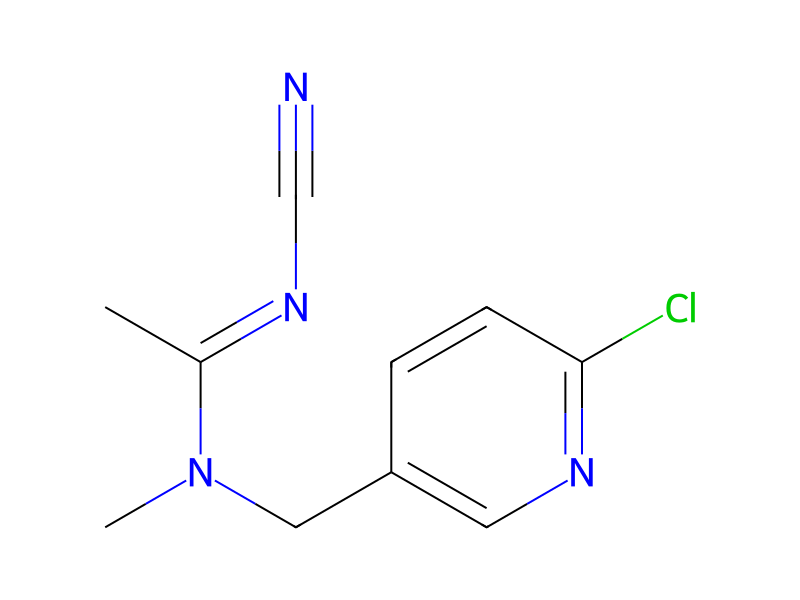
Basic information
- CAS
135410-20-7- Standard SMILES
CC(=NC#N)N(C)Cc1ccc(Cl)nc1- InChIKey
WCXDHFDTOYPNIE-UHFFFAOYSA-N- Molecular formula
- C10H11ClN4
- Average molar mass
- 222.67 g/mol
- Monoisotopic mass
- 222.0672241
Overview
Acetamiprid is a carboxamidine that is acetamidine in which the amino hydrogens are substituted by a (6-chloropyridin-3-yl)methyl and a methyl group while the hydrogen attached to the imino nitrogen is replaced by a cyano group. It has a role as a neonicotinoid insectide, a xenobiotic and an environmental contaminant. It is a nitrile, a carboxamidine and a monochloropyridine. It is functionally related to a 2-chloropyridine.
Names & identifiers
- Preferred name
- N-((6-Chloro-3-pyridinyl)methyl)-N'-cyano-N-methylethanimidamide
- IUPAC
- N-[(6-chloro-3-pyridinyl)methyl]-N'-cyano-N-methylethanimidamide
- English name
- Acetamiprid
- Molecular formula
- C10H11ClN4
- Molecular weight
- 222.67
Names & synonyms
160430-64-8N-((6-Chloro-3-pyridinyl)methyl)-N'-cyano-N-methylethanimidamideDTXSID901015148N-[(6-chloro-3-pyridinyl)methyl]-N'-cyano-N-methylethanimidamideRefChem:1090707DTXCID8014300Acetamiprid135410-20-7IntruderMospilanAssailStonkat
Show more names
MORTALMOSPILDATEacetamipriACETAMIPRIISSACETAMIPRID 95%TC(E/Z)-AcetamipridAcetamiprid20%SP/Mospilan20Acetamiprid20%SP/Mospilan20SP
PiorunPrize(E)-N-((6-Chloropyridin-3-yl)methyl)-N'-cyano-N-methylacetimidamideN-[(6-chloropyridin-3-yl)methyl]-N'-cyano-N-methylethanimidamideAcetamiprid [ISO]NI 25(E)-acetamiprid(Z)-acetamiprid
Database identifiers
- CAS
135410-20-7、160430-64-8- PubChem CID
- 213021
- DTXSID
DTXSID901015148
Properties
Computed structural properties
- XLogP
- 1.4
- Topological polar surface area
- 52.3 Ų
- Hydrogen bond donors
- 0
- Hydrogen bond acceptors
- 3
- Rotatable bonds
- 3
- Heavy atoms
- 15
- Formal charge
- 0
- Complexity
- 280
Experimental & physicochemical properties
Pesticides
Pesticides
Insecticides
Environmental transformation -> Pesticides (parent, predecessor)
LogP0.8
Collision Cross Section
155.1 Ų [M+H]+ [CCS Type: DT; Buffer gas: N2; Ionization: APCI+; Dataset: TOXCAST; Source Identifier: DTXSID0034300]
150.24 Ų [M+H]+ [CCS Type: TW]
152.21 Ų [M+H]+
Physicochemical properties
- Melting point
- 100 · 100-102°C
- Boiling point
- 352.38 · 352.380±52.00 °C(Press: 760.00 Torr)(predicted)
- Density
- 1.174 · 1.174±0.14 g/cm3(Temp: 25 °C; Press: 760 Torr)(predicted)
- storage temp.
- 2 · 2-8°C
- pka
- -0.44 · -0.440±0.10(predicted)
- form
- Crystal
- color
- White
- Major Application
Safety & regulation
Safety information is for reference only and does not replace the supplier’s Safety Data Sheet (SDS), applicable regulations, or professional assessment.
GHS classification
GHS Classification
Danger
H301: Toxic if swallowed [Danger Acute toxicity, oral]
P203, P264, P270, P273, P280, P301+P316, P318, P321, P330, P391, P405, and P501 (click each P-code to see the statement)
Danger
H301 (97.4%): Toxic if swallowed [Danger Acute toxicity, oral]
P260, P264, P270, P271, P273, P284, P301+P316, P304+P340, P316, P320, P321, P330, P403+P233, P405, and P501 (click each P-code to see the statement)
Hazard information
Hazard Classes and Categories
Acute Tox. 3 (97.4%)
Acute toxicity (Oral) - Category 3
Repr. 2
Safety data
- PPE
- Eyeshields, Faceshields, Gloves, type P2 (EN 143) respirator cartridges
- wgk
- 3
- rtecs
- KJ4235200
- ridadr
- UN 2811
- Toxicity
- LD50 in male, female rats, male, female mice (mg/kg): 217, 146, 198, 184 orally (Takahashi)
- risk_code
- 23/25-57
- Signal word
- Danger
- Symbol(GHS)
- GHS06,GHS09
- hazard_code
- T
- safety_code
- 45
- Storage Class
- 6.1C - Combustible acute toxic Cat.3toxic compounds or compounds which causing chronic effects
- Hazard statements
- H301-H410
Chemistry & industry
Uses & manufacturing
Use Classification
Insecticides
Environmental transformation -> Pesticides (parent, predecessor)
Applications
UsesInsecticide.
Upstream & downstream products
Upstream raw materials
Additional notes
DefinitionChEBI: A carboxamidine that is acetamidine in which the amino hydrogens are substituted by a (6-chloropyridin-3-yl)methyl and a methyl group while the hydrogen attached to the imino nitrogen is replaced by a cyano group.
Related reactions
0 records
No related reactions yet