Carbetapentane
HCID 2562
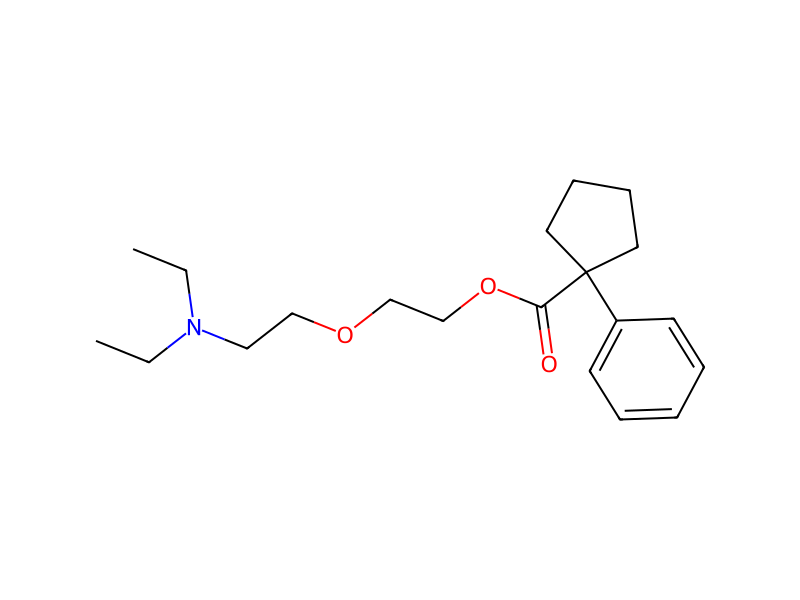
Basic information
- CAS
77-23-6- Standard SMILES
CCN(CC)CCOCCOC(=O)C1(c2ccccc2)CCCC1- InChIKey
CFJMRBQWBDQYMK-UHFFFAOYSA-N- Molecular formula
- C20H31NO3
- Average molar mass
- 333.5 g/mol
- Monoisotopic mass
- 333.23039385
Overview
1-phenyl-1-cyclopentanecarboxylic acid 2-[2-(diethylamino)ethoxy]ethyl ester is a member of benzenes.
Names & identifiers
- Preferred name
- Carbetapentane
- IUPAC
- 2-[2-(diethylamino)ethoxy]ethyl 1-phenylcyclopentane-1-carboxylate
- English name
- Pentoxyverine
- Molecular formula
- C20H31NO3
- Molecular weight
- 333.46
Names & synonyms
carbetapentanePentoxyverine77-23-6PentoxiverinPentoxyverinAtussilPentoxiverinaPentoxyverinumSedotussin1-Phenyl-1-cyclopentanecarboxylateUCB 2543DTXSID9022734
Show more names
PENTOXIFYLLINEUrexTuclasePentoxyverine Baseucb2543u.c.b.2543U.C.B. 2543
2-(2-Diethylaminoethoxy)ethyl 1-phenylcyclopentanecarboxylate2-(Diethylaminoethoxy)ethyl 1-phenyl-1-cyclopentanecarboxylate2-(Diethylaminoethoxy)ethyl 1-phenylcyclopentyl-1-carboxylate32C726X12W1-Phenylcyclopentane-1-carboxylic acid diethylaminoethoxyethyl esterEthanol, 2-(2-(diethylamino)ethoxy)-, 1-phenylcyclopentanecarboxylate (ester)DTXCID1027341-Phenylcyclopentanecarboxylic acid 2-(2-diethylaminoethoxy)ethyl ester
Database identifiers
- CAS
77-23-6- PubChem CID
- 2562
- DTXSID
DTXSID9022734- ChEMBL
CHEMBL73234- ChEBI
CHEBI:94484- UNII
- 32C726X12W
- EC Number
- 201-014-1
- Nikkaji
- J4.198J
Properties
Computed structural properties
- XLogP
- 3.8
- Topological polar surface area
- 38.8 Ų
- Hydrogen bond donors
- 0
- Hydrogen bond acceptors
- 4
- Rotatable bonds
- 11
- Heavy atoms
- 24
- Formal charge
- 0
- Complexity
- 356
Experimental & physicochemical properties
Drugs
Pharmaceuticals
Pharmaceuticals -> Listed in ZINC15
SolubilitySOL IN ETHYL ALC /CITRATE/
Human DrugsPharmaceuticals
Boiling Point165-170 °C @ 0.01 MM OF HG
Melting Point90-95
Collision Cross Section175.5 Ų [M+H]+ [CCS Type: TW; Method: Major Mix IMS/Tof Calibration Kit (Waters)]
Other Experimental PropertiesCRYSTALS; MP: 93 °C; FREELY SOL IN WATER, CHLOROFORM; SOL IN ALC, ACETONE, ETHYL ACETATE; PRACTICALLY INSOL IN ETHER, PETROLEUM ETHER, BENZENE /CITRATE/
Physicochemical properties
- Boiling point
- 165 · 165-170 °C (1.33Pa)
- Density
Safety & regulation
Safety information is for reference only and does not replace the supplier’s Safety Data Sheet (SDS), applicable regulations, or professional assessment.
Hazard information
Regulatory InformationChemical: Cyclopentanecarboxylic acid, 1-phenyl-, 2-[2-(diethylamino)ethoxy]ethyl ester
Other Safety InformationIMAP assessments - Cyclopentanecarboxylic acid, 1-phenyl-, 2-[2-(diethylamino)ethoxy]ethyl ester: Environment tier I assessment
Toxicology
Human Toxicity ExcerptsDRYNESS OF MOUTH OR THROAT, FEELING OF TIGHTNESS IN CHEST, & SLIGHT DEGREE OF RESPIRATORY DEPRESSION...ALLERGIC DERMATITIS /ADVERSE EFFECT, ORAL/
Safety data
- hs_code
- 2922509090
- Toxicity
- LD50 oral in rat: 150mg/kg
- Signal word
- Warning
- Symbol(GHS)
- GHS07
- Hazard statements
- H302-H315-H319-H335
- Precautionary statements
- P261-P305+P351+P338
- Hazardous Substances Data
- 77-23-6(Hazardous Substances Data)
Chemistry & industry
Pharmacology
ATC Code
R - Respiratory system
QR - Respiratory system
Protein BindingNo pharmacokinetic data available.
Pharmacodynamics
Pentoxyverine induces an antitussive action. In animal studies, intraperitoneal administration of pentoxyverine inhibited citric-acid-induced cough in guinea-pigs _in vivo_. Some mice and rat studies suggest that pentoxyverine may also exert anticonvulsant activities without inducing a protective effect from NMDA-induced lethality. Protective effects against maximal electroshock-induced seizures in a dose-related fashion was also observed following either intraperitoneal or oral administration. In hERG-transfected cells, pentoxyverine inhibited the outward current of the hERG ion channel with half-maximal inhibition concentrations (IC50) of 3.0 µM. In rats receiving intrathecal administration, pentoxyverine exhibited dose-dependent spinal blockade with a more sensory-selective action over motor blockade. It induced a spinal blockade with a more sensory/nociceptive-selective action over motor blockade compared to lidocaine.
Mechanism of Action
While the mechanism of antitussive action of pentoxyverine is not fully understood, it is thought to be mediated via sigma-1 receptors expressed in the central nervous system. Pentoxyverine acts as an agonist at sigma receptors with the Ki of 75±28 nM, as demonstrated in a competitive binding assay. The function of sigma receptors on cough suppressant activities is unclear, however these receptors are highly expressed in the nucleus tractus solitarius (NTS) of the brainstem where the afferent fibres first synapse. NTS is located very close to the cough centre in the brainstem thus may function as a ‘gate' for the cough reflex and allow sigma-1 receptor agonists to modulate afferent activity prior to reaching the cough center. It is suggested that highly lipophilic sigma-1 agonists may penetrate the CNS following systemic administration. When administered as aerosols, sigma-1 receptor agonists may temporarily act in the periphery to modulate cough by acting activate sigma receptors expressed in the lungs. However there is limited evidence of peripheral localization of the sigma agonists following aerosol administration and the ruling out of systemic exposure. The local anesthesia action of pentoxyverine may occur through inhibition of voltage-gated Na(+) currents.
Related reactions
0 records
No related reactions yet