
uspto-grants-2013_07 · 10.6084/m9.figshare.5104873.v1 · US08476298B2
查看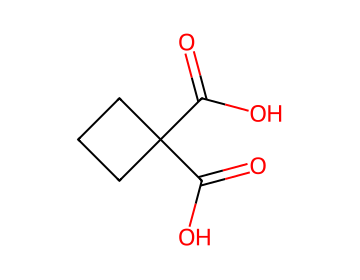
IDENTITY
COMPUTED
GHS
This chemical does not meet GHS hazard criteria for 1.2% (1 of 83) of reports.
Danger
H314 (98.8%): Causes severe skin burns and eye damage [Danger Skin corrosion/irritation];H318 (27.7%): Causes serious eye damage [Danger Serious eye damage/eye irritation]
P260, P264, P264+P265, P280, P301+P330+P331, P302+P361+P354, P304+P340, P305+P354+P338, P316, P317, P321, P363, P405, and P501 (click each P-code to see the statement)
Aggregated GHS information provided per 83 reports by companies from 5 notifications to the ECHA C&L Inventory. Each notification may be associated with multiple companies.;Reported as not meeting GHS hazard criteria per 1 of 83 reports by companies.;There are 4 notifications provided by 82 of 83 reports by companies with hazard statement code(s).;Information may vary between notifications depending on impurities, additives, and other factors. The percentage value in parenthesis indicates the notified classification ratio from companies that provide hazard codes. Only hazard codes with percentage values above 10% are shown. For more detailed information, please visit ECHA C&L website.
HAZARDS
Chemical: 1,1-Cyclobutanedicarboxylic acid
Status: Active Update: 15-05-2018 https://echa.europa.eu/registration-dossier/-/registered-dossier/25854
Skin Corr. 1C (98.8%);Eye Dam. 1 (27.7%)
TOXICITY
◉ Summary of Use during Lactation;After carboplatin administration to nursing mothers, excretion of platinum into milk occurs. The exact forms and toxicities of platinum excreted into breastmilk are not known. The nursing infant would receive platinum compounds orally rather than intravenously and oral absorption of platinum compounds by infants is not known. Platinum in milk may increase with repeated courses of chemotherapy. Most sources consider that mothers receiving antineoplastic therapy should not breastfeed, especially with alkylating agents such as cisplatin. It is probably not safe to breastfeed during carboplatin therapy, and breastfeeding should be discontinued. Resuming breastfeeding 3 weeks after the last dose of cisplatin has been done safely in one case.;Chemotherapy may adversely affect the normal microbiome and chemical makeup of breastmilk. Women who receive chemotherapy during pregnancy are more likely to have difficulty nursing their infant.;◉ Effects in Breastfed Infants;Relevant published information was not found as of the revision date.;◉ Effects on Lactation and Breastmilk;A telephone follow-up study was conducted on 74 women who received cancer chemotherapy at one center during the second or third trimester of pregnancy to determine if they were successful at breastfeeding postpartum. Only 34% of the women were able to exclusively breastfeed their infants, and 66% of the women reported experiencing breastfeeding difficulties. This was in comparison to a 91% breastfeeding success rate in 22 other mothers diagnosed during pregnancy, but not treated with chemotherapy. Other statistically significant correlations included: 1. mothers with breastfeeding difficulties had an average of 5.5 cycles of chemotherapy compared with 3.8 cycles among mothers who had no difficulties; and 2. mothers with breastfeeding difficulties received their first cycle of chemotherapy on average 3.4 weeks earlier in pregnancy. Of the 3 women who received a regimen containing the similar drug, cisplatin, 1 had breastfeeding difficulties.
REGULATORY
Chemical: 1,1-Cyclobutanedicarboxylic acid
Status: Active Update: 15-05-2018 https://echa.europa.eu/registration-dossier/-/registered-dossier/25854
USES
1,1-Cyclobutanedicarboxylic acid: ACTIVE
ALIASES
REACTIONS
uspto-grants-2013_07 · 10.6084/m9.figshare.5104873.v1 · US08476298B2
查看
uspto-grants-2013_07 · 10.6084/m9.figshare.5104873.v1 · US08497284B2
查看
uspto-grants-2011_11 · 10.6084/m9.figshare.5104873.v1 · US08067436B2
查看
uspto-grants-2015_11 · 10.6084/m9.figshare.5104873.v1 · US09174947B2
查看
Training data from https://doi.org/10.1039/C8SC04228D (7/10) · 10.1039/C8SC04228D
查看
uspto-grants-2006_10 · 10.6084/m9.figshare.5104873.v1 · US07125887B2
查看
uspto-grants-2012_05 · 10.6084/m9.figshare.5104873.v1 · US08178532B2
查看
uspto-grants-2009_08 · 10.6084/m9.figshare.5104873.v1 · US07579473B2
查看