
uspto-grants-2010_06 · 10.6084/m9.figshare.5104873.v1 · US07728034B2
查看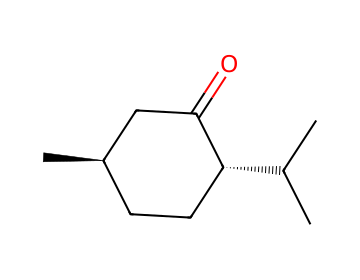
IDENTITY
COMPUTED
PROPERTIES
3.05
Slight peppermint odor
CHARACTERISTIC ODOR SIMILAR TO MENTHOL
Bitter
0.888-0.895
Colorless, oily, mobile liq
Slightly sol in water; sol in org solvents /L-form/
SOL IN ALC, ETHER, ACETONE, ACETIC ACID, ALL PROP IN BENZENE; SLIGHTLY SOL IN WATER /D & DL-FORMS/
SOL IN ALL PROP IN ALC, ETHER, CARBON DISULFIDE /L-FORM/
SOL IN ACETONE /L-FORM/
Sol in alc, fixed oils; very slightly sol in water.
SOL IN MOST COMMON ORG SOLVENTS
210 °C
207.00 to 210.00 °C. @ 760.00 mm Hg
207 °C
When heated to decomposition it emits acrid smoke and irritating fumes.
-6 °C
0.27 [mmHg]
INDEX OF REFRACTION: 1.4480-1.4520 @ 20 °C; SPECIFIC OPTICAL ROTATION: + OR - 2 DEG /DL-FORM/
1.448-1.453
Liquid
Liquid
Colorless liquid with a mild odor of peppermint; [Hawley]
Liquid with a mild odor of peppermint; [Merck Index] Clear colorless liquid; [Sigma-Aldrich MSDS]
Liquid
colourless to pale yellowish liquid with a mint-like odour
GHS
This chemical does not meet GHS hazard criteria for < 0.1% (1 of 1816) of reports.
Warning
H226 (74.2%): Flammable liquid and vapor [Warning Flammable liquids];H315 (14.6%): Causes skin irritation [Warning Skin corrosion/irritation];H317 (14.2%): May cause an allergic skin reaction [Warning Sensitization, Skin];H412 (88.8%): Harmful to aquatic life with long lasting effects [Hazardous to the aquatic environment, long-term hazard]
P210, P233, P240, P241, P242, P243, P261, P264, P272, P273, P280, P302+P352, P303+P361+P353, P321, P332+P317, P333+P317, P362+P364, P370+P378, P403+P235, and P501 (click each P-code to see the statement)
Aggregated GHS information provided per 1816 reports by companies from 15 notifications to the ECHA C&L Inventory. Each notification may be associated with multiple companies.;Reported as not meeting GHS hazard criteria per 1 of 1816 reports by companies.;There are 14 notifications provided by 1815 of 1816 reports by companies with hazard statement code(s).;Information may vary between notifications depending on impurities, additives, and other factors. The percentage value in parenthesis indicates the notified classification ratio from companies that provide hazard codes. Only hazard codes with percentage values above 10% are shown. For more detailed information, please visit ECHA C&L website.
HAZARDS
Chemical: Cyclohexanone, 5-methyl-2-(1-methylethyl)-, (2R,5S)-rel-
Chemical: Cyclohexanone, 5-methyl-2-(1-methylethyl)-, (2S-trans)-
Regulation (EC) No 1831/2003 (amended)
Cyclohexanone, 5-methyl-2-(1-methylethyl)-, (2S,5R)- is listed on the EPA's Chemical Data Reporting (CDR) system. Manufacturers and importers of Cyclohexanone, 5-methyl-2-(1-methylethyl)-, (2S,5R)- are required to report information about their production and use of this chemical to the EPA under the Toxic Substances Control Act (TSCA). (40 eCFR Part 711)
Cyclohexanone, 5-methyl-2-(1-methylethyl)-, (2R,5S)-rel- is listed on the EPA's Chemical Data Reporting (CDR) system. Manufacturers and importers of Cyclohexanone, 5-methyl-2-(1-methylethyl)-, (2R,5S)-rel- are required to report information about their production and use of this chemical to the EPA under the Toxic Substances Control Act (TSCA). (40 eCFR Part 711)
Status: Active Update: 08-10-2020 https://echa.europa.eu/registration-dossier/-/registered-dossier/12246
IMAP assessments - Menthone and isomenthone: Human health tier II assessment
IMAP assessments - Menthone and isomenthone: Human health tier II assessment
Emergency treatment: Peppermint oil; A mild skin irritant in rabbits; After oral dosing at 400-800 mg/kg/day for 28 days, rats have liver and kidney dysfunction and histopathological cysts in the white matter of the cerebellum; [HSDB] Peppermint oil causes CNS depression and hypothermia in rat feeding studies; [Haddad, p. 1439] Safe when used as a flavoring agent in food; [JECFA]
A skin irritant that may cause sensitization; [ECHA REACH Registrations] May cause irritation; [Sigma-Aldrich MSDS] Search for (14073-97-3[EC/RN Number]) AND (allergic OR dermatitis OR sensitizer OR sensitization): no results; [PubMed] See Menthone.
Menthone is a food additive permitted for direct addition to food for human consumption as a synthetic flavoring substance and adjuvant in accordance with the following conditions: a) they are used in the minimum quantity required to produce their intended effect, and otherwise in accordance with all the principles of good manufacturing practice, and 2) they consist of one or more of the following, used alone or in combination with flavoring substances and adjuvants generally recognized as safe in food, prior-sanctioned for such use, or regulated by an appropriate section in this part.
Flam. Liq. 3 (74.2%);Skin Irrit. 2 (14.6%);Skin Sens. 1 (14.2%);Aquatic Chronic 3 (88.8%)
Skin Irrit. 2 (92.7%);Skin Sens. 1 (92.6%)
Skin irritation - category 2
Skin irritation - category 2
SAFETY
SRP: At the time of review, criteria for land treatment or burial (sanitary landfill) disposal practices are subject to significant revision. Prior to implementing land disposal of waste residue (including waste sludge), consult with environmental regulatory agencies for guidance on acceptable disposal practices.
TOXICITY
TERRESTRIAL FATE: Based on a classification scheme(1), an estimated Koc value of 120(SRC), determined from a water solubility of 688 mg/l(2) and a regression-derived equation(3), indicates that menthone is expected to have high mobility in soil(SRC). Volatilization of menthone from moist soil surfaces is expected to be an important fate process(SRC) given an estimated Henry's Law constant of 1.6X10⁻⁴ atm-cu m/mole(SRC), using a fragment constant estimation method(4). Menthone is not expected to volatilize from dry soil surfaces(SRC) based upon an estimated vapor pressure of 0.28 mm Hg(SRC), determined from a fragment constant method(5).
AQUATIC FATE: Based on a classification scheme(1), an estimated Koc value of 120(SRC), determined from a water solubility of 688 mg/l(2) and a regression-derived equation(3), indicates that menthone is not expected to adsorb to suspended solids and sediment in water(SRC). Volatilization from water surfaces is expected(3) based upon an estimated Henry's Law constant of 1.6X10⁻⁴ atm-cu m/mole(SRC), developed using a fragment constant estimation method(4). Volatilization half-lives for a model river and model lake are 0.5 and 8 days, respectively(SRC), using an estimation method(3). According to a classification scheme(5), an estimated BCF value of 15(SRC), from its water solubility(2) and a regression-derived equation(3), suggests the potential for bioconcentration in aquatic organisms is low(SRC).
ATMOSPHERIC FATE: According to a model of gas/particle partitioning of semivolatile organic compounds in the atmosphere(1), menthone, which has an estimated vapor pressure of 0.28 mm Hg at 25 °C(2), is expected to exist solely as a vapor in the ambient atmosphere. Vapor-phase menthone is degraded in the atmosphere by reaction with photochemically-produced hydroxyl radicals(SRC); the half-life for this reaction in air is estimated to be 14 hours(SRC) from its estimated rate constant of 2.6X10⁻¹¹ cu cm/molecule-sec(SRC), determined by a fragment constant estimation method(3).
Neurotoxin - Other CNS neurotoxin;Occupational hepatotoxin - Secondary hepatotoxins: the potential for toxic effect in the occupational setting is based on cases of poisoning by human ingestion or animal experimentation.
Skin Sensitizer - An agent that can induce an allergic reaction in the skin.
Menthone was identified, not quantified, in the exudate of garden wastes(1).
The Koc of menthone is estimated as approximately 120(SRC), using a water solubility of 688 mg/l(1) and a regression-derived equation(2). According to a classification scheme(3), this estimated Koc value suggests that menthone is expected to have high mobility in soil(SRC).
Menthone is found naturally in many essential oils, such as pennyroyal, peppermint and geranium(1).
Menthone's production and use in perfumes and flavor compositions(1) may result in its release to the environment through various waste streams(SRC).
An estimated BCF of 15 was calculated for menthone(SRC), using a water solubility of 688 mg/l(1) and a regression-derived equation(2). According to a classification scheme(3), this BCF suggests the potential for bioconcentration in aquatic organisms is low(SRC).
The Henry's Law constant for menthone is estimated as 1.6X10⁻⁴ atm-cu m/mole(SRC) using a fragment constant estimation method(1). This Henry's Law constant indicates that menthone is expected to volatilize from water surfaces(2). Based on this Henry's Law constant, the volatilization half-life from a model river (1 m deep, flowing 1 m/sec, wind velocity of 3 m/sec)(2) is estimated as approximately 0.5 days(SRC). The volatilization half-life from a model lake (1 m deep, flowing 0.05 m/sec, wind velocity of 0.5 m/sec)(2) is estimated as approximately 8 days(SRC). Menthone's Henry's Law constant(1,SRC) indicates that volatilization from moist soil surfaces may occur(SRC). Menthone is not expected to volatilize from dry soil surfaces(SRC) based upon an estimated vapor pressure of 0.28 mm Hg(SRC) determined from a fragment constant method(3).
ADMIN OF 3 MMOL/KG MENTHONE, INTRAGASTRICALLY TO RATS INHIBITED HEPATIC S-3-HYDROXY-3-METHYLGLUTARYL-COA REDUCTASE BY 50%.
Essential oils of four plants (two species of lavender, peppermint, and a eucalyptus) and some of their principal constituents, i.e., linalool, linalyl acetate, fenchone, menthone, menthol, and eucalyptol, were tested in vitro for their acaricidal activity against Tyrophagus longior, a mite species that is a pest in stored food. Two different procedures were carried out to test the activity of these compounds by direct contact and by inhalation. In the direct contact assays five different quantities of each undiluted substance (6, 2, 1, 0.5, and 0.25 ul) were spread on the internal surface of 6-cm petri dishes, each containing 10 mites. The activity by inhalation was tested using two petri dishes of different sizes: the smaller one (6 cm), containing 10 mites, was covered with a filter paper disk and enclosed in a bigger dish (9 cm) containing 6 oz 2 mul of each undiluted substance. At the highest doses, the essential oils of the two lavender species and of peppermint killed 100% of the mites, both by direct contact and by inhalation. Eucalyptus oil was the least active. Among the essential oil constituents, menthol showed the highest activity, killing 100% of the mites at the lowest dose (0.25 ul) by direct contact and at 6 ul by inhalation. However, linalool, fenchone, and menthone also showed good acaricidal activity. Eucalyptol, like the essential oil of which it is the principal constituent, had the lowest activity.
Menthone, a component of peppermint oil, was given p.o. to groups of 10 male and 10 female rats at dose levels of 0, 200, 400 and 800 mg/kg bw/day, respectively, for 28 days. After 19 days the dose was reduced to 400 mg/kg bw in the female group receiving the highest dose. Analyses of plasma showed a dose-dependent decrease in creatinine content and a dose-dependent increase in alkaline phosphatase activity and bilirubin. The relative weights of liver and spleen were increased. Cyst-like spaces were seen histopathologically in the white matter of the cerebellum of the two highest dose groups. The no-effect level for menthone in this study was lower than 200 mg/kg bw/day.
Menthone was a mild skin irritant and of low acute dermal toxicity in rabbits. No evidence of sensitizing potential was found in a volunteer study with a dilute solution. In rats, menthone demonstrated a moderate to low acute oral toxicity. On repeated oral administration, menthone produced increases in liver, kidney and spleen weights of rats. Mutagenic activity was reported in the bacterium Salmonella typhimurium (Ames test).
The rate constant for the vapor-phase reaction of menthone with photochemically-produced hydroxyl radicals has been estimated as 2.6X10⁻¹¹ cu cm/molecule-sec at 25 °C(SRC) using a structure estimation method(1). This corresponds to an atmospheric half-life of about 14 hours at an atmospheric concentration of 5X10+5 hydroxyl radicals per cu cm(1). Menthone is not expected to undergo hydrolysis in the environment due to the lack of hydrolyzable functional groups(2) nor to directly photolyze due to the lack of absorption in the environmental UV spectrum.
Occupational exposure to menthone may occur through inhalation and dermal contact with this compound at workplaces where menthone is produced or used. The general population may be exposed to menthone through dermal contact with perfumes and ingestion of products containing menthone. (SRC)
SURFACE WATER: Menthone was identified, not quantified, in several streams and brooks in Switzerland(1).
REGULATORY
Chemical: Cyclohexanone, 5-methyl-2-(1-methylethyl)-, (2R,5S)-rel-
Chemical: Cyclohexanone, 5-methyl-2-(1-methylethyl)-, (2S-trans)-
Regulation (EC) No 1831/2003 (amended)
Cyclohexanone, 5-methyl-2-(1-methylethyl)-, (2S,5R)- is listed on the EPA's Chemical Data Reporting (CDR) system. Manufacturers and importers of Cyclohexanone, 5-methyl-2-(1-methylethyl)-, (2S,5R)- are required to report information about their production and use of this chemical to the EPA under the Toxic Substances Control Act (TSCA). (40 eCFR Part 711)
Cyclohexanone, 5-methyl-2-(1-methylethyl)-, (2R,5S)-rel- is listed on the EPA's Chemical Data Reporting (CDR) system. Manufacturers and importers of Cyclohexanone, 5-methyl-2-(1-methylethyl)-, (2R,5S)-rel- are required to report information about their production and use of this chemical to the EPA under the Toxic Substances Control Act (TSCA). (40 eCFR Part 711)
Status: Active Update: 08-10-2020 https://echa.europa.eu/registration-dossier/-/registered-dossier/12246
Menthone is a food additive permitted for direct addition to food for human consumption as a synthetic flavoring substance and adjuvant in accordance with the following conditions: a) they are used in the minimum quantity required to produce their intended effect, and otherwise in accordance with all the principles of good manufacturing practice, and 2) they consist of one or more of the following, used alone or in combination with flavoring substances and adjuvants generally recognized as safe in food, prior-sanctioned for such use, or regulated by an appropriate section in this part.
PHARMACOLOGY
...KETONES (EG CARVONE & MENTHONE) ARE REDUCED TO SECONDARY ALCOHOLS WHICH ARE THEN EXCRETED AS GLUCURONIDES. MENTHONE, ASYMMETRIC REDUCTION /TO/ NEO-MENTHOL, GLUCURONIDE CONJUGATION /TO/ MENTHYL GLUCURONIDE.
Extracellular;Membrane
USES
Ketone present in peppermint oil; [Hawley] Used in perfumes and flavorings; [HSDB] Peppermint oil contains menthol, menthone, and more than 30 other chemicals. It is widely used as a flavoring agent and herbal remedy. [Haddad, p. 1439]
Present in a variety of volatile oils; Used in perfumes and flavors; [Merck Index] Used in cleaning-washing products, polishes, waxes, consumer biocidal products, and cosmetics-personal care products; [ECHA REACH Registrations]
In perfume & flavor compositions /L-form/
Use (kg; approx.) in Germany (2009): >10;Consumption (g per capita; approx.) in Germany (2009): 0.000122;Calculated removal (%): 82.3
2023: 10,000 lb;2022: 11,000 lb;2021: 26,000 lb;2020: 32,000 lb
2023: 1,130 lb;2022: 1,184 lb;2021: 1,123 lb;2020: 387 lb
Fragrance;Not Known or Reasonably Ascertainable
Fragrance
Not Known or Reasonably Ascertainable
BY OXIDATION OF MENTHOL...
ASSAY: 98% /DL-FORM/; 95% /OPTICALLY ACTIVE FORM/
Note: Apinol obtained by dry distillation of wood of Pinus palustris mill (P australis michx), Pinaceae is chiefly L-menthone... Amber-colored oil, BP about 182.2 °C, density 0.946. /Apinol/
Information on 14 consumer products that contain Menthone in the following categories is provided:;• Auto Products;• Commercial / Institutional;• Inside the Home;• Personal Care
Information on 11 consumer products that contain L-Menthanone in the following categories is provided:;• Commercial / Institutional;• Inside the Home
Fragrance Ingredients
Fragrance Ingredients
Fragrance Ingredients
Fragrance Ingredients
Flavouring Agent -> FLAVOURING_AGENT -> JECFA Functional Classes
Flavoring Agents -> JECFA Flavorings Index
Not Known or Reasonably Ascertainable
Not Known or Reasonably Ascertainable
Cyclohexanone, 5-methyl-2-(1-methylethyl)-, (2R,5S)-rel-: ACTIVE
Cyclohexanone, 5-methyl-2-(1-methylethyl)-, (2S,5R)-: ACTIVE
L-ISOMENTHONE HAS BEEN IDENTIFIED IN REUNION GERANIUM, PELARGONIUM CAPITATUM, & OTHERS. /L-ISOMENTHONE/
FLAVORS USEFUL IN: TOOTHPASTE FLAVORS, MINT FLAVORS.
ALIASES
REACTIONS
uspto-grants-2010_06 · 10.6084/m9.figshare.5104873.v1 · US07728034B2
查看
uspto-grants-1993_11 · 10.6084/m9.figshare.5104873.v1 · US05266592
查看
uspto-grants-2010_08 · 10.6084/m9.figshare.5104873.v1 · US07767718B2
查看
uspto-grants-2010_04 · 10.6084/m9.figshare.5104873.v1 · US07705055B2
查看
uspto-grants-2000_01 · 10.6084/m9.figshare.5104873.v1 · US06018050
查看
uspto-grants-1998_06 · 10.6084/m9.figshare.5104873.v1 · US05767282
查看
uspto-grants-1976_05 · 10.6084/m9.figshare.5104873.v1 · US03954794
查看
uspto-grants-2006_10 · 10.6084/m9.figshare.5104873.v1 · US07125908B2
查看