
HRID 944As reactant
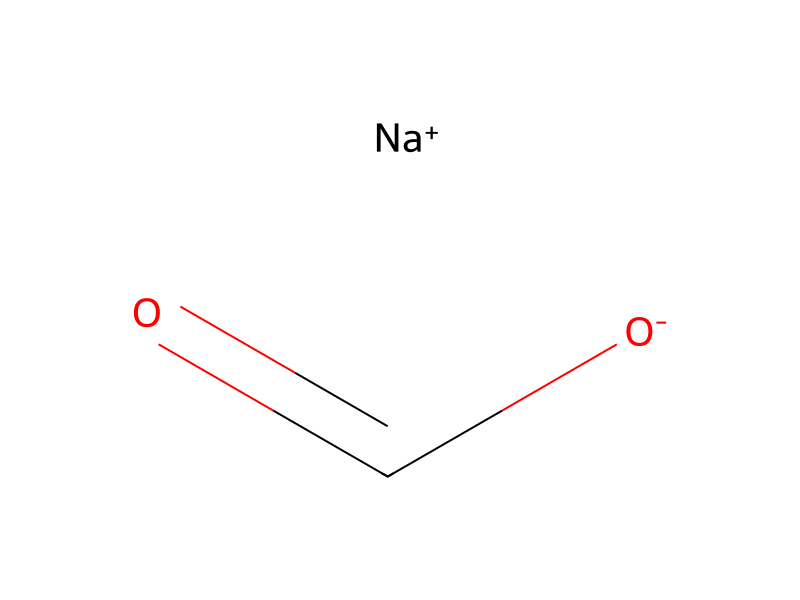
141-53-7O=C[O-].[Na+]HLBBKKJFGFRGMU-UHFFFAOYSA-MSodium formate is an organic sodium salt which is the monosodium salt of formic acid. It has a role as a buffer and an astringent. It contains a formate.
141-53-7DTXSID2027090CHEMBL183491CHEBI:62965Cosmetic ingredients (Sodium Formate) -> CIR (Cosmetic Ingredient Review)
Preservative; Buffering
1.92 @ 20 °C
1.9 g/cm³
1.92 @25 °C
COLORLESS MONOCLINIC CRYSTALS
WHITE GRANULES OR CRYSTALLINE POWDER
SLIGHTLY SOLUBLE IN ALCOHOL, INSOL IN ETHER
SOLUBLE IN GLYCEROL
SOLUBILITY IN WATER: 97.2 G/100 CC @ 20 °C
SOLUBILITY IN WATER: 160 G/100 CC @ 100 °C
Solubility in water, g/100ml at 20 °C: 97
253 °C
253 °C
257 °C
Safety information is for reference only and does not replace the supplier’s Safety Data Sheet (SDS), applicable regulations, or professional assessment.
This chemical does not meet GHS hazard criteria for 97.1% (2698 of 2778) of all reports.
Not Classified
Aggregated GHS information provided per 2778 reports by companies from 10 notifications to the ECHA C&L Inventory.
Chemical: Formic acid, sodium salt
Regulation (EC) No 1831/2003 (amended)
Formic acid, sodium salt (1:1) is listed on the EPA's Chemical Data Reporting (CDR) system. Manufacturers and importers of Formic acid, sodium salt (1:1) are required to report information about their production and use of this chemical to the EPA under the Toxic Substances Control Act (TSCA). (40 eCFR Part 711)
REACH registered substance: Sodium formate (EC: 205-488-0)
Sodium formate: Non hazardous
After ingestion of 3-4 gm/day, albuminuria and hematuria may occur; Also may cause cardiac depression and methemoglobinemia at high doses; [HSDB] Decomposed by heating forming carbon monoxide and hydrogen; An eye and respiratory tract irritant; [ICSC] High concentrations may cause respiratory tract irritation; Solutions may cause skin and eye irritation; [CHEMINFO] An irritant; [MSDSonline]
FORMATE ION IS EXTENSIVELY OXIDIZED IN VIVO...
GIVEN ORALLY TO NORMAL HUMAN, ABOUT 2.1% WAS ELIMINATED AS FORMIC ACID IN URINE IN 24 HR AFTER 2.96 & 4.4 G OF NA FORMATE.
CIR ingredient: Sodium Formate
Used in analytical chemistry as precipitant for noble metals, to buffer strong mineral acids to higher pH, for dyeing and printing fabrics, for tanning leather, and to make other organic chemicals; Also used as an electroplating agent, an acidulant in the textile industry, a reducing agent, a mordant, a complexing agent, and a therapeutic caustic and astringent; [HSDB] Used in photographic fixing baths; [CHEMINFO]
Electroplating [Category: Plate]
IN ANALYTICAL CHEM AS PRECIPITANT FOR NOBLE METALS; BUFFERING OF STRONG MINERAL ACIDS TO HIGHER PH
MEDICATION: CAUSTIC, ASTRINGENT AGENT; DYEING & PRINTING FABRICS
CHEM INT FOR FORMIC ACID, OXALIC ACID; ELECTROPLATING AGENT; ACIDULANT IN TEXTILE INDUSTRY, LEATHER TANNING
(1972) No Data
(1975) No Data
(1986) No Data
(1972) No Data
(1975) No Data
(1984) 1.68X10+9 g
2023: 10,000,000 - <50,000,000 lb
(1972) 1.45X10+10 GRAMS (TECHNICAL GRADE)
(1975) 1.5X10+10 GRAMS (TECHNICAL GRADE)
(1986) No Data


Dry Powder; CBI; Large Crystals; Liquid
White deliquescent solid; [Merck Index] White powder; [MSDSonline]
HYGROSCOPIC WHITE GRANULES OR CRYSTALLINE POWDER.
AT TEMP HIGHER THAN 253 °C, IT DECOMP INTO SODIUM OXALATE & HYDROGEN, THEN INTO SODIUM CARBONATE
AQ SOLN IS NEUTRAL; PH IS ABOUT 7; HAS BUFFERING ACTION
SOLUBILIZES TRIVALENT METAL IONS IN SOLN BY FORMING COMPLEX ION; HAS SLIGHT ODOR OF FORMIC ACID
SLIGHTLY HYGROSCOPIC
CSL00194
Nitrous oxide + Nitric oxide + Sodium + Hydrogen + Sodium formate + Toluene
"A safety letter from Merck & Co. chemists titled “Nitric Oxide at High Pressure” (C&EN, Jan. 30, page 6) described two explosions during depressurization of a reaction between NO and methanol under basic conditions. The products in a model system with sodium methoxide were described as nitrous oxide and formic acid, presumably as sodium formate. A potential danger in this system should be pointed out: Sodium formate undergoes thermal decomposition to give hydrogen gas (J. Am. Chem. Soc.,DOI: 10.1021/ja02245a004), which explodes spontaneously in the presence of nitrous oxide above critical limits (J. Am. Chem. Soc., DOI: 10.1021/ja01179a036), even in the absence of a catalyst or source of ignition. The presence of hydrogen and nitrous oxide above a reaction mixture was undoubtedly the cause of an explosion and fire in my laboratory in 1981 during workup of a reaction between sodium and nitric oxide. The major product of the reaction is cis-sodium hyponitrite, which decomposes immediately in water to form sodium hydroxide and nitrous oxide. The employee, a biology major who was badly burned, had carried out the reaction a number of times without incident. This time he tried twice and failed to disperse about 30 g of sodium in toluene and, without consulting me, decided to continue the reaction. The explosion occurred as he was attempting to destroy the unreacted sodium, a lump too large to remove from the flask, by dropwise addition of water. Most of the sodium had reacted at the time of the explosion, and there was no indication of mechanical failure. At the time, I was unaware of the extreme incompatibility of the two gases, and the accident was extremely puzzling. The reaction mixture was close to room temperature and was stirred rapidly while the headspace was flushed with a stream of nitrogen. When I arrived at the laboratory a few minutes after the accident, nitrogen was still flowing from the burned-off end of the plastic tubing. Since that time, I noticed a reference to the “hydrogen explosion” in the ancient chemical literature as a way to identify nitrous oxide." (reprint of the full-text)
Explosive
Medium (up to 100g)
10.1021/cen-09013-letters
Fresh air, rest.
Remove contaminated clothes. Rinse skin with plenty of water or shower.
First rinse with plenty of water for several minutes (remove contact lenses if easily possible), then refer for medical attention.
Rinse mouth.
3.0 [ppm]
25 [ppm]
250 [ppm]
The CIR Expert Panel concluded that formic acid and sodium formate are safe in the present practices of use and concentration in cosmetics, as described in this safety assessment, when formulated to be non-irritating.
Safe for use in cosmetics, with qualifications
Cough. Sore throat.
Redness. Pain.
FORMATE ION IS EXTENSIVELY OXIDIZED IN VIVO, BUT IT MAY HAVE DIRECT ACTIONS ON BRAIN (CAUSE OF CONVULSIONS IN POISONED ANIMALS?).
FORMATE, USUALLY AS SODIUM FORMATE, HAS BEEN FED TO VARIOUS ANIMALS & ADMIN PARENTERALLY WITHOUT OCULAR DISTURBANCE.
FORMATE IS...INHIBITOR OF CERTAIN ENZYMES, EG, CATALASE, & HAS BEEN INVESTIGATED FOR POTENTIAL INJURIOUSNESS TO RETINA & OPTIC NERVE. HOWEVER, NO EVIDENCE HAS BEEN OBTAINED OF SUCH RETINAL TOXICITY IN EXPERIMENTAL ANIMALS, & 0.02 MOLAR FORMATE HAS NOT BEEN FOUND TO AFFECT METAB OF RETINA IN VITRO. /FORMATE/
REACTION OF SODIUM HYDROXIDE & CARBON MONOXIDE
CARBON MONOXIDE & SODIUM HYDROXIDE ARE HEATED UNDER PRESSURE, ALSO FROM PENTAERYTHRITOL MANUFACTURE.
GRADES: TECHNICAL; CP.
/Available as/ ACS, purified & technical grades
EPA Safer Chemical Functional Use Classes -> Enzymes and Enzyme Stabilizers;Processing Aids and Additives
Safer Chemical Classes -> Green circle - The chemical has been verified to be of low concern
Cosmetics -> Preservative; Buffering
Not Known or Reasonably Ascertainable
Formic acid, sodium salt (1:1): ACTIVE
NA FORMATE (0.5 MMOLE) INHIBITED ACCUMULATION OF METHEMOGLOBIN AND ERYTHROCYTE LYSIS CAUSED BY 2.6 & 3.3 MMOLE PRIMAQUINE.
Sodium formate appears in sodium methylate at 0.3%
Uses1. Sodium formate is mainly for the production of formic acid, oxalic acid and insurance powder and so on. 2. It is used as the reagent for the determination of phosphorus and arsenic, disinfectant and mordant. 3. It is used as preservatives, with diuretic effect. It is mutatis mutandis in EEC countries, but the British are not allowed to use. 4. Sodium formate is used as intermediates in the production of formic acid and oxalic acid, but also for the production of dimethyl formamide, also used in medicine, printing and dyeing industry. It is also heavy metal precipitant. 5. It is used as alkyd paints, plasticizers, high explosives, acid-resistant materials, aviation lubricants, additives of adhesives. 6. It is used for precipitating noble metal, may form trivalent metal complex ions in the solution. With buffer effect, it can be used for correcting pH value of strong mineral acids to be higher. It is precipitant of heavy metal.
DescriptionSodium formate, HCOONa, is the sodium salt of formic acid, HCOOH. It usually appears as a white deliquescent powder.
UsesSodium formate is used in several fabric dyeing and printing processes. It is also used as a buffering agent for strong mineral acids to increase their pH, and as a food additive ( E237 ) .
UsesPrecipitant for noble metals.
UsesIn dyeing and printing fabrics; also In animal chemistry as a precipitant for the "noble" metals. Solubilizes trivalent metal ions in solution by forming complex ions. Buffering action adjusts the pH of strong mineral acids to higher values.
General DescriptionSodium formate is the colorless sodium salt of formic acid. It can be prepared by reacting formic acid with sodium hydroxide or carbonate. Its crystal structure has been investigated. Its crystals exhibit monoclinic-holohedral symmetry.
PreparationSodium formate can be prepared in the laboratory by neutralizing formic acid with sodium carbonate. It can also be obtained by reacting chloroform with an alcoholic solution of sodium hydroxide. CHCl3 + 4NaOH → HCOONa + 3NaCl + 2H2O or by reacting sodium hydroxide with chloral hydrate. C2HCl3(OH)2 + NaOH → CHCl3 + HCOONa + H2O The latter method is, in general, preferred to the former because the low aqueous solubility of CHCl3 makes it easier to separate out from the sodium formate solution, by fractional crystallization, than the soluble NaCl would be. For commercial use, sodium formate is produced by absorbing carbon monoxide under pressure in solid sodium hydroxide at 160 °C. CO + NaOH → HCOONa Sodium formate may also be created via the haloform reaction between ethanol and sodium hypochlorite in the presence of a base.
DefinitionChEBI: An organic sodium salt which is the monosodium salt of formic acid.