StartseiteMCPWorkbenchSkills
StartseiteWorkbenchBenachrichtigungenMein Bereich
llms.txt · MCP-AnleitungDatenschutz · Nutzungsbedingungen · Supportv1.8.3
  1. Startseite
  2. /Verbindung

Thiocarbonohydrazid

Thiocarbohydrazide

HCID 2724189
Neue Reaktion
Drucken
GrundinformationenÜberblickNamen und BezeichnerEigenschaftenSicherheit und RegulatorischesChemie und IndustrieZugehörige ReaktionenNotizen zur Verbindung
TeilstruktursucheÄhnliche Strukturen suchen

Grundinformationen

CAS
2231-57-4
Standard-SMILES
NNC(=S)NN
InChIKey
LJTFFORYSFGNCT-UHFFFAOYSA-N
Summenformel
CH6N4S
Durchschnittliche Molmasse
106,15 g/mol
Monoisotopische Masse
106,03131738

Überblick

Thiocarbazide appears as crystalline needles and plates. Used in electron microscopy to produce electron-opaque deposits for ultra structural analysis. (EPA, 1998)

Namen und Bezeichner

Bevorzugter Name
Thiocarbohydrazide
IUPAC
1,3-diaminothiourea
Lokaler Name
Thiocarbonohydrazid
Englischer Name
Thiocarbohydrazide
Summenformel
CH6N4S
Molmasse
106.15

Namen und Synonyme

Thiocarbohydrazide2231-57-4ThiocarbazideCarbonothioic dihydrazide1,3-diaminothioureaCarbohydrazide, thio-1,3-DIAMINO-2-THIOUREAThiocarbonic dihydrazideHydrazinecarbohydrazonothioic acidUSAF EK-7372DTXSID70274611IZ2H82NWU
Weitere Namen anzeigen
usafek-7372AURORA 1561thiocarbazide1thio-carbohydrazid
NSC-689DTXCID707461RefChem:189436218-769-8ThiocarbonohydrazideNSC 689TCHCHEBI:9549

Datenbank-Bezeichner

CAS
2231-57-4
PubChem CID
2724189
DTXSID
DTXSID7027461
ChEMBL
CHEMBL3181818
ChEBI
CHEBI:9549
UNII
1IZ2H82NWU
EC Number
218-769-8
Nikkaji
J48.453I

Eigenschaften

Berechnete Struktureigenschaften

XLogP
-1
Polarare Oberfläche (TPSA)
108 Ų
H-Brücken-Donoren
4
H-Brücken-Akzeptoren
3
Frei drehbare Bindungen
0
Schwere Atome
6
Formalladung
0
Komplexität
45,5

Experimentelle und physikochemische Eigenschaften

Chemical ClassesNitrogen Compounds -> Thiourea Compounds
SpringerMaterials PropertiesCrystal structure
Melting Point · 2 Einträge

338 °F Decomposes (EPA, 1998)

164 °C

Physical Description · 2 Einträge

Thiocarbazide appears as crystalline needles and plates. Used in electron microscopy to produce electron-opaque deposits for ultra structural analysis. (EPA, 1998)

Solid; [CAMEO] White powder; [Alfa Aesar MSDS]

Physikochemische Eigenschaften

Schmelzpunkt
171 · 171-174 °C (dec.)(lit.)
Siedepunkt
230.1 · 230.1±23.0 °C(Predicted)
Dichte
1.273 · 1.273 (estimate)
Brechungsindex
1.5605 · 1.5605 (estimate)
storage temp.
Keep in dark place,Sealed in dry,Room Temperature

Sicherheit und Regulatorisches

Sicherheitsangaben dienen nur zur Orientierung und ersetzen weder das Sicherheitsdatenblatt (SDB) des Lieferanten noch geltende Vorschriften oder eine fachliche Bewertung.

GHS-Klassifizierung

GHS Classification · 6 Einträge

Danger

H300 (97.9%): Fatal if swallowed [Danger Acute toxicity, oral]

P260, P262, P264, P270, P271, P280, P284, P301+P316, P302+P352, P304+P340, P316, P320, P321, P330, P361+P364, P403+P233, P405, and P501 (click each P-code to see the statement)

Aggregated GHS information provided per 47 reports by companies from 5 notifications to the ECHA C&L Inventory. Each notification may be associated with multiple companies.

Danger

H300: Fatal if swallowed [Danger Acute toxicity, oral]

Gefahrenhinweise

Regulatory Information · 2 Einträge

Chemical: Carbonothioic dihydrazide

The New Jersey Worker and Community Right to Know Act requires public and private employers to provide information about hazardous substances at their workplaces. (N.J.S.A. 34:5A-1 et. seq.)

DOT LabelPoison
Fire HazardsWhen heated to decomposition it emits very toxic fumes of nitrogen oxides and sulfur oxides. (EPA, 1998)
Health HazardsHigh oral toxicity. (EPA, 1998)
Hazards Summary · 1 Eintrag

Emergency treatment: Thiocarbazide; Causes seizures in animal experiments; No reports of human poisoning cases; [HSDB] Not irritating to rabbit skin or eyes; Muscle spasms observed in lethal-dose studies of rats (oral and inhalation); Causes gene mutations in bacteria and unscheduled DNA synthesis in vitro; [EPA ChAMP] A mild eye irritant; Causes convulsions, somnolence, and dyspnea in oral lethal-dose studies of rats, guinea pigs, and mice; [RTECS] An irritant; [Alfa Aesar MSDS]

Chemie und Industrie

Pharmakologische Informationen

MeSH Pharmacological Classification · 1 Eintrag

Substances used for the detection, identification, analysis, etc. of chemical, biological, or pathologic processes or conditions. Indicators are substances that change in physical appearance, e.g., color, at or approaching the endpoint of a chemical titration, e.g., on the passage between acidity and alkalinity. Reagents are substances used for the detection or determination of another substance by chemical or microscopical means, especially analysis. Types of reagents are precipitants, solvents, oxidizers, reducers, fluxes, and colorimetric reagents. (From Grant & Hackh's Chemical Dictionary, 5th ed, p301, p499)

Verwendung und Herstellung

Uses · 3 Einträge

Used in electron microscopy to deposit electron-opaque material for ultrastructural analysis and as a veterinary medication; [HSDB] Used to make pesticides and other agricultural chemicals; [EPA]

THIOCARBOHYDRAZIDE IS USED IN ELECTRON MICROSCOPY TO PRODUCE ELECTRON-OPAQUE DEPOSITS FOR ULTRASTRUCTURAL ANALYSIS.

MEDICATION (VET)

General Manufacturing InformationCarbonothioic dihydrazide: ACTIVE

Anwendungen

VerwendenThiocarbohydrazide is used in electron microscopy to produce electron-opaque deposits for ultra structural analysis. It is used in the synthesis of oxazine grass ketones.


Vor- und nachgelagerte Produkte

Vorgelagerte Rohstoffe

SchwefelwasserstoffFormylhydrazinWasserstoff

Zugehörige Reaktionen

42
Reaktionsaufzeichnung erstellen
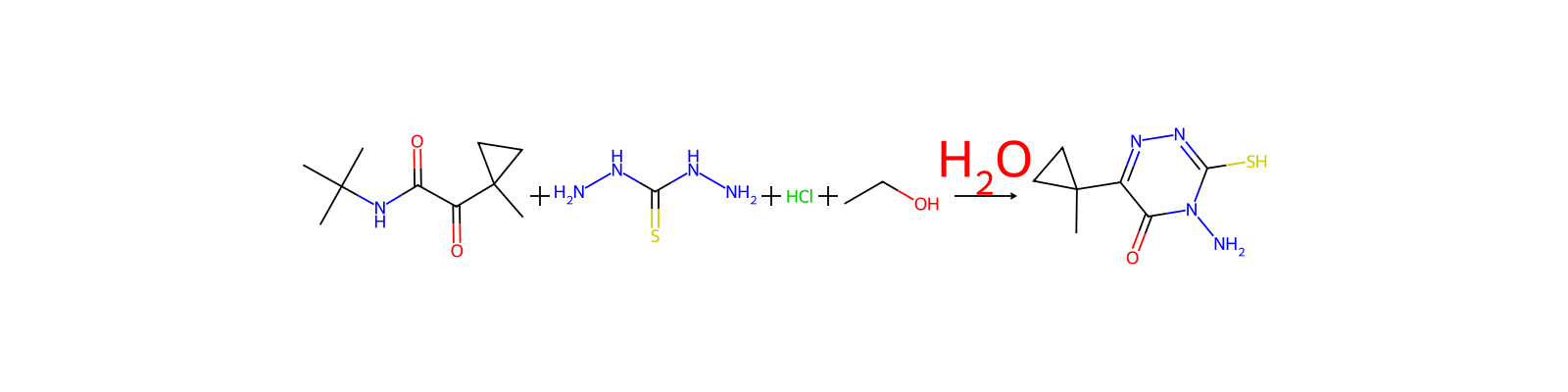
Reaktionsgleichung von HRID 12442
HRID 12442als Edukt
Reaktionsgleichung von HRID 26952
HRID 26952als Edukt
Reaktionsgleichung von HRID 26953
HRID 26953als Edukt
Reaktionsgleichung von HRID 46798
HRID 46798als Edukt
Reaktionsgleichung von HRID 67724
HRID 67724als Edukt
Reaktionsgleichung von HRID 231390
HRID 231390als Edukt
Reaktionsgleichung von HRID 343619
HRID 343619als Edukt
Reaktionsgleichung von HRID 343990
HRID 343990als Edukt
ZurückSeite 1 von 6

Notizen zur Verbindung

Auf dieser SeiteGrundinformationenÜberblickNamen und BezeichnerEigenschaftenSicherheit und RegulatorischesChemie und IndustrieZugehörige ReaktionenNotizen zur Verbindung
Löslichkeit
Very slightly soluble (0.5g/100g, 25°C). Insoluble in ether.
Aggregatzustand
Crystalline Powder
pka
10.58 · 10.58±0.70(Predicted)
Farbe
White to gray-beige
BRN
506657 · 506657
InChI
InChI=1S/CH6N4S/c2-4-1(6)5-3/h2-3H2,(H2,4,5,6)
InChIKey
LJTFFORYSFGNCT-UHFFFAOYSA-N
SMILES
C(=S)(NN)NN
CAS Datenbank
2231 · 2231-57-4(CAS DataBase Reference)
NIST chemische Informationen
Carbonothioic dihydrazide(2231-57-4)
EPA chemische Informationen
Thiocarbazide (2231-57-4)
Reactive Group
Amides and Imides
Reactivity Profile · 1 Eintrag

THIOCARBAZIDE is a thioamide, which may behave as a weak base and therefore will react with acids forming salts with production of heat. It may react with acids and reducing agents to form toxic hydrogen sulfide gas. This may be vigorous depending on the nature of the reducing agent. Organic amides/imides react with azo and diazo compounds to generate toxic gases. The combustion of these compounds generates mixed oxides of nitrogen (NOx).

Air and Water ReactionsNo rapid reaction with air. No rapid reaction with water.
Hazard Classes and Categories · 2 Einträge

Acute Tox. 2 (97.9%)

Acute toxicity (Oral) - Category 2

Sicherheit und Schutzausrüstung

Fire Fighting · 1 Eintrag

(Non-Specific -- Poisonous Solid, n.o.s.) Wear self-contained (positive pressure if available) breathing apparatus and full protective clothing. Stay upwind, keep out of low areas. Move container from fire area if you can do so without risk.

First AidNote: No information on specific clinical effects of exposure was available.
Nonfire Spill Response(Non-Specific -- Poisonous Solid, n.o.s.) Do not touch spilled material.
Isolation and EvacuationExcerpt from ERG Guide 154 [Substances - Toxic and/or Corrosive (Non-Combustible)]:
Protective Action Criteria (PAC) · 3 Einträge

0.033 [mg/m3]

0.37 [mg/m3]

2.2 [mg/m3]

Personal Protective Equipment (PPE) · 1 Eintrag

For emergency situations, wear a positive pressure, pressure-demand, full facepiece self-contained breathing apparatus (SCBA) or pressure- demand supplied air respirator with escape SCBA and a fully-encapsulating, chemical resistant suit. (EPA, 1998)

Toxikologische Informationen

InteractionsPRETREATMENT OF MICE WITH PYRIDOXAL PHOSPHATE (0.25 MMOL/KG) PROTECTED THEM AGAINST CONVULSIONS & DEATH PRODUCED BY LOW DOSES OF THIOCARBOHYDRAZIDE.
Adverse EffectsNeurotoxin - Other CNS neurotoxin
Human Toxicity Excerpts · 1 Eintrag

In the manufacture of rubber, irritant contact dermatitis may occur from a variety of acids, alkalies, detergents, and solvents used in the process. Allergic contact dermatitis occurs not infrequently and is almost always due to an organic accelerator or antioxidant. While the list of potential sensitizing accelerators and antioxidants is enormous, common allergens include ... thioureas. /Thioureas/

Non-Human Toxicity Excerpts · 2 Einträge

THE CONVULSANT ACTION OF THIOCARBOHYDRAZIDE (TCH) WAS STUDIED IN MICE. GLUTAMIDE DECARBOXYLASE ACTIVITY IN WHOLE BRAIN HOMOGENATES FROM MICE KILLED AT ONSET OF SEIZURES, WAS SIGNIFICANTLY REDUCED.

WHEN AN AQ SOLN OF THE CONVULSIVE HYDRAZIDE, THIOCARBOHYDRAZIDE (TCH) WAS INJECTED INTO HOUSEFLIES SENSITIVE TO DDT & HOUSEFLIES RESISTANT TO DDT, THE LD50 VALUE AFTER 24 HR WAS 0.3-0.6 GAMMA/FLY. WHEN TCH WAS DISSOLVED IN 20 GAMMA DIMETHYLSULFOXIDE PLUS 80 GAMMA BENZENE & APPLIED TOPICALLY, THE LD50 WAS 0.8-1.0 GAMMA/FLY. IN VIVO TRACER STUDIES WITH (14)C FORMATE REVEALED THAT BOTH DDT & TCH INCR LABELING OF PURINES, WHILE REDUCING THE CONTENT OF LABELED PROLINE.

Toxicity DataLC50 (rat) = 50 mg/m3/4h

Sicherheitsdaten

F
4.4-8
wgk
3
tsca
TSCA listed
ridadr
UN 2811 6.1/PG 1
hs_code
2930909099
RTECS-Nr.
FF2975000
risk_code
5-26/28-36/38-21
hazard_code
T+
safety_code
28-36/37/39-45-38-36/37-28A-1
hazard_class
6.1
packing_group
I
Speicherklasse
6.1A - Combustible acute toxic Cat. 1 and 2very toxic hazardous materials
Giftige Stoffe Daten
2231-57-4(Hazardous Substances Data)
Hazard Classifications
Acute Tox. 2 Oral
Kohlendisulfid
Hydrazine hydrate
Carbamimidothioic acid
Acetonazin
Hydrazin

Nachgelagerte Produkte

1,5-Diphenyl-3-thiocarbazonMetribuzin3-thio-4-amino-6-t-butyl-1,2,4-triazine-5-one4-Amino-6-tert-butyl-3-mercapto-1,2,4-triazin-5(4H)-on4-Amino-5-(3-bromophenyl)-4H-1,2,4-triazole-3-thiol4-Amino-5-(2-thienyl)-4H-1,2,4-triazole-3-thiol4-Amino-5-(2-chlorobenzyl)-4H-1,2,4-triazole-3-thiol3H-1,2,4-Triazole-3-thione,4-amino-2,4-dihydro-5-(1-methylethyl)-(9CI)Ethyl-3-hydrazino-5-methyl-1H-pyrazol-4-carboxylat4-Amino-5-(3-fluorophenyl)-4H-1,2,4-triazole-3-thiol