
HRID 1605123As product
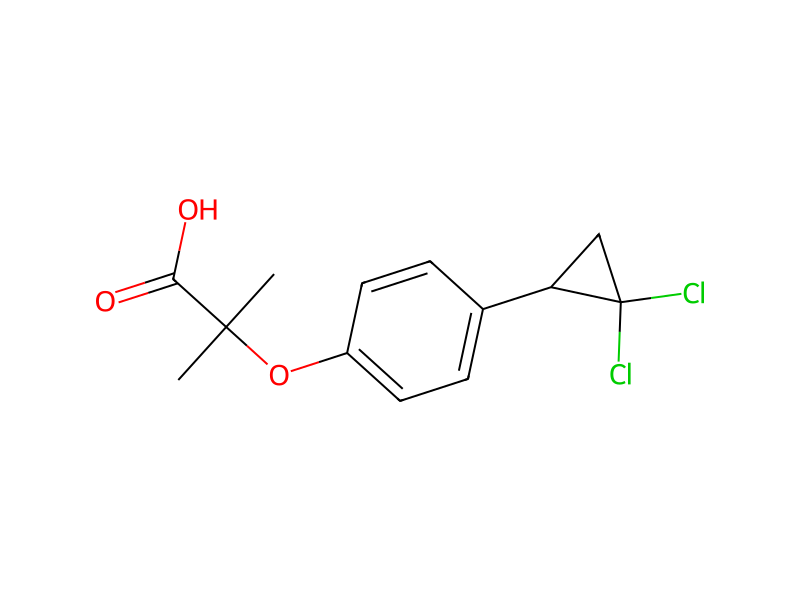
52214-84-3CC(C)(Oc1ccc(C2CC2(Cl)Cl)cc1)C(=O)OKPSRODZRAIWAKH-UHFFFAOYSA-NCiprofibrate is a monocarboxylic acid, an organochlorine compound and a member of cyclopropanes. It has a role as an antilipemic drug.
52214-84-3DTXSID8020331CHEMBL557555CHEBI:50867Safety information is for reference only and does not replace the supplier’s Safety Data Sheet (SDS), applicable regulations, or professional assessment.
Danger
H350 (95%): May cause cancer [Danger Carcinogenicity]
P203, P280, P318, P405, and P501 (click each P-code to see the statement)
Aggregated GHS information provided per 40 reports by companies from 3 notifications to the ECHA C&L Inventory.
Drug-Induced Liver Injury Severity and Toxicity (DILIst)
ciprofibrate
DILI Positive
DOI:10.1016/j.drudis.2019.09.022
C10AB08
C - Cardiovascular system
QC - Cardiovascular system
Substances that lower the levels of certain LIPIDS in the BLOOD. They are used to treat HYPERLIPIDEMIAS.
A class of nongenotoxic CARCINOGENS that induce the production of hepatic PEROXISOMES and induce hepatic neoplasms after long-term administration.
DescriptionCiprofibrate is a potent, long-acting hypolipidemic agent related to clofibrate, bezafibrate and fenofibrate. It is effective in types IIa, IIb, IIX and IV hyperlipoproteinemias, and produces a beneficial elevation of the anti-atherogenic HDL.
DescriptionCiprofibrate is an agonist of peroxisome proliferator-activated receptor α (PPARα; EC50 = 0.9 μM in a transactivation assay). It is selective for PPARα over PPARγ and PPARδ at 300 μM. Ciprofibrate (250 μM) induces cell cycle arrest at the G2/M and S phases in Fao rat, but not HepG2 human, hepatocellular carcinoma cells. It decreases fasting plasma levels of triglycerides and increases fasting plasma glucose levels in the apolipoprotein CIII transgenic mouse model of hypertriglyceridemia when administered at a dose of 10 mg/kg. Formulations containing ciprofibrate have been used in the treatment of hypertriglyceridemia.
UsesPeroxisome proliferator-activated receptor α (PPARα) is a ligand-activated transcription factor involved in the regulation of lipid homeostasis. Activation of PPARα results in expression of a variety of genes, particularly those involved in fatty acid β-oxidation, binding, and transport. Ciprofibrate activates PPARα with an EC50 value of 20 μM and only marginally affects PPARγ (EC50 = >300 μM). It has been shown to lower adipose tissue weight and reduce plasma insulin concentrations in obese rats and has been used clinically in the treatment of dyslipidemia. Ciprofibrate reportedly stimulates cholesteryl ester transfer protein expression and improves the flow of cholesterol through the indirect reverse cholesterol transport system, preserving plasma HDL.
Usesantihyperlipidemic
UsesCiprofibrate is a hypolipemic agent, related structurally to Clofibrate (C586910). Ciprofibrate is used as an antilipemic.
DefinitionChEBI: Ciprofibrate is a monocarboxylic acid, a member of cyclopropanes and an organochlorine compound. It has a role as an antilipemic drug.